排序器的终局之战:SEC亮剑,Layer 2的去中心化“生死时速”

marsbitPublicado a 2025-09-09Actualizado a 2025-09-10

一场关于“定义”的风暴正在加密世界的地平线上悄然聚集。美国证券交易委员会(SEC)委员,素有“加密教母”之称的Hester Peirce一句看似不经意的提醒,却可能成为压垮许多Layer 2(L2)现有架构的最后一根稻草。她指出,凡是依赖中心化排序器(Sequencer)的L2,其核心功能都可能被SEC认定为“交易所”。这并非危言耸听,而是一场关乎生死存亡的合规大考。当监管的目光穿透营销的辞藻,直击技术架构的核心时,一场L2领域的“去中心化”竞赛已然鸣枪。


SEC的“凝视”:功能,而非名称,决定一切

要理解这场风暴的核心,我们必须先读懂SEC近年来的监管逻辑。在SEC主席Gary Gensler的领导下,其核心思想早已明确:“是什么不重要,像什么才重要”。监管机构并不关心一个项目自称为“去中心化协议”还是“流动性解决方案”,他们只关心其运作的实质。

在SEC对Coinbase和Kraken等头部平台的指控文件中,这一逻辑被反复强调。SEC认为,只要一个平台提供了“汇集买卖双方订单,并使用既定、非自由裁量的方法使这些订单相互作用”的功能,它就构成了事实上的交易所。现在,请将这段描述与L2中心化排序器的工作原理进行对比。

排序器,这个L2网络的心脏,其核心职责正是接收来自用户的海量交易,然后以“既定、非自由裁量的方法”——通常是基于“先到先得”(FCFS)的原则——对它们进行排序、打包,最终提交到Layer 1主链上。如果把用户提交的交易看作是买卖订单,那么这个由单一实体(例如Arbitrum背后的Offchain Labs,Optimism的OP Labs,或Base背后的Coinbase)全权掌控的排序过程,与传统交易所的“撮合引擎”在功能上何其相似?

这正是SEC可能发难的关键所在。从监管者的视角看,当一个实体能够单方面决定数亿乃至数十亿美元交易的最终顺序时,它就拥有了巨大的权力,同时也构成了一个清晰的问责单点。正如Hester Peirce一直倡导的“安全港”提案所暗示的,只有当网络达到“功能性去中心化”,即创始团队无法再单方面控制网络运行时,它才能真正摆脱被归类为证券或受监管金融实体的风险。

一旦被正式认定为“未注册交易所”,其后果将是灾难性的。SEC过往的执法行动已经给出了答案:不仅面临高达数十亿美元的罚款(如针对Terraform Labs的44.7亿美元和解金),还可能被要求交出所有“非法所得”,并被法院下达永久性禁令,业务全面停摆。对于追求轻快、高效的L2协议而言,这无疑是灭顶之灾。


L2的“心脏搭桥手术”:从效率优先到生存优先

过去几年,L2的发展叙事始终围绕着效率和用户体验。为了在激烈的市场竞争中脱颖而出,绝大多数L2项目不约而同地选择了中心化排序器这条“捷径”。这样做的好处显而易见:极低的交易延迟、可预测的交易成本,以及对最大可提取价值(MEV)问题的有效抑制,例如防止了普遍存在于以太坊主网的“三明治攻击”。这为L2生态的初期繁荣立下了汗马功劳。

然而,这份以牺牲去中心化换来的“魔鬼交易”,如今正让L2项目们寝食难安。监管的达摩克利斯之剑高悬,曾经的技术优势,一夜之间可能转变为最致命的合规软肋。一场深刻的范式转移正在发生:L2的竞争焦点,正从单纯的性能比拼,转向一场关于架构安全和未来生存权的“心脏搭桥手术”。

这场手术的核心,就是拆解排序器的单点控制权。这并非易事,去中心化排序器面临着一系列复杂的技术挑战,它几乎是“区块链不可能三角”在L2层面的再次上演。一个去中心化的排序器网络需要在保证高性能(低延迟、高吞吐量)的同时,设计出公平的激励机制来鼓励诚实节点,并建立一套高效的共识机制来应对潜在的作恶行为。任何一个环节处理不当,都可能导致网络性能下降,甚至重新引入MEV问题,使用户体验倒退。

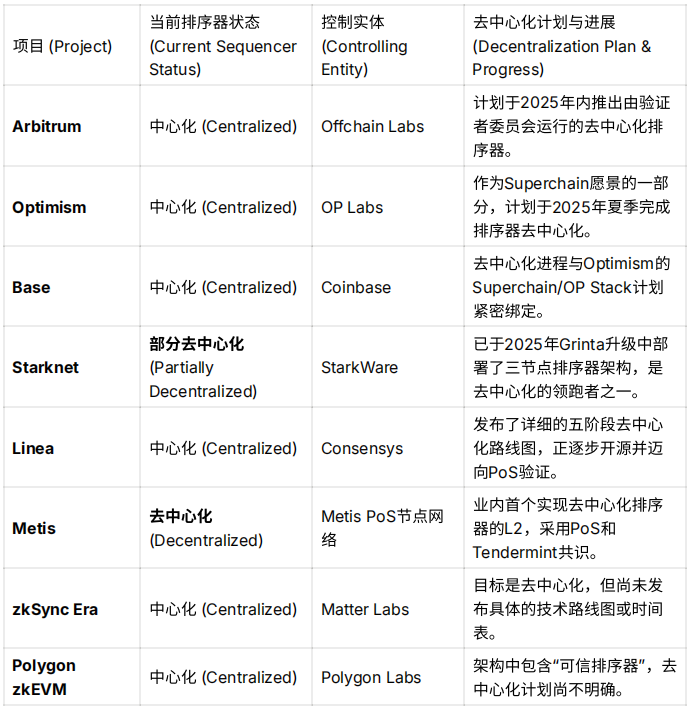
尽管困难重重,但求生的本能正驱动着整个L2赛道加速变革。各大主流L2的战略布局和执行速度,清晰地勾勒出了一幅“去中心化竞赛”的图景。
SEC

从表格中可以观察到清晰的战略分野。ArbitrumOptimism这两大巨头,作为曾经“中心化红利”的最大受益者,如今正调转船头,将2025年设定为去中心化的关键节点。Starknet则展现了其技术前瞻性,已经率先进入了“多节点”运行的阶段,抢占了先机。而Metis早已作为先行者,为整个行业验证了PoS去中心化排序器的可行性。Linea则以其清晰的路线图,向市场传递了确定性。相比之下,部分项目在此问题上的规划则显得相对模糊,这在未来可能成为其发展的制约因素。


通往“信任最小化”的未来:共享排序器与新叙事

面对去中心化的挑战,除了各个L2项目“闭门造车”外,一个更具颠覆性的解决方案也正在浮现——共享排序器(Shared Sequencers)。以Espresso SystemsAstria为代表的项目,正在构建一个中立、开放、高性能的去中心化排序网络。

这个想法非常巧妙。与其让每个L2都耗费巨大精力去构建和维护自己的排序器委员会,不如将排序工作外包给一个专为排序而生的“公共基础设施层”。L2项目可以像接入互联网一样,即插即用地接入这个共享网络,从而瞬间获得去中心化、抗审查以及跨链互操作性的能力。

这不仅极大地降低了L2实现去中心化的门槛,更可能重塑整个模块化区块链的格局。一个中立的共享排序层,能够天然地为所有连接于其上的L2提供一个原子可组合性的桥梁,使得用户可以在不同L2之间进行无缝、低成本的交互。这无疑是对当前L2生态碎片化问题的有力回应。


结语:告别“狂野西部”,走向成熟

L2的故事,正从一个关于“扩容”的纯粹技术叙事,演变为一个关于“合规”与“成熟”的宏大篇章。SEC的潜在监管,如同一剂强效催化剂,正迫使整个行业提前思考那些曾经被增长速度所掩盖的根本性问题。

中心化排序器的时代,作为一个必要的过渡阶段,或许即将落幕。未来的竞争,将不再仅仅是TPS(每秒交易处理量)和Gas费用的比拼,更是网络韧性、治理稳健性和合规远见的全方位较量。那些能够率先完成这场“心脏搭桥手术”,真正走向信任最小化架构的L2,不仅将赢得监管的默许,更将赢得用户和开发者最终的信任。这场“生死时速”,最终通向的,是一个更去中心化、也更具生命力的加密未来。

Lecturas Relacionadas

The 'Stock Call King' Serenity: 3840% Annual Return, Beating Institutions to the Punch

This article profiles the mysterious stock trader and analyst known as Serenity, who has gained significant influence on social media platform X as a "stock call king." Serenity claims extraordinary annual returns of 3840% for the current year and 2256% over the past two years, primarily by focusing on overlooked companies within the AI and semiconductor supply chains. Operating anonymously, Serenity describes himself as a former Reddit WallStreetBets trader, an AI/semiconductor supply chain analyst, and a former AI research scientist. His core investment strategy, termed the "Chokepoint" theory, involves identifying small, critical bottleneck companies in the AI infrastructure ecosystem—such as those in photonics, substrates, and materials—that are essential yet undervalued. He argues these "invisible champions" become crucial as demand for AI hardware surges, creating significant investment opportunities before large institutions take notice. A frequently cited example is stock AXTI, which he has recommended for over two years and claims has yielded over 10,000% returns. The article notes that while Serenity's free, public posts on X have garnered a large following, his identity and exact portfolio size remain unverified, leading to some skepticism. Critics question if his reported returns are fabricated or if he might be manipulating prices of low-market-cap stocks. Serenity counters that he shares research freely to democratize information, allowing retail investors to benefit before institutional buy-ins, and that percentage returns are more meaningful than disclosing specific dollar amounts. Ultimately, the article presents Serenity as a polarizing figure—either a visionary analyst with a superior research framework or a potentially sophisticated market player. It concludes that the truth of his claims and legacy will only be determined by time.

Odaily星球日报Hace 3 min(s)

The 'Stock Call King' Serenity: 3840% Annual Return, Beating Institutions to the Punch

Odaily星球日报Hace 3 min(s)

Will Ethereum's Native Privacy Proposal EIP-8182 Absorb Liquidity from Other Privacy Coins?

The article discusses Ethereum Improvement Proposal (EIP) 8182, titled "Private ETH and ERC-20 Transfers," a draft proposal to integrate native privacy directly into the Ethereum protocol layer (L1). Currently, Ethereum transactions are fully transparent, and existing privacy solutions like Tornado Cash are third-party dApps with limitations: small anonymity sets (mixing pools), lack of interoperability, and regulatory vulnerability. EIP-8182 aims to create a large, unified "shared shielded pool" and zero-knowledge proof (ZK) precompiles within the core protocol. Key features include a massive, shared anonymity pool for all users and dApps, significantly enhancing privacy strength; native support for private transfers of ETH and any ERC-20 token; a decentralized system contract architecture without admin controls or fees; and the use of ZK proofs to validate transactions without revealing specific details. If implemented, this upgrade could position Ethereum as the world's largest privacy-focused blockchain. By offering a built-in, highly private environment with a vast user base and liquidity, it might attract institutional and individual users, potentially drawing liquidity away from dedicated privacy coins like Zcash and Monero, or even users seeking privacy on Bitcoin. The integration could transform Ethereum from a transparent public ledger into a dominant privacy-centric platform, with potential future enhancements like fully homomorphic encryption (FHE) for compliance capabilities.

marsbitHace 7 min(s)

Will Ethereum's Native Privacy Proposal EIP-8182 Absorb Liquidity from Other Privacy Coins?

marsbitHace 7 min(s)

Investors Frantically Snap Up AI Firms with 'No Profits': A High-Stakes Gamble on 'the Right to Define the Future'

"Investors are pouring billions into Chinese AI startups with no profits, betting on the future of the industry. A state-backed fund is reportedly in talks to lead DeepSeek's funding at a $45B valuation, just weeks after it was valued at $10B. Along with companies like Zhipu AI, MiniMax, and Kimi (backed by Meituan and Alibaba), their combined valuation exceeds $140B. This isn't a typical venture capital play. Investors are paying for 'future definition rights'—a chance to set the standards for the next tech era. Morgan Stanley notes a 6-12 month window for this scarcity premium before more AI companies go public. Despite massive losses, these companies show strong growth. Zhipu AI's API revenue grew 60x, Kimi's annual recurring revenue doubled to $200M in a month, and MiniMax turned its gross margin positive, with over 70% of revenue from overseas. Their valuations vastly exceed profitable firms like iFlytek. Crucially, technical progress underpins this growth. DeepSeek's latest model boasts costs just 1% of a leading competitor's, while Zhipu AI has raised API prices due to high demand. However, gaps with top global models remain. Tech giants like Tencent and Alibaba, investing heavily while describing their own AI efforts as 'leaky boats,' are also investing in these startups as a hedge. Key risks loom: the closing scarcity window, computing power bottlenecks limiting growth, and the sustainability of DeepSeek's cost-advantage model. With state capital now a major player, the success of these companies has become a strategic national concern. The next year will test if their soaring valuations can be justified by future profits."

marsbitHace 57 min(s)

Investors Frantically Snap Up AI Firms with 'No Profits': A High-Stakes Gamble on 'the Right to Define the Future'

marsbitHace 57 min(s)

SEC Slams the Brakes at the Last Minute, Halting "Tokenized U.S. Stocks"

On May 22, the U.S. SEC postponed the release of a key "innovation exemption" draft that would have permitted crypto-native platforms to issue and trade tokenized U.S. stocks on decentralized venues without full traditional exchange compliance. This would have legalized a "third-party token" model used overseas, where platforms issue tokens tracking stock prices without the underlying company's involvement, raising unresolved questions about shareholder rights, dividends, and sanctions enforcement. Meanwhile, the SEC had already approved a different, compliant path for tokenization led by Nasdaq and NYSE. Their model integrates tokenized stocks into existing settlement systems (like DTCC), preserving all shareholder rights. This creates a fundamental conflict: crypto platforms seek a permissionless, 24/7 on-chain parallel market, while traditional exchanges advocate for an upgraded, regulated version of the current system. Intense lobbying from traditional exchange groups like the World Federation of Exchanges argued the exemption would create an unfair regulatory advantage and dilute investor protection. Even some compliant crypto firms favored delay. Internally, SEC commissioners were divided on the scope and pace of the exemption. The delay highlights a critical policy crossroads. With significant trading volume already occurring overseas, the SEC's decision will determine whether the U.S. embraces a dual-track system for tokenized equities or sidelines itself from an emerging global infrastructure. The core unresolved question remains the legal status and rights of holders of third-party tokenized stocks. The SEC paused because the draft framework risked creating a major new asset class with profound, unanswered legal implications.

marsbitHace 1 hora(s)

SEC Slams the Brakes at the Last Minute, Halting "Tokenized U.S. Stocks"

marsbitHace 1 hora(s)

Trading

Spot
Futuros

Artículos destacados

Cómo comprar LAYER

¡Bienvenido a HTX.com! Hemos hecho que comprar Solayer (LAYER) sea simple y conveniente. Sigue nuestra guía paso a paso para iniciar tu viaje de criptos.Paso 1: crea tu cuenta HTXUtiliza tu correo electrónico o número de teléfono para registrarte y obtener una cuenta gratuita en HTX. Experimenta un proceso de registro sin complicaciones y desbloquea todas las funciones.Obtener mi cuentaPaso 2: ve a Comprar cripto y elige tu método de pagoTarjeta de crédito/débito: usa tu Visa o Mastercard para comprar Solayer (LAYER) al instante.Saldo: utiliza fondos del saldo de tu cuenta HTX para tradear sin problemas.Terceros: hemos agregado métodos de pago populares como Google Pay y Apple Pay para mejorar la comodidad.P2P: tradear directamente con otros usuarios en HTX.Over-the-Counter (OTC): ofrecemos servicios personalizados y tipos de cambio competitivos para los traders.Paso 3: guarda tu Solayer (LAYER)Después de comprar tu Solayer (LAYER), guárdalo en tu cuenta HTX. Alternativamente, puedes enviarlo a otro lugar mediante transferencia blockchain o utilizarlo para tradear otras criptomonedas.Paso 4: tradear Solayer (LAYER)Tradear fácilmente con Solayer (LAYER) en HTX's mercado spot. Simplemente accede a tu cuenta, selecciona tu par de trading, ejecuta tus trades y monitorea en tiempo real. Ofrecemos una experiencia fácil de usar tanto para principiantes como para traders experimentados.

267 Vistas totalesPublicado en 2025.02.11Actualizado en 2025.03.21

Cómo comprar LAYER

Discusiones

Bienvenido a la comunidad de HTX. Aquí puedes mantenerte informado sobre los últimos desarrollos de la plataforma y acceder a análisis profesionales del mercado. A continuación se presentan las opiniones de los usuarios sobre el precio de LAYER (LAYER).

活动图片