Cardano Community Funds Core Upgrades In Historic Vote

bitcoinistPublicado a 2025-08-04Actualizado a 2025-08-04

Resumen

In a watershed governance moment for Cardano, ADA holders have directly approved core protocol funding for the first time, greenlighting...

Trusted Editorial content, reviewed by leading industry experts and seasoned editors. Ad Disclosure

In a watershed governance moment for Cardano, ADA holders have directly approved core protocol funding for the first time, greenlighting Input Output Engineering’s multi-year roadmap with 73.93% support. The treasury withdrawal was ratified on August 2, marking what the development company called “a new era of decentralized delivery” for the network.

The approval authorizes a treasury withdrawal of 96,817,080 ADA for the 2025 Input Output Engineering (IOE) Core Development Proposal, according to on-chain records. This is the first time Cardano’s community has explicitly sanctioned core engineering spend via governance, rather than relying on pre-agreed budgets or foundation allocations.

A Historic Approval For The Cardano Developer

Input Output publicly framed the vote as a structural shift in how Cardano evolves. In a company statement, Tim Harrison, EVP Community & Ecosystem, called it “a milestone moment for Cardano,” emphasizing that, “for the first time, core protocol development is being funded directly by the community.” He said the mandate enables the team to proceed “with full transparency [and] shared responsibility.”

Accountability is central to the new model. Intersect, Cardano’s member-based organization, will act as an independent administrator, with milestone-based disbursements released only upon verified delivery. Oversight is to be enforced through smart contracts and a dedicated committee, complemented by monthly public updates, engineering timesheets, and quarterly budget reports.

On social channels, the message was one of collective ownership. Input Output said, “The Cardano community just made history… core development funding has been directly approved by the community,” adding that the decision is “more than a vote of confidence, it’s a shared commitment to progress.” Cardano founder Charles Hoskinson amplified the sentiment: “Thank you everyone for your support and trust. Let’s get it done.”

The ratified roadmap targets throughput, developer experience, and interoperability across several fronts. IOE highlighted Ouroboros Leios as a foundational performance upgrade intended to raise throughput without trading off security or decentralization; Hydra for ultra-low-latency, low-cost transactions to support real-time uses; Mithril enhancements to cut bootstrap time and enable lightweight clients; nested transactions to extend smart-contract expressivity and cross-chain behavior; and Project Acropolis, a modular re-architecture of the Cardano node designed to make core contributions more accessible. Performance optimizations—faster sync, lower RAM, reduced operator costs—round out the near-term engineering agenda.

Ricky Rand, General Manager at Input Output Engineering, cast the vote as both mandate and test: “Securing this funding is just the start… a model for how decentralized funding and delivery can work at scale. The real work begins now—delivering with integrity [and] reporting with transparency.”

The on-chain decision arrives amid a broader governance cadence. Intersect noted in mid-July that dozens of treasury withdrawal actions were being advanced for community decision, with DReps—delegate representatives—tasked to vote on each. IOE’s roadmap sits within that slate but stands out as the first community-authorized core protocol funding, a role historically filled by centralized stewards in many networks.

Beyond execution by IOE, the process explicitly anticipates wider participation. Input Output said it will onboard external vendors, many from the Cardano Developer Ecosystem Coalition, to expand delivery capacity and help those contributors mature into independent proposers in future rounds—an approach intended to harden decentralization over time.

At press time, ADA traded at $0.73.
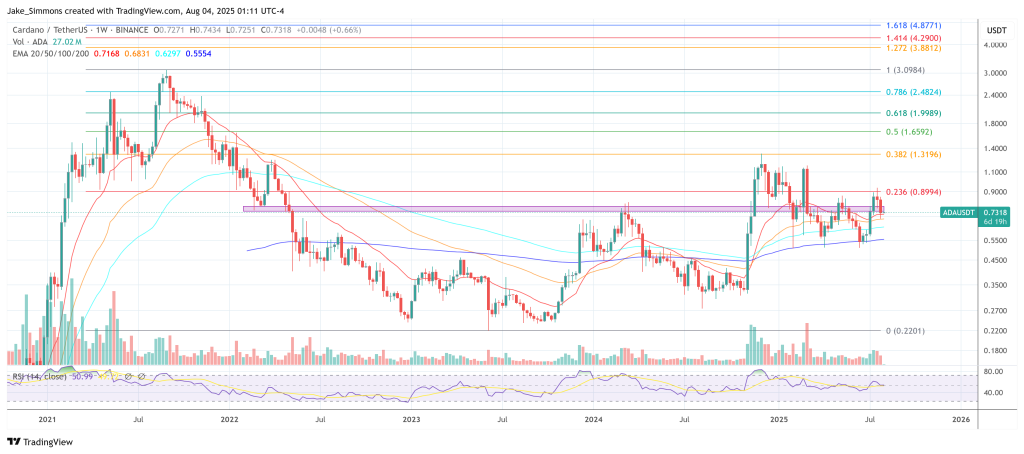
Cardano price
ADA remains below resistance, 1-week chart | Source: ADAUSDT on TradingView.com
Featured image created with DALL.E, chart from TradingView.com
Editorial Process for bitcoinist is centered on delivering thoroughly researched, accurate, and unbiased content. We uphold strict sourcing standards, and each page undergoes diligent review by our team of top technology experts and seasoned editors. This process ensures the integrity, relevance, and value of our content for our readers.

Jake Simmons has been a Bitcoin enthusiast since 2016. Ever since he heard about Bitcoin, he has been studying the topic every day and trying to share his knowledge with others. His goal is to contribute to Bitcoin's financial revolution, which will replace the fiat money system. Besides BTC and crypto, Jake studied Business Informatics at a university. After graduation in 2017, he has been working in the blockchain and crypto sector. You can follow Jake on Twitter at @realJakeSimmons.

Criptos en tendencia

Lecturas Relacionadas

BIS Report Compliance Observations: The True Risks of Stablecoins Go Beyond 'De-pegging'

The BIS report, "Anchoring trust in money: innovation beyond stablecoins," highlights that the primary risks of stablecoins extend beyond potential de-pegging. It argues that the core challenge is whether stablecoins can be integrated into a financial system that is identifiable, monitorable, accountable, and regulatable. While acknowledging efficiency gains like faster payments and programmability, BIS emphasizes that money requires an institutional framework—including legal certainty, liquidity support, and financial integrity controls—which many stablecoins currently lack. The report details compliance risks, noting that while blockchain transactions are transparent, address visibility does not equate to identity or purpose clarity. This creates a systemic risk as pseudonymity, non-custodial wallets, and cross-chain bridges can undermine AML/CFT controls. Furthermore, these risks can spill over into the traditional financial system through on- and off-ramps. The future direction, per BIS, is not to prohibit innovation but to embed regulatory rules—such as identity verification and transaction screening—directly into the technological infrastructure of tokenized finance. The key takeaway for compliance is that any new financial instrument must clearly address questions of customer identification, transaction monitoring, accountability, and cross-border rule consistency to be viable as a mainstream payment tool.

marsbitHace 58 min(s)

BIS Report Compliance Observations: The True Risks of Stablecoins Go Beyond 'De-pegging'

marsbitHace 58 min(s)

When US Giants Collectively "Defect" to Chinese AI Models

When Silicon Valley Giants Turn to Chinese AI Models to Cut Costs A surprising trend is emerging: major U.S. tech companies are significantly reducing AI costs by switching to Chinese models. Coinbase, the largest U.S. cryptocurrency exchange, reportedly halved its AI spending after migrating to China's GLM-5.2 and Kimi 2.7 models, despite increasing usage. They achieved this through a sophisticated three-part strategy: implementing an automatic routing system to select the most cost-effective model per task, boosting cache hit rates from 5% to 60% to reuse computations, and employing "context engineering" to provide AI with more precise, less cluttered information. They are not alone. AI startup Lindy switched from Claude to DeepSeek, saving millions, while Snowflake's tests found GLM-5.2 solved 66% of coding tasks compared to Claude Opus's 67%—but at a fraction of the cost (output pricing is 5-7 times lower). While the top Western models may offer slightly better stability, the massive price differential is leading many businesses to reconsider their value proposition. This shift signals a deeper change in the AI industry, moving beyond pure performance benchmarks to a fierce cost competition. As pressure mounts, even OpenAI and Anthropic have begun slashing prices. For users, this means more choices, lower costs, and a crucial lesson: using multiple models based on task complexity, optimizing with caching, and keeping contexts lean are now key to leveraging AI efficiently and affordably.

marsbitHace 1 hora(s)

When US Giants Collectively "Defect" to Chinese AI Models

marsbitHace 1 hora(s)

BIS Report Compliance Watch: The Real Risks of Stablecoins Are Not Just 'De-pegging'

BIS Report Compliance Observations: The real risks of stablecoins go beyond "depegging" The BIS report "Anchoring trust in money: innovation beyond stablecoins" argues that while stablecoins and tokenization offer efficiency gains, their primary risk lies in fitting into an identifiable, monitorable, accountable, and regulatable financial system. Money's trust stems not just from technology but from institutional arrangements: a common unit of account, guaranteed redemption at par, liquidity support, regulatory frameworks, and financial integrity requirements. Stablecoins, operating on permissionless blockchains with pseudo-anonymity and non-custodial wallets, create systemic compliance gaps: unclear customer identity, incomplete fund origins, unexplained transaction purposes, fragmented cross-chain paths, and ambiguous liability. On-chain transparency does not equal compliance transparency. Public addresses don't reveal identity or intent. While blockchain analytics aid law enforcement, they cannot replace routine, large-scale AML/CFT controls. Effective compliance requires a closed-loop process encompassing customer onboarding, transaction monitoring, investigation, reporting, and audit. Stablecoin risks are not confined to the blockchain; they re-enter the traditional financial system via on/off-ramps, exchanges, and payment institutions. This forces banks to monitor client accounts for activity linked to virtual assets. The future direction is not to prohibit innovation but to embed rules into the technology. Tokenized finance should integrate with the existing two-tier monetary system, embedding compliance—like customer identification, pre-transaction screening, and auditable data trails—directly into the transaction flow. For compliance professionals, the key takeaway is that any new financial instrument must answer core questions: Who identifies the customer? Who monitors transactions? Who handles exceptions? Who is liable? Compliance is not the antithesis of innovation but the essential infrastructure for its sustainable growth.

链捕手Hace 1 hora(s)

BIS Report Compliance Watch: The Real Risks of Stablecoins Are Not Just 'De-pegging'

链捕手Hace 1 hora(s)

When American Giants 'Defect' to Chinese AI Models

Summary: The trend of major U.S. technology firms adopting more cost-effective Chinese AI models is gaining momentum. A prime example is Coinbase, the largest U.S. cryptocurrency exchange, which reportedly halved its AI expenditure by switching to Chinese models GLM-5.2 and Kimi 2.7, while its usage volume increased. This was achieved through a sophisticated cost-saving system featuring intelligent model routing (selecting the most suitable model per task), dramatically improving cache hit rates from 5% to 60%, and implementing "Context Engineering" to streamline prompts. This shift is not isolated. Other companies like the AI startup Lindy and data cloud firm Snowflake are making similar moves, drawn by the significant price disparity. For instance, GLM-5.2 costs $1.40/$4.40 per million tokens (input/output), compared to $5/$25 for Claude Opus 4.7. While top Western models may offer slightly higher stability or speed in complex tasks, the performance gap is narrowing, making the price difference harder to justify for many enterprise use cases. The implications are significant for both businesses and individual users. It highlights the importance of a multi-model strategy based on task requirements, the value of caching and reusing outputs, and the effectiveness of providing concise context. Ultimately, this migration signals a potential reshaping of the AI industry's pricing model, moving competition from pure performance benchmarks to practical cost-effectiveness, with increased choice and downward price pressure benefiting end-users.

链捕手Hace 1 hora(s)

When American Giants 'Defect' to Chinese AI Models

链捕手Hace 1 hora(s)

Trading

Spot

Artículos destacados

Cómo comprar ADA

¡Bienvenido a HTX.com! Hemos hecho que comprar Cardano (ADA) sea simple y conveniente. Sigue nuestra guía paso a paso para iniciar tu viaje de criptos.Paso 1: crea tu cuenta HTXUtiliza tu correo electrónico o número de teléfono para registrarte y obtener una cuenta gratuita en HTX. Experimenta un proceso de registro sin complicaciones y desbloquea todas las funciones.Obtener mi cuentaPaso 2: ve a Comprar cripto y elige tu método de pagoTarjeta de crédito/débito: usa tu Visa o Mastercard para comprar Cardano (ADA) al instante.Saldo: utiliza fondos del saldo de tu cuenta HTX para tradear sin problemas.Terceros: hemos agregado métodos de pago populares como Google Pay y Apple Pay para mejorar la comodidad.P2P: tradear directamente con otros usuarios en HTX.Over-the-Counter (OTC): ofrecemos servicios personalizados y tipos de cambio competitivos para los traders.Paso 3: guarda tu Cardano (ADA)Después de comprar tu Cardano (ADA), guárdalo en tu cuenta HTX. Alternativamente, puedes enviarlo a otro lugar mediante transferencia blockchain o utilizarlo para tradear otras criptomonedas.Paso 4: tradear Cardano (ADA)Tradear fácilmente con Cardano (ADA) en HTX's mercado spot. Simplemente accede a tu cuenta, selecciona tu par de trading, ejecuta tus trades y monitorea en tiempo real. Ofrecemos una experiencia fácil de usar tanto para principiantes como para traders experimentados.

1.5k Vistas totalesPublicado en 2024.12.10Actualizado en 2026.06.02

Cómo comprar ADA

Discusiones

Bienvenido a la comunidad de HTX. Aquí puedes mantenerte informado sobre los últimos desarrollos de la plataforma y acceder a análisis profesionales del mercado. A continuación se presentan las opiniones de los usuarios sobre el precio de ADA (ADA).

活动图片