Ripple CTO Drops Bombshell On Pre-IPO Shares As Linqto Meltdown Explodes

bitcoinistPublicado a 2025-07-01Actualizado a 2025-07-01

Resumen

Linqto’s once-celebrated promise to “democratize” (Ripple) pre-IPO investing is collapsing under the weight of federal probes, a looming bankruptcy filing...

Trusted Editorial content, reviewed by leading industry experts and seasoned editors. Ad Disclosure

Linqto’s once-celebrated promise to “democratize” (Ripple) pre-IPO investing is collapsing under the weight of federal probes, a looming bankruptcy filing and a furious customer base that now numbers roughly 13,000.

According to an internal review first detailed by The Wall Street Journal, investigators for the Securities and Exchange Commission and the US Department of Justice are examining allegations that former chief executive William Sarris secretly marked up Ripple shares by more than 60 percent, sold customer stock without permission and promoted deals to thousands of investors who failed to meet accredited-investor standards. New management concedes that client accounts have been frozen since February and warns that a Chapter 11 filing could leave many investors as unsecured creditors.

A March 14 press release from the company’s new leadership confirmed “pervasive securities-law violations,” the pausing of all trading and the dismissal of nearly half the staff while Linqto “explores all options to preserve value,” including court-supervised restructuring. The same statement insists that the special-purpose vehicles (SPVs) holding customers’ assets remain on issuer cap tables, but concedes that an independent forensic review is under way to verify that claim.

Into that vacuum stepped attorney John E. Deaton, who told his X followers that the situation is a “total clusterfuck” and that roughly 11,500 Linqto users bought units in SPVs that, in turn, were supposed to own Ripple shares. Deaton says as many as 5,000 of those investors are non-accredited, creating “a regulatory compliance nightmare” now squarely on the SEC’s radar. He plans to host a live session at 3 p.m. EST today to detail what he calls a “heavily involved” enforcement action and to explain why simply refunding principal would strip investors of six- and seven-figure gains booked on private-share price appreciation.

“You Never Owned Ripple Shares”— CTO

Ripple’s chief technology officer David Schwartz—better known online as “JoelKatz”—added fuel to the blaze by reminding holders that they never owned Ripple equity outright. “You don’t own the shares directly,” Schwartz wrote, “but you own a portion of a legal entity that owns the shares.” He elaborated, saying: “So if you ‘bought’ Z shares, you own X fraction of a legal entity with Y shares where X×Y=100. This generally lets you buy ‘shares’ more easily and in smaller quantities, but the equivalent per-share price is usually higher.”

This clarification dismantled a key misconception among many Linqto clients who believed they were holding Ripple stock directly. The implications are now being examined not only by the SEC but also by customers who fear their indirect ownership could be rendered illiquid or encumbered in bankruptcy court.

When pressed about whether those SPVs could be affected by Linqto’s financial collapse, Schwartz responded: “The legal entity that owns the shares that you own part of should not have exposure to Linqto going bankrupt. So a direct encumbrance on the shares to cover Linqto’s debts shouldn’t happen. But the entity may face operational challenges depending on exactly how it’s structured.”

That operational risk is precisely what has many investors on edge. If trustees, custodians, or record-keepers tied to those SPVs are forced to restructure, change providers, or liquidate assets, investors may find themselves in prolonged legal limbo with no access to their holdings—even if the shares remain technically intact on the cap table.

The Alleged George Soros Link

Complicating perceptions further, Schwartz addressed a separate thread linking billionaire George Soros to Ripple. He clarified that Soros Fund Management backed PolySign—another private company in which many Linqto users invested—during its 2022 acquisition of fund administrator MG Stover, but said he was “not aware of any Soros connection to Ripple.”

Initially, Schwartz wrote: “It wouldn’t surprise me very much since his funds own bits of almost everything (Salesforce, Amazon, Google, JP Morgan, Goldman, Uber, FedEx, and many more), but I couldn’t find any actual connection.”

However, after further reflection, he corrected himself: “Oh, wait, I remember now. Yes, Soros’ fund did invest in PolySign to help finance the acquisition of MG Stover! No connection to Ripple AFAICT though.”

The deeper regulatory concern is structural. Linqto created more than 500 SPVs, each designed to pool hundreds of retail investors while keeping the underlying issuer’s shareholder count below the 2,000-owner threshold that triggers public-reporting obligations. Internal emails obtained by investigators show former executives exhorting staff to “take no prisoners” in sales campaigns—at times buying back Ripple shares from customers at $55 each, only to flip them to Ripple for $61, banking an $8 million spread. If those shares never made it into the SPVs—as suggested in confidential memos cited by investigators—questions of beneficial ownership, tax liability and voting rights could embroil Ripple itself in discovery.

What happens next will hinge on three converging clocks: Linqto’s restructuring timetable, the SEC’s enforcement calendar and the pace at which SPV trustees can—or cannot—demonstrate clean title to almost half a billion dollars’ worth of private-company shares. Until then, thousands of would-be Ripple shareholders remain locked out of their accounts, watching from the sidelines as a legal and regulatory cyclone decides whether their “pre-IPO dream” survives or is wiped out in a courtroom ledger.

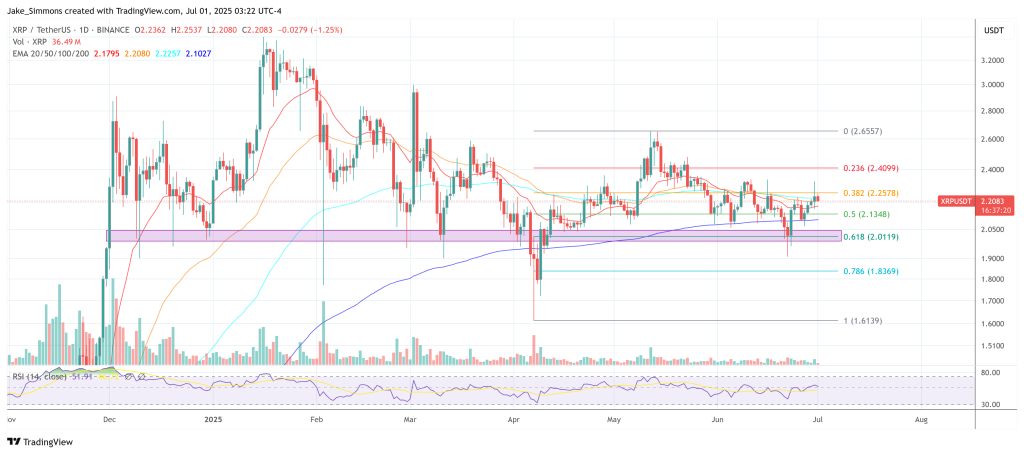
At press time, XRP traded at $2.20.
XRP price
XRP price, 1-day chart | Source: XRPUSDT on TradingView.com
Featured image created with DALL.E, chart from TradingView.com
Editorial Process for bitcoinist is centered on delivering thoroughly researched, accurate, and unbiased content. We uphold strict sourcing standards, and each page undergoes diligent review by our team of top technology experts and seasoned editors. This process ensures the integrity, relevance, and value of our content for our readers.

Jake Simmons has been a Bitcoin enthusiast since 2016. Ever since he heard about Bitcoin, he has been studying the topic every day and trying to share his knowledge with others. His goal is to contribute to Bitcoin's financial revolution, which will replace the fiat money system. Besides BTC and crypto, Jake studied Business Informatics at a university. After graduation in 2017, he has been working in the blockchain and crypto sector. You can follow Jake on Twitter at @realJakeSimmons.

Lecturas Relacionadas

Ondo, the Leader in RWA Tokenization, is Entering the Perp DEX Arena

Ondo Finance, the dominant player in the real-world asset (RWA) tokenization space, is entering the perpetual futures (Perp) DEX arena with the launch of "Ondo Perps." This move signifies a strategic pivot from primarily being an asset issuer to becoming a comprehensive trading infrastructure provider. The platform uniquely focuses on tokenized traditional assets like stocks, indices (e.g., US 500), and commodities (gold, silver, oil), offering up to 20x leverage for 24/7 trading. A key differentiator is its planned multi-asset collateral system, which will allow users to employ tokenized stocks and bonds as margin, enabling sophisticated portfolio hedging and strategies. This approach leverages Ondo's existing strengths—deep institutional relationships, regulatory approvals, and a vast library of tokenized assets—to create a bridge between traditional finance liquidity and decentralized, permissionless trading. By integrating its asset issuance (Ondo Global Markets) with a proprietary trading venue, Ondo aims to complete the RWA financialization loop, transforming tokenized holdings from passive investments into productive capital for leverage and complex financial engineering. The launch positions Ondo Perps not just as another derivatives exchange, but as a foundational piece of next-generation infrastructure merging TradFi assets with DeFi-native execution.

Foresight NewsHace 35 min(s)

Ondo, the Leader in RWA Tokenization, is Entering the Perp DEX Arena

Foresight NewsHace 35 min(s)

Founder of Baixing.com: The Notion That Large Language Models Will Devour Everything, I Believe Half of It

Founder of Baixing.com: I Only Half-Believe the Saying “Large Language Models Will Devour Everything” Author: Wang Jianshuo, Founder of Baixing.com Many proclaim that large models are everything, but the author is skeptical. He argues that such sweeping claims often stem from a limited understanding of the future. Drawing parallels to past technologies like electricity and the internet—which were predicted to “devour everything” but didn’t—he suggests that large language models (LLMs) are better seen as a foundational base. Like electricity, this base is essential for modern development, but its real value emerges only when applied to specific scenarios through various “machines” or “tools” (e.g., Claude Code for programming, Claude Design for design). The author acknowledges that LLMs may indeed replace many existing software systems built on rigid rules, workflows, and forms (e.g., CRMs, SaaS tools), as these are precisely what LLMs excel at processing. However, he emphasizes that beyond software, elements like customer data, execution capabilities (e.g., booking a flight), trust, and physical-world interactions will not be “devoured.” Instead, he foresees that after streamlining existing software, LLMs will open up a larger space for innovative, next-generation applications. These new tools will likely feature fluid interfaces and rely less on fixed rules, unleashing greater creativity. The author cautions against short-sightedness, recalling how in 2004 many believed internet giants like Sina, Sohu, and NetEase would monopolize the market—only to be proven wrong by subsequent disruptions. In conclusion, while LLMs are a crucial foundation and a current focal point, the true mainstream of this wave lies in the diverse applications built atop them to solve concrete problems. The phrase “devour everything” is imprecise; the real opportunity lies in identifying and leveraging the areas where LLMs do bring transformative change.

marsbitHace 49 min(s)

Founder of Baixing.com: The Notion That Large Language Models Will Devour Everything, I Believe Half of It

marsbitHace 49 min(s)

Founder of Baixing.com: I Only Half Believe in the Notion that Large Language Models Devour Everything

The founder of Baixing Wang states that while large language models (LLMs) are an extremely important foundational technology—akin to electricity or the internet—he only "half believes" the notion that they will "consume everything." He argues that LLMs provide a base layer of intelligence, but real-world value and transformation come from integrating this intelligence into specific applications and devices designed for particular scenarios—like how electricity powers various appliances from washing machines to TVs. He agrees LLMs will likely consume or replace a significant portion of existing rule-based, workflow-driven software (e.g., many SaaS systems, CRMs), as these are precisely what LLMs excel at handling. However, numerous other elements—such as customer data, execution capabilities (e.g., booking a flight), trust, and physical-world interactions—will not be consumed. Wang emphasizes that after LLMs absorb certain software layers, they will open up a much larger space for innovation: new types of "streaming" software with less rigid interfaces, where fixed rules are managed by AI. This next wave of applications built on top of the stable LLM foundation is where the true mainstream opportunity lies. He cautions against the short-sightedness of declaring any technology as all-consuming, drawing parallels to past premature predictions about internet giants monopolizing the web. The key is to find opportunities within the areas LLMs do transform.

链捕手Hace 54 min(s)

Founder of Baixing.com: I Only Half Believe in the Notion that Large Language Models Devour Everything

链捕手Hace 54 min(s)

Trading

Spot
活动图片