BitMart市场行情周报(6.16-6.22)

Odaily星球日报Publicado a 2025-06-23Actualizado a 2025-06-23

Resumen

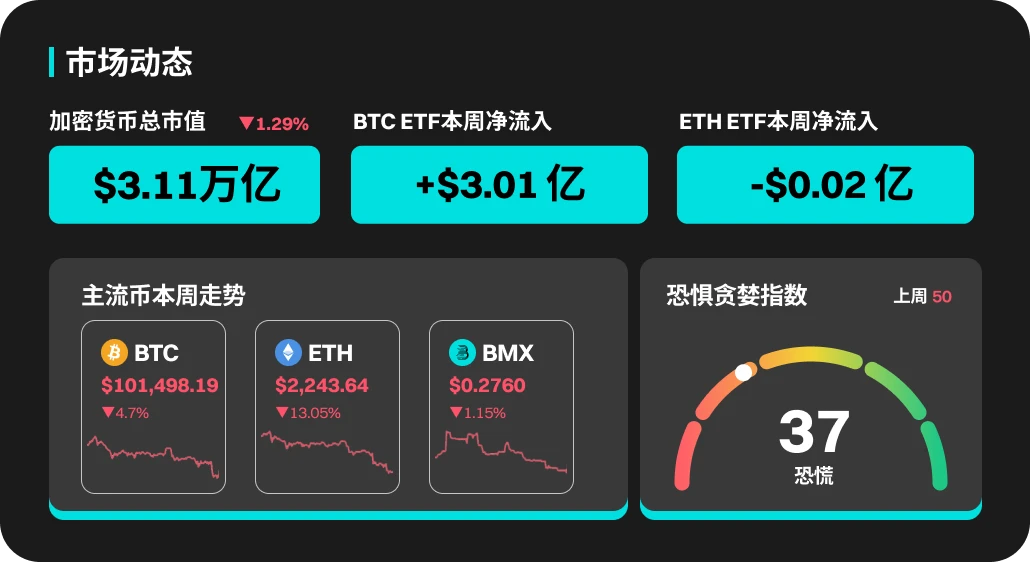
过去一周加密货币总市值为3.11万亿,较上周下降了1.29%。

据 BitMart 6 月 23 日市场行情报告,过去一周加密货币总市值为 3.11 万亿,较上周下降了 1.29% 。
BitMart市场行情周报(6.16-6.22)

本周加密市场动态

上周(2025.06.16 – 2025.06.22),BTC ETF 单周净流入 3.01 亿美元,连续两周保持资金正流入,但规模较前期明显收窄。过去一周,BTC 跌破 100, 000 美元大关,最低触及约 98, 000 美元,目前价格在 101, 498.19 美元 附近震荡整理,整体市场情绪趋于谨慎。BTC 市占率暂报 63.2% ,小幅回落,但仍位于高位区间。

ETH ETF 上周录得小幅净流出 0.02 亿美元,结束此前连续三周净流入态势。ETH 价格过去一周跟随大盘承压,下跌幅度明显,周跌幅约 13% ,目前价格在 2, 243.64 美元 附近。ETH/BTC 汇率继续受制于 0.025 关键阻力位,资金面与价格表现均较前期偏弱。尽管 ETH 多次尝试反弹,但未能有效收复 2, 400 美元 上方关键位置。
BitMart市场行情周报(6.16-6.22)

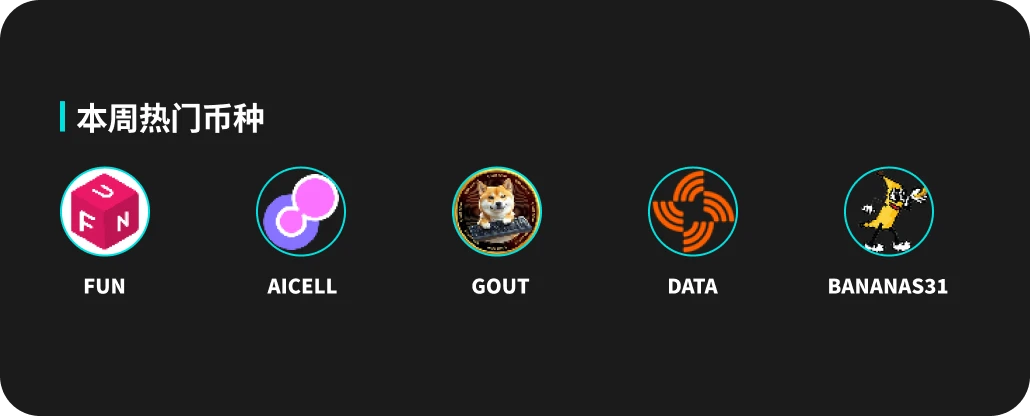
本周热门币种

热门币种方面,FUN、AICELL、GOUT、DATA 和 BANANAS 31 都有着不俗的表现。FUN 本周价格上涨 236.39% ,目前市值$ 13 M。GOUT 价格上涨 99.58% , 最高价格为 0.0002286 USDT。
BitMart市场行情周报(6.16-6.22)

美国市场大盘及热点新闻

美股市场:美股三大指数 06 月 20 日收盘涨跌不一。截至收盘,道琼斯工业平均指数比前一交易日上涨 35.16 点,收于 42206.82 点,涨幅为 0.08% ;标准普尔 500 种股票指数下跌 13.03 点,收于 5967.84 点,跌幅为 0.22% ;纳斯达克综合指数下跌 98.86 点,收于 19447.41 点,跌幅为 0.51% 。

大型科技股多数下跌,谷歌跌近 4% ,Meta、英特尔、亚马逊、英伟达跌超 1% ,微软小幅下跌;苹果涨超 2% ,奈飞、特斯拉小幅上涨。Circle 涨超 20% ,创收盘历史新高。生物科技公司 Capricor Therapeutics Inc.(CAPR)跌超 30% 。Kroger Co.(KR)涨近 10% ,创最近 15 个月最佳单日表现。

周二晚上 10 点,美联储主席鲍威尔在众议院金融服务委员会发表半年度货币政策报告证词;

周三晚上 10 点,美联储主席鲍威尔在参议院委员会就半年度货币政策报告作证词陈述

美 SEC 将于 6 月 26 日召开圆桌会议,拟审查高管薪酬披露规则

热门板块及项目解锁

SOON(SOON)将于北京时间 6 月 23 日下午 4 点 30 分解锁约 4188 万枚代币,与现流通量的比例为 22.41% ,价值约 840 万美元

Venom(VENOM)将于北京时间 6 月 25 日下午 4 点解锁约 5926 万枚代币,与现流通量的比例为 2.84% ,价值约 1000 万美元

AltLayer(ALT)将于北京时间 6 月 25 日下午 6 点解锁约 2.4 亿枚代币,与现流通量的比例为 6.83% ,价值约 670 万美元

IOTA(IOTA)将于北京时间 6 月 25 日上午 8 点解锁约 1516 万枚代币,与现流通量的比例为 0.39% ,价值约 230 万美元

Blast(BLAST)将于北京时间 6 月 26 日晚上 10 点解锁约 105 亿枚代币,与现流通量的比例为 34.98% ,价值约 2250 万美元

稳定币(Stablecoins)

随着美国参议院通过“GENIUS Act”为稳定币发行设定新的监管框架,Circle (USDC) 股价大涨 16% ,Coinbase 同样受益上扬约 17% 

风险提示:

使用 BitMart 服务的风险完全由您自行承担。所有加密货币投资(包括收益)本质上都具有高度投机性,并且涉及巨大的损失风险。过去、假设或模拟的表现并不一定代表未来的结果。

数字货币的价值可能会上涨或下跌,购买、出售、持有或交易数字货币可能存在很大的风险。您应根据您的个人投资目标、财务状况和风险承受能力,仔细考虑交易或持有数字货币是否适合您。 BitMart 不提供任何投资、法律或税务建议。

Lecturas Relacionadas

Stablecoins Becoming the Next Policy Challenge for the Fed's Walsh Version

Fed Governor Christopher Waller's speech at the June 22 conference on the U.S. dollar's international role signifies a notable policy shift: stablecoins like USDT and USDC are now being formally considered as potential channels for transmitting U.S. dollar liquidity globally. With their combined market cap surpassing $250 billion and high transaction volumes, these digital assets are moving from the periphery of crypto policy to the core of monetary system research. The key concern for policymakers is how stablecoin flows interact with traditional dollar infrastructure. Their growth could affect bank deposits, demand for short-term Treasury securities (like T-bills), and global access to dollars, depending on whether demand originates overseas or substitutes for domestic bank balances. Issuers' reserve management—holding assets in banks, money market funds, or Treasuries—links stablecoin activity directly to these core markets. The Fed's research agenda now examines whether stablecoins, by combining payment and balance-holding functions on digital rails, could complicate monetary policy implementation or transmit liquidity stress to banks. While current Treasury holdings by issuers are under 1% of the total market, their concentrated demand could marginally impact yields, especially during periods of stress. Consequently, stablecoins are evolving from mere crypto trading tools into a private-layer dollar transmission system with public policy implications, prompting closer regulatory scrutiny of their reserve robustness, redemption mechanisms, and systemic integration.

marsbitHace 2 min(s)

Stablecoins Becoming the Next Policy Challenge for the Fed's Walsh Version

marsbitHace 2 min(s)

A 380% Soar, Shenzhen’s 100-Billion-Yuan IPO Rings the Bell

HKC Holdings, a major Chinese display panel manufacturer, has successfully listed on the Shenzhen Stock Exchange's main board. The company's shares surged over 380% on its debut, pushing its market capitalization to around 350 billion yuan (formerly reaching 500 billion yuan). Founded by Wang Zhiyong in Shenzhen's Huaqiangbei electronics market nearly three decades ago, HKC evolved from assembling monitors to becoming a global top-tier supplier of semiconductor display panels for TVs, monitors, and smartphones. The IPO marks a significant milestone for HKC and its backers. The company's growth into the capital-intensive panel manufacturing sector was supported through partnerships with state-owned capital from regions like Chongqing, Mianyang, and Chuzhou. Its shareholder list also includes BOE Technology's investment arm. In recent years, HKC reported strong financials, with core panel business contributing over 70% of revenue and clients including Samsung, TCL, and Xiaomi. This listing is seen as part of a broader trend in Shenzhen's evolving tech landscape. Beyond established giants, the city is nurturing clusters of leading companies in specialized sectors like robotics—exemplified by the "Shenzhen Robot Valley"—and storage chips, where a group of firms dubbed the "Storage Five Tigers" has achieved a combined trillion-yuan market valuation. Shenzhen's strategic focus on emerging industries such as AI terminals, low-altitude economy, and humanoid robotics aims to build new industrial depth and foster the next generation of tech champions.

marsbitHace 14 min(s)

A 380% Soar, Shenzhen’s 100-Billion-Yuan IPO Rings the Bell

marsbitHace 14 min(s)

Domestic First Explosion-Proof Certification, World's First Fueling Brain Solution: How Did They Secure Two 'Firsts'?

China's embodied AI sector is booming, with over ¥37 billion in funding this year. The focus has shifted decisively to real-world application, particularly in hazardous, repetitive tasks humans should avoid. A key, often prohibitive, barrier to entry for robots in environments like gas stations and oil fields is obtaining explosion-proof certification, requiring meticulous hardware and circuit design from the ground up. The article explores three main application areas. At gas stations, the challenge lies in executing a long, precise sequence of actions (opening caps, handling the fuel nozzle) with millimeter accuracy across diverse car models. For facility inspections, robots need sustained autonomous patrols combined with real-time anomaly detection and response. Port scenarios introduce the complexity of multi-robot coordination. Addressing the core challenge of long-horizon tasks, the piece highlights a technical breakthrough: a "world model"-driven approach. This enables predictive planning, allowing the AI to visualize the desired end-state (e.g., nozzle returned, cap closed) and work backward to synthesize intermediate visual frames. This "imagination" of the task trajectory, as implemented in the H-GAR architecture, guides action generation, significantly reducing cumulative error in multi-step operations. The three-step H-GAR process involves generating a coarse action draft, synthesizing target-conditioned observation frames, and then refining actions based on visual context and a memory of past successful motions. The conclusion emphasizes that success in specialized, safety-critical fields requires long-term commitment and deep integration of the "embodied brain" (AI) with a purpose-built, certified physical "body." Mastering this brain-body-data闭环 (closed-loop) is positioned as a crucial competitive advantage for commercialization.

marsbitHace 1 hora(s)

Domestic First Explosion-Proof Certification, World's First Fueling Brain Solution: How Did They Secure Two 'Firsts'?

marsbitHace 1 hora(s)

Trading

Spot
Futuros
活动图片