16B Login Credentials Leak Exposes Dire Need for Non-Custodial Crypto Wallets Like Best Wallet

bitcoinistPublicado a 2025-06-20Actualizado a 2025-06-20

Resumen

Cybernews has discovered a database containing a massive 16B individual login credentials, secured through multiple hacks from different sectors. These...

Trusted Editorial content, reviewed by leading industry experts and seasoned editors. Ad Disclosure

Cybernews has discovered a database containing a massive 16B individual login credentials, secured through multiple hacks from different sectors.

These include credentials stolen from Apple, META (Facebook), Telegram, and even governmental institutions.

The data sets compiled varied in size, from the smallest one, containing 16M records, to the largest one, with over 3.5B.

More importantly, the data sets contained users from all over the world, including Russia, Portugal, the US, and China.

The scariest part isn’t the sheer volume of leaked data, but the fact that it’s ongoing.

New Stolen Datasets Emerge Weekly

According to the researchers involved in the report, we’re not talking about one massive breach or even several significant leaks.

Instead, we’re talking about a continuous stream of breaches, which are piling up to create a concerning picture:

This is not just a leak – it’s a blueprint for mass exploitation. With over 16 billion login records exposed, cybercriminals now have unprecedented access to personal credentials that can be used for account takeover, identity theft, and highly targeted phishing. […] This is fresh, weaponizable intelligence at scale.’

Researchers, Cybernews Report

The situation is so bad that this 16B data leak compilation seems modest in the grand scheme of things. China’s massive 4B data leak speaks to that, as does the Mother of All Breaches (MOAB), packing a stunning 26B leak.

Cybernews exposed the latter in early 2024, the victim being Leak-Lookup, a data breach search engine.

Leak–Lookup took to X to clarify that everything was the result of a firewall misconfiguration and that the problem had been fixed.

Leak-Lookup X postTo go hand in hand with this not-so-jolly news, pro-Israel hacker group Predatory Sparrow also proudly announced a $90M theft from an Iranian crypto exchange.

According to the group, the goal was to weaken Iran’s military resolve in the current conflict.

While no state actor took responsibility for the attack, Rafe Pilling, the director of Threat Intelligence at Sophos, stated that:

‘It bears all the hallmarks of a false persona used by a government-sponsored threat group to conduct disruptive operations against targets linked to illicit Iranian revenue generation, logistical entities, transport infrastructure and other strategic sectors.
While we don’t expect to find strong technical links between Israel and Predatory Sparrow, the actions of the group align strongly with Israel’s regional priorities.’

Rafe Pilling, The Guardian interview

The problem is that most data leaks fly under the radar, and we only see the tip of the iceberg. But the real-world potential impact of this thriving cybercrime industry is gloomy, to say the least.

Here is a study by Bright Defense, which details the fallout associated with cybercriminal activity in recent years. The list is too long to include in one screenshot.

Bright Defense reportThis makes cybersecurity more important today than ever, especially in the crypto sector, which is rife with data security concerns.

Non-custodial wallets like Best Wallet may offer a solution by making your data and private keys your responsibility, rather than the exchange’s, which, as we have seen, can too easily be breached.

How Best Wallet Enhances Your Crypto Security

Best Wallet enhances your crypto security by being a non-custodial and no-KYC wallet.

This protects your anonymity, limits your blockchain footprint, and safeguards your funds in case of a data leak.

It’s also much more user-friendly than a hardware wallet and completely free to download.
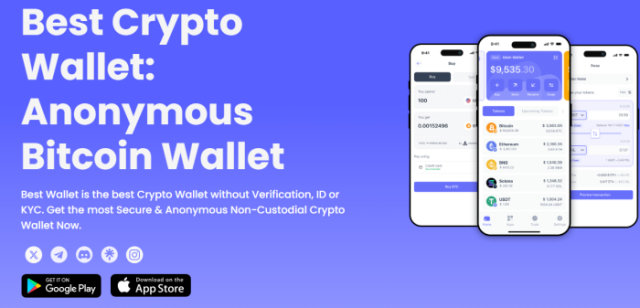
Best Wallet appThe wallet app has an intuitive UI, letting you swap, deposit, and stake your funds on the fly.

It also features a Token Launchpad, which gives you access to tokens in presales, so you can invest in tomorrow’s top coins before they go live.

One of these is Best Wallet’s native $BEST token, which has already raised $13.45M with a coin price of $0.025205.

The project offers stakers a dynamic APY of 103% and consists of four phases, each with multiple long-term goals.
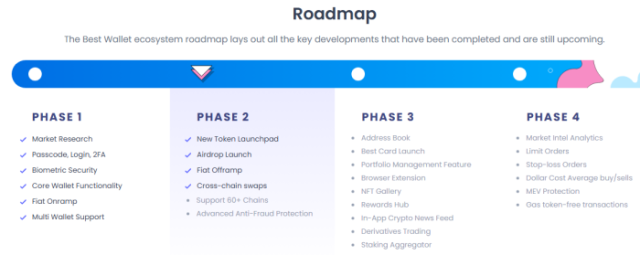
Best Wallet roadmapHolding $BEST has multiple perks, such as higher staking rewards, community governance rights, reduced transaction fees, and early access to new projects.

Based on the coin’s utility and provided it sees widespread adoption post-launch, our analysts expect $BEST to reach a price point of $0.072 by the end of 2025, for an ROI of 185%.

A 5-year prediction sees $BEST going up to $0.82, giving an ROI of 3,153% if you invest at today’s price. This would make $BEST one of the best altcoins to buy in 2025.

To get the most out of Best Wallet, buy $BEST today through the Upcoming Tokens section or at the official presale website.

Will Data Leaks Damage the Crypto Sector?

It’s unlikely that data leaks will disrupt or damage the crypto sector, given its relentless growth and continuous advancements in cybersecurity.

Using tools like Best Wallet also contributes to your security and anonymity on the blockchain, reducing your exposure to data leaks.

Don’t take this as financial advice. Do your own research (DYOR) and invest wisely.

Editorial Process for bitcoinist is centered on delivering thoroughly researched, accurate, and unbiased content. We uphold strict sourcing standards, and each page undergoes diligent review by our team of top technology experts and seasoned editors. This process ensures the integrity, relevance, and value of our content for our readers.

As a crypto writer, Bogdan’s responsibilities are split between researching and writing articles and entertaining the team with his humor bordering on the politically incorrect, an aspiring Bill Burr, if you will. Thanks to his 12+ years of writing experience in just as many fields, including tech, cybersecurity, modelling, fitness, crypto, and other topics-that-shall-not-be-named, he's become a genuine asset to the team. While his position as a senior writer at PrivacyAffairs thought him valuable lessons about the power of self-management, his entire writing career was and is an exercise in self-improvement. Now, he's ready to sink his teeth into crypto and teach people how to take control of their own money on the blockchain. With fiat as an eternally devaluing currency, Bitcoin and altcoins seem like the best-fitting alternative for Bogdan. Bogdan’s biggest professional accomplishment, aside from securing a position as a main writer for Bitcoinist, was his 5-year run as a writing manager at Blackwood Productions, where he coordinated a team of four writers. During that time, he learned the value of teamwork and that of creating a working environment that breeds efficiency, positivity, and friendship.

Lecturas Relacionadas

Nearly a Hundred Players Rush into Embodied Data: With 4.47 Billion Yuan in Financing in One Year, Who Can Really Make Money by 'Selling Data'?

The domestic embodied AI data industry has attracted nearly 100 players, with 70 focused on data collection and 27 on data infrastructure. In the past year, 15 independent embodied data service providers raised approximately 4.47 billion yuan. Despite this growth, the sector remains early-stage, fragmented, and faces significant challenges. Data collection methods are diverse, categorized into four main routes: teleoperation of real robots, human demonstration without a robot (using motion capture, exoskeletons, etc.), simulation synthesis, and distillation from internet videos. Most companies (43%) adopt hybrid approaches, combining multiple routes, as no single method can meet all training needs. Teleoperation alone is pursued by 31% of players, often by state-owned platforms and robot companies, while newer firms favor asset-light, no-hardware human demonstration. Independent data service providers now form the largest player group (40%), indicating the emergence of a distinct industry segment rather than just a subsidiary function for robot makers. Two-thirds of all players are "embodied-native" startups, while one-third are companies that pivoted from fields like AI data annotation, which are more prevalent in the data infrastructure layer. Current annual industry capacity is estimated at 1.6-1.8 million hours plus 70-80 million data points, with a short-term goal to increase this 15-20 fold within 1-3 years. Data collection factories are spread across 20 provinces in China, concentrated in the Yangtze River Delta, Beijing-Tianjin-Hebei, and Pearl River Delta regions. Financially, the 4.47 billion yuan raised in the past year pales compared to the 43.8 billion yuan raised by the broader embodied intelligence sector in just the first half of 2026, highlighting that data remains a less "sexy" bet for investors. The 15 funded independent providers show clear stratification: a top tier led by a unicorn (Lightwheel Intelligence, 3.1 billion yuan), a middle tier of 11 firms raising tens to hundreds of millions, and an early-stage tier of 3 companies. Sixty-nine investment institutions have participated, but none have made concentrated bets, reflecting uncertainty about viable business models. Over half of these funded companies are less than a year old, most are at pre-A or A rounds, and profitability remains largely unproven. In summary, the embodied data industry has become an independent track creating jobs and local economic activity. However, it is still nascent, with unformed consensus, unsolved problems, and unproven business models. The coming 1-2 years will be a critical validation window to see if companies can build sustainable, profitable businesses purely by "selling data."

marsbitHace 42 min(s)

Nearly a Hundred Players Rush into Embodied Data: With 4.47 Billion Yuan in Financing in One Year, Who Can Really Make Money by 'Selling Data'?

marsbitHace 42 min(s)

Dialogue with Multicoin Partner: The Crypto Market Has Bottomed Out, Favoring Three Cryptocurrencies in This Cycle

In a recent interview, Multicoin Capital managing partner Tushar Jain shared his views on the crypto market. He believes the market has bottomed and is at an inflection point, citing that negative news no longer causes significant price declines and application adoption continues to grow. Jain remains highly bullish on Solana, viewing it as the correct architectural choice for internet capital markets, particularly for spot and tokenized security trading. He is also positive on Hyperliquid, noting its leadership in decentralized derivatives trading. His investment approach focuses on concentrating capital in top convictions rather than equal allocation. A distinct opportunity he highlights is Zcash (ZEC), which he sees as a return to the industry's cypherpunk ethos and a potential top-five asset by market cap. For assets like Zcash without cash flows, his valuation framework is based on relative market cap ranking. Regarding investment strategy, Jain employs a "three-part" entry method to avoid timing pitfalls and emphasizes long-term "active management" over "active trading." He outlines four sources of investment edge: informational, analytical, behavioral/psychological, and structural. On portfolio management, the fund uses Bitcoin as its "cash," selling assets into Bitcoin during market euphoria to reduce beta risk and using Bitcoin to buy dips. Sales occur only if a better opportunity arises, the investment thesis breaks, or valuations become excessively overheated. While respectful of Ethereum's resilience, he questions its unclear scaling roadmap. Finally, Jain reaffirms his commitment to the thesis that blockchains will form the foundational architecture for future capital markets.

marsbitHace 1 hora(s)

Dialogue with Multicoin Partner: The Crypto Market Has Bottomed Out, Favoring Three Cryptocurrencies in This Cycle

marsbitHace 1 hora(s)

Trading

Spot
活动图片