В K33 Research объяснили снижение темпов закупки биткоинов компанией Strategy

cryptonews.ruPublicado a 2025-03-28Actualizado a 2025-05-28

  • В K33 Research прокомментировали сокращение покупок биткоинов Strategy.
  • Эксперты во главе с Ветле Лундой считают, что это обусловлено конкуренцией, сокращением премии и спроса со стороны инвесторов.

Компания Strategy (ранее MicroStrategy) столкнулась с рядом факторов, включая растущую конкуренцию в секторе управляющих биткоин-казначействами, что сказалось на темпах аккумуляции первой криптовалюты фирмой. Это следует из нового отчета, опубликованного главой отдела исследований в K33 Research Ветле Лундой.

Напомним, в последний раз Strategy пополняла свой портфель в период с 19 по 25 мая 2025 года. Компания купила 4020 BTC на более чем $427 млн. Как и предыдущие, эта инвестиция была профинансирована за счет привлечения средств через различные ценные бумаги.

В частности, в период с 19 по 25 мая Strategy получила $348,7 млн от выпуска акций MSTR, что подтверждает ее релиз. Согласно отчету K33 Research, с 12 по 16 мая поступления составили $705,7 млн, с 5 по 9 мая — $1,33 млрд.

При этом в период с 4 ноября по 16 декабря еженедельные вливания капитала от выпуска MSTR составляли в среднем $2,13 млрд. На основании этого Лунде пришел к выводу, что «план 41/41» протекает хуже, чем «план 21/21».
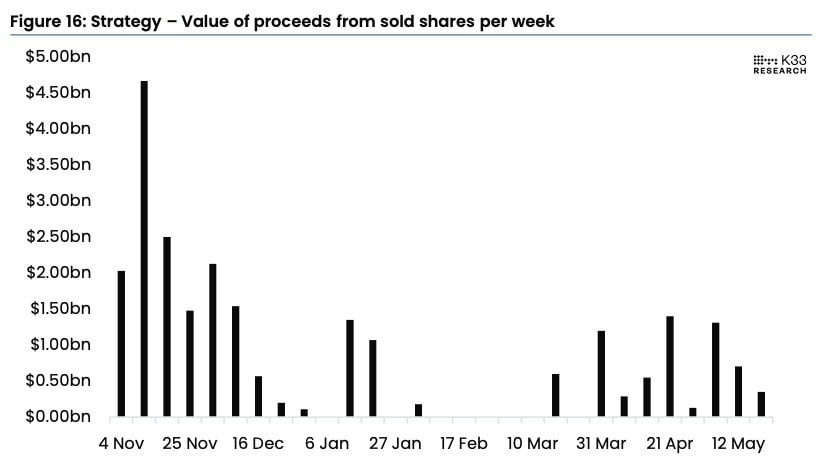
Объем вливаний в Strategy от реализации своих ценных бумаг, по неделям. Источник: K33 Research.

Помимо сокращения объема поступлений от эмиссии дополнительных ценных бумаг, эксперт указал на еще два фактора, из-за которых темпы покупки биткоинов Strategy сократились:

  • растущая конкуренция в секторе управляющих казначействами в первой криптовалюте;
  • резкое сокращение премии MSTR к биткоинам на балансе компании, со 185% до 163% в период с 19 по 23 мая.

В мае 2025 года сразу несколько контрагентов заявили о создании собственного биткоин-резерва. В их числе — Trump Media, принадлежащая президенту США Дональду Трампу. Она намерена вложить в первую криптовалюту до $2,5 млрд, что позволит ей войти в тройку крупнейших держателей актива среди публичных компаний.

При этом, агрессивные закупки биткоинов компаний из этой ниши, по мнению экспертов K33 Research, едва ли повлияют на движение цены актива, резюмировал Лунде. По его словам, в секторах деривативов и спотовых торгов эйфория остается умеренной.

Lecturas Relacionadas

Michael Saylor Identifies Bitcoin's 'Most Significant Breakthrough' in History

Michael Saylor, Executive Chairman of Strategy Inc., identifies Bitcoin's most significant breakthrough as its ability to transform economic energy into digital form and securely anchor it to individuals, families, companies, machines, or nations. He positions Bitcoin as a monetary technology enabling digital control of economic value, rather than merely a tradable cryptocurrency. This builds on his previous thesis describing Bitcoin as digital monetary energy, characterized by proof-of-work, fixed supply, digital transferability, and owner-controlled keys. Technically, Bitcoin does not legally tie coins to an identity but enables controlled digital ownership through cryptographic credentials. Ownership depends on securing private keys, which authorize transactions. While blockchain analysis allows for transaction tracking, Saylor's concept emphasizes the control aspect. Strategy Inc. serves as a corporate example, holding a large Bitcoin reserve. As of mid-August, the company reported owning 840,447 BTC. It has executed several sales in recent weeks. Saylor also outlines a four-tier digital money model with Bitcoin at the equity level. Beyond corporate adoption, U.S. banking regulators note increasing interest, with many recent bank charter applicants proposing digital asset-related activities, including stablecoin payments. Institutional analyses, like one from Fidelity Digital Assets, assess Bitcoin's properties such as scarcity and decentralization but caution about its speculative and volatile nature, without endorsing Saylor's energy metaphor.

cryptonews.ruHace 2 min(s)

Michael Saylor Identifies Bitcoin's 'Most Significant Breakthrough' in History

cryptonews.ruHace 2 min(s)

The Danger of Old Bookmarks: How an Expired Tornado Cash Domain Cost a User 1,000 ETH

A user lost over 1,010 ETH (worth millions) due to a phishing attack via an expired official domain of the Tornado Cash protocol. As reported on August 20, 2026, the domain `tornado.cash` was not renewed by the original developers amid U.S. OFAC sanctions and was subsequently registered by malicious actors. They deployed a fake frontend mimicking the legitimate Tornado Cash interface. Through this site, the attackers gained access to the user's deposit notes—the data required to withdraw funds from the protocol's pools—and drained the ETH within 12 hours. On-chain data shows the stolen funds (e.g., wallet 0xd8B356...) were withdrawn from Tornado Cash pools. However, on-chain analyst Specter cast doubt on the victim's story. He suggested the individual might be involved in illicit activity, noting that a large sum of BTC was received from a coin-mixing service (Whirlpool) and converted to ETH before being sent to the fake Tornado Cash site. The victim's explanation of urgently moving funds due to a compromised hardware wallet was questioned, as the fund trail indicated deliberate obfuscation. Specter speculated this might be a conflict between malicious actors rather than a simple phishing case. The incident highlights the danger of expired domains for major protocols, where old bookmarks can lead to compromised sites. WHOIS records show the domain was registered in March 2025. Broader analysis notes that in 2025, over $1.8 billion was lost to scams and exploits, largely through social engineering like phishing via familiar but hijacked links. This case underscores the persistent risk when a domain's legal status changes but user trust and search engine reputation remain.

cryptonews.ruHace 44 min(s)

The Danger of Old Bookmarks: How an Expired Tornado Cash Domain Cost a User 1,000 ETH

cryptonews.ruHace 44 min(s)

Trading

Spot
活动图片