JuCoin理财宝正式上线

Odaily星球日报Publicado a 2025-05-26Actualizado a 2025-05-26

Resumen

配合社区激励活动同步推出。

5 月 26 日,数字资产交易平台 JuCoin 正式推出首期 USDT 定息理财产品,为广大用户提供安全、灵活且高回报的数字资产增值服务。本次产品上线,不仅是 JuCoin 理财业务的正式起航,更是其金融服务战略升级的重要里程碑,致力于满足用户在数字时代日益增长的财富管理需求。

产品亮点

JuCoin 理财首批 USDT 定息产品正式上线,产品覆盖 6 种不同期限,从 7 天到 90 天

产品亮点

6 种期限随心选: 7 天/15 天/30 天/45 天/60 天/90 天

阶梯利率更划算:买对额度,享受更高特惠利率

本金保障 + 专业风控:资金更安心,收益更稳健

收益计算超简单

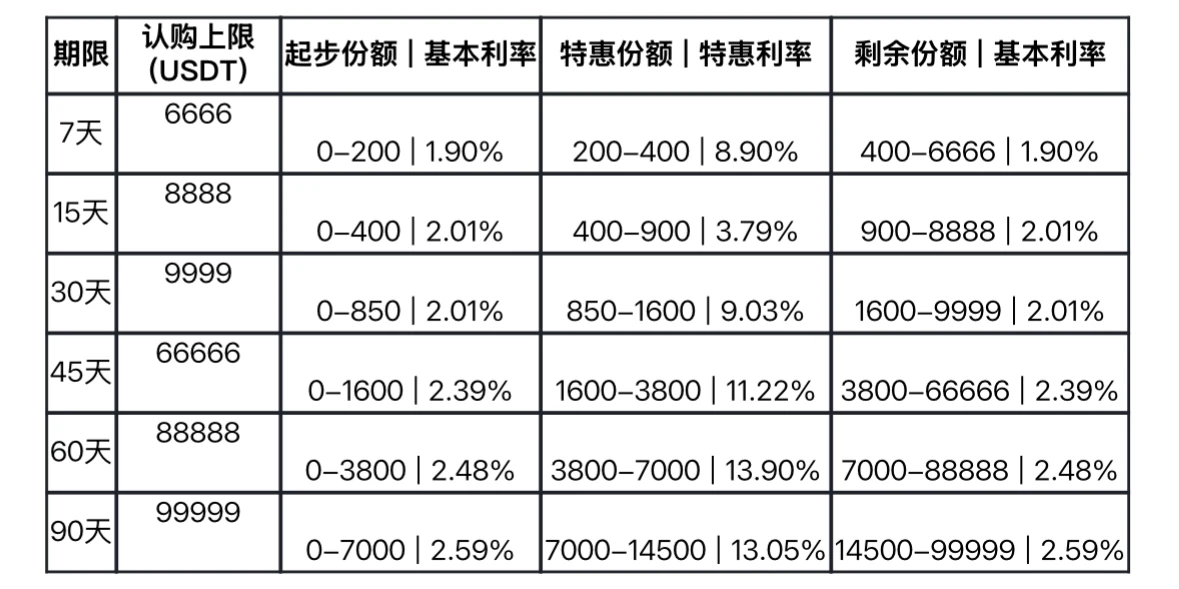
JuCoin 采用"阶梯利率"计算方式:

1. 每个产品都设有"起步份额"和"特惠份额"

2. 起步份额内:享受基础利率

3. 超过起步份额:特惠份额部分享受更高利率

4. 超过特惠份额:超出部分回归基础利率
JuCoin理财宝正式上线

举个例子

Jason 购买了 45 天产品,投入 4000 USDT:

• 前 1600 USDT:享受 2.39% 基本年化利率

• 中间 2200 USDT(3800-1600):享受 11.22% 特惠年化利率

• 最后 200 USDT:回归 2.39% 基本年化利率

• 实际综合年化≈ 7.25% 

( 1600* 2.39% + 2200* 11.22% + 200* 2.39% )/4000 ≈ 7.25% 

温馨提示:

• 不同产品设有不同认购上限

• 收益按日计算,到期自动发放

• 详情请查看产品页面说明

社区激励计划

JuCoin 团队一直相信社区的力量,倾听用户的声音

这次是 JuCoin 理财产品的首次亮相,超高利息理财产品之外,还为所有参与宣传和邀请的朋友准备了丰厚奖励金池。KOL、社群领袖、普通用户都可以轻松参与。

活动玩法要素 :

人人都可以邀请赚钱

分享邀请码,邀请新朋友来 JuCoin 注册并购买理财产品,有机会赚现金奖励

满足条件就奖励现金

只要被邀请用户认购了一定额度的理财产品,并保持账户存额≥ 2000 USDT 状态 45 天以上,就算“成功邀请”。邀请者将获得与“成功邀请”存款总额挂钩的现金奖励。账户存额=用户账户中的闲置 USDT+购买的理财产品份额

(奖励计算细则即将公布,敬请关注官方公告和 AMA 直播)

老用户也有奖励

如果已有用户购买了 2000 USDT 以上份额的 45 天/60 天/90 天理财产品,也会给其邀请人发放奖金。

即使未满足条件,也能拿返佣

就算朋友暂时没有达标,用户依然可以享有 JuCoin 基础邀请返佣政策,未来朋友在平台的交易行为,用户最高可以拿 30% 返佣分成。

未来展望

JuCoin 这次推出的基于 USDT 的 7 至 90 天短期系列定息理财产品仅仅是开始。

此次活动不仅为用户提供优质的理财选择,也标志着 JuCoin 在数字资产财富管理领域迈出的关键一步。在活动期间 JuCoin 将密切关注用户的使用行为和反馈,深入了解社区的真实需求,并积极采纳建议,作为未来产品设计与功能优化的重要参考。

当前活动不设固定截止时间,现有的理财产品与特惠利率将在较长一段时间内持续开放。若用户暂时错过了心仪产品的额度,也无需担心:当相关产品到期后,额度将自动释放并重新开放认购。

随着产品研发的持续推进,JuCoin 未来计划推出更多满足用户多样化需求的理财方向和功能特性,包括但不限于:

• 多币种理财: 支持 USDC 等其他主流稳定币的理财产品

• 流动性改良:具备灵活赎回或可交易转让机制的理财工具

• 无门槛收益:无需锁仓认购,即可享受收益的活期账户

• 专业级理财工具:涵盖 RWA 资产、市场波动率、双币对冲策略、FoF 等的结构化理财产品

结语

JuCoin将持续以用户为核心,构建稳健、高效且创新的数字资产理财生态。在当前牛市背景下,JuCoin 平台正通过理财宝的稳健收益策略,并结合其在 CeDeFi 等创新领域的持续布局,为用户提供全面且高效的数字资产管理方案。
Lecturas Relacionadas

Building the Bright Path While Secretly Crossing Chencang: Is Walsh Paving the Way for a September "Rate Cut"?

The title "Building the Plank Road Openly While Secretly Crossing at Chencang: Is Walsh Paving the Way for a September 'Rate Cut'?" suggests Federal Reserve Chair Kevin Walsh's hawkish stance may be a deliberate smokescreen. Academy Securities analyst Peter Tchir argues in a report that markets, currently pricing a 75% chance of a September hike, are missing a potential path to a September rate cut that Walsh himself might be quietly preparing. Tchir posits that Walsh's hawkish rhetoric aims to suppress long-term yield risks (with the 10-year Treasury yield falling recently) while creating room for a narrative shift based on upcoming data. The potential political endgame, according to this view, could be rate cuts in September and October, ahead of the midterm elections. This hinges on a political logic where the Trump administration's preference for lower rates remains unchanged. A core part of Tchir's argument involves redefining inflation metrics. He contends the Fed under Walsh may deprioritize the PCE index, criticizing its lagging components like Owners' Equivalent Rent (OER). Instead, he points to alternative, more real-time indicators like the New Tenant Repeat Rent Index (NTRR) and the Truflation daily index, which shows core inflation around 1.45%. He suggests the Fed could shift its data narrative to justify policy easing. Furthermore, Tchir downplays AI-driven inflation fears. He argues that consumer price sensitivity, evidenced by negative market reactions to price hikes (e.g., Apple), contradicts persistent inflation narratives. He also separates AI/data center spending—which he sees as relatively rate-insensitive—from broader consumer affordability issues, implying rate hikes are misdirected. Based on this analysis, Tchir sees a re-pricing of rate cut expectations as likely, creating opportunities in short-duration Treasuries. He maintains a neutral-to-slightly-bullish view on the long end of the yield curve. For equities, he recommends a significant overweight in energy (especially global nuclear assets) and, within defense/security themes, an overweight in biotech/pharma versus an underweight in semiconductors, expressing caution on AI/data center valuations.

marsbitHace 24 min(s)

Building the Bright Path While Secretly Crossing Chencang: Is Walsh Paving the Way for a September "Rate Cut"?

marsbitHace 24 min(s)

"King of Shilling" Hayes Strikes Again, This Time Setting His Sights on Deribit

On June 29, BitMEX co-founder Arthur Hayes acquired approximately 6.16 million SYN tokens via OTC platform Flowdesk, valued at around $2.2 million. Subsequently, Hayes publicly endorsed SYN on X, calling it one of the most asymmetric investments he's seen since HYPE and declaring it time for an on-chain options DEX to challenge industry leader Deribit, naming Hypercall as that challenger. The article details the evolution of the Synapse Protocol, originally launched in 2021 as a cross-chain messaging and liquidity network. While its TVL peaked above $1 billion during the last bull market, it has since declined. The protocol's team has since built Hypercall, an on-chain options trading platform on Hyperliquid's HyperEVM, which supports trading options on "any asset" with features like 24/7 trading and defined risk limited to the premium paid. Deribit, founded in 2016, is highlighted as the dominant centralized crypto options exchange, commanding roughly 85% market share in BTC and ETH options. Its strengths include deep liquidity and professional tools, though it faces critiques over custody risk, KYC requirements, and regulatory uncertainty. The analysis suggests Hypercall's potential lies in decentralization, permissionless access, and transparency, potentially carving a niche in DeFi-native and emerging asset options. However, it faces significant challenges competing with Deribit's established network effect and liquidity depth. The piece concludes by noting Hayes's recent and mixed "call" history, referencing his previous promotion and subsequent sale of HYPE, as well as a controversial price target report for CARDS from his family office, Maelstrom, which was followed by a significant price drop for the asset. This activity has drawn criticism, with some accusing Hayes of creating exit liquidity for his followers.

Foresight NewsHace 1 hora(s)

"King of Shilling" Hayes Strikes Again, This Time Setting His Sights on Deribit

Foresight NewsHace 1 hora(s)

One Year After the Crash of Crypto Treasury Companies, Copycats Are Already Making a Comeback

One year after the collapse of digital asset treasury (DAT) companies, which wiped out up to 99% for early investors, the scheme has returned in a new guise. Recently, Triller Group announced it would become a "SpaceX treasury company," causing its market cap to surge. This follows the rebranding of another firm, LGHL, now targeting a token called HYPE. The original model, popularized by MicroStrategy (MSTR) and its "Bitcoin yield" narrative, saw companies trading at massive premiums to their underlying crypto holdings. However, most followers like TwentyOne, Metaplanet, and Nakamoto have crashed 80-95%+ from their peaks, erasing nearly all value for late investors. The author argues these structures have no fundamental reason to trade at premiums when low-fee Bitcoin ETFs or direct ownership exist. The cycle persists due to speculative demand driven by FOMO, gamification, and a belief the system is rigged, met by insiders and promoters who profit from the pump-and-dump dynamics. Drawing a parallel to the 1637 Tulip Mania, the piece concludes that such frenzies are not a bug but a recurring product of markets, where greater fools provide demand and insiders supply the schemes. Despite holding Bitcoin personally, the author condemns this specific packaging of assets into leveraged corporate vehicles marketed as innovation, a cycle seemingly unstoppable until a major crash.

marsbitHace 1 hora(s)

One Year After the Crash of Crypto Treasury Companies, Copycats Are Already Making a Comeback

marsbitHace 1 hora(s)

Trading

Spot
活动图片