The US Securities and Exchange Commission (SEC) has charged New York-based crypto investment Unicoin and three top executives for allegedly misleading investors and defrauding over $100 million from customers.
Crypto Company Hit With SEC Lawsuit
On Tuesday, the SEC announced it had filed a lawsuit in the US District Court For The Southern District of New York against crypto company Unicoin, its CEO and Board Chairman Alex Konanykhin, its former president Silvina Moschini, and its former CIO Alex Dominguez.
The regulatory agency accused the Defendants of making false and misleading statements related to the Unicoin token and the offering of the company’s common stock, charging Unicoin, Konanykhin, Moschini, and Dominguez with violations of the antifraud provisions of the federal securities laws.
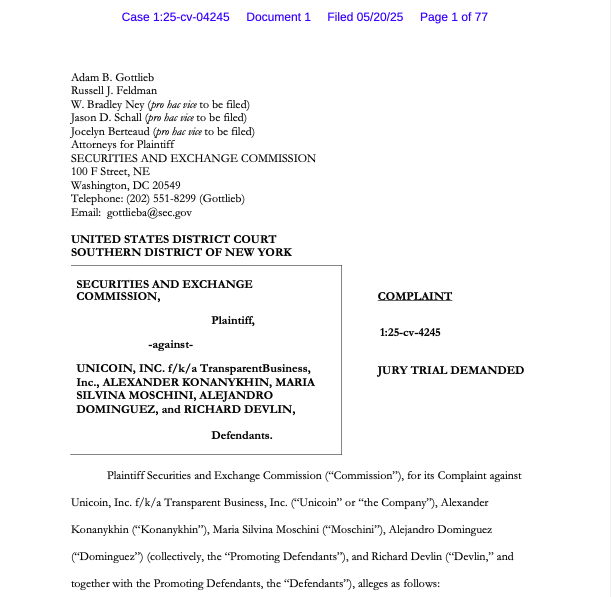
SEC's complaint against Unicoin and its top executives. Source: SEC
It also charged Konanykhin and Unicoin with violating the registration provisions of the Securities Act of 1933, and Konanykhin as a control person for certain of the company’s antifraud violations.
Additionally, it accused Richard Devlin, Unicoin’s general counsel, of violating federal securities laws by making similar false statements in private placement memos the company used to offer and sell rights certificates and Unicoin common stock.
According to Mark Cave, Associate Director in the SEC’s Division of Enforcement, Unicoin and the executives “exploited thousands of investors with fictitious promises that its tokens, when issued, would be backed by real-world assets including an international portfolio of valuable real estate holdings.”
However, “the real estate assets were worth a mere fraction of what the company claimed, and the majority of the company’s sales of rights certificates were illusory. Unicoin’s most senior executives are alleged to have perpetuated the fraud, and today’s action seeks accountability for their conduct,” Cave explained.
Unicoin To ‘Fight Back’ Allegations In Court
The SEC’s complaint affirms that, since February 2022, Unicoin and Konanykhin violated the federal securities laws by engaging in unregistered offers and sales of rights certificates, with Konanykhin offering and selling over 37.9 million of his rights certificates “to offer better pricing and target investors the company had prohibited from participating in the offering to avoid jeopardizing its exemption to registration requirements.”
The executive trio is accused of convincing over 5,000 investors to purchase rights certificates “through false and misleading statements that portrayed them as investments in safe, stable, and profitable ‘next generation’ crypto assets,” including claiming that the tokens had sold more than $3 billion in rights certificates, when it seemingly raised just $110 million.
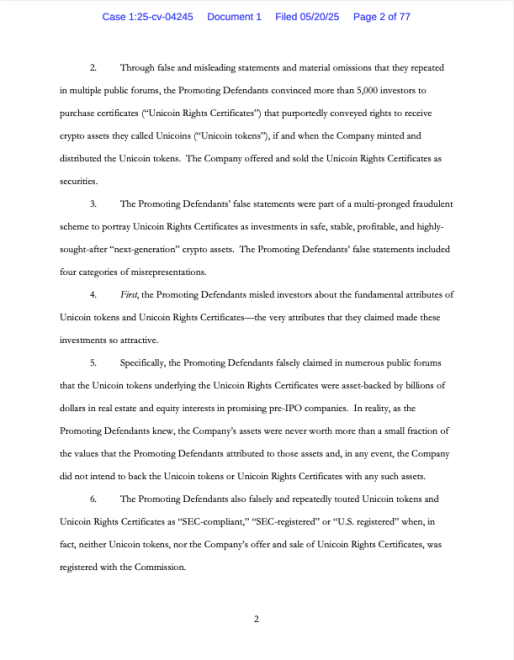
SEC's complaint accuses the Defendants of false and misleading statements. Source: SEC
The SEC also alleges that the crypto company falsely claimed the right certificates and Unicoin tokens were “SEC-registered” or “US-registered,” and made extensive promotional efforts to market the right certificates to the public, including advertisements in major airports, New York taxis, on television, and on social media.
As such, the complaint seeks permanent injunctive relief, disgorgement of ill-gotten gains with prejudgment interest, and civil penalties against the Defendants. Additionally, it seeks officer-and-director bars against Konanykhin, Moschini, and Dominguez.
In an April interview with crypto journalist and podcast host Eleanor Terret, Unicoin’s CEO revealed the company planned to fight the SEC’s allegations in court as news of a potential lawsuit emerged.
Following the financial watchdog’s complaint, Konanykhin told Terret they lament the SEC’s actions, affirming they are persecuting “the most compliant cryptocurrency company in the country using blatantly false charges.”
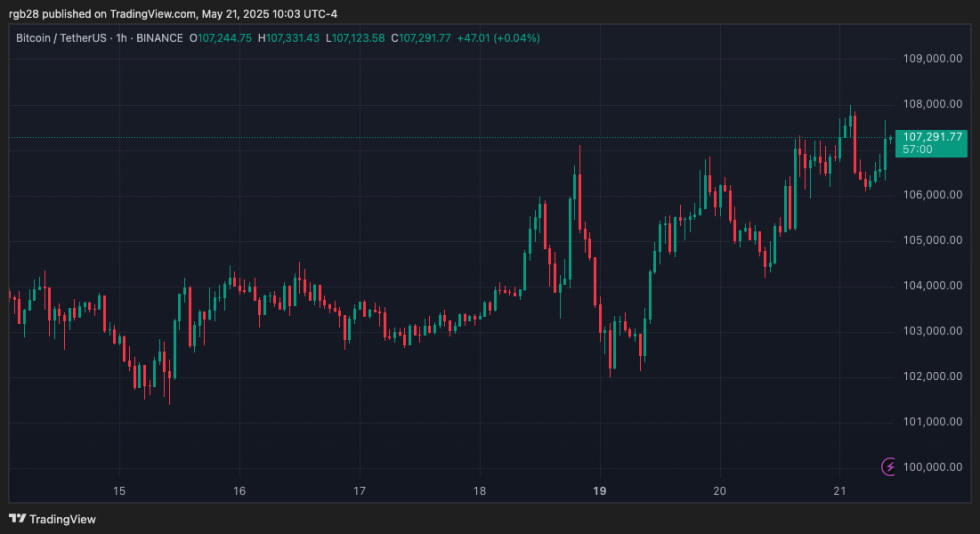
Bitcoin (BTC) trades at $107,291 in the one-week chart. Source: BTCUSDT on TradingView

Related Posts