SKYAI nears October 2025 lows as manipulation concerns weigh on sentiment

ambcryptoPublicado a 2026-07-10Actualizado a 2026-07-10

Resumen

In mid-June, SkyAI (SKYAI) experienced a brief rally of 216%, surging from $0.151 to $0.479. However, it has since plummeted 92% from that peak. On-chain researchers, citing data from Nansen and Bubblemaps, allege the price action is consistent with market manipulation—where a concentrated supply held by a few wallets was distributed to retail investors during hype, leading to a violent dump. The token has broken key support at $0.146 and is rapidly approaching its October 2025 lows near $0.007. Although a recent spike in trading volume and open interest briefly pushed the price to $0.05, this bounce quickly reversed into another sell-off. With ongoing manipulation concerns and fading retail interest, the recovery outlook for SKYAI remains highly uncertain.

In mid-June, SkyAI [SKYAI] witnessed some short-term bullish momentum. The $0.20 key support zone was defended, and a 216% rally from $0.151 to $0.479 occurred in a week.

However, the bears have regained control of the market since then. The altcoin has fallen 92% since the $0.479 high.

Researcher Freeman wrote in a post on X that the crash wasn’t the fade of an organic AI hype. Using Nansen data, whales dumping SKYAI during bounces, such as the mid-June one to $0.47, were detailed.

The post succinctly broke down the manipulation playbook.

Parabolic narrative pump → concentrated supply in few wallets → heavy distribution into retail FOMO → violent dump.

Bubblemaps had also flagged patterns it said were consistent with potential market manipulation on centralized exchanges. The pattern was something investigator ZachXBT had also been warning of, in relation to RAVE.

AMBCrypto had apprised readers of the decline in Open Interest following the mid-June rally to $0.479.

As more supply hits the market, the pressure on the token would increase. It is unclear if there is enough market conviction in SKYAI to reverse the severe drawdown.

Compared to large orders, retail influence was fading. This was another red flag for traders and investors of suspicious price action and market activity.

Assessing the current SKYAI trends
Source: SKYAI on TradingView

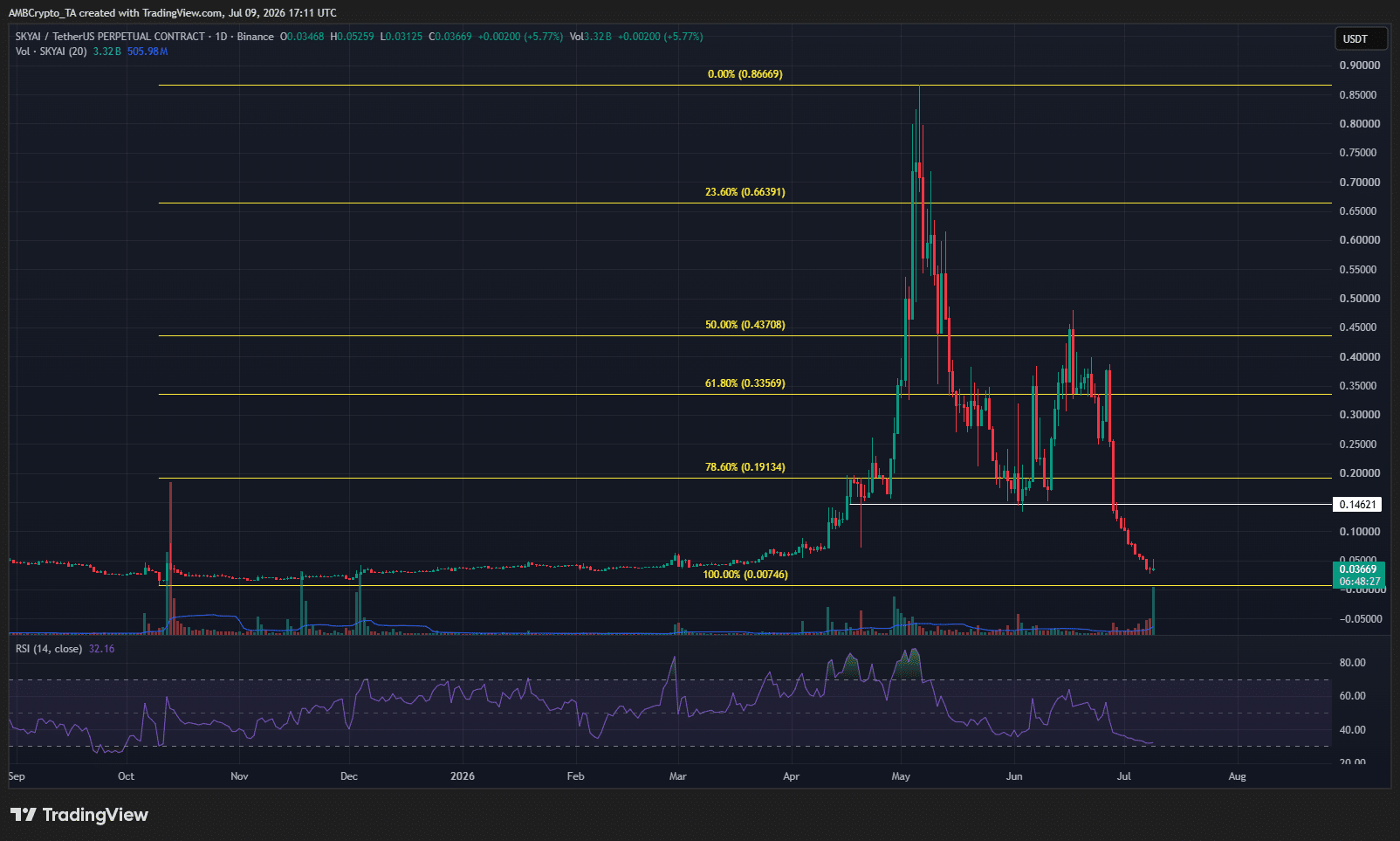
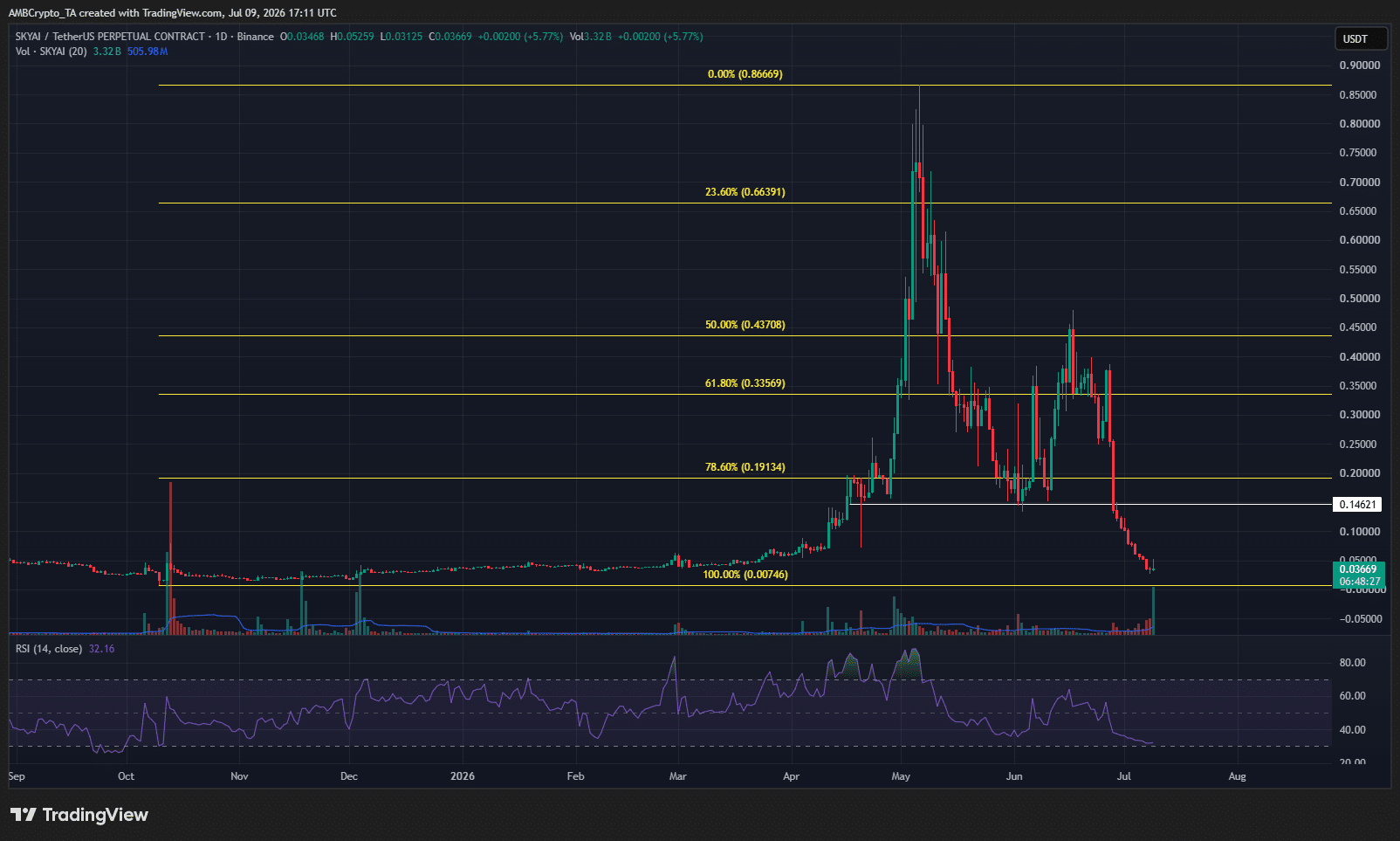
SKYAI has fallen below the $0.146 support that had been in place since April. More accurately, the current market price was 75% below this key former support level.

The token was rapidly falling toward the $0.007 lows from October 2025, but there was high trading volume on the day of writing. On the back of this volume, the price reached $0.05.

The Open Interest nearly doubled from $6.81 million on July 8 to $13.14 million in recent trading hours. The combination of the sharp correction and ongoing manipulation allegations leaves the recovery outlook uncertain.


Final Summary

  • On-chain investigators have linked SKYAI’s extreme price volatility to allegations of concentrated insider-controlled supply.
  • A bounce to the $0.05 level has turned into another short-term sell-off in recent hours.

Preguntas relacionadas

QAccording to the article, what specific pattern of price action does researcher Freeman describe as the 'manipulation playbook' for SKYAI?

AFreeman describes the manipulation playbook as: Parabolic narrative pump → concentrated supply in few wallets → heavy distribution into retail FOMO → violent dump.

QWhat key support level from April has SKYAI fallen below, and by what percentage is the current price below that level?

ASKYAI has fallen below the $0.146 support level that had been in place since April. The current market price is 75% below this key former support level.

QWhat happened to Open Interest (OI) for SKYAI between July 8 and the recent trading hours mentioned in the article?

AThe Open Interest nearly doubled from $6.81 million on July 8 to $13.14 million in recent trading hours.

QWhat was the price range of the '216% rally' that SKYAI experienced in mid-June?

AThe 216% rally in mid-June occurred from $0.151 to $0.479.

QBesides Freeman, which other investigators or services have flagged potential market manipulation patterns related to SKYAI?

ABubblemaps had flagged patterns consistent with potential market manipulation on centralized exchanges. The article also mentions that investigator ZachXBT had been warning of a similar pattern in relation to another token, RAVE.

Lecturas Relacionadas

Tsinghua AI Mathematician Emerges: From Intuition to Theorem, Contributing to an 84-Page Quantum Algorithm Paper

Tsinghua University’s Intelligent Industry Research Institute (AIR) has developed an AI mathematician agent named AIM, designed not just to solve math problems but to actively participate in early-stage research. In a recent study, researchers collaborated with AIM to develop "Sign Embedding Quantum Algorithms," resulting in an 84-page paper on quantum algorithms for matrix equations and functions. The research began with a human researcher's intuition: can rational approximation serve as a design principle for quantum algorithms? AIM helped expand this idea into multiple candidate research directions. Human researchers then filtered and focused on the most promising path. AIM assisted in organizing theorems, generating proof drafts, and performing complexity analysis, while humans maintained oversight, auditing assumptions and refining derivations. This case illustrates a human-AI collaborative workflow: AI rapidly explores and expands research avenues, generates draft materials, and aids in checking derivations; human researchers provide critical judgment on direction, value, and validity. The process emphasizes "high-throughput candidate generation + human value gating + AI-assisted audit and repair + human final integration." The resulting quantum algorithm framework offers a unified approach to several matrix problems, advancing quantum linear algebra under more general conditions. This work suggests AI's role in theoretical research is evolving from task-specific assistance to supporting the entire research lifecycle—enhancing exploration and efficiency while keeping human expertise central to guiding inquiry and ensuring rigor. *Paper & System Links:* - AIM application report: https://arxiv.org/abs/2606.24899 - Quantum algorithm paper: https://arxiv.org/abs/2604.25333 - AIM repository: https://github.com/TheoryFoundry/AIMv2

marsbitHace 4 min(s)

Tsinghua AI Mathematician Emerges: From Intuition to Theorem, Contributing to an 84-Page Quantum Algorithm Paper

marsbitHace 4 min(s)

Short-Lived Meme Mania: Can It Be the Icebreaker for Robinhood's RWA Narrative?

Robinhood recently launched its own Layer 2 network, Robinhood Chain, built on Arbitrum and focusing on tokenized stocks, RWA, DeFi, and AI finance. Shortly after launch, a meme coin called CASHCAT, named after an early unused Robinhood brand, surged in popularity, achieving a market cap near $150 million and high daily trading volume. It gained traction through third-party DEXs and launchpads like Uniswap and Noxa.fun, bypassing Robinhood's official listing process. This highlights a key feature of the permissionless chain: even assets not officially approved can achieve significant liquidity and trading activity. While CASHCAT currently dominates the chain's meme coin sector, its high turnover indicates speculative trading. The rapid proliferation of new meme coins risks dispersing liquidity. Meanwhile, the chain's core RWA sector remains relatively small at $12.5 million. CEO Vlad Tenev has expressed that the chain is well-suited for both RWA and meme coins. In the optimistic scenario, meme-driven activity could bootstrap the chain's user base and liquidity for its long-term RWA vision. However, if the meme frenzy fades quickly, the RWA narrative may struggle to gain traction independently. The incident demonstrates that on a permissionless platform, the market itself can create major assets, offering Robinhood a potential new growth avenue beyond its core crypto business as it navigates the long-term development of the tokenized asset market.

Foresight NewsHace 8 min(s)

Short-Lived Meme Mania: Can It Be the Icebreaker for Robinhood's RWA Narrative?

Foresight NewsHace 8 min(s)

The Fall of Zapper: An Act of God or a Human Error?

The Fall of Zapper: A Post-Mortem of a DeFi Pioneer In July 2026, Zapper, a once-dominant DeFi portfolio tracker, announced its shutdown. Born in 2020 from a merger, Zapper capitalized on the DeFi Summer boom, reaching 2 million monthly users and processing over $13B in transactions, backed by $16.5M in funding from investors like Framework Ventures and Coinbase Ventures. Its core "Zap" feature simplified complex multi-step DeFi operations. Despite its early success, Zapper failed to build a sustainable business model. Revenue from DEX aggregation was minimal due to fierce competition, while maintaining its multi-chain data infrastructure was costly. Furthermore, the DeFi landscape shifted: capital consolidated around top protocols, reducing the need for complex portfolio tracking across numerous platforms. Zapper's user base and core demand eroded. The company attempted multiple pivots, including an NFT-based points system, a social app (Chainchat), and plans for a ZAP token protocol. However, these initiatives—often focused on creating new, speculative C端需求 rather than solving existing pain points—ultimately failed. Critics argue Zapper remained trapped in a "blockchain purist" mindset, prioritizing costly, non-revenue-generating features over its competitive DEX aggregator. Unlike competitor DeBank, which successfully pivoted to its Rabby Wallet, Zapper lacked a diversified revenue stream. Its closure highlights the peril for tooling projects that fail to adapt to market shifts and monetize effectively, serving as a cautionary tale for the industry.

Foresight NewsHace 46 min(s)

The Fall of Zapper: An Act of God or a Human Error?

Foresight NewsHace 46 min(s)

Trading

Spot
活动图片