США предложили законопроект против доминирования крупных криптокомпаний

cryptonews.ruPublicado a 2024-10-06Actualizado a 2025-05-06

Цель — сделать рынок прозрачнее и демократичнее

В Конгрессе США представили новый законопроект о цифровых активах. Его суть — снизить влияние крупных игроков и дать больше возможностей сообществу.
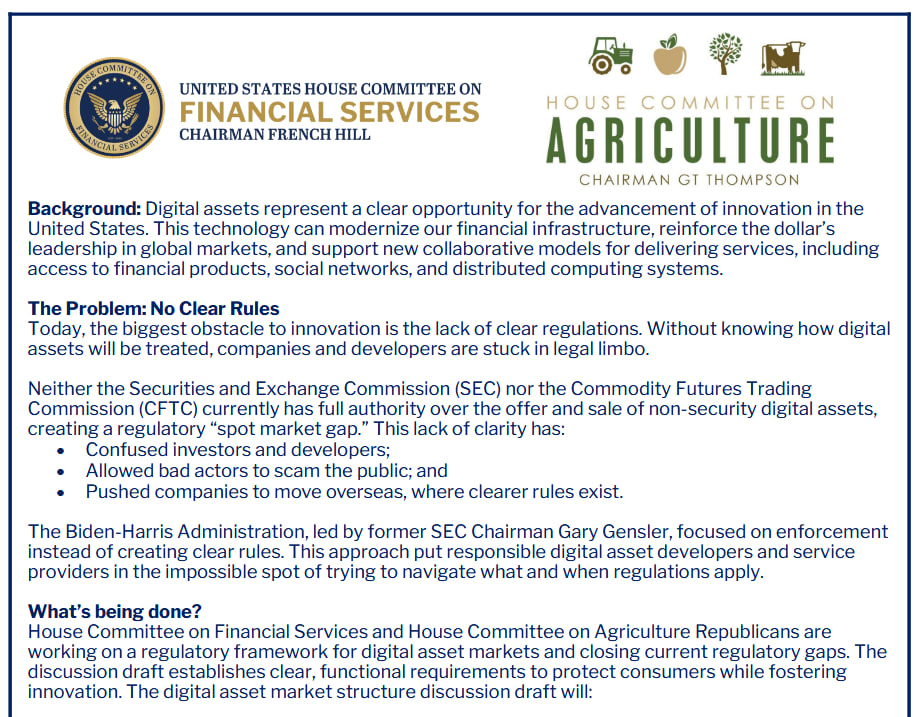
Инициативу 5 мая внесли республиканцы — Гленн Томпсон и Френч Хилл. Это новая версия закона FIT21. В документе есть важные изменения, которые могут повлиять на всю индустрию.

Больше прозрачности: доли от 1% под контролем

Главное новшество — снижение порога раскрытия информации. Теперь любой, кто владеет более 1% от эмиссии токена, должен публично раскрыть данные. Раньше планка была на уровне 5%.

«Это сигнал: крупные держатели больше не будут в тени», — прокомментировал Джастин Слоутер из Paradigm.

По его словам, такой шаг может сделать рынок более открытым. И дать шанс новым проектам. Критика олигархии в крипте звучит давно. Теперь у регулятора появился инструмент, чтобы на это повлиять.

Что будет с DeFi и децентрализованными протоколами

Законопроект делает послабления для DeFi. Протоколы, позволяющие пользователям совершать сделки напрямую, без посредников, не будут обязаны регистрироваться как брокеры. Это важный шаг для Web3.

Также вводится понятие «зрелая блокчейн-система» — такая сеть, которая больше не управляется одним центром. Под это определение могут попасть многие крупные блокчейны, включая Ethereum.

SEC будет надзирать до децентрализации

Пока проекты не станут децентрализованными — регулировать их будет SEC. Но документ проводит четкое различие между токенами и классическими ценными бумагами. Вводится новое определение: «инвестиционный контрактный актив».

Lecturas Relacionadas

Ondo, the Leader in RWA Tokenization, is Entering the Perp DEX Arena

Ondo Finance, the dominant player in the real-world asset (RWA) tokenization space, is entering the perpetual futures (Perp) DEX arena with the launch of "Ondo Perps." This move signifies a strategic pivot from primarily being an asset issuer to becoming a comprehensive trading infrastructure provider. The platform uniquely focuses on tokenized traditional assets like stocks, indices (e.g., US 500), and commodities (gold, silver, oil), offering up to 20x leverage for 24/7 trading. A key differentiator is its planned multi-asset collateral system, which will allow users to employ tokenized stocks and bonds as margin, enabling sophisticated portfolio hedging and strategies. This approach leverages Ondo's existing strengths—deep institutional relationships, regulatory approvals, and a vast library of tokenized assets—to create a bridge between traditional finance liquidity and decentralized, permissionless trading. By integrating its asset issuance (Ondo Global Markets) with a proprietary trading venue, Ondo aims to complete the RWA financialization loop, transforming tokenized holdings from passive investments into productive capital for leverage and complex financial engineering. The launch positions Ondo Perps not just as another derivatives exchange, but as a foundational piece of next-generation infrastructure merging TradFi assets with DeFi-native execution.

Foresight NewsHace 1 hora(s)

Ondo, the Leader in RWA Tokenization, is Entering the Perp DEX Arena

Foresight NewsHace 1 hora(s)

Founder of Baixing.com: The Notion That Large Language Models Will Devour Everything, I Believe Half of It

Founder of Baixing.com: I Only Half-Believe the Saying “Large Language Models Will Devour Everything” Author: Wang Jianshuo, Founder of Baixing.com Many proclaim that large models are everything, but the author is skeptical. He argues that such sweeping claims often stem from a limited understanding of the future. Drawing parallels to past technologies like electricity and the internet—which were predicted to “devour everything” but didn’t—he suggests that large language models (LLMs) are better seen as a foundational base. Like electricity, this base is essential for modern development, but its real value emerges only when applied to specific scenarios through various “machines” or “tools” (e.g., Claude Code for programming, Claude Design for design). The author acknowledges that LLMs may indeed replace many existing software systems built on rigid rules, workflows, and forms (e.g., CRMs, SaaS tools), as these are precisely what LLMs excel at processing. However, he emphasizes that beyond software, elements like customer data, execution capabilities (e.g., booking a flight), trust, and physical-world interactions will not be “devoured.” Instead, he foresees that after streamlining existing software, LLMs will open up a larger space for innovative, next-generation applications. These new tools will likely feature fluid interfaces and rely less on fixed rules, unleashing greater creativity. The author cautions against short-sightedness, recalling how in 2004 many believed internet giants like Sina, Sohu, and NetEase would monopolize the market—only to be proven wrong by subsequent disruptions. In conclusion, while LLMs are a crucial foundation and a current focal point, the true mainstream of this wave lies in the diverse applications built atop them to solve concrete problems. The phrase “devour everything” is imprecise; the real opportunity lies in identifying and leveraging the areas where LLMs do bring transformative change.

marsbitHace 2 hora(s)

Founder of Baixing.com: The Notion That Large Language Models Will Devour Everything, I Believe Half of It

marsbitHace 2 hora(s)

Founder of Baixing.com: I Only Half Believe in the Notion that Large Language Models Devour Everything

The founder of Baixing Wang states that while large language models (LLMs) are an extremely important foundational technology—akin to electricity or the internet—he only "half believes" the notion that they will "consume everything." He argues that LLMs provide a base layer of intelligence, but real-world value and transformation come from integrating this intelligence into specific applications and devices designed for particular scenarios—like how electricity powers various appliances from washing machines to TVs. He agrees LLMs will likely consume or replace a significant portion of existing rule-based, workflow-driven software (e.g., many SaaS systems, CRMs), as these are precisely what LLMs excel at handling. However, numerous other elements—such as customer data, execution capabilities (e.g., booking a flight), trust, and physical-world interactions—will not be consumed. Wang emphasizes that after LLMs absorb certain software layers, they will open up a much larger space for innovation: new types of "streaming" software with less rigid interfaces, where fixed rules are managed by AI. This next wave of applications built on top of the stable LLM foundation is where the true mainstream opportunity lies. He cautions against the short-sightedness of declaring any technology as all-consuming, drawing parallels to past premature predictions about internet giants monopolizing the web. The key is to find opportunities within the areas LLMs do transform.

链捕手Hace 2 hora(s)

Founder of Baixing.com: I Only Half Believe in the Notion that Large Language Models Devour Everything

链捕手Hace 2 hora(s)

Trading

Spot
活动图片