Руководитель Fireblocks: «Спрос на недолларовые стейблкоины растет по всему миру»

cryptonews.ruPublicado a 2021-09-01Actualizado a 2025-05-01

Правительства за пределами США, включая Сингапур, все больше интересуются стейблкоинами, не привязанными к доллару США, несмотря на их ограниченную ликвидность, сказала директор по политике Fireblocks Деа Маркова на Token2049.

Маркова описала конкуренцию со стейблкоинами, привязанными к доллару, как «все дело в суверенитете». Она сравнила ситуацию с более ранней напряженностью между правительствами и американскими платежными гигантами, такими как Visa и Mastercard.

«Сейчас мы наблюдаем ту же динамику со стейблкоинами — пока в меньших масштабах — но они определенно становятся новой ареной для суверенных проблем», — сказала она.

По словам Марковой, стейблкоины, привязанные к доллару, работающие в Европейском союзе, уже «испытывают огромную головную боль», особенно со стороны центральных банков.

«Хотя они соответствуют нормативным требованиям и регулируются, они испытывают постоянное сопротивление», — сказала она.

Европейский центральный банк усиливает давление, чтобы ускорить разработку цифрового евро, ссылаясь на опасения по поводу системного влияния стейблкоинов, привязанных к доллару, в еврозоне.

29 апреля Банк Италии опубликовал отчет, в котором говорится, что зависимость стейблкоинов, привязанных к доллару, от казначейских облигаций США может увеличить уязвимости системного риска.

В рыночной капитализации стейблкоинов доминируют монеты, привязанные к доллару, особенно Tether (USDT) и USD Coin (USDC) от Circle. По данным DefiLlama, эти две монеты в совокупности составляют 210,9 млрд долларов США (или 87,2%) от общей рыночной капитализации таких токенов в размере 241,8 млрд долларов США. Фактически, все 10 ведущих стейблкоинов привязаны к доллару США.
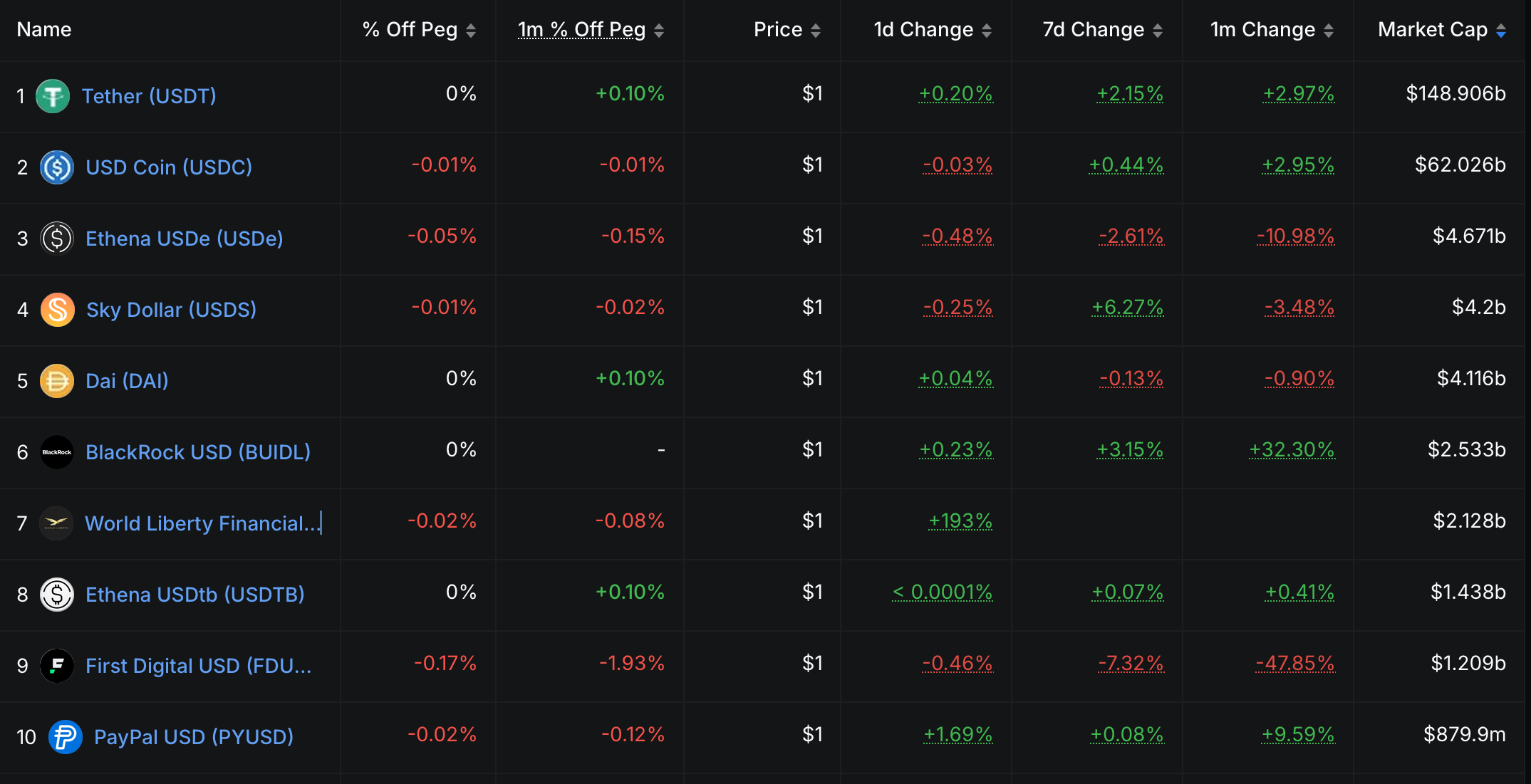

10 лучших стейблкоинов по рыночной капитализации. Источник: DefiLlama.

По мнению Марковой, ситуация похожа на предыдущие конфликты между правительствами и американскими платежными гигантами, такими как Visa и Mastercard.

«Сейчас мы наблюдаем ту же динамику со стейблкоинами — пока в меньших масштабах — но они определенно становятся новой ареной для суверенных проблем», — сказала она.

ОАЭ впереди в «регулятивном мышлении»

Маркова добавила, что Объединенные Арабские Эмираты «определенно впереди в своем регуляторном мышлении» в отношении стейблкоинов. Она привела в пример Абу-Даби, отметив, что эмират не требует, чтобы эмитенты стейблкоинов имели локальный адрес или лицензию, в отличие от подхода к регулированию в Европе.

Маркова объяснила, что подход Абу-Даби заключается в проведении комплексной проверки глобальных стейблкоинов и принятии решения о том, могут ли местные биржи их предложить.

«Это гораздо более разумный подход, чтобы предоставить местным предприятиям доступ к глобальной ликвидности и платежам», — заключила она.

В декабре 2024 года USDT был одобрен в качестве признанного виртуального актива в Абу-Даби, а 29 апреля Circle получил регулирующее одобрение для USDC. Тем временем учреждения Абу-Даби сотрудничают в запуске регулируемого стейблкоина, привязанного к дирхаму.


Lecturas Relacionadas

The "Impossible Triad" Is Fundamentally a Pseudo-Problem

The article argues that blockchain's fundamental limitation is not the scalability trilemma (decentralization, scalability, security), which has been largely solved, but the lack of **privacy** and, until recently, clear **legitimacy**. Blockchain is described as a slow, expensive, globally shared computer whose core value is censorship resistance and verifiability. While ideal for native digital assets like money (e.g., stablecoins), its default transparency acts as a **tax**, exposing all transactions and enabling MEV extraction, which deters serious institutional capital. Simultaneously, its permissionless nature created regulatory ambiguity. The piece contends that **privacy** is the missing critical feature. It rejects the false choice between total transparency and complete anonymity. Modern cryptography (like zero-knowledge proofs) enables **compliant privacy**: users can prove facts (solvency, KYC status, compliance) without revealing the underlying sensitive data (specific holdings, identities). This preserves auditability for regulators and eliminates the leak of financial information. With recent regulatory progress (e.g., the GENIUS Act) addressing legitimacy, adding default, provably compliant privacy becomes a pure upgrade. It transforms blockchain from a costly, public ledger into a confidential settlement layer, finally bridging the gap to mainstream institutional and individual adoption of on-chain finance.

链捕手Hace 11 hora(s)

The "Impossible Triad" Is Fundamentally a Pseudo-Problem

链捕手Hace 11 hora(s)

Optical Chips: Collective Capacity Expansion

The global optical chip industry is experiencing a massive wave of expansion driven by surging AI data center demand. Major players across the US, Japan, Europe, and China are aggressively investing to ramp up production capacity. In the US, Coherent is expanding its 6-inch Indium Phosphide (InP) semiconductor fab in Texas, supported by CHIPS Act funding and a $2 billion strategic investment from NVIDIA. Lumentum is building a new factory for InP optical devices, and Nokia is scaling its advanced photonic chip packaging and testing capabilities. NVIDIA's investments aim to secure future supply of critical lasers and optical interconnect products for AI infrastructure. Japan's JX Advanced Metals, a leading InP substrate supplier, plans a multi-billion yen investment to increase its capacity 7-10 times, strengthening its grip on the crucial upstream materials market. In Europe, IQE and Tower Semiconductor settled a patent dispute and signed a multi-year InP epitaxial wafer supply agreement, highlighting that next-generation silicon photonics platforms will integrate high-performance InP components. STMicroelectronics and Sivers Semiconductors are also expanding silicon photonics production and partnerships. China is rapidly building out its domestic supply chain. Dongshan Precision's subsidiary, Source Photonics, announced a $12 billion project to expand optical chip and module production. Companies like Sanan Optoelectronics and Yunnan Germanium are scaling up InP chip manufacturing and substrate production, moving towards vertical integration from materials to modules. While debate continues around the exact future architecture—whether CPO (Co-Packaged Optics), NPO, or pluggables will dominate—analysts like Morgan Stanley argue the underlying driver is unchangeable: the explosive growth in bandwidth demand. This will inevitably increase the volume of optical engines, lasers, and related content per GPU, regardless of the final technical path. The competition for "more light" in the AI era has intensified into a global, full-chain capacity race.

marsbitHace 14 hora(s)

Optical Chips: Collective Capacity Expansion

marsbitHace 14 hora(s)

Trading

Spot
Futuros
活动图片