Суд США официально заморозил апелляцию Ripple против SEC

cryptonews.ruPublicado a 2024-11-17Actualizado a 2025-04-17

Апелляционный суд второго округа США официально приостановил рассмотрение апелляции между SEC и Ripple.

Суд вынес постановление через неделю после того, как Ripple и SEC совместно запросили приостановить дальнейшее рассмотрение апелляции. Как сообщалось ранее, стороны предположили, что достигнуто соглашение об урегулировании апелляции.

Судья Хосе А. Кабранес из Второго округа удовлетворил запрос, временно приостановив апелляционное разбирательство. Это означает, что ни SEC, ни Ripple не будут подавать никаких апелляционных записок, пока суд не отменит апелляционное приостановление.

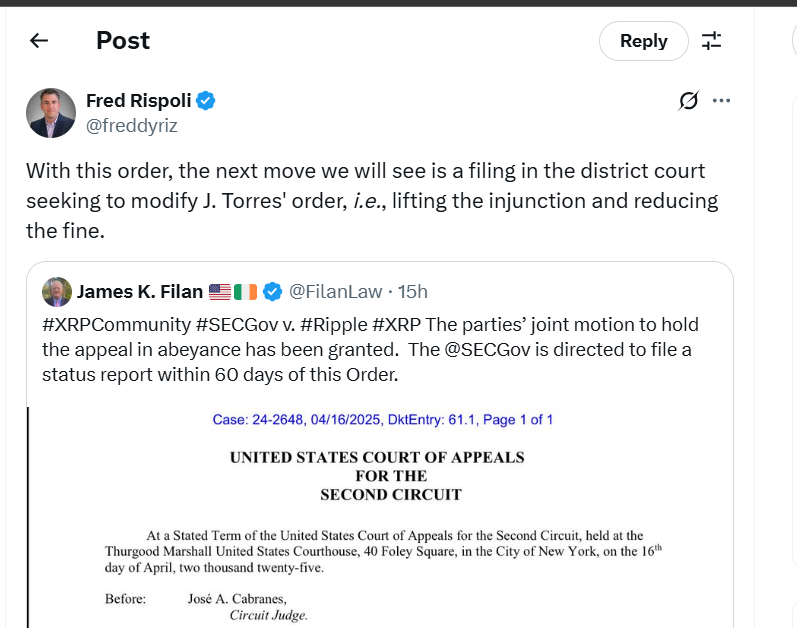
Примечательно, что суд обязал SEC подать отчет о состоянии дела в течение 60 дней с момента вынесения постановления, которое было вынесено 16 апреля. Отчет, который, как ожидается, будет подан не позднее 15 июня, предоставит суду обновленную информацию о том, урегулировали ли стороны апелляцию или желают продолжить рассмотрение дела.

#XRPCommunity #SECGov против #Ripple #XRP Совместное ходатайство сторон об отсрочке апелляции было удовлетворено. @SECGov предписано подать отчет о статусе в течение 60 дней с момента вынесения этого постановления. pic.twitter.com/mUgEBaJRuU

— Джеймс К. Филан 🇺🇸🇮🇪 (@FilanLaw) 16 апреля 2025 г.

Соглашение все еще требует одобрения SEC

После временной приостановки апелляции SEC должна принять решение о принципиальном соглашении с Ripple для возможного урегулирования.

Стоит отметить, что соглашение касается отмены Комиссией по ценным бумагам и биржам (SEC) постоянного запрета, наложенного федеральным судом Нью-Йорка на институциональные продажи XRP компанией Ripple, и сокращения штрафа со 125 до 50 миллионов долларов.

Чтобы продолжить, комиссары SEC должны одобрить это внутреннее принципиальное соглашение. На данный момент руководство агентства все еще рассматривает эти условия.

Следующий шаг в судебном процессе Ripple

После одобрения стороны совместно представят ходатайство об изменении окончательного решения окружного судьи США Аналисы Торрес. В частности, SEC и Ripple попросят судью Торрес отменить постоянный запрет и сократить штраф до 50 миллионов долларов.

Популярный эксперт в области права, адвокат Фред Рисполи, также разделяет это мнение в ответ на последнее постановление Апелляционного суда второго округа.
Напомним, судья Торрес вынесла постоянный запрет и наложила штраф на Ripple после того, как пришла к выводу, что компания нарушила федеральные законы о ценных бумагах, продавая XRP институциональным клиентам.

Судебный запрет запрещает Ripple заниматься будущими институциональными продажами XRP без получения необходимых исключений от SEC. Однако приказ рассматривался как серьезное ограничение для операций Ripple в США.

Многие предположили, что это может помешать компании эффективно обслуживать клиентов с помощью ее платежного решения, которое использует XRP для трансграничных платежей. Поэтому Ripple добивалась отмены судебного запрета и выплаты уменьшенного штрафа.

Примечательно, что адвокат Рисполи предсказал, что иск Ripple будет полностью урегулирован до 25 мая, что потенциально положит конец делу, начатому в декабре 2020 года.


Lecturas Relacionadas

Li Fei-Fei's Latest Long-Form Article: When Video Generation, Robotics, and NVIDIA All Call Themselves World Models, We Need a Taxonomy

In a new article, Dr. Fei-Fei Li addresses the widespread and often inconsistent use of the term "world model" in AI. She proposes a clear, functional taxonomy rooted in the classic Partially Observable Markov Decision Process (POMDP) loop (agent → action → state → observation → agent). According to this framework, current systems called "world models" are different projections of this loop, categorized by their primary output: 1. **Renderers**: Output observations (pixels). Their goal is visual fidelity for human consumption (e.g., video generation models like Sora). They are the most commercially mature but are limited by a focus on appearance over physical accuracy. 2. **Simulators**: Output states (geometric, physical, dynamic representations). They provide a structurally accurate world for both human professionals (e.g., architects) and computational agents (e.g., robots for training). Li argues simulators are the crucial, underappreciated bridge, as they can underpin both rendering and planning. 3. **Planners**: Output actions. Given an observation and a goal, they decide what an agent should do next (e.g., robotic action models). This area is highly promising but remains the least mature for real-world deployment. Li highlights a key trend: the boundaries between these three categories are beginning to blur, as they all rely on a shared underlying understanding of geometry, physics, and dynamics. The logical endpoint is a unified world foundation model capable of switching between rendering, simulation, and planning based on downstream needs. This convergence, she concludes, is central to advancing spatial intelligence—enabling machines not just to talk about the world, but to truly understand, imagine, and interact with it.

marsbitHace 4 hora(s)

Li Fei-Fei's Latest Long-Form Article: When Video Generation, Robotics, and NVIDIA All Call Themselves World Models, We Need a Taxonomy

marsbitHace 4 hora(s)

Forbes Feature: Stablecoin Cross-Border Payments Are Faster, But Not Yet Cheaper

A Forbes feature delves into the state of stablecoin-based cross-border payments, noting rapid growth but a key shortfall: while faster and more accessible, they are not yet cheaper. At a recent industry conference in Mexico City, optimism about technology, regulation, and volume was tempered by discussions with practitioners. The core issue is liquidity. Traditional FX brokers charge 60-70 basis points, and stablecoins promise to slash this to 2-5 basis points. However, this theoretical cost advantage cannot be realized until deep liquidity pools are established at scale, requiring significant institutional capital inflow. A major adoption barrier is trust. Businesses often rely on long-standing relationships with traditional brokers, valuing reliability over marginal cost savings. This shift will be gradual. Furthermore, successful companies in the space are not positioning themselves as replacements for legacy systems like SWIFT, but as complements. They leverage stablecoins for speed while using traditional rails for their standardization and reliability in ensuring accurate payment details—a critical factor for supplier payments to avoid customs issues. Companies like Caliza, experiencing high monthly growth, exemplify this hybrid approach. The industry anticipates consolidation, as long-term viability will depend on securing the essential trifecta: proper licensing, robust fiat on/off-ramps, and deep liquidity. Without these, firms risk being mere intermediaries rather than building sustainable businesses.

marsbitHace 4 hora(s)

Forbes Feature: Stablecoin Cross-Border Payments Are Faster, But Not Yet Cheaper

marsbitHace 4 hora(s)

Trading

Spot
活动图片