FOX Journalist Slams Ripple: $10 Billion CEO, But No Financials

bitcoinistPublicado a 2025-03-22Actualizado a 2025-03-22

Resumen

In a post on X, Fox Business reporter Charles Gasparino has raised questions about Ripple and its CEO Brad Garlinghouse....

Trusted Editorial content, reviewed by leading industry experts and seasoned editors. Ad Disclosure

In a post on X, Fox Business reporter Charles Gasparino has raised questions about Ripple and its CEO Brad Garlinghouse. According to Gasparino, Garlinghouse may now be worth an estimated $10 billion—yet the firm’s financial disclosures remain largely concealed from public view.

Ripple CEO Faces Scrutiny

“With the recent price surge in XRP, the net worth of Brad Garlinghouse, Ripple’s CEO, is around $10 billion, making him one of the richest people in the country,” Gasparino wrote. “And yet, why hasn’t anyone seen a public filing from Ripple about just how much money the company makes? Ripple is a business after all, in the traditional sense. It is not a blockchain experiment.”

He further hinted that this lack of transparency could become a pivotal issue for Paul Atkins, the former SEC Commissioner who has been nominated by President Donald Trump to lead the US Securities and Exchange Commission (SEC). Atkins is scheduled to appear before the Senate Banking Committee on March 27, 2025, for his confirmation hearing, where he is expected to face lawmakers like US Senator Elizabeth Warren.

“That’s going to be the key question for Paul Atkins and the SEC on the Ripple case going forward. Retail trading of XRP passes the decentralization test, according to the SEC. But there’s no doubt it was used to build the Ripple platform, which is a business. Under securities laws, that usually mandates disclosures of financials. This could come up during Atkins confirmation hearing next week from someone like Senator Warren who does know securities laws, I am told,” Gasparino wrote.

Garlinghouse and Ripple, for their part, have not publicly commented on Gasparino’s remarks. While the company is known for releasing quarterly XRP Markets Reports detailing its token holdings and the status of certain escrow accounts, it does not publish comprehensive financial statements like public companies do. Because the firm is privately held, US securities law does not require it to submit filings such as 10-Ks or 10-Qs.

Gasparino’s posts arrive amid another significant legal development for Ripple. Just this week, Garlinghouse revealed that the US Securities and Exchange Commission ended its appeal of Judge Analisa Torres’s July 2023 ruling in Manhattan, which found that XRP sold on public exchanges does not meet the legal definition of a security.

Senator Elizabeth Warren, widely considered a critic of cryptocurrency, is seen as a potential linchpin in the upcoming confirmation hearing. Gasparino noted that the Massachusetts senator may press Atkins to address whether Ripple, as a private company issuing a token integral to its operations, must disclose traditional financials under securities laws.

If Garlinghouse’s net worth truly stands at $10 billion, he would be hovering around the 100th spot on Forbes’ US wealth rankings, fueled largely by the rise in XRP’s market value. Ripple’s token, initially allocated at 100 billion units, has sparked repeated questions over the years about how profits flow to corporate leadership and early founders.

While public records are sparse, court documents in the SEC’s lawsuit against Ripple shed some light on Garlinghouse’s personal sales of XRP. Between 2017 and 2020, Garlinghouse sold an estimated $164.26 million worth of XRP, with more than 90% of the sales conducted on foreign exchanges. The highest single-year sale occurred in 2017, netting around $42.27 million in one self-directed transaction via Bitstamp.

Chris Larsen, Ripple’s executive chairman and co-founder, reportedly accounted for the remaining portion of the $600 million in personal, unregistered XRP sales cited in the SEC lawsuit. Meanwhile, the initial founders—Arthur Britto, Jed McCaleb, and Larsen—collectively received 20 billion XRP when the token was created. Ripple later locked 55 billion XRP in escrow in 2017, aiming to provide predictability around token supply.

At press time, XRP traded at $2.41.

XRP price
XRP is squeezed between trend line and 0.382 Fib, 1-day chart | Source: XRPUSDT on TradingView.com
Featured image from YouTube, chart from TradingView.com
Editorial Process for bitcoinist is centered on delivering thoroughly researched, accurate, and unbiased content. We uphold strict sourcing standards, and each page undergoes diligent review by our team of top technology experts and seasoned editors. This process ensures the integrity, relevance, and value of our content for our readers.

Jake Simmons has been a Bitcoin enthusiast since 2016. Ever since he heard about Bitcoin, he has been studying the topic every day and trying to share his knowledge with others. His goal is to contribute to Bitcoin's financial revolution, which will replace the fiat money system. Besides BTC and crypto, Jake studied Business Informatics at a university. After graduation in 2017, he has been working in the blockchain and crypto sector. You can follow Jake on Twitter at @realJakeSimmons.

Lecturas Relacionadas

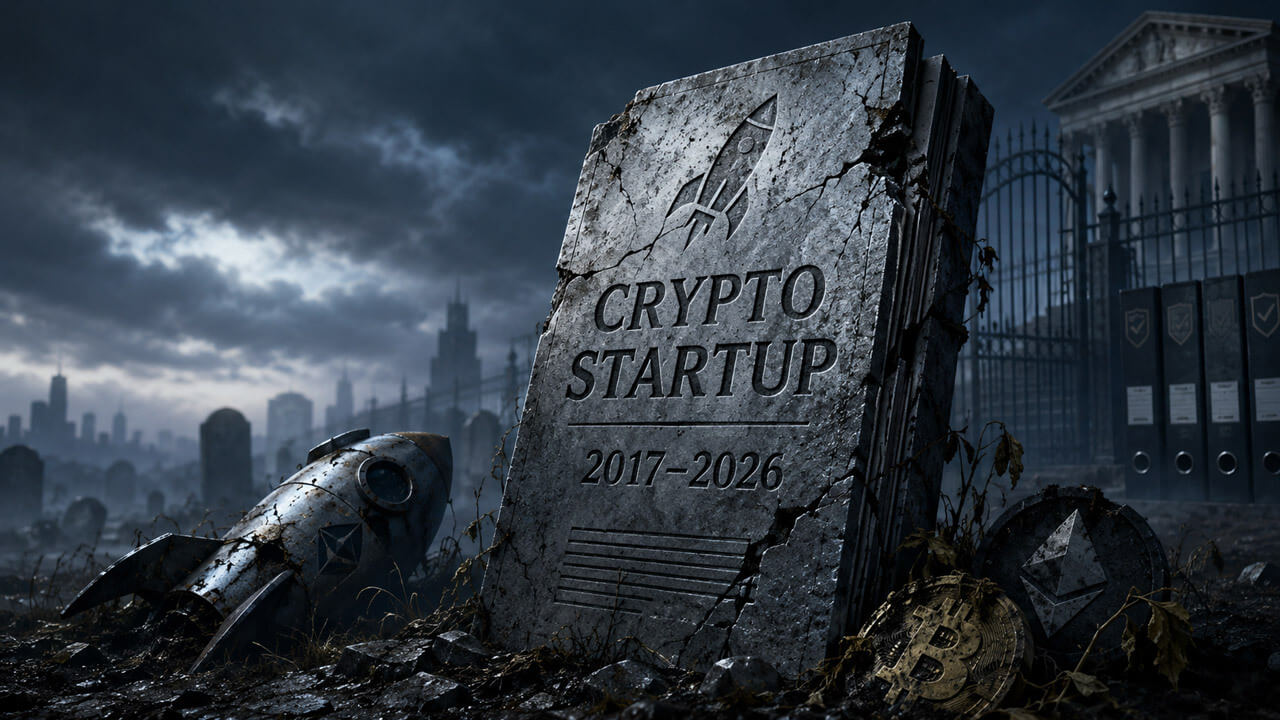
A Decade of Change: The Demise of Crypto Startups

"The Decade-Long Transformation: The Demise of Crypto Startups" The article traces the dramatic evolution of the cryptocurrency industry from its anarchic beginnings to its current highly regulated and institutionalized state. In the early days (circa 2017), launching a crypto startup was remarkably simple: a whitepaper, a GitHub repository, and a Telegram group could attract thousands of retail investors via an Initial Coin Offering (ICO). Founders operated anonymously with near-zero regulatory and financial barriers, enabling rapid, global innovation but also widespread fraud. By 2026, the landscape is fundamentally different. To operate in major markets like the US, EU, and Asia, crypto businesses must now navigate a complex web of regulations akin to traditional finance. Compliance costs are prohibitive: estimates for a US multi-state operation range from $750,000 to $1.2 million in the first three years, with annual costs exceeding $2 million thereafter. Regulations like MiCA in the EU and New York's BitLicense have created high capital and operational hurdles that act as barriers to entry. Simultaneously, venture capital investment has shifted dramatically. Following the collapses of Terra and FTX, funding has concentrated in later-stage, established companies, creating a "barbell market." Early-stage and seed funding has shrunk significantly, while mega-funds like Andreessen Horowitz's $15 billion pool dominate. Most capital now flows to trading platforms, lending infrastructure, and B2B services. This environment favors mergers and acquisitions as the primary path for growth. Companies like Coinbase and Ripple are acquiring firms like Deribit and Hidden Road not for their technology, but for their licenses, banking relationships, and institutional trust—assets far more valuable than code. Distribution channels, compliance, and brand reputation have become the new moats, overshadowing pure technical innovation. The industry's maturation brings benefits: reduced scams, increased institutional participation, and clearer regulatory frameworks. However, it comes at a cost. The low-barrier, experimental ethos that defined crypto's first decade is fading. Entrepreneurs without substantial capital, pre-existing licenses, or institutional connections face immense challenges. Funding for exploratory fields like decentralized social media or novel governance models is drying up. Ultimately, the crypto industry is replicating the consolidation pattern seen in banking and tech after the 2008 financial crisis. While this brings stability and legitimacy, it raises a critical question: in this new, resource-intensive reality, is there still room for the disruptive, from-scratch innovation that gave birth to the sector?

Foresight NewsHace 57 min(s)

A Decade of Change: The Demise of Crypto Startups

Foresight NewsHace 57 min(s)

Trading

Spot
活动图片