Биткоин может восстановиться до $90 тыс на фоне ослабления опасений по поводу инфляции после заседания FOMC

cryptonews.ruPublicado a 2024-11-20Actualizado a 2025-03-20

Биткоин может восстановиться выше ключевой психологической отметки $90 000 на фоне ослабления опасений по поводу денежной инфляции в крупнейшей экономике мира.

Более чем двухмесячный нисходящий тренд биткоина вызвал многочисленные опасения, что текущий бычий цикл биткоина может закончиться, что противоречит теории четырехлетнего рыночного цикла.

Несмотря на широко распространенные опасения инвесторов, биткоин может быть на пути к восстановлению выше $90 000 из-за ослабления опасений по поводу инфляции в Соединенных Штатах, по словам Маркуса Тилена, генерального директора 10x Research.

«Мы можем увидеть некоторое ралли против тренда, поскольку цены перепроданы, и есть большая вероятность, что ФРС будет умеренно голубиной», — сказал Тилен.

«Это не крупное бычье развитие, а скорее тонкая настройка со стороны политиков. Мы думаем, что BTC будет находиться в более широком диапазоне консолидации, но мы можем торговаться обратно к $90 000», — добавил он.
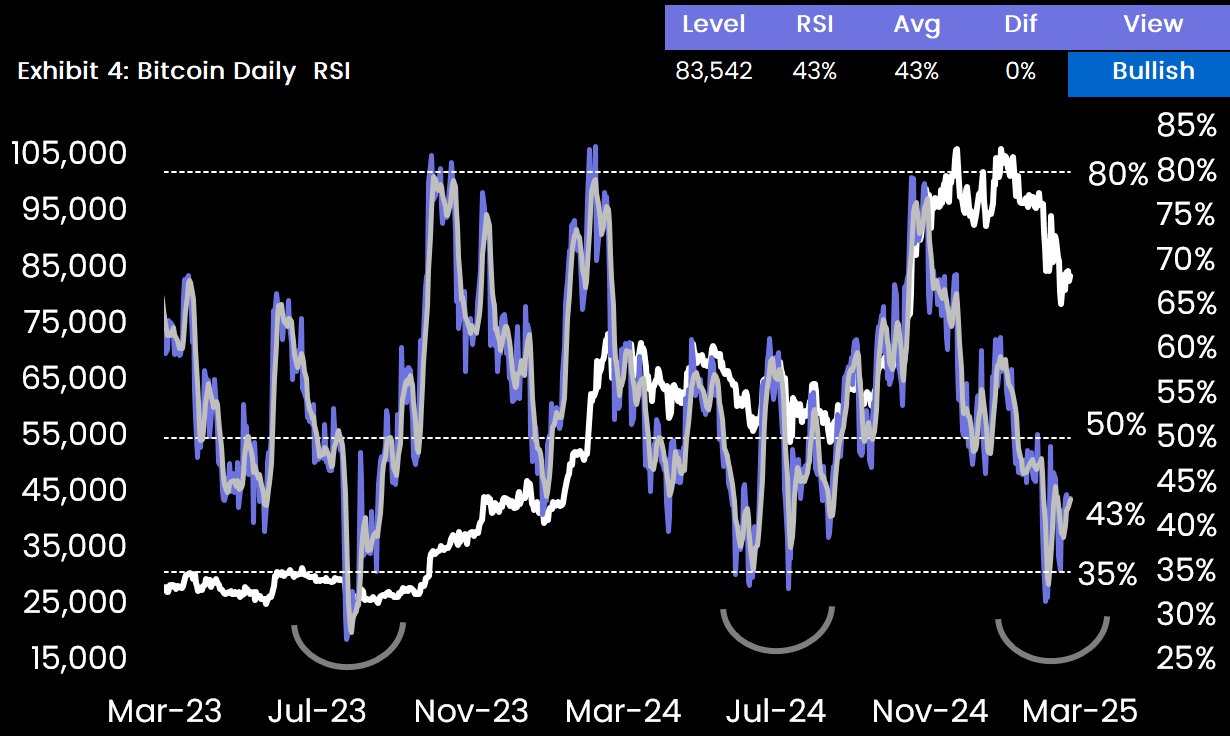

Дневной индикатор RSI биткоина. Источник: 10x Research

Уверенность инвесторов также может повыситься из-за комментариев председателя Федеральной резервной системы Джерома Пауэлла, указывающих на то, что ФРС «останется на месте на фоне растущей неопределенности среди домохозяйств и предприятий», — написала 10x Research в сообщении X от 17 марта.

«Пауэлл также выразил сомнения относительно устойчивого инфляционного воздействия тарифов Трампа, сославшись на сценарий 2019 года, когда инфляция, связанная с тарифами, была временной, и ФРС в конечном итоге снизила ставки три раза», — добавила компания.

Тем временем инвесторы с нетерпением ждут заседания Федерального комитета по открытым рынкам (FOMC) для получения информации о денежно-кредитной политике ФРС на оставшуюся часть 2025 года, что может повлиять на аппетит инвесторов к рискованным активам, таким как биткоин.

Заседание FOMC имеет решающее значение для траектории BTC: аналитик

Трейдеры и инвесторы будут следить за любыми намеками на завершение программы количественного смягчения (QT) ФРС, «шагом, который может повысить ликвидность и рискованные активы», по словам Ильи Калчева, аналитика по распределению на платформе инвестиций в цифровые активы Nexo.

«Предстоящее решение ФРС может стать основным катализатором дальнейших движений», — сказал аналитик.

«Если председатель Пауэлл расправит свои голубиные крылья, биткоин может взлететь на обновленном бычьем импульсе», — добавил он.

«Однако сохраняющиеся опасения по поводу инфляции или подтверждение жестких финансовых условий, таких как повышенные процентные ставки или продолжающееся ужесточение ликвидности, могут ограничить потенциал роста», — пояснил аналитик.
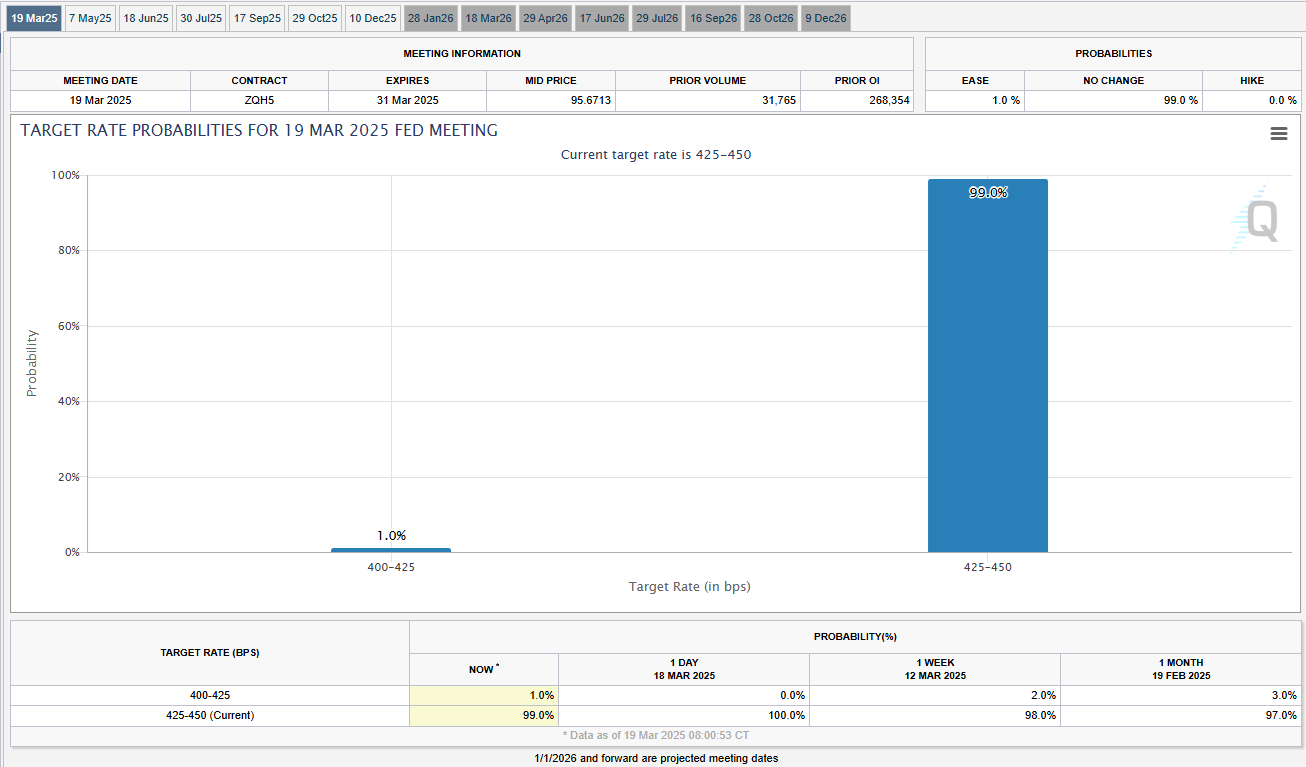

Вероятность целевых процентных ставок ФРС. Источник: инструмент FedWatch от CME Group

В настоящее время рынки оценивают вероятность того, что ФРС сохранит процентные ставки на прежнем уровне, 99%, согласно последним оценкам инструмента FedWatch от CME Group.

Тем не менее, инвесторы сократили свои вложения в американские акции на рекордные 40 процентных пунктов в период с февраля по март, согласно последнему опросу Bank of America, что вызывает опасения, что опасения рецессии могут повлиять на ценовую динамику биткоина.


Lecturas Relacionadas

Li Fei-Fei's Latest Long-Form Article: When Video Generation, Robotics, and NVIDIA All Call Themselves World Models, We Need a Taxonomy

In a new article, Dr. Fei-Fei Li addresses the widespread and often inconsistent use of the term "world model" in AI. She proposes a clear, functional taxonomy rooted in the classic Partially Observable Markov Decision Process (POMDP) loop (agent → action → state → observation → agent). According to this framework, current systems called "world models" are different projections of this loop, categorized by their primary output: 1. **Renderers**: Output observations (pixels). Their goal is visual fidelity for human consumption (e.g., video generation models like Sora). They are the most commercially mature but are limited by a focus on appearance over physical accuracy. 2. **Simulators**: Output states (geometric, physical, dynamic representations). They provide a structurally accurate world for both human professionals (e.g., architects) and computational agents (e.g., robots for training). Li argues simulators are the crucial, underappreciated bridge, as they can underpin both rendering and planning. 3. **Planners**: Output actions. Given an observation and a goal, they decide what an agent should do next (e.g., robotic action models). This area is highly promising but remains the least mature for real-world deployment. Li highlights a key trend: the boundaries between these three categories are beginning to blur, as they all rely on a shared underlying understanding of geometry, physics, and dynamics. The logical endpoint is a unified world foundation model capable of switching between rendering, simulation, and planning based on downstream needs. This convergence, she concludes, is central to advancing spatial intelligence—enabling machines not just to talk about the world, but to truly understand, imagine, and interact with it.

marsbitHace 47 min(s)

Li Fei-Fei's Latest Long-Form Article: When Video Generation, Robotics, and NVIDIA All Call Themselves World Models, We Need a Taxonomy

marsbitHace 47 min(s)

Forbes Feature: Stablecoin Cross-Border Payments Are Faster, But Not Yet Cheaper

A Forbes feature delves into the state of stablecoin-based cross-border payments, noting rapid growth but a key shortfall: while faster and more accessible, they are not yet cheaper. At a recent industry conference in Mexico City, optimism about technology, regulation, and volume was tempered by discussions with practitioners. The core issue is liquidity. Traditional FX brokers charge 60-70 basis points, and stablecoins promise to slash this to 2-5 basis points. However, this theoretical cost advantage cannot be realized until deep liquidity pools are established at scale, requiring significant institutional capital inflow. A major adoption barrier is trust. Businesses often rely on long-standing relationships with traditional brokers, valuing reliability over marginal cost savings. This shift will be gradual. Furthermore, successful companies in the space are not positioning themselves as replacements for legacy systems like SWIFT, but as complements. They leverage stablecoins for speed while using traditional rails for their standardization and reliability in ensuring accurate payment details—a critical factor for supplier payments to avoid customs issues. Companies like Caliza, experiencing high monthly growth, exemplify this hybrid approach. The industry anticipates consolidation, as long-term viability will depend on securing the essential trifecta: proper licensing, robust fiat on/off-ramps, and deep liquidity. Without these, firms risk being mere intermediaries rather than building sustainable businesses.

marsbitHace 48 min(s)

Forbes Feature: Stablecoin Cross-Border Payments Are Faster, But Not Yet Cheaper

marsbitHace 48 min(s)

Li Feifei's Latest Article: When Video Generation, Robotics, and NVIDIA All Claim to Have 'World Models,' We Need a Taxonomy

"World Model" has become a widely used yet ambiguous term in AI. Drawing from the classic POMDP framework (agent → action → state → observation), this article proposes a functional taxonomy to clarify the concept. It identifies three distinct types, categorized by their output in the perception-action loop: 1. **Renderers**: Output visual observations (pixels). These models, like advanced video generators, prioritize visual fidelity but often lack underlying physical accuracy. 2. **Simulators**: Output the state of the world (geometry, physics, dynamics). They provide a structurally accurate representation for professionals (e.g., architects) and serve as training environments for robots and AI agents. 3. **Planners**: Output actions. Given an observation and a goal, they determine what an agent should do next, closing the perception-action loop (e.g., vision-language-action models). While renderers are currently the most commercially mature and planners are the most aspirational, the article argues that **simulators are the crucial, underappreciated hub**. By working at the level of geometry and physics, a simulator can project upwards to create visuals for humans and downwards to predict action consequences for agents. The future lies in the convergence of these three functions. Emerging research and products, like World Labs' Marble model which outputs both visual splats and physical collision meshes, are beginning to blur these boundaries. The logical endpoint is a unified world foundation model capable of rendering, simulating, and planning based on a shared understanding of spatial and temporal structures—ultimately enabling machines to understand, imagine, and interact with the physical world.

链捕手Hace 59 min(s)

Li Feifei's Latest Article: When Video Generation, Robotics, and NVIDIA All Claim to Have 'World Models,' We Need a Taxonomy

链捕手Hace 59 min(s)

Trading

Spot
活动图片