Li Feifei's Latest Article: When Video Generation, Robotics, and NVIDIA All Claim to Have 'World Models,' We Need a Taxonomy

链捕手Publicado a 2026-07-05Actualizado a 2026-07-05

Resumen

"World Model" has become a widely used yet ambiguous term in AI. Drawing from the classic POMDP framework (agent → action → state → observation), this article proposes a functional taxonomy to clarify the concept. It identifies three distinct types, categorized by their output in the perception-action loop: 1. **Renderers**: Output visual observations (pixels). These models, like advanced video generators, prioritize visual fidelity but often lack underlying physical accuracy. 2. **Simulators**: Output the state of the world (geometry, physics, dynamics). They provide a structurally accurate representation for professionals (e.g., architects) and serve as training environments for robots and AI agents. 3. **Planners**: Output actions. Given an observation and a goal, they determine what an agent should do next, closing the perception-action loop (e.g., vision-language-action models). While renderers are currently the most commercially mature and planners are the most aspirational, the article argues that **simulators are the crucial, underappreciated hub**. By working at the level of geometry and physics, a simulator can project upwards to create visuals for humans and downwards to predict action consequences for agents. The future lies in the convergence of these three functions. Emerging research and products, like World Labs' Marble model which outputs both visual splats and physical collision meshes, are beginning to blur these boundaries. The logical endpoint is a ...

Author: Li Feifei

Translation: Jiayang

'World model' is probably the hottest and most confusing concept in the AI field since 2025. When Sora emerged, OpenAI called it a world simulator; Genie lets you walk around in generated scenes and is also called a world model; robotics companies say they're working on world models; NVIDIA says Omniverse is the infrastructure for world models; even game engines have been pulled into this narrative. Everyone is using the same term, but they're talking about completely different things.

Today, Li Feifei published a new article on her personal Substack to clarify this concept. She first returns to the most classic diagram in reinforcement learning textbooks (the POMDP closed loop: agent → action → state → observation → agent), then points out that what are now called 'world models' are actually three different projections of this closed loop. Those outputting pixels (observations) are renderers, those outputting states are simulators, and those outputting actions are planners. The classification criteria are very simple: it depends on which part of the loop you output.
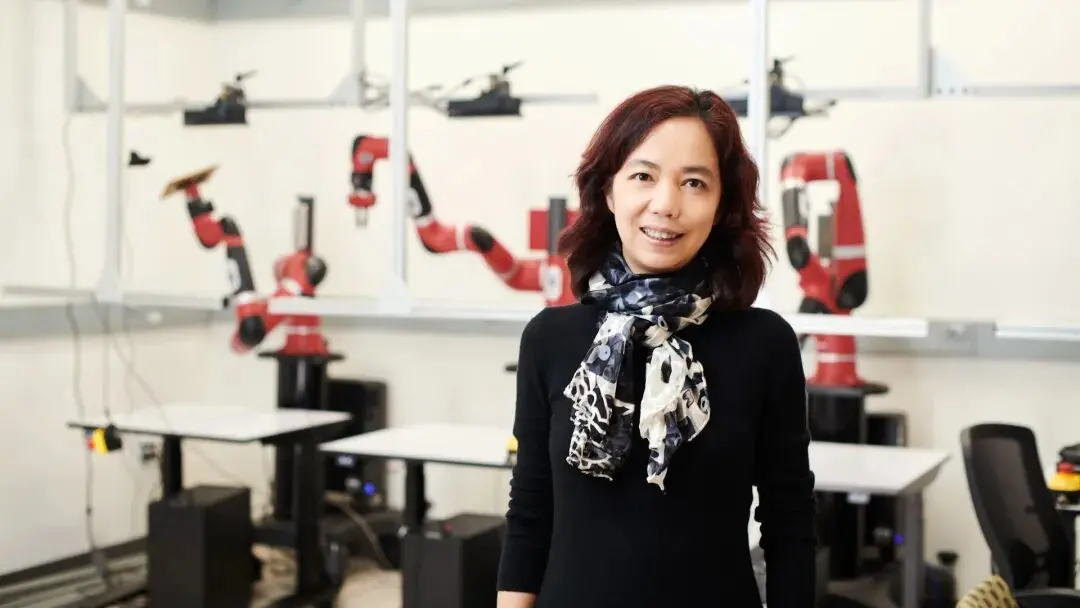
(Source: MIT Technology Review)

She assesses that among the three, renderers are the most commercially mature but have a ceiling (looking good does not equal physical correctness); planners are the most exciting but furthest from real-world deployment (the chasm between lab demos and practical usability remains vast); and simulators are the severely underestimated critical hub. Because simulators operate at the level of geometry, physics, and dynamics, they can project upwards into pixels for human consumption and also derive action consequences downwards for robot use. Mastering simulation simultaneously provides the foundation for rendering and planning; the reverse is not true.

This article is, of course, also a product manifesto for World Labs. Their Marble already outputs both Gaussian splats and collision meshes, attempting to unify renderer and simulator into a single model. The ultimate vision described at the end of the article is a unified world foundation model that can freely switch between rendering, simulation, and planning based on downstream needs. Whether this vision can be realized is another matter, but as an analytical framework, the tripartite classification of renderer/simulator/planner may indeed help cut through some of the noise surrounding the current 'world model' concept.

The full translation follows.

"The world is all that is the case." — Ludwig Wittgenstein, Tractatus Logico-Philosophicus, 1921

The world is not made of words.

In an earlier article, we proposed that spatial intelligence is the next frontier for AI, and world models are the path toward it. Here, the World Labs team and I want to delve one level deeper: among the many things currently labeled as "world models," which functional modules truly constitute this capability, and what are their respective purposes?

Language models have endowed machines with powerful mastery over concepts, vocabulary, and reasoning. But the physical world, whether virtual or real, operates on a completely different substrate. Language models learn the statistical structure of text; world models learn the statistical structure of space and time: how light falls on a surface, what a garden looks like from an angle never captured by a camera, how objects respond to forces and follow physical laws.

This makes "world model" one of the most important and simultaneously most abused terms in today's AI field. Computer vision, robotics, reinforcement learning, and generative AI all claim to be building world models, but each refers to something drastically different. A video model that generates gorgeous but physically impossible flames, a language model that improvises playable games, a physics engine that faithfully simulates a combustion process—they are all called by the same name.

The ancient Greeks could never agree on what the world was made of—be it fire, water, or indivisible atoms—because "the world" has never been a single thing. It has always been a substitute term used by a thinker to reason about a certain totality. AI inherits the same problem, and it happens precisely at the moment when the field needs precision the most.

The Loop Behind the Taxonomy

To clear up this confusion, we can start with a diagram older than all the technologies mentioned above. All reinforcement learning textbooks, including the classic by Sutton and Barto, have used variations of the same diagram for decades to describe how an agent interacts with the world. Its formal name is the Partially Observable Markov Decision Process (POMDP), and the term "world model" was originally defined within this tradition.

An agent (which can be a human, a robot, or a software system) takes an action. These actions change the state of the world. But the agent can never directly see the state itself; what it receives are observations: photons hitting the retina, sensor readings, pixels in a video frame. New observations guide new actions, and the cycle repeats.

The word "state" needs to be unpacked because its meaning shifts across different domains. This is not the chemist's state, not the distinction between solid, liquid, and gas. This is the physicist's and roboticist's state: a complete description of everything happening in the world at a given moment, including every object, every position, every velocity, every property. The state is the underlying reality of the world, in principle complete, but forever unobservable directly by any agent within it. Observations are the agent's partial view of this reality. Actions are the agent's response accordingly.

This closed loop (agent → action → state → observation → agent) is precisely the structure that gives the term "world model" its technical meaning. The phrase itself is even older, traceable to Kenneth Craik's 1943 proposal that the mind reasons by running "small-scale models" of reality, and by the late 1980s and early 1990s, the concept was introduced into neural networks. This loop also explains what people mean when they use the term today. The various things now called world models are actually different projections of the same closed loop, each outputting a different component of the loop.

Three Functions of World Models

The first type of world model is the Renderer. A renderer outputs observations, specifically pixels for the human eye, and the most important quality metric is visual fidelity. A video model that transforms text prompts into cinematic aerial shots is a renderer; interactive systems like Google's Genie 3 or World Labs' own RTFM are also renderers, generating visuals in real-time based on user input. Such models lack an explicit understanding of 3D structure. They generate what a viewer would see, not what things are like in themselves. The building in an aerial shot might look flawless from above, but try navigating the city below, and they will collapse.

The second type is the Simulator. A simulator outputs states: a geometrically, physically, or kinematically faithful representation of the world upon which both humans and computer programs can compute and interact. The renderer's contract is purely visual, while the simulator's contract is structural, demanding geometry that holds up under scrutiny, physics that obey Newton's laws, and dynamics that behave as expected by physical principles. Simulators serve two classes of users. Professionals like architects, designers, filmmakers, and game developers require accuracy beyond visual plausibility. Computer programs like reinforcement learning agents, robot controllers, and autonomous vehicles treat the simulator as a training ground to interact with the world at scale, testing scenarios that are either dangerous, expensive, or simply impossible to execute in reality.

The third type is the Planner. A planner outputs actions. Given an observation and a goal, the planner answers the question: what should the agent do next? In many ways, the planner is the inverse of the renderer. The renderer takes actions as input and produces observations; the planner takes observations as input and produces actions, thereby closing the perception-action loop. Vision-Language-Action models (VLA), model-based systems, and the new wave of World Action Models are all different attempts at planners: enabling systems to decide what a robot should do in an unstructured world.

These three categories cover most of the work currently being implemented, and the distinction is useful in practice. But these categories are not fundamentally separate. They share the same underlying knowledge about how the world works: geometry, physics, dynamics. A model that can render a cup from any angle should, in principle, also be able to simulate what happens if the cup is pushed and plan a hand to pick it up. Increasingly, the most interesting research is deliberately blurring the boundaries between these three.
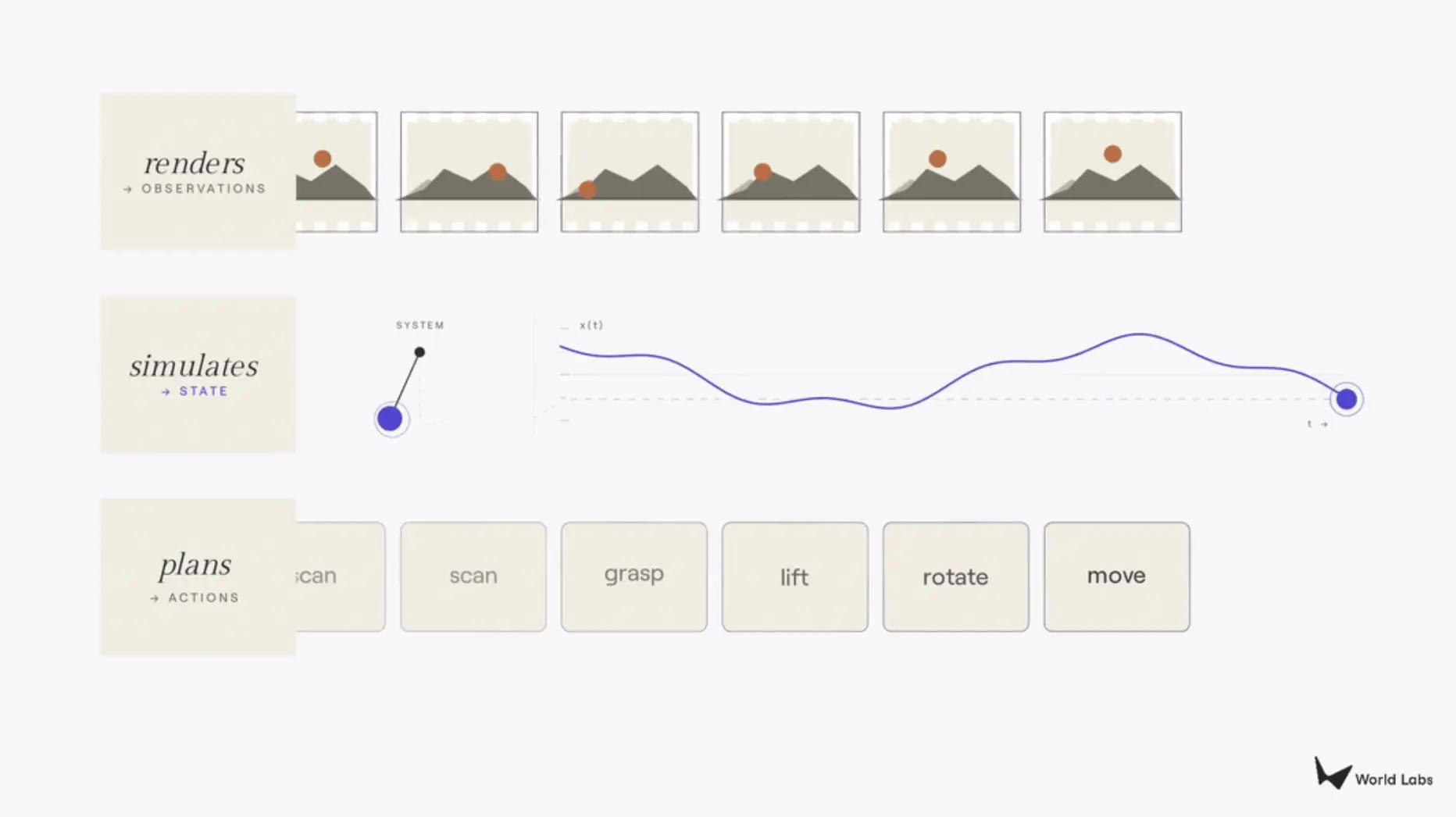
Illustration | Three Types of World Models (Source: Substack)

Why Simulation Is the Key Hub

Among the three categories, simulators receive the least public attention yet are the most important of the three. This article seeks to correct that asymmetry.

Renderers are currently the most commercially mature. Numerous image or text-to-video products are rapidly expanding in consumer and enterprise markets. Google's Nano Banana model has brought renderer-level image generation capabilities to potentially hundreds of millions of users. The technology is real, and the market is real. However, renderers optimize for visual plausibility rather than physical accuracy, and this ceiling is important. Their outputs are beautiful, but you cannot use them to design a building or train a robot.

Planners are the most exciting and least mature, closely tied to the rapidly evolving field of robot learning. The past two years have produced many robot demos that look impressive in videos, but we need to be honest about what these demos actually show. Almost all demos are confined to highly constrained lab environments with limited objects and short task durations. None have been validated against the complexity, diversity, and duration required for real-world deployment. The gap from a stunning demo video to a robot that works reliably in a kitchen, warehouse, or operating room remains vast.

Nevertheless, the scale of commercial bets is substantial. A wave of well-funded new entrants is racing to launch general-purpose planning systems, while large infrastructure players are layering planning capabilities atop broader simulation stacks.

Simulation is the bridge connecting the two. If language is an abstraction of the world and pixels are a projection of the world, then geometry, physics, and dynamics are the world itself. A simulator must operate at this level: it is the structural skeleton from which visual appearances (for renderers) and action consequences (for planners) can both be derived.

A model that masters simulation can project its understanding into pixels for human consumption and into action predictions for embodied agents. A model that masters only rendering or only planning can do neither. The commercial space here is immense. NVIDIA's Omniverse alone, according to the company's estimate, targets a market opportunity exceeding a trillion dollars, covering factories, warehouses, supply chains, and digital twins. Robot training, autonomous vehicle testing, architectural visualization, engineering design, drug discovery—all rely on some form of simulation.

The most difficult open questions in the field are also concentrated here. 3D data with explicit geometry, material properties, and physical annotations is orders of magnitude scarcer than internet videos used for renderer training. The sim-to-real gap (the difference between how objects behave in simulation versus the real world) persists. Generative simulators introduce new risks on top of this: AI-generated geometry might look correct but actually contain self-intersections or incorrect scales, leading to absurd results in physics simulation. The computational cost of large-scale multi-physics simulation (rigid bodies, deformable objects, fluids, cloth all interacting simultaneously) remains orders of magnitude higher than simulation in a single domain.

At World Labs, Marble is our first step in this direction. It takes multimodal input (text, image, video, or spatial sketches) and generates explorable 3D environments, simultaneously outputting Gaussian splats for visual exploration and collision meshes for physics engines. But Marble is only the first chapter of a long arc. As the boundaries between rendering, simulation, and planning begin to dissolve, the entire field is writing this story.

The Boundaries Are Blurring, and What Comes Next

The most important trend in the field right now is that the three categories are beginning to merge. The underlying consensus is that the knowledge required to render a world, simulate it, and act within it is largely the same. Continuing with the previous example, a model that truly understands how a cup sits on a table (its geometry, material properties, response to forces, etc.) should be able to render that cup from any angle, simulate what happens if the cup is pushed, and plan a hand to pick it up. The three categories are three projections of the same underlying understanding.

For instance, a small but growing body of work from various robotics labs has recently shown the possibility, at least conceptually, that a pre-trained video renderer can serve as the backbone for joint world prediction and action prediction, allowing a single model to simultaneously imagine "what will happen" and "what to do," thus bridging renderers and planners. World Labs' Marble can already output both Gaussian splats and collision meshes from a single model, dissolving the boundary between renderer and simulator. At every level, the move is from passive output to interactive systems: renderers become responsive to action conditioning, simulators generate worlds that are more controllable and editable, and planners begin deliberative reasoning rather than merely reacting.

The logical endpoint is a unified world model: a foundation model capable of rendering photorealistic views, generating physically accurate structures, planning action sequences, and switching between different output modalities based on the needs of downstream users. We will still face a series of formidable challenges. The data landscape is extremely uneven, with renderers sitting on vast amounts of internet video, while simulators and planners face severe shortages of 3D assets and robot demonstration data. Optimization for visual beauty may come at the expense of precision needed for robotics or high-fidelity simulation. Reconciling these tensions within a single architecture is the central open problem in world model research today, and what World Labs is committed to solving as Marble continues to evolve.
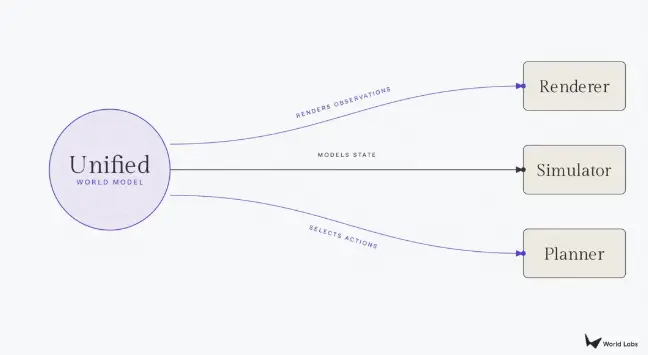
(Source: Substack)

But the overall direction is clear. From the late 1980s to today, the field's bet has always been the same: that if the world model is rich enough, everything an agent needs to see the world, build it, and act within it is contained therein. This bet is now driving a generation of research. And what truly gives it weight is the already-occurring convergence: the three threads of rendering, simulation, and planning, each already supporting industries worth billions, started as independent research directions and are now beginning to merge. When the boundaries disappear, the confluence of the three will redefine something larger: the relationship between machine intelligence and the physical world it inhabits, which is the long-term trajectory of spatial intelligence.

Language has given machines a way to talk about the world. World models are the path by which machines finally come to understand, imagine, reason, and interact with it.

Reference: 1.https://drfeifei.substack.com/p/a-functional-taxonomy-of-world-models

Criptos en tendencia

Preguntas relacionadas

QAccording to Fei-Fei Li's article, what are the three main functional categories of 'world models' in AI, and what do they primarily output?

AAccording to Fei-Fei Li, the three functional categories are: 1. Renderers, which output observations (e.g., pixels for human consumption). 2. Simulators, which output the world's state (a geometrically, physically accurate representation). 3. Planners, which output actions (deciding what an agent should do next).

QWhy does the article argue that the simulator is the 'key hub' among the three categories of world models?

AThe article argues the simulator is the key hub because it works at the foundational level of geometry, physics, and dynamics—the 'skeleton' of the world. From an accurate simulation, one can derive visual outputs for renderers and action consequences for planners, but a model that only knows rendering or planning cannot achieve the other.

QWhat is the POMDP loop, and how does it provide the framework for defining the different types of world models?

AThe POMDP (Partially Observable Markov Decision Process) loop describes an agent taking an action, which changes the world's state. The agent then receives an observation (a partial view of the state), which informs its next action. World models are different projections of this loop: renderers output observations, simulators output states, and planners output actions.

QWhat is the main limitation of current renderer-type world models, despite their commercial maturity?

AThe main limitation is that they optimize for visual fidelity, not physical accuracy. Their output can look beautiful but may not be physically correct, making them unsuitable for tasks like architectural design or training robots, which require structural and physical correctness.

QWhat is the 'logical end point' or ultimate vision for world models described in the article, and what is a key challenge in achieving it?

AThe ultimate vision is a unified world foundation model capable of rendering photorealistic views, generating physically accurate structures, and planning action sequences, switching between these outputs based on downstream needs. A key challenge is the extremely uneven data landscape, with abundant internet video for renderers but severe scarcity of high-quality 3D and robotics demonstration data for simulators and planners.

Lecturas Relacionadas

Li Fei-Fei's Latest Long-Form Article: When Video Generation, Robotics, and NVIDIA All Call Themselves World Models, We Need a Taxonomy

In a new article, Dr. Fei-Fei Li addresses the widespread and often inconsistent use of the term "world model" in AI. She proposes a clear, functional taxonomy rooted in the classic Partially Observable Markov Decision Process (POMDP) loop (agent → action → state → observation → agent). According to this framework, current systems called "world models" are different projections of this loop, categorized by their primary output: 1. **Renderers**: Output observations (pixels). Their goal is visual fidelity for human consumption (e.g., video generation models like Sora). They are the most commercially mature but are limited by a focus on appearance over physical accuracy. 2. **Simulators**: Output states (geometric, physical, dynamic representations). They provide a structurally accurate world for both human professionals (e.g., architects) and computational agents (e.g., robots for training). Li argues simulators are the crucial, underappreciated bridge, as they can underpin both rendering and planning. 3. **Planners**: Output actions. Given an observation and a goal, they decide what an agent should do next (e.g., robotic action models). This area is highly promising but remains the least mature for real-world deployment. Li highlights a key trend: the boundaries between these three categories are beginning to blur, as they all rely on a shared underlying understanding of geometry, physics, and dynamics. The logical endpoint is a unified world foundation model capable of switching between rendering, simulation, and planning based on downstream needs. This convergence, she concludes, is central to advancing spatial intelligence—enabling machines not just to talk about the world, but to truly understand, imagine, and interact with it.

marsbitHace 1 hora(s)

Li Fei-Fei's Latest Long-Form Article: When Video Generation, Robotics, and NVIDIA All Call Themselves World Models, We Need a Taxonomy

marsbitHace 1 hora(s)

Forbes Feature: Stablecoin Cross-Border Payments Are Faster, But Not Yet Cheaper

A Forbes feature delves into the state of stablecoin-based cross-border payments, noting rapid growth but a key shortfall: while faster and more accessible, they are not yet cheaper. At a recent industry conference in Mexico City, optimism about technology, regulation, and volume was tempered by discussions with practitioners. The core issue is liquidity. Traditional FX brokers charge 60-70 basis points, and stablecoins promise to slash this to 2-5 basis points. However, this theoretical cost advantage cannot be realized until deep liquidity pools are established at scale, requiring significant institutional capital inflow. A major adoption barrier is trust. Businesses often rely on long-standing relationships with traditional brokers, valuing reliability over marginal cost savings. This shift will be gradual. Furthermore, successful companies in the space are not positioning themselves as replacements for legacy systems like SWIFT, but as complements. They leverage stablecoins for speed while using traditional rails for their standardization and reliability in ensuring accurate payment details—a critical factor for supplier payments to avoid customs issues. Companies like Caliza, experiencing high monthly growth, exemplify this hybrid approach. The industry anticipates consolidation, as long-term viability will depend on securing the essential trifecta: proper licensing, robust fiat on/off-ramps, and deep liquidity. Without these, firms risk being mere intermediaries rather than building sustainable businesses.

marsbitHace 1 hora(s)

Forbes Feature: Stablecoin Cross-Border Payments Are Faster, But Not Yet Cheaper

marsbitHace 1 hora(s)

Trading

Spot

Artículos destacados

Qué es $S$

Entendiendo SPERO: Una Visión General Completa Introducción a SPERO A medida que el panorama de la innovación continúa evolucionando, la aparición de tecnologías web3 y proyectos de criptomonedas juega un papel fundamental en la configuración del futuro digital. Un proyecto que ha atraído la atención en este campo dinámico es SPERO, denotado como SPERO,$$s$. Este artículo tiene como objetivo reunir y presentar información detallada sobre SPERO, para ayudar a entusiastas e inversores a comprender sus fundamentos, objetivos e innovaciones dentro de los dominios web3 y cripto. ¿Qué es SPERO,$$s$? SPERO,$$s$ es un proyecto único dentro del espacio cripto que busca aprovechar los principios de descentralización y tecnología blockchain para crear un ecosistema que promueva la participación, la utilidad y la inclusión financiera. El proyecto está diseñado para facilitar interacciones de igual a igual de nuevas maneras, proporcionando a los usuarios soluciones y servicios financieros innovadores. En su esencia, SPERO,$$s$ tiene como objetivo empoderar a los individuos al proporcionar herramientas y plataformas que mejoren la experiencia del usuario en el espacio de las criptomonedas. Esto incluye habilitar métodos de transacción más flexibles, fomentar iniciativas impulsadas por la comunidad y crear caminos para oportunidades financieras a través de aplicaciones descentralizadas (dApps). La visión subyacente de SPERO,$$s$ gira en torno a la inclusividad, buscando cerrar brechas dentro de las finanzas tradicionales mientras aprovecha los beneficios de la tecnología blockchain. ¿Quién es el Creador de SPERO,$$s$? La identidad del creador de SPERO,$$s$ sigue siendo algo oscura, ya que hay recursos públicos limitados que proporcionan información de fondo detallada sobre su(s) fundador(es). Esta falta de transparencia puede derivarse del compromiso del proyecto con la descentralización, una ética que muchos proyectos web3 comparten, priorizando las contribuciones colectivas sobre el reconocimiento individual. Al centrar las discusiones en torno a la comunidad y sus objetivos colectivos, SPERO,$$s$ encarna la esencia del empoderamiento sin señalar a individuos específicos. Como tal, comprender la ética y la misión de SPERO sigue siendo más importante que identificar a un creador singular. ¿Quiénes son los Inversores de SPERO,$$s$? SPERO,$$s$ cuenta con el apoyo de una diversa gama de inversores que van desde capitalistas de riesgo hasta inversores ángeles dedicados a fomentar la innovación en el sector cripto. El enfoque de estos inversores generalmente se alinea con la misión de SPERO, priorizando proyectos que prometen avances tecnológicos sociales, inclusión financiera y gobernanza descentralizada. Estas fundaciones de inversores suelen estar interesadas en proyectos que no solo ofrecen productos innovadores, sino que también contribuyen positivamente a la comunidad blockchain y sus ecosistemas. El respaldo de estos inversores refuerza a SPERO,$$s$ como un contendiente notable en el dominio de proyectos cripto que evoluciona rápidamente. ¿Cómo Funciona SPERO,$$s$? SPERO,$$s$ emplea un marco multifacético que lo distingue de los proyectos de criptomonedas convencionales. Aquí hay algunas de las características clave que subrayan su singularidad e innovación: Gobernanza Descentralizada: SPERO,$$s$ integra modelos de gobernanza descentralizada, empoderando a los usuarios para participar activamente en los procesos de toma de decisiones sobre el futuro del proyecto. Este enfoque fomenta un sentido de propiedad y responsabilidad entre los miembros de la comunidad. Utilidad del Token: SPERO,$$s$ utiliza su propio token de criptomoneda, diseñado para servir diversas funciones dentro del ecosistema. Estos tokens permiten transacciones, recompensas y la facilitación de servicios ofrecidos en la plataforma, mejorando la participación y la utilidad general. Arquitectura en Capas: La arquitectura técnica de SPERO,$$s$ apoya la modularidad y escalabilidad, permitiendo la integración fluida de características y aplicaciones adicionales a medida que el proyecto evoluciona. Esta adaptabilidad es fundamental para mantener la relevancia en el cambiante paisaje cripto. Participación de la Comunidad: El proyecto enfatiza iniciativas impulsadas por la comunidad, empleando mecanismos que incentivan la colaboración y la retroalimentación. Al nutrir una comunidad sólida, SPERO,$$s$ puede abordar mejor las necesidades de los usuarios y adaptarse a las tendencias del mercado. Enfoque en la Inclusión: Al ofrecer tarifas de transacción bajas e interfaces amigables para el usuario, SPERO,$$s$ busca atraer a una base de usuarios diversa, incluyendo a individuos que anteriormente pueden no haber participado en el espacio cripto. Este compromiso con la inclusión se alinea con su misión general de empoderamiento a través de la accesibilidad. Cronología de SPERO,$$s$ Entender la historia de un proyecto proporciona información crucial sobre su trayectoria de desarrollo y hitos. A continuación se presenta una cronología sugerida que mapea eventos significativos en la evolución de SPERO,$$s$: Fase de Conceptualización e Ideación: Las ideas iniciales que forman la base de SPERO,$$s$ fueron concebidas, alineándose estrechamente con los principios de descentralización y enfoque comunitario dentro de la industria blockchain. Lanzamiento del Whitepaper del Proyecto: Tras la fase conceptual, se lanzó un whitepaper completo que detalla la visión, los objetivos y la infraestructura tecnológica de SPERO,$$s$ para generar interés y retroalimentación de la comunidad. Construcción de Comunidad y Primeras Interacciones: Se realizaron esfuerzos de divulgación activa para construir una comunidad de primeros adoptantes y posibles inversores, facilitando discusiones en torno a los objetivos del proyecto y obteniendo apoyo. Evento de Generación de Tokens: SPERO,$$s$ llevó a cabo un evento de generación de tokens (TGE) para distribuir sus tokens nativos a los primeros seguidores y establecer liquidez inicial dentro del ecosistema. Lanzamiento de la dApp Inicial: La primera aplicación descentralizada (dApp) asociada con SPERO,$$s$ se puso en marcha, permitiendo a los usuarios interactuar con las funcionalidades centrales de la plataforma. Desarrollo Continuo y Alianzas: Actualizaciones y mejoras continuas a las ofertas del proyecto, incluyendo alianzas estratégicas con otros actores en el espacio blockchain, han moldeado a SPERO,$$s$ en un jugador competitivo y en evolución en el mercado cripto. Conclusión SPERO,$$s$ se erige como un testimonio del potencial de web3 y las criptomonedas para revolucionar los sistemas financieros y empoderar a los individuos. Con un compromiso con la gobernanza descentralizada, la participación comunitaria y funcionalidades diseñadas de manera innovadora, allana el camino hacia un paisaje financiero más inclusivo. Como con cualquier inversión en el espacio cripto que evoluciona rápidamente, se anima a los posibles inversores y usuarios a investigar a fondo y participar de manera reflexiva con los desarrollos en curso dentro de SPERO,$$s$. El proyecto muestra el espíritu innovador de la industria cripto, invitando a una mayor exploración de sus innumerables posibilidades. Mientras el viaje de SPERO,$$s$ aún se desarrolla, sus principios fundamentales pueden, de hecho, influir en el futuro de cómo interactuamos con la tecnología, las finanzas y entre nosotros en ecosistemas digitales interconectados.

111 Vistas totalesPublicado en 2024.12.17Actualizado en 2024.12.17

Qué es $S$

Qué es AGENT S

Agent S: El Futuro de la Interacción Autónoma en Web3 Introducción En el paisaje en constante evolución de Web3 y las criptomonedas, las innovaciones están redefiniendo constantemente cómo los individuos interactúan con las plataformas digitales. Uno de estos proyectos pioneros, Agent S, promete revolucionar la interacción humano-computadora a través de su marco agente abierto. Al allanar el camino para interacciones autónomas, Agent S busca simplificar tareas complejas, ofreciendo aplicaciones transformadoras en inteligencia artificial (IA). Esta exploración detallada profundizará en las complejidades del proyecto, sus características únicas y las implicaciones para el dominio de las criptomonedas. ¿Qué es Agent S? Agent S se presenta como un marco agente abierto innovador, diseñado específicamente para abordar tres desafíos fundamentales en la automatización de tareas informáticas: Adquisición de Conocimiento Específico del Dominio: El marco aprende inteligentemente de diversas fuentes de conocimiento externas y experiencias internas. Este enfoque dual le permite construir un rico repositorio de conocimiento específico del dominio, mejorando su rendimiento en la ejecución de tareas. Planificación a Largo Plazo de Tareas: Agent S emplea planificación jerárquica aumentada por la experiencia, un enfoque estratégico que facilita la descomposición y ejecución eficiente de tareas complejas. Esta característica mejora significativamente su capacidad para gestionar múltiples subtareas de manera eficiente y efectiva. Manejo de Interfaces Dinámicas y No Uniformes: El proyecto introduce la Interfaz Agente-Computadora (ACI), una solución innovadora que mejora la interacción entre agentes y usuarios. Utilizando Modelos de Lenguaje Multimodal de Gran Escala (MLLMs), Agent S puede navegar y manipular diversas interfaces gráficas de usuario sin problemas. A través de estas características pioneras, Agent S proporciona un marco robusto que aborda las complejidades involucradas en la automatización de la interacción humana con las máquinas, preparando el terreno para una multitud de aplicaciones en IA y más allá. ¿Quién es el Creador de Agent S? Si bien el concepto de Agent S es fundamentalmente innovador, la información específica sobre su creador sigue siendo elusiva. El creador es actualmente desconocido, lo que resalta ya sea la etapa incipiente del proyecto o la elección estratégica de mantener a los miembros fundadores en el anonimato. Independientemente de la anonimidad, el enfoque sigue siendo en las capacidades y el potencial del marco. ¿Quiénes son los Inversores de Agent S? Dado que Agent S es relativamente nuevo en el ecosistema criptográfico, la información detallada sobre sus inversores y patrocinadores financieros no está documentada explícitamente. La falta de información disponible públicamente sobre las bases de inversión u organizaciones que apoyan el proyecto plantea preguntas sobre su estructura de financiamiento y hoja de ruta de desarrollo. Comprender el respaldo es crucial para evaluar la sostenibilidad del proyecto y su posible impacto en el mercado. ¿Cómo Funciona Agent S? En el núcleo de Agent S se encuentra una tecnología de vanguardia que le permite funcionar de manera efectiva en diversos entornos. Su modelo operativo se basa en varias características clave: Interacción Humano-Computadora Similar a la Humana: El marco ofrece planificación avanzada de IA, esforzándose por hacer que las interacciones con las computadoras sean más intuitivas. Al imitar el comportamiento humano en la ejecución de tareas, promete elevar las experiencias de los usuarios. Memoria Narrativa: Empleada para aprovechar experiencias de alto nivel, Agent S utiliza memoria narrativa para hacer un seguimiento de las historias de tareas, mejorando así sus procesos de toma de decisiones. Memoria Episódica: Esta característica proporciona a los usuarios una guía paso a paso, permitiendo que el marco ofrezca apoyo contextual a medida que se desarrollan las tareas. Soporte para OpenACI: Con la capacidad de ejecutarse localmente, Agent S permite a los usuarios mantener el control sobre sus interacciones y flujos de trabajo, alineándose con la ética descentralizada de Web3. Fácil Integración con APIs Externas: Su versatilidad y compatibilidad con varias plataformas de IA aseguran que Agent S pueda encajar sin problemas en ecosistemas tecnológicos existentes, convirtiéndolo en una opción atractiva para desarrolladores y organizaciones. Estas funcionalidades contribuyen colectivamente a la posición única de Agent S dentro del espacio cripto, ya que automatiza tareas complejas y de múltiples pasos con una intervención humana mínima. A medida que el proyecto evoluciona, sus posibles aplicaciones en Web3 podrían redefinir cómo se desarrollan las interacciones digitales. Cronología de Agent S El desarrollo y los hitos de Agent S pueden encapsularse en una cronología que resalta sus eventos significativos: 27 de septiembre de 2024: El concepto de Agent S fue lanzado en un documento de investigación integral titulado “Un Marco Agente Abierto que Usa Computadoras Como un Humano”, mostrando las bases del proyecto. 10 de octubre de 2024: El documento de investigación fue puesto a disposición del público en arXiv, ofreciendo una exploración profunda del marco y su evaluación de rendimiento basada en el benchmark OSWorld. 12 de octubre de 2024: Se lanzó una presentación en video, proporcionando una visión visual de las capacidades y características de Agent S, involucrando aún más a posibles usuarios e inversores. Estos marcadores en la cronología no solo ilustran el progreso de Agent S, sino que también indican su compromiso con la transparencia y la participación comunitaria. Puntos Clave Sobre Agent S A medida que el marco Agent S continúa evolucionando, varios atributos clave destacan, subrayando su naturaleza innovadora y potencial: Marco Innovador: Diseñado para proporcionar un uso intuitivo de las computadoras similar a la interacción humana, Agent S aporta un enfoque novedoso a la automatización de tareas. Interacción Autónoma: La capacidad de interactuar de manera autónoma con las computadoras a través de GUI significa un salto hacia soluciones informáticas más inteligentes y eficientes. Automatización de Tareas Complejas: Con su metodología robusta, puede automatizar tareas complejas y de múltiples pasos, haciendo que los procesos sean más rápidos y menos propensos a errores. Mejora Continua: Los mecanismos de aprendizaje permiten a Agent S mejorar a partir de experiencias pasadas, mejorando continuamente su rendimiento y eficacia. Versatilidad: Su adaptabilidad en diferentes entornos operativos como OSWorld y WindowsAgentArena asegura que pueda servir a una amplia gama de aplicaciones. A medida que Agent S se posiciona en el paisaje de Web3 y criptomonedas, su potencial para mejorar las capacidades de interacción y automatizar procesos significa un avance significativo en las tecnologías de IA. A través de su marco innovador, Agent S ejemplifica el futuro de las interacciones digitales, prometiendo una experiencia más fluida y eficiente para los usuarios en diversas industrias. Conclusión Agent S representa un audaz avance en la unión de la IA y Web3, con la capacidad de redefinir cómo interactuamos con la tecnología. Aunque aún se encuentra en sus primeras etapas, las posibilidades para su aplicación son vastas y atractivas. A través de su marco integral que aborda desafíos críticos, Agent S busca llevar las interacciones autónomas al primer plano de la experiencia digital. A medida que nos adentramos más en los reinos de las criptomonedas y la descentralización, proyectos como Agent S sin duda desempeñarán un papel crucial en la configuración del futuro de la tecnología y la colaboración humano-computadora.

515 Vistas totalesPublicado en 2025.01.14Actualizado en 2025.01.14

Qué es AGENT S

Cómo comprar S

¡Bienvenido a HTX.com! Hemos hecho que comprar Sonic (S) sea simple y conveniente. Sigue nuestra guía paso a paso para iniciar tu viaje de criptos.Paso 1: crea tu cuenta HTXUtiliza tu correo electrónico o número de teléfono para registrarte y obtener una cuenta gratuita en HTX. Experimenta un proceso de registro sin complicaciones y desbloquea todas las funciones.Obtener mi cuentaPaso 2: ve a Comprar cripto y elige tu método de pagoTarjeta de crédito/débito: usa tu Visa o Mastercard para comprar Sonic (S) al instante.Saldo: utiliza fondos del saldo de tu cuenta HTX para tradear sin problemas.Terceros: hemos agregado métodos de pago populares como Google Pay y Apple Pay para mejorar la comodidad.P2P: tradear directamente con otros usuarios en HTX.Over-the-Counter (OTC): ofrecemos servicios personalizados y tipos de cambio competitivos para los traders.Paso 3: guarda tu Sonic (S)Después de comprar tu Sonic (S), guárdalo en tu cuenta HTX. Alternativamente, puedes enviarlo a otro lugar mediante transferencia blockchain o utilizarlo para tradear otras criptomonedas.Paso 4: tradear Sonic (S)Tradear fácilmente con Sonic (S) en HTX's mercado spot. Simplemente accede a tu cuenta, selecciona tu par de trading, ejecuta tus trades y monitorea en tiempo real. Ofrecemos una experiencia fácil de usar tanto para principiantes como para traders experimentados.

1.1k Vistas totalesPublicado en 2025.01.15Actualizado en 2026.06.02

Cómo comprar S

Discusiones

Bienvenido a la comunidad de HTX. Aquí puedes mantenerte informado sobre los últimos desarrollos de la plataforma y acceder a análisis profesionales del mercado. A continuación se presentan las opiniones de los usuarios sobre el precio de S (S).

活动图片