Dogecoin Bollinger Bands Tell A Bullish Story, Here’s The Level To Watch

bitcoinistPublicado a 2025-02-22Actualizado a 2025-02-22

Resumen

Dogecoin's price action with the Bollinger Bands indicator shows it is now at a junction of either a breakout to...

Dogecoin’s price action with the Bollinger Bands indicator shows it is now at a junction of either a breakout to the upside or another downward move. Technical analysis shows that Dogecoin’s interaction with the Bollinger Bands suggests it could go on a swift upwards move. However, there remains a critical risk factor that the bulls need to keep an eye on.

Dogecoin’s Struggle Around The Middle Bollinger Band

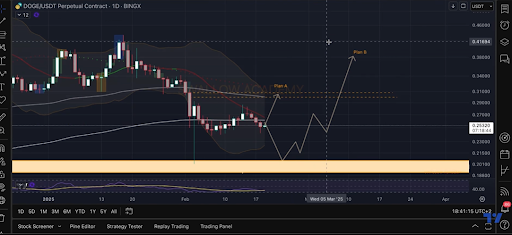
Dogecoin’s price action with the Bollinger Bands was noted on the TradingView platform by crypto analyst SwallowAcademy. SwallowAcademy’s analysis highlights that since the start of February, Dogecoin has been trading within the Bollinger bands, but not without turbulence. A price crash in early February saw Dogecoin break below the lower Bollinger band on February 3 with a strong wick. However, it has since recovered and is now back trading within the Bollinger bands. 

Typically, such a move is followed by a rally toward the middle Bollinger band, which has indeed happened. Instead of continuing into a full-fledged bullish trend, DOGE has faced resistance at the middle band. This shows that there’s either a lingering selling pressure or a lack of strong buying pressure. 
Dogecoin
DOGE trending inside the bollinger band | Source: SwallowAcademy on Tradingview

This behavior is unusual compared to Dogecoin’s price action this cycle, where it would typically see a reversal to the middle band and then a continued move toward the upper Bollinger band. Instead, the cryptocurrency remains stuck around the middle band, struggling to break through convincingly. As noted by the analyst, the key test now is whether the meme coin can break past this resistance, which could cause a rally of at least 15%.

The Danger Level To Watch For DOGE Bulls

The bullish plan is for Dogecoin to break above the middle Bollinger band and then aim for the upper band. If Dogecoin manages to hold support and push beyond the middle Bollinger band resistance, the bullish outlook remains intact. Breaking past this level would likely cause a return above $0.30. From here, there could be a stronger move toward the $0.40 price level, which would then confirm a continuation of the larger uptrend. However, there is a critical risk factor that bulls need to keep an eye on.

There’s a possibility of a deeper retest before a major breakout that cannot be ignored. The analyst noted that following Dogecoin’s explosive breakout in November 2024, there was no proper retest of a key resistance zone within that rally. As is the nature of cryptocurrencies, such gaps tend to get revisited, meaning there is a possibility that DOGE could decline to retest the unfilled order block.

If this scenario plays out, Dogecoin could drop to as low as $0.20 again. A successful retest of this zone could then lay the foundation for a significant breakout to the predicted $0.4 target.

At the time of writing, DOGE is trading at $0.2534.

Dogecoin
DOGE trading at $0.25 on the 1D chart | Source: DOGEUSDT on Tradingview.com
Featured image from Adobe Stock, chart from Tradingview.com
Scott Matherson

Scott Matherson

Scott Matherson is a leading crypto writer at Bitcoinist, who possesses a sharp analytical mind and a deep understanding of the digital currency landscape. Scott has earned a reputation for delivering thought-provoking and well-researched articles that resonate with both newcomers and seasoned crypto enthusiasts. Outside of his writing, Scott is passionate about promoting crypto literacy and often works to educate the public on the potential of blockchain.

Lecturas Relacionadas

CLARITY Act Countdown: How Will the Crypto Market Fare If It Doesn't Pass Before the August Recess?

The CLARITY Act, a major US crypto market structure bill, faces a tight deadline before the Senate's August 10 recess. It must overcome final hurdles—negotiations on ethics provisions and law enforcement concerns—to secure the 60 votes needed for passage. Analysts warn that missing this window significantly lowers its chances in 2026, with prediction markets giving only a 40% probability of success this year. If the act fails to pass by the recess, the market is expected to react not with a crash but with continued "slow bleeding," particularly in premium products like ETFs. June saw record net outflows from US Bitcoin spot ETFs, partly attributed to this legislative uncertainty. Assets like XRP, which would receive permanent commodity classification under the act, stand to lose a "regulatory premium" on further delays. Bitcoin and Ethereum, already classified as commodities by regulators, face less direct impact, but DeFi innovation and institutional capital inflows would remain stifled by regulatory ambiguity. The path forward includes passing before the recess (a major catalyst), postponement to 2027 (prolonging uncertainty), or failure, requiring the bill to be reintroduced in the next Congress. Despite the stalled negotiations, the bill's advancement this far signals the US is closer than ever to resolving crypto regulatory clarity.

marsbitHace 15 min(s)

CLARITY Act Countdown: How Will the Crypto Market Fare If It Doesn't Pass Before the August Recess?

marsbitHace 15 min(s)

The Impact of OUSD on Circle, Tether, and Paxos: Not a Simple Negative, but a More Complex Competitive Landscape

OUSD's Impact on Circle, Tether, and Paxos: A Nuanced Competitive Reshuffle The launch of OUSD, a new stablecoin initiative, has complex implications for the stablecoin market. For Circle (CRCL), the initial 15-20% stock drop reflects legitimate competitive concerns but is not a "death sentence." Circle retains deep liquidity, existing integrations, and first-mover advantages. A potential restructuring or termination of its Coinbase partnership could even double its net revenue in the short term, providing more competitive freedom. However, OUSD, backed by Stripe's engineering and product strengths, could become the default stablecoin within the Stripe ecosystem for new adopters, challenging USDC's position. OUSD does not solve the core barrier for corporate adoption: it remains a credit exposure to its issuer (likely a Bridge-related entity), which, like Circle, is not an investment-grade entity. Large banks and asset managers could still capture the most lucrative enterprise use cases. Circle must accelerate its payment/fintech product development and consider defensive M&A. For Tether, OUSD targets a different market segment. Tether will continue focusing on distribution channels not prioritized by Stripe or Circle. Its market share may decline over time, but within a significantly growing total market. Paxos faces the greatest pressure. OUSD undermines the key selling points of its USDG stablecoin, and Paxos's regulatory advantages may diminish as frameworks mature. This poses a more existential challenge, explaining Paxos's recent shift back to its brokerage-as-a-service business.

marsbitHace 19 min(s)

The Impact of OUSD on Circle, Tether, and Paxos: Not a Simple Negative, but a More Complex Competitive Landscape

marsbitHace 19 min(s)

OUSD's Impact on Circle, Tether, and Paxos: Not a Simple Negative, but a More Complex Competitive Reshuffle

This article analyzes the impact of the newly announced stablecoin OUSD, backed by a consortium including Stripe, on major incumbents like Circle (USDC), Tether (USDT), and Paxos (USDG). For Circle, the announcement is not a simple negative. While the initial market reaction was rational, it's not a "death sentence." Circle retains deep liquidity, existing integrations, and first-mover advantage. A potential restructuring or termination of its exclusive revenue-sharing deal with Coinbase could even near-double its net income in the short term, providing more competitive flexibility. However, within the Stripe ecosystem, OUSD, with its strong engineering and product focus, could become the default choice, displacing USDC for new integrations. Circle must accelerate its own fintech product development and consider defensive M&A. OUSD does not directly threaten Tether's core markets, which focus on different distribution channels. Tether's market share may decline over time but within a significantly growing overall market. Paxos faces the greatest pressure. OUSD undermines the primary value proposition of its USDG stablecoin, and Paxos's regulatory advantages may erode as frameworks mature, posing a more existential challenge. This explains Paxos's recent strategic pivot towards brokerage-as-a-service. A fundamental unresolved issue for enterprise adoption remains: if issued by a Bridge-related entity, OUSD, like USDC, still represents a credit exposure to a non-investment-grade issuer, unless a parent company guarantee is provided. Large banks and asset managers entering the space later could still compete for the most lucrative enterprise use cases.

链捕手Hace 20 min(s)

OUSD's Impact on Circle, Tether, and Paxos: Not a Simple Negative, but a More Complex Competitive Reshuffle

链捕手Hace 20 min(s)

Trading

Spot
活动图片