CLARITY Act Countdown: How Will the Crypto Market Fare If It Doesn't Pass Before the August Recess?

marsbitPublicado a 2026-07-05Actualizado a 2026-07-05

Resumen

The CLARITY Act, a major US crypto market structure bill, faces a tight deadline before the Senate's August 10 recess. It must overcome final hurdles—negotiations on ethics provisions and law enforcement concerns—to secure the 60 votes needed for passage. Analysts warn that missing this window significantly lowers its chances in 2026, with prediction markets giving only a 40% probability of success this year. If the act fails to pass by the recess, the market is expected to react not with a crash but with continued "slow bleeding," particularly in premium products like ETFs. June saw record net outflows from US Bitcoin spot ETFs, partly attributed to this legislative uncertainty. Assets like XRP, which would receive permanent commodity classification under the act, stand to lose a "regulatory premium" on further delays. Bitcoin and Ethereum, already classified as commodities by regulators, face less direct impact, but DeFi innovation and institutional capital inflows would remain stifled by regulatory ambiguity. The path forward includes passing before the recess (a major catalyst), postponement to 2027 (prolonging uncertainty), or failure, requiring the bill to be reintroduced in the next Congress. Despite the stalled negotiations, the bill's advancement this far signals the US is closer than ever to resolving crypto regulatory clarity.

Author: Qin Xiaofeng, Odaily Planet Daily

The highly anticipated Digital Asset Market Structure Act (CLARITY Act) has unsurprisingly been delayed once again. Senator Cynthia Lummis previously stated that negotiators expected to finalize a compromise text around July 4th (U.S. Independence Day) and "advance it in July," but progress has clearly lagged.

Now, with the Senate's August 10th recess approaching, the window of opportunity is shrinking rapidly: the bill must meet the 60-vote threshold in the Senate (requiring at least 7 Democratic defections), be reconciled with the text from the Senate Agriculture Committee, merged with the House bill, and signed by the President—all within the next 25 working days. The timeline is extremely tight.

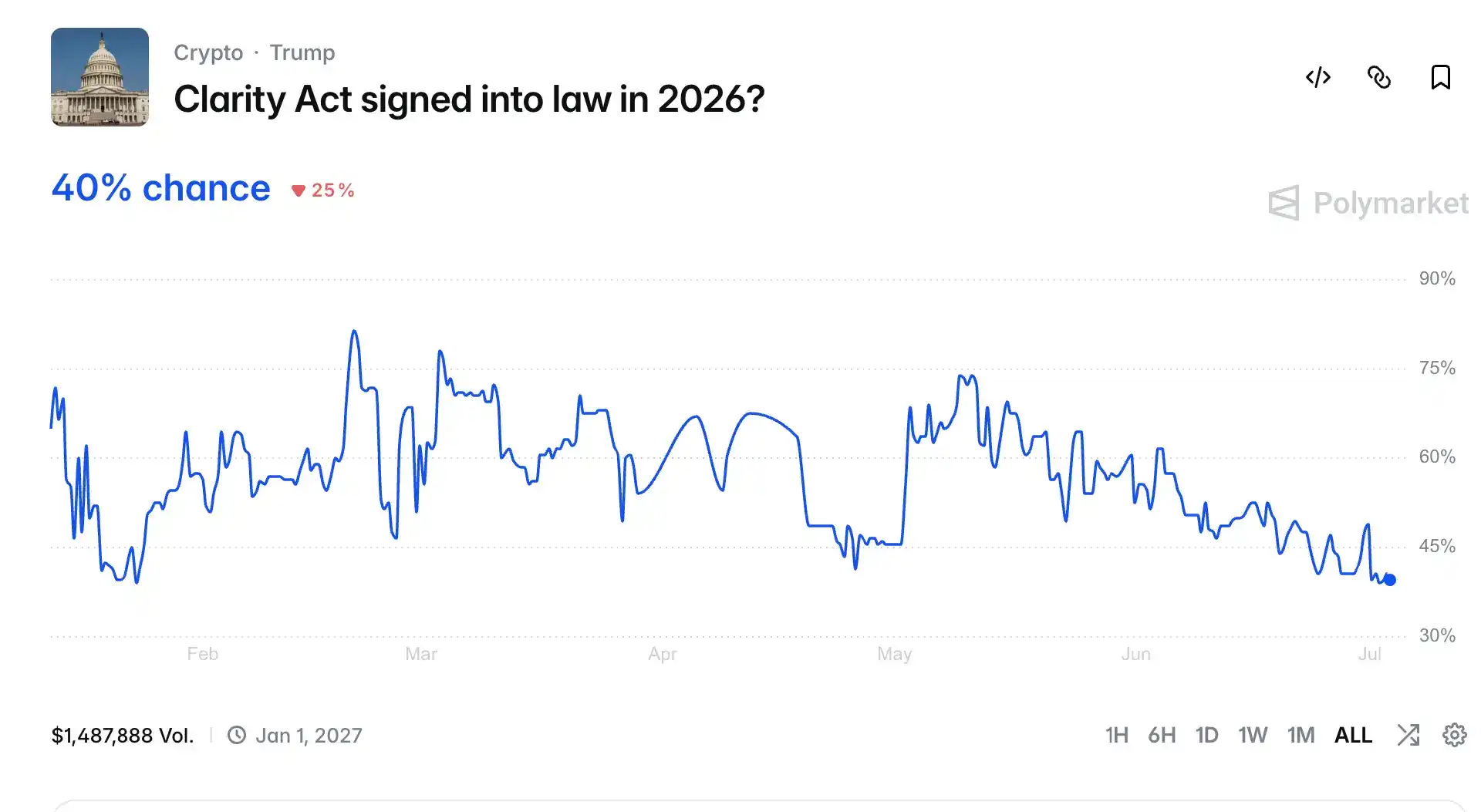
If the window before the August recess is missed, the probability of the CLARITY Act passing this year will further decrease. In fact, data from the prediction market Polymarket shows the probability of the bill passing this year is only 40%; Galaxy Digital has also lowered the probability of passage by 2026 to 50%.
I. Review of the Latest Progress on the CLARITY Act

The CLARITY Act is landmark crypto market structure legislation being advanced in the U.S. Congress, aiming to clarify the regulatory boundaries between the SEC and CFTC, provide a non-security pathway for decentralized tokens, and mandate registration and anti-money laundering obligations for digital commodity intermediaries.

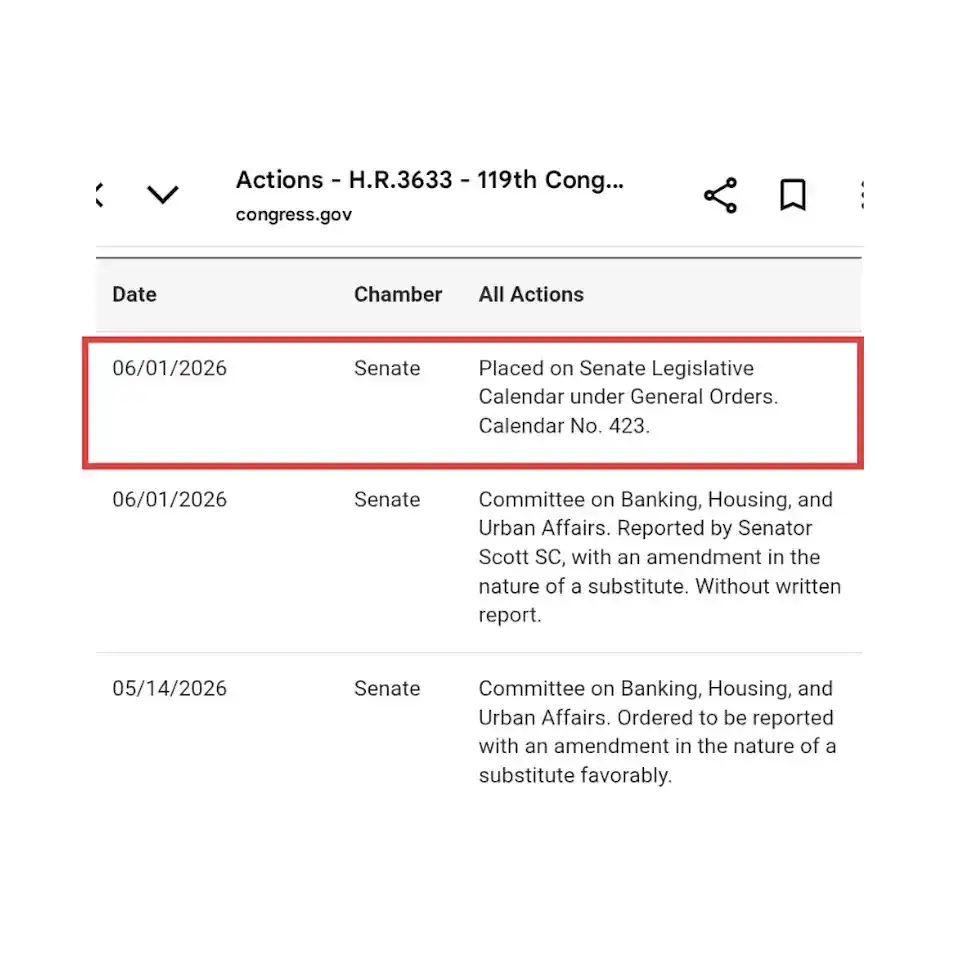
On July 17, 2025, the House of Representatives passed HR 3633, proposed by French Hill, with 294 votes in favor and 134 against, including over 70 votes from Democrats. On May 14, 2026, the Senate Banking Committee advanced and passed it with a 15-9 vote (supported by 13 Republicans and 2 Democrats). On June 1, 2026, the CLARITY Act was officially placed on the Senate legislative calendar (Calendar No. 423), qualifying for full consideration.

However, progress on the CLARITY Act throughout June was not smooth. On June 9th, negotiations over the ethics clause regarding the President's crypto holdings broke down, directly leading to some Democratic lawmakers softening their stance or imposing additional conditions, slowing the pace of the bill reaching the floor for debate. On June 10th, the White House held meetings with police and prosecutor groups. Afterwards, the enforcement battle over Section 604 (the developer protection clause) in the Blockchain Regulatory Certainty Act reached an impasse; if unresolved, law enforcement groups might lobby against it, and Democratic lawmakers might also vote against it for "insufficiently protecting consumers/combating crime."

In simple terms, the former is a "political/ethics hurdle," and the latter is an "enforcement/security red line." Together, they constitute the final two major obstacles before the CLARITY Act can "clear" the Senate. If these are not resolved, it will be difficult to gather the 60 votes and finalize the text, making it impossible to complete the legislation before the August 10th recess. These two sets of negotiations are the key "stumbling blocks" directly hindering the final advancement of the CLARITY Act, causing the July 4th target to be missed and the overall progress to stall. Negotiations are still trying to break the deadlock, but time is running very short.

Brian Gardner, Chief Washington Policy Strategist at Stifel Financial, stated that for the bill to pass in 2026, "it likely needs to pass the Senate by the end of July, preferably in June," and warned that if the Senate misses the recess deadline, the outlook would deteriorate significantly.
However, the market has largely lost hope for the bill's passage this year. Alex Thorn, Head of Galaxy Research, lowered his prediction for the bill passing in 2026 from 75% to 60% on June 5th, citing the increasingly tight Senate schedule. Data from the prediction market Polymarket shows the probability of the bill passing this year is only 40%.

II. What Will Happen to Crypto If the CLARITY Act Fails to Pass on Schedule?

According to CCN's analysis, if the CLARITY Act fails to pass before the August recess, the market's most likely reaction will not be a crash, but rather a "slow bleed through premium products." In fact, the poor performance of cryptocurrencies throughout June indicates that the market has already begun to reprice for legislative uncertainty. (Odaily Note: The premium products here mainly refer to various spot ETFs.)

Data shows that throughout June, U.S. spot Bitcoin ETFs saw cumulative net outflows of approximately $4.5 billion, equivalent to about 77,000 BTC being redeemed. This marks the largest monthly net outflow since the products launched in January 2024, surpassing the previous record from February 2025 (~$3.56 billion), setting the worst monthly record ever.

In fact, XRP might be the asset most directly and significantly affected by the bill, as it would permanently cement its commodity classification, eliminating the risk of reversible agency interpretation. In case of long-term delay or failure, XRP could lose some of its "regulatory premium."

Geoffrey Kendrick, Global Head of Digital Asset Research at Standard Chartered, forecasts an XRP target price of $8, contingent on the Senate fully passing the relevant bill and $4-8 billion in ETF inflows. JPMorgan predicts that if the bill passes, XRP ETFs could see $4.3-8.4 billion in inflows in the first year. Data shows that since the launch of XRP spot ETFs in November 2025, cumulative net inflows have been about $1.41 billion, with 84% from retail, while institutional inflows await clearer regulatory signals.

For Bitcoin, which was already classified as a commodity through a joint SEC-CFTC interpretation in March 2026, the CLARITY Act's main role would be to codify this reversible decision into permanent federal law. Even if the bill fails or is significantly delayed, Bitcoin's "digital gold" narrative is relatively robust, and the direct impact would be smaller.

The impact on ETH is similar to Bitcoin. Ethereum was also classified as a commodity via the joint interpretation. Failure of the bill could lead to prolonged compliance ambiguity for DeFi protocols, stifling innovation and capital inflows. Standard Chartered's Geoffrey Kendrick previously forecasted an ETH target price of $7,500 by the end of 2026 (later revised to $4,000), contingent on the passage of the relevant bills.

Kristin Smith, President of the Solana Policy Institute, stated that many asset allocators are actively exploring investments in digital assets but are holding back funds due to the lack of clear regulatory guidelines. The same principle applies to institutional DeFi; currently, DeFi projects are also on hold awaiting the outcome of Section 604.

III. What's the Path Forward?

Time is running short for the CLARITY Act to overcome the final hurdles. The following scenarios are possible:

  • First, Passage Before the August Recess: The biggest catalyst, likely triggering a significant price rebound, especially for XRP and related ETFs.
  • Second, Postponement to 2027: The scenario least desired by the market, extending the "slow bleed" process, with institutional capital continuing to wait on the sidelines.
  • Third, Failure and Pushing to the Next Congress: The CLARITY Act is currently in the 119th Congress. If the Senate floor vote, reconciliation, and final passage are not completed before the August 2026 recess, the entire process cannot conclude within this Congress. When the new Congress (120th, 2027-2028) begins, the bill must be reintroduced and go through the entire process of committee consideration, floor debate, etc., all over again.

The CLARITY Act is currently at a critical stage of being "on the cusp but stuck." Technically, it's on the Senate calendar, but political negotiations, the time window, and bipartisan support remain the biggest obstacles.

However, as Vincent Chok, CEO of First Digital, stated: "The fact that the CLARITY Act has reached the Senate floor vote itself shows the U.S. is closer than ever to resolving regulatory ambiguity... A successful vote would accelerate this process, but failure won't necessarily stop it. In fact, delays in the U.S. framework could create urgency and extend the time window for setting global standards, potentially positioning the U.S. as the de facto global digital asset hub."


Criptos en tendencia

Preguntas relacionadas

QWhat is the CLARITY Act and what are its primary objectives in regulating the US cryptocurrency market?

AThe CLARITY Act, officially the Digital Asset Market Transparency Act, is a landmark piece of U.S. crypto market structure legislation. Its primary objectives are to clarify the jurisdictional boundaries between the SEC and CFTC, provide a non-security pathway for decentralized tokens, and mandate that digital commodity intermediaries register and comply with anti-money laundering obligations.

QWhat are the two main political and procedural obstacles currently blocking the CLARITY Act's progress in the Senate?

AThe two main obstacles are: 1) A political/ethics threshold related to negotiations over a provision concerning presidential crypto holdings, which softened some Democratic support. 2) A law enforcement/safety red line concerning the developer protection clause (Section 604) in the related Blockchain Regulatory Certainty Act, which law enforcement groups oppose. These unresolved issues make it difficult to secure the necessary 60 votes for Senate passage.

QAccording to the article, what is the most likely market consequence if the CLARITY Act fails to pass before the August recess?

AThe most likely consequence is not a market crash, but a 'slow bleed' through premium products like spot ETFs. The article points to the record $4.5 billion in net outflows from US Bitcoin spot ETFs in June as evidence that the market is already repricing assets due to legislative uncertainty, and this trend would likely continue.

QWhy is XRP considered the asset most directly impacted by the fate of the CLARITY Act?

AXRP is most directly impacted because the Act would permanently codify its classification as a commodity into federal law, eliminating the risk of a reversible agency interpretation (like the SEC potentially re-classifying it as a security). Without the Act's passage, XRP could lose a portion of its 'regulatory clarity premium' that has been supporting its valuation expectations for an ETF and institutional inflows.

QWhat are the three potential future scenarios for the CLARITY Act outlined in the article if it does not pass before the August recess?

AThe three scenarios are: 1) Passage before the August recess (leading to a significant price rebound, especially for XRP). 2) Delayed to 2027, extending the period of market uncertainty and 'slow bleed'. 3) Failure in the current (119th) Congress, requiring the entire legislative process to restart from scratch in the next (120th) Congress beginning in 2027.

Lecturas Relacionadas

The Impact of OUSD on Circle, Tether, and Paxos: Not a Simple Negative, but a More Complex Competitive Landscape

OUSD's Impact on Circle, Tether, and Paxos: A Nuanced Competitive Reshuffle The launch of OUSD, a new stablecoin initiative, has complex implications for the stablecoin market. For Circle (CRCL), the initial 15-20% stock drop reflects legitimate competitive concerns but is not a "death sentence." Circle retains deep liquidity, existing integrations, and first-mover advantages. A potential restructuring or termination of its Coinbase partnership could even double its net revenue in the short term, providing more competitive freedom. However, OUSD, backed by Stripe's engineering and product strengths, could become the default stablecoin within the Stripe ecosystem for new adopters, challenging USDC's position. OUSD does not solve the core barrier for corporate adoption: it remains a credit exposure to its issuer (likely a Bridge-related entity), which, like Circle, is not an investment-grade entity. Large banks and asset managers could still capture the most lucrative enterprise use cases. Circle must accelerate its payment/fintech product development and consider defensive M&A. For Tether, OUSD targets a different market segment. Tether will continue focusing on distribution channels not prioritized by Stripe or Circle. Its market share may decline over time, but within a significantly growing total market. Paxos faces the greatest pressure. OUSD undermines the key selling points of its USDG stablecoin, and Paxos's regulatory advantages may diminish as frameworks mature. This poses a more existential challenge, explaining Paxos's recent shift back to its brokerage-as-a-service business.

marsbitHace 1 hora(s)

The Impact of OUSD on Circle, Tether, and Paxos: Not a Simple Negative, but a More Complex Competitive Landscape

marsbitHace 1 hora(s)

OUSD's Impact on Circle, Tether, and Paxos: Not a Simple Negative, but a More Complex Competitive Reshuffle

This article analyzes the impact of the newly announced stablecoin OUSD, backed by a consortium including Stripe, on major incumbents like Circle (USDC), Tether (USDT), and Paxos (USDG). For Circle, the announcement is not a simple negative. While the initial market reaction was rational, it's not a "death sentence." Circle retains deep liquidity, existing integrations, and first-mover advantage. A potential restructuring or termination of its exclusive revenue-sharing deal with Coinbase could even near-double its net income in the short term, providing more competitive flexibility. However, within the Stripe ecosystem, OUSD, with its strong engineering and product focus, could become the default choice, displacing USDC for new integrations. Circle must accelerate its own fintech product development and consider defensive M&A. OUSD does not directly threaten Tether's core markets, which focus on different distribution channels. Tether's market share may decline over time but within a significantly growing overall market. Paxos faces the greatest pressure. OUSD undermines the primary value proposition of its USDG stablecoin, and Paxos's regulatory advantages may erode as frameworks mature, posing a more existential challenge. This explains Paxos's recent strategic pivot towards brokerage-as-a-service. A fundamental unresolved issue for enterprise adoption remains: if issued by a Bridge-related entity, OUSD, like USDC, still represents a credit exposure to a non-investment-grade issuer, unless a parent company guarantee is provided. Large banks and asset managers entering the space later could still compete for the most lucrative enterprise use cases.

链捕手Hace 1 hora(s)

OUSD's Impact on Circle, Tether, and Paxos: Not a Simple Negative, but a More Complex Competitive Reshuffle

链捕手Hace 1 hora(s)

Trading

Spot

Artículos destacados

Qué es DOGE M

Doge Matrix ($doge m): La Nueva Raza de Criptomonedas Impulsadas por la Comunidad Introducción En el paisaje en constante evolución de las criptomonedas, nuevos proyectos emergen constantemente, cada uno con el objetivo de captar el interés de inversores y entusiastas por igual. Uno de los últimos en entrar en este dominio es Doge Matrix, representado por el símbolo de ticker $doge m. Este proyecto ha atraído atención gracias a sus raíces en la popular cultura de memes que rodea a Dogecoin, estableciendo su lugar dentro del espacio web3. Este artículo tiene como objetivo proporcionar un análisis integral de Doge Matrix, cubriendo su visión general, creador, inversores, funcionalidad, cronología y aspectos notables. ¿Qué es Doge Matrix ($doge m)? Doge Matrix es un proyecto de criptomoneda impulsado por la comunidad que aparentemente se basa en el atractivo generalizado de Dogecoin, una moneda digital conocida por su mascota Shiba Inu y sus orígenes en memes. Si bien los objetivos generales de Doge Matrix no están ampliamente definidos, se caracteriza por un compromiso con la participación y el apoyo de la comunidad. A diferencia de las criptomonedas tradicionales que a menudo enfatizan la utilidad o el valor intrínseco a través de tecnologías subyacentes, Doge Matrix se posiciona dentro de un espacio que abraza el fenómeno cultural de las criptomonedas, apelando particularmente a aquellos que resuenan con la ética de los activos basados en memes. Aprovechando las fortalezas de la comunidad de Dogecoin, Doge Matrix opera como parte de un ecosistema más amplio, invitando a la participación y el compromiso de usuarios que comparten un interés en la criptomoneda y el paisaje digital. ¿Quién es el Creador de Doge Matrix ($doge m)? La identidad del creador de Doge Matrix sigue siendo desconocida. Esta falta de transparencia no es un acontecimiento poco común en el espacio de las criptomonedas, donde algunos proyectos se lanzan sin revelar las identidades de sus fundadores. La ausencia de información sobre el equipo fundador puede generar preguntas entre los posibles inversores sobre la responsabilidad y dirección del proyecto. ¿Quiénes son los Inversores de Doge Matrix ($doge m)? Hasta el momento, no hay información disponible públicamente que detalle los inversores o fundaciones de inversión que respaldan a Doge Matrix. El proyecto parece depender principalmente del apoyo de la comunidad en lugar de inversiones institucionales. Este modelo se alinea con la naturaleza impulsada por la comunidad de la iniciativa, fomentando un entorno donde la dirección del proyecto es moldeada por sus participantes en lugar de ser dictada por unos pocos patrocinadores financieros seleccionados. ¿Cómo Funciona Doge Matrix ($doge m)? Los detalles sobre los mecanismos operativos de Doge Matrix son algo vagos, reflejando una tendencia más amplia de proyectos en el espacio de las monedas meme donde las funcionalidades innovadoras no siempre están claramente articuladas. No obstante, Doge Matrix parece estar diseñado para aprovechar el ecosistema existente de criptomonedas alentar la participación de los usuarios mientras se conecta con las referencias culturales familiares asociadas a Dogecoin. Sus características potencialmente únicas derivan de las interacciones comunitarias en lugar de avances tecnológicos, enfatizando experiencias compartidas y colaboración entre los poseedores de tokens. Si bien las innovaciones exactas no se han delineado explícitamente, el proyecto parece crear un espacio donde los miembros de la comunidad pueden interactuar, compartir ideas y propulsar el potencial del proyecto hacia adelante. Cronología de Doge Matrix ($doge m) Reflexionar sobre la cronología del proyecto revela eventos notables que han definido su trayectoria hasta ahora: 25 de noviembre de 2024: Doge Matrix alcanzó su valor máximo histórico, marcando un hito significativo en su historia temprana. 1 de enero de 2025: Por el contrario, Doge Matrix alcanzó su valor mínimo histórico, ilustrando la volatilidad a menudo asociada con las criptomonedas, especialmente en las primeras etapas del ciclo de vida de un proyecto. En curso: El proyecto continúa siendo activamente negociado y respaldado por su comunidad, aunque aún no se han divulgado hitos u objetivos futuros específicos. Puntos Clave Sobre Doge Matrix ($doge m) Enfoque Comunitario En el corazón de Doge Matrix hay un compromiso con la participación de la comunidad. El proyecto prospera sobre la premisa de colaboración y objetivos compartidos entre sus miembros, enfatizando la importancia del esfuerzo colectivo. A diferencia de los proyectos centralizados que a menudo tienen una estructura de liderazgo definida, Doge Matrix actualmente muestra un enfoque más fluido hacia la gobernanza, donde la voz de cada miembro de la comunidad importa. Volatilidad El mercado de criptomonedas es notorio por su volatilidad, y Doge Matrix no es una excepción. Su historial de precios refleja fluctuaciones significativas entre valores altos y bajos, lo cual es típico de muchas nuevas criptomonedas, pero subraya los riesgos asociados con la inversión en tokens emergentes. Falta de Información Detallada Una de las características más llamativas de Doge Matrix es la escasez de información detallada sobre sus fundamentos tecnológicos y mecanismos operativos. Esta ambigüedad requiere que los posibles inversores realicen una diligencia debida exhaustiva antes de involucrarse con el proyecto. Conclusión En resumen, Doge Matrix ($doge m) ilustra una nueva ola de proyectos de criptomonedas que se apoyan en gran medida en la participación de la comunidad y la relevancia cultural. Si bien carece de ciertos detalles, como liderazgo claro, objetivos definidos y funcionalidad detallada, el proyecto ha logrado generar interés dentro de la comunidad cripto, aprovechando el atractivo establecido de la cultura de memes. Al igual que con cualquier inversión en el espacio de las criptomonedas, comprender los riesgos inherentes y realizar una investigación exhaustiva es esencial para los participantes potenciales. Doge Matrix se erige como un recordatorio de la naturaleza dinámica y, a veces, impredecible de la industria cripto, marcada por una evolución constante y entusiasmo por iniciativas impulsadas por la comunidad.

435 Vistas totalesPublicado en 2025.02.03Actualizado en 2025.02.03

Qué es DOGE M

Qué es $M

Entendiendo Mantis ($M): Una Nueva Era en la Interoperabilidad entre Cadenas En el paisaje en constante evolución de Web3 y las criptomonedas, nuevos proyectos se esfuerzan por ofrecer soluciones innovadoras destinadas a mejorar la experiencia del usuario y expandir las posibilidades funcionales dentro del ecosistema financiero descentralizado. Uno de estos proyectos que está ganando atención es Mantis ($M), un protocolo pionero fundado en los principios de interoperabilidad entre cadenas y liquidaciones basadas en intenciones. Este artículo profundiza en los aspectos esenciales de Mantis, incluyendo su funcionalidad central, creadores, respaldo de inversión, características innovadoras y hitos críticos. ¿Qué es Mantis ($M)? Mantis se describe como un protocolo de liquidación de intenciones multi-dominio que simplifica las interacciones entre cadenas, permitiendo a los usuarios ejecutar transacciones financieras complejas a través de varias plataformas de blockchain sin problemas. El protocolo opera a través de tres capas principales: Expresión de Intenciones: Los usuarios pueden articular sus objetivos de transacción utilizando un lenguaje natural facilitado por el DISE LLM, un modelo de lenguaje de IA avanzado. Por ejemplo, un usuario podría expresar el deseo de intercambiar Ethereum (ETH) por Solana (SOL) con una tolerancia de deslizamiento específica del 1%. Ejecución: Esta capa emplea una red de solucionadores que compiten para cumplir con las intenciones de los usuarios. Las transacciones se ejecutan utilizando mecanismos como Coincidencia de Deseos (CoWs) y Subastas de Flujo de Órdenes (OFAs), que aseguran que las demandas de los usuarios se satisfagan de manera óptima. Liquidación: Aprovechando el protocolo de Comunicación Inter-Blockchain (IBC), Mantis permite transacciones atómicas entre cadenas, permitiendo a los usuarios operar a través de varias cadenas soportadas, incluyendo Ethereum, Solana y Cosmos. Mantis está diseñado para introducir generación de rendimiento nativa para activos inactivos, utilizando pruebas criptográficas para mantener la integridad de las transacciones a lo largo de todo el proceso. Creadores y Equipo de Desarrollo Mantis fue concebido por la Composable Foundation, una organización impulsada por la investigación notable por su énfasis en soluciones de interoperabilidad de blockchain. Esta fundación colabora con instituciones académicas de renombre, incluyendo la Universidad de Harvard y la Universidad de Lisboa, contribuyendo a extensos esfuerzos de investigación y desarrollo que informan la arquitectura y funcionalidad de Mantis. El compromiso de la Composable Foundation de fomentar la innovación en el espacio de blockchain posiciona a Mantis como una solución robusta para la creciente demanda de interoperabilidad entre múltiples redes de blockchain. Inversores y Respaldo Si bien los detalles específicos sobre inversores individuales no se han divulgado públicamente, Mantis disfruta de un respaldo sustancial de varias entidades, incluyendo: Subvenciones del ecosistema de cadenas habilitadas por IBC, que apoyan el crecimiento del protocolo y su integración dentro de ecosistemas de finanzas descentralizadas. Asociaciones estratégicas con proveedores de infraestructura que mejoran las capacidades de la red de Mantis y sus estrategias de implementación. Financiamiento a través del tesoro de la Composable Foundation, asegurando un apoyo financiero sostenido para el desarrollo continuo y los costos operativos. Estos esfuerzos colaborativos reflejan un consenso entre las partes interesadas sobre la importancia de mejorar la funcionalidad entre cadenas y la utilidad potencial de las innovaciones infraestructurales de Mantis. Innovaciones Clave Mantis se distingue por varias innovaciones pioneras que mejoran su funcionalidad y utilidad: Intenciones Agnósticas a la Cadena: Los usuarios pueden iniciar transacciones desde cualquier cadena soportada mientras liquidan en otra. Esta flexibilidad empodera a los usuarios, impulsando una mayor interacción entre diferentes plataformas. Interfaz Potenciada por IA: La integración del DISE LLM permite a los usuarios realizar operaciones complejas de DeFi utilizando lenguaje natural, simplificando así las interacciones y haciendo que la tecnología blockchain sea accesible a un público más amplio. Captura de MEV Inter-Dominio: Mantis crea un mercado interno para el valor máximo extraíble (MEV) a través de competencias entre solucionadores. Este enfoque innovador permite una mayor eficiencia y extracción de valor en transacciones complejas. Capa de Liquidación Modular: El protocolo soporta varios métodos de verificación, incluyendo pruebas de conocimiento cero y rollups optimistas, proporcionando un marco versátil que puede adaptarse a las tecnologías de blockchain emergentes. Línea de Tiempo Histórica El desarrollo de Mantis está marcado por varios hitos críticos que trazan su trayectoria y crecimiento: | Año | Hito | |————|———————————————————————–| | 2022 | Desarrollo del concepto inicial dentro de la división de investigación de la Composable Foundation. | | Q3 2024 | Lanzamiento de la testnet con capacidades de puenteo entre Solana y Ethereum. | | Q1 2025 | Evento de Generación de Token (TGE) anticipado junto con el lanzamiento de la mainnet. | | Q2 2025 | Integración esperada del DISE LLM y expansión de las capacidades entre cadenas. | | 2025 H2 | Soporte planeado para más de 15 cadenas a través de futuras actualizaciones de IBC. | Esta línea de tiempo describe la evolución de Mantis, desde discusiones conceptuales hasta la implementación activa y fases de crecimiento futuro. Estrategia de Crecimiento del Ecosistema La estrategia de Mantis para el crecimiento del ecosistema incluye varias iniciativas diseñadas para fomentar la participación de los usuarios y el compromiso de los desarrolladores: Sistema de Créditos: Los usuarios pueden ganar créditos del protocolo al proporcionar liquidez y participar en programas de referidos. Estos créditos son canjeables por incentivos en el futuro, fomentando una comunidad de usuarios robusta. Kit de Desarrollo de Software Modular (SDK): Este conjunto de herramientas empodera a los desarrolladores para crear aplicaciones basadas en modelos impulsados por intenciones utilizando la infraestructura de Mantis, promoviendo así la innovación dentro de su ecosistema. Modelo de Gobernanza: A medida que el protocolo madura, los poseedores de tokens $M tendrán voz en la gobernanza del protocolo, permitiéndoles votar sobre actualizaciones y cambios propuestos, mejorando así el compromiso de la comunidad y la descentralización. Mantis representa un avance significativo en el ámbito de la arquitectura entre cadenas. Al integrar sin problemas algoritmos avanzados de IA con un marco de liquidación robusto, Mantis busca abordar los problemas de fragmentación dentro de los ecosistemas multi-cadena. Su enfoque innovador prioriza la mejora de la experiencia del usuario mientras se adhiere a los principios fundamentales de descentralización y seguridad, estableciendo un nuevo estándar para la futura interoperabilidad de las tecnologías blockchain. A medida que Mantis continúa su camino de crecimiento e implementación, promete ser un proyecto a seguir de cerca en el competitivo paisaje de Web3 y las finanzas descentralizadas. Con su enfoque en cruzar fronteras y elevar la participación del usuario, Mantis está preparado para ser una parte integral de los futuros desarrollos en el espacio de las criptomonedas.

56 Vistas totalesPublicado en 2025.03.18Actualizado en 2025.03.18

Qué es $M

Cómo comprar M

¡Bienvenido a HTX.com! Hemos hecho que comprar MemeCore (M) sea simple y conveniente. Sigue nuestra guía paso a paso para iniciar tu viaje de criptos.Paso 1: crea tu cuenta HTXUtiliza tu correo electrónico o número de teléfono para registrarte y obtener una cuenta gratuita en HTX. Experimenta un proceso de registro sin complicaciones y desbloquea todas las funciones.Obtener mi cuentaPaso 2: ve a Comprar cripto y elige tu método de pagoTarjeta de crédito/débito: usa tu Visa o Mastercard para comprar MemeCore (M) al instante.Saldo: utiliza fondos del saldo de tu cuenta HTX para tradear sin problemas.Terceros: hemos agregado métodos de pago populares como Google Pay y Apple Pay para mejorar la comodidad.P2P: tradear directamente con otros usuarios en HTX.Over-the-Counter (OTC): ofrecemos servicios personalizados y tipos de cambio competitivos para los traders.Paso 3: guarda tu MemeCore (M)Después de comprar tu MemeCore (M), guárdalo en tu cuenta HTX. Alternativamente, puedes enviarlo a otro lugar mediante transferencia blockchain o utilizarlo para tradear otras criptomonedas.Paso 4: tradear MemeCore (M)Tradear fácilmente con MemeCore (M) en HTX's mercado spot. Simplemente accede a tu cuenta, selecciona tu par de trading, ejecuta tus trades y monitorea en tiempo real. Ofrecemos una experiencia fácil de usar tanto para principiantes como para traders experimentados.

853 Vistas totalesPublicado en 2025.07.02Actualizado en 2026.06.02

Cómo comprar M

Discusiones

Bienvenido a la comunidad de HTX. Aquí puedes mantenerte informado sobre los últimos desarrollos de la plataforma y acceder a análisis profesionales del mercado. A continuación se presentan las opiniones de los usuarios sobre el precio de M (M).

活动图片