«Ралли монстров» впереди? Аналитик прогнозирует рост Кардано (ADA)

cryptonews.ruPublicado a 2020-12-06Actualizado a 2025-02-06

  • Али Мартинес предсказал, что в ближайшем будущем ADA увидит «монстрическое параболическое ралли».
  • Мартинес подчеркнул фрактальную модель, которую альткойн сформировал в 2021 году, что привело к огромному росту.
  • Соучредитель Vortex Глеб подтвердил, что доверие китов к токену ADA ослабевает.

По мнению криптоаналитика Али Мартинеса, ADA может рассчитывать на значительный рост в ближайшем будущем. ADA сталкивается с сильным сопротивлением уровню цен в 1 доллар, но Мартинес утверждает, что криптовалюта ожидает «чудовищное параболическое ралли».

В сообщении на X (ранее Twitter) Мартинес опубликовал график ценового действия ADA, подчеркнув, что криптовалюта формирует паттерны, аналогичные бычьему ралли на криптовалютном рынке в 2021 году. Аналитик показал фрактальную фигуру на графике, где ADA ранее консолидировалась в диапазоне, прежде чем взорваться в 2021 году. Похожая фаза накопления, по-видимому, сформировалась недавно, отмеченная прорывом ключевого уровня сопротивления.
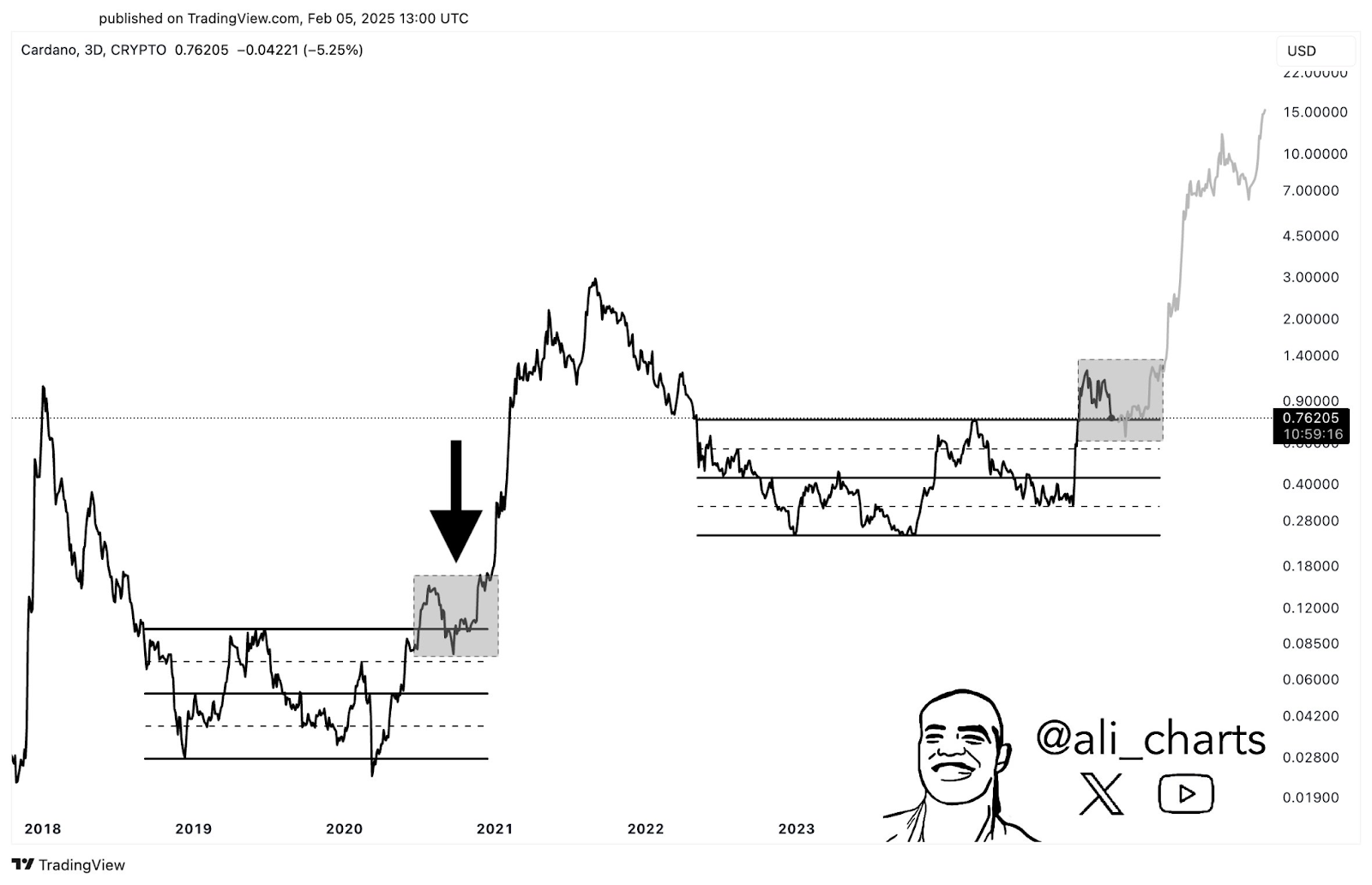
Заштрихованные области и черная стрелка подчеркивают сходство между прошлыми и нынешними ценовыми структурами. Если история повторится, ADA может оказаться на грани сильного роста, что потенциально может привести к значительному повышению цен. Это связано с тем, что прошлые рыночные циклы часто влияют на будущие тенденции технического анализа.

Активность китов: медвежий знак?

С другой стороны, существуют определенные медвежьи индикаторы, на которые следует обратить внимание ценовому действию ADA. Хотя альткойн остается в топ-10, киты ADA отступили: чистый поток упал на 90% всего за неделю. Соучредитель алгоритмического маркет-мейкера Vortex Глеб заявил на X, что когда крупные держатели, владеющие более чем 0,1% предложения криптовалюты, начинают снижать свою активность, «это сигнализирует о снижении доверия».

Not many people are talking about Cardano $ADA lately, but it’s still top 10 in the market, so here’s my quick analysis.

ADA’s whales have pulled back, with netflow dropping by 90% in just a week.

That’s a huge red flag 🚨 pic.twitter.com/t9iE6W8QSU

— Gleb (@glebgora) February 5, 2025

Связанный: Зашифрованное заявление Чарльза Хоскинсона: что задумал Cardano?

Глеб пояснил, что снижение активности означает меньшее количество транзакций, что, в свою очередь, означает снижение ликвидности и повышение волатильности. Предприниматель считает, что если так будет продолжаться, «цена ADA может столкнуться с серьезным давлением».

Анализ цен ADA: смешанные сигналы

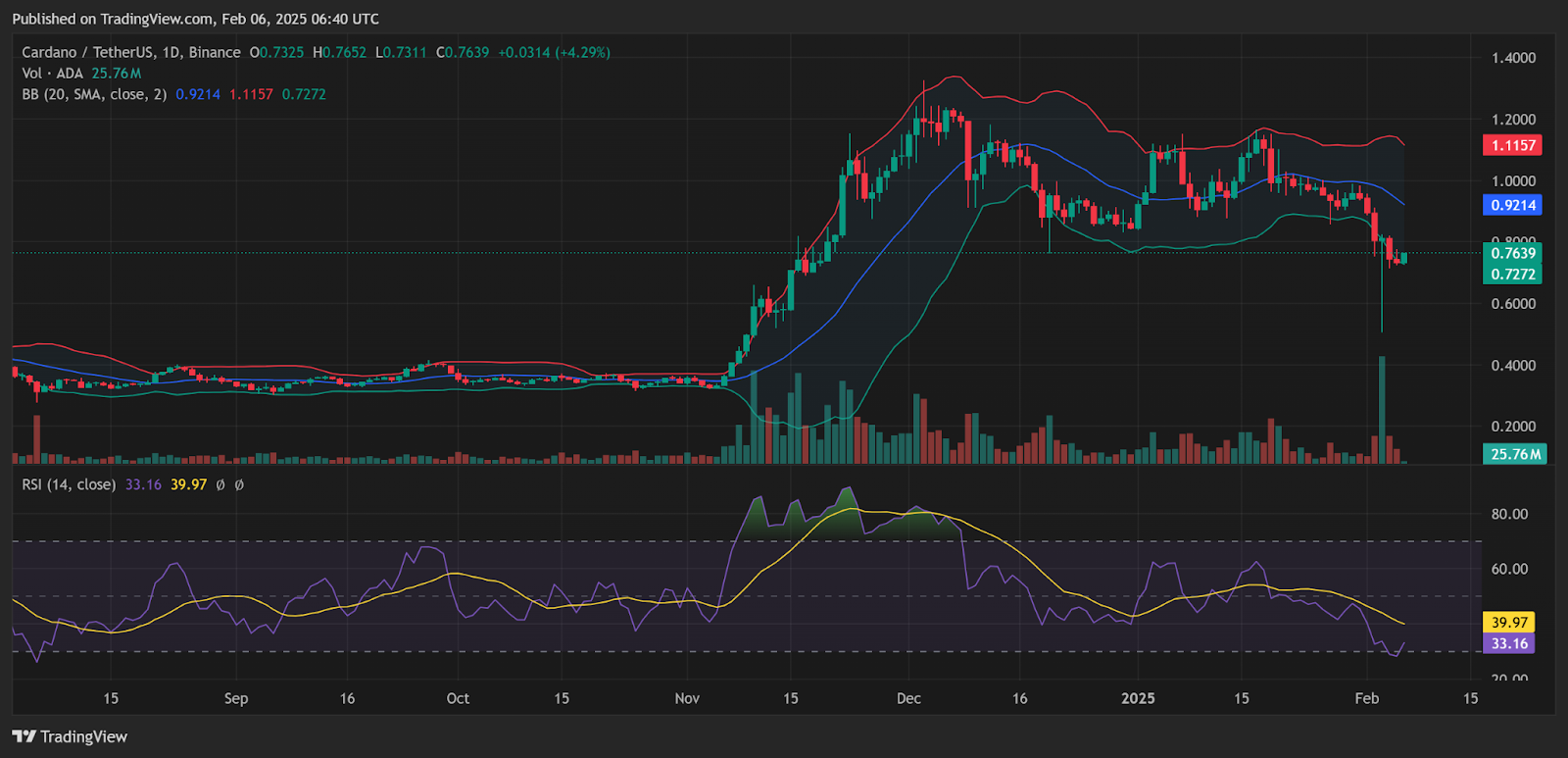
График цен ADA ниже показывает, что цена цифрового актива вошла в область перепроданности, но быстро восстановилась, составив на момент публикации значение 33,16. Наклон линии предполагает небольшой всплеск давления покупателей и увеличение шансов на попытку пробить отметку в доллар.
Связанный: Переход Кардано к полностью децентрализованному управлению – ADA на подъеме?

Ценовое действие ADA упало до нижней границы полос Боллинджера и несколько дней назад пробилось ниже нижней линии тренда полос. Тем не менее, нижняя линия тренда по-прежнему остается поддержкой для альткойна.


Criptos en tendencia

Lecturas Relacionadas

When the World Cup Collides with Agents: From Web2 to Web3, How Are Wallets Evolving into Agentic Wallets?

World Cup as a Catalyst for Agentic Wallets: From Web2 to Web3 This article explores how the World Cup provides a real-world scenario for observing the evolution of digital wallets from simple asset managers towards "Agentic Wallets"—intelligent, AI-powered interfaces. Using the example of prediction markets like Polymarket, it illustrates how AI Agents can lower the barrier to Web3 interaction. Instead of navigating complex DApps, users can express intent in natural language (e.g., "I think Portugal will win") within platforms like Discord or web pages. The Agent then interprets this intent, finds the relevant market, and seamlessly guides the user through the on-chain transaction via their wallet. The core shift is from wallets as mere "function menus" for signing transactions to "intent interpreters" that understand user goals. The article highlights parallel developments in traditional finance, such as Mastercard's "Agent Pay" and WeChat Pay's AI tests, which focus on granting AI controlled, authorized, and auditable payment capabilities. This underscores a broader trend of AI entering the financial layer. However, the article emphasizes that the primary challenge for Agentic Wallets in Web3 is not automation but establishing clear security boundaries. Unlike traditional systems with chargebacks, on-chain transactions are often irreversible. Therefore, future wallets must ensure users retain ultimate control and comprehension. They need to transparently communicate an Agent's permissions, spending limits, authorized durations, and provide easy ways to pause or revoke access. The World Cup experiments represent early steps toward wallets that are not just applications but ubiquitous, intelligent interfaces that simplify Web3 while keeping users securely in control.

marsbitHace 1 hora(s)

When the World Cup Collides with Agents: From Web2 to Web3, How Are Wallets Evolving into Agentic Wallets?

marsbitHace 1 hora(s)

Options Don't Work in DeFi? Vitalik Might Not Agree

For years, the prevailing view has been that options struggle to gain traction in DeFi due to complexity, fragmented liquidity, and lack of natural demand compared to products like perpetual futures. However, a recent algorithmic stablecoin design proposed by Vitalik Buterin presents a different perspective, using options not as a standalone trading product, but as foundational infrastructure for other financial instruments. In this design, one unit of ETH is split into two components: a "stable" side (P) that retains value up to a specified strike price, and an "upside" side (N) that captures all appreciation above that strike. Combined, they always equal one ETH, eliminating debt, margin, and liquidation risks inherent in typical collateralized debt position (CDP) stablecoins. The stable component essentially mimics the payoff of a covered call option. To function as a stablecoin, this structure requires continuously rolling deep in-the-money calls, which introduces challenges like rollover slippage, predictable transaction flow vulnerable to front-running, and persistent liquidity needs. A core hurdle is finding consistent buyers for the leveraged ETH upside exposure (N). While it offers leverage without funding rates or liquidation, it must compete with simpler alternatives like direct call options or perpetuals. The system's scalability depends on a sustained demand for this specific form of leverage. The author draws parallels to their experience with Rysk, where earlier versions of DeFi options protocols struggled. The breakthrough came with Rysk V12, which aligns incentives: asset holders generate yield by selling covered calls against their holdings, while market makers efficiently acquire the desired option exposure. This demonstrates that options can find product-market fit when embedded as a risk distribution and pricing engine within structured products, stablecoins, or yield-generating assets, rather than marketed as a complex direct trading instrument. Vitalik's proposal reinforces this architectural approach—using fully collateralized, non-custodial, and physically settled options as a fundamental building block. The real opportunity for options in DeFi may lie not in becoming the next perpetual swap, but in powering the next generation of on-chain financial products.

marsbitHace 1 hora(s)

Options Don't Work in DeFi? Vitalik Might Not Agree

marsbitHace 1 hora(s)

Conversation with Investor Zheng Di: MicroStrategy's Coin Sale Experiment, AI Economy, and Opportunities in US Stocks

Frontier tech investor Zheng "Didier" Di discusses the recent Bitcoin price drop, the financial strategy shift at MicroStrategy, the AI-driven surge in U.S. stocks, and the evolving role of crypto exchanges. Didier posits that the recent BTC decline stems less from macro factors or ETF outflows, and more from market repricing due to MicroStrategy's new financial structure. Following a wave of preferred stock and debt issuance (STRC, STRZ, etc.), MicroStrategy must now manage cash flow to pay dividends, potentially leading to a market expectation of sustained, small-scale BTC sales to maintain its "per-share bitcoin neutral" principle. Didier views this as a financial "experiment" testing market capacity for such recurring sell pressure, which, while creating near-term structural headwinds, likely avoids a true "death spiral" absent major new external shocks. Shifting to AI, Didier argues that tokens are becoming the new form of labor, with AI models and compute (tokenized inputs) increasingly replacing human roles in execution and middle-management. This drives enterprise efficiency and higher margins, fueling the sustained rally in U.S. semiconductor, data center, and infrastructure stocks. He foresees an emerging "machine economy" where automated agents transact and collaborate on-chain. Regarding crypto exchanges offering U.S. equities, Didier sees this as a natural evolution. With few crypto-native assets generating lasting value, exchanges are pivoting towards real-world assets (RWAs) like stocks and bonds. This doesn't necessarily cannibalize crypto but reflects a maturing industry focusing on blockchain's core utilities: decentralized choice and efficient settlement. He notes that trading logic for crypto natives doesn't need to drastically change, as meme-driven and fundamentalist strategies find analogs in U.S. markets. The "1011 event" (likely referring to a major market crash) severely damaged crypto market liquidity, marking a probable end to the altcoin speculative cycle, with capital flowing towards the deeper liquidity of U.S. markets. For the macro outlook, Didier is cautious about near-term market pressure from potential mega-IPOs (e.g., SpaceX) and the U.S. midterm elections, which could bring more regulatory scrutiny. Long-term, he remains bullish on AI's productivity gains and its convergence with blockchain/Web3, predicting a shift from speculative frenzy to a more institutionalized, industrial phase for the crypto sector.

marsbitHace 2 hora(s)

Conversation with Investor Zheng Di: MicroStrategy's Coin Sale Experiment, AI Economy, and Opportunities in US Stocks

marsbitHace 2 hora(s)

Playnance’s $GCOIN Lists on KoinBX Amid Rapid Growth in India

Playnance's native token, $GCOIN, has been listed on the cryptocurrency exchange KoinBX as of June 18. This move aims to enhance accessibility for its rapidly growing community, particularly in India, where the blockchain-powered Web3 iGaming ecosystem has gained significant traction. Over 130 partners in Playnance's "Be the Boss" program have built communities engaging thousands of active players in the region. The "Be the Boss" model allows participants to create and manage their own gaming communities, earning rewards tied to community activity. CEO Pini Peter noted India's high engagement, with community leaders successfully building player networks. One partner, Dr. Nicolas, reported earning over $57,000 through the program in recent months, highlighting both the financial rewards and the opportunity to grow an engaged community. $GCOIN serves as the ecosystem's core utility token, incentivizing participation and aligning the interests of players and community leaders ("Bosses"). The listing on KoinBX is part of Playnance's strategy to expand globally, increasing the token's utility and accessibility by combining community ownership, gamified engagement, and blockchain-based incentives. Founded in 2020, Playnance is a Web3 iGaming infrastructure company focused on creating live, non-custodial, on-chain products to onboard mainstream users. It currently processes approximately one million transactions daily, aiming to simplify the user experience while maintaining full on-chain transparency.

TheNewsCryptoHace 3 hora(s)

Playnance’s $GCOIN Lists on KoinBX Amid Rapid Growth in India

TheNewsCryptoHace 3 hora(s)

Trading

Spot
Futuros

Artículos destacados

Cómo comprar ADA

¡Bienvenido a HTX.com! Hemos hecho que comprar Cardano (ADA) sea simple y conveniente. Sigue nuestra guía paso a paso para iniciar tu viaje de criptos.Paso 1: crea tu cuenta HTXUtiliza tu correo electrónico o número de teléfono para registrarte y obtener una cuenta gratuita en HTX. Experimenta un proceso de registro sin complicaciones y desbloquea todas las funciones.Obtener mi cuentaPaso 2: ve a Comprar cripto y elige tu método de pagoTarjeta de crédito/débito: usa tu Visa o Mastercard para comprar Cardano (ADA) al instante.Saldo: utiliza fondos del saldo de tu cuenta HTX para tradear sin problemas.Terceros: hemos agregado métodos de pago populares como Google Pay y Apple Pay para mejorar la comodidad.P2P: tradear directamente con otros usuarios en HTX.Over-the-Counter (OTC): ofrecemos servicios personalizados y tipos de cambio competitivos para los traders.Paso 3: guarda tu Cardano (ADA)Después de comprar tu Cardano (ADA), guárdalo en tu cuenta HTX. Alternativamente, puedes enviarlo a otro lugar mediante transferencia blockchain o utilizarlo para tradear otras criptomonedas.Paso 4: tradear Cardano (ADA)Tradear fácilmente con Cardano (ADA) en HTX's mercado spot. Simplemente accede a tu cuenta, selecciona tu par de trading, ejecuta tus trades y monitorea en tiempo real. Ofrecemos una experiencia fácil de usar tanto para principiantes como para traders experimentados.

1.5k Vistas totalesPublicado en 2024.12.10Actualizado en 2026.06.02

Cómo comprar ADA

Discusiones

Bienvenido a la comunidad de HTX. Aquí puedes mantenerte informado sobre los últimos desarrollos de la plataforma y acceder a análisis profesionales del mercado. A continuación se presentan las opiniones de los usuarios sobre el precio de ADA (ADA).

活动图片