Пользователи аппаратного кошелька Ledger получают фишинговые уведомления об утечке данных

cryptonews.ruPublicado a 2024-11-18Actualizado a 2024-12-18

По данным издания BleepingComputer, пользователи аппаратных кошельков Ledger подверглись новой фишинговой атаке, нацеленной на кражу закрытых ключей и фраз восстановления.

Мошенники выдают себя за службу поддержки компании Ledger, сообщают об утечке конфиденциальных данных и просят подтвердить фразу восстановления.

«Чтобы защитить ваши активы, мы настоятельно рекомендуем вам проверить безопасность вашей фразы восстановления с помощью нашего безопасного инструмента проверки», — говорится в сообщении злоумышленников.

Переход по прикрепленной ссылке перенаправляет пользователей на сайт Amazon AWS, а затем выводит на фишинговую страницу, замаскированную под официальный сервис Ledger.
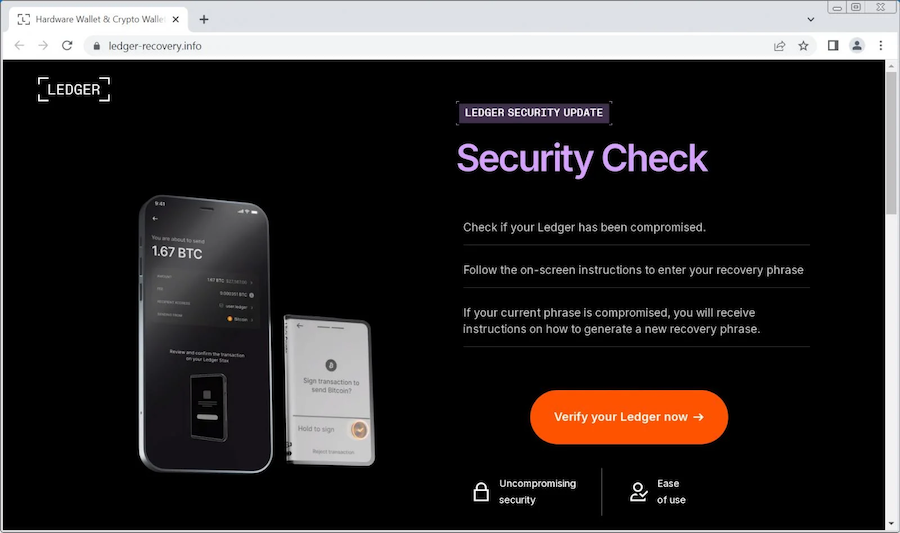
287.png

При вводе каждого слова фишинговая страница проверяет, является ли оно одним из 2 048 допустимых слов, которые можно ввести как часть фразы восстановления. При этом какую бы фразу ни ввел пользователь, она всегда будет указывать на ее недействительность. Таким образом мошенники добиваются того, чтобы жертвы вводили фразу несколько раз и позволяли злоумышленникам убедится, что вводятся правильные слова.

В BleepingComputer напомнили, что Ledger никогда не просит владельцев криптокошельков назвать фразу для восстановления и ее не следует сообщать кому-либо еще.

Ранее для кражи криптоактивов мошенники пытались убедить пользователей аппаратного кошелька Ledger активировать функцию безопасности Ledger Clear Signing, якобы позволяющую автоматически перепроверять адреса смарт-контрактов, суммы и комиссии.


Lecturas Relacionadas

Li Fei-Fei's Latest Long-Form Article: When Video Generation, Robotics, and NVIDIA All Call Themselves World Models, We Need a Taxonomy

In a new article, Dr. Fei-Fei Li addresses the widespread and often inconsistent use of the term "world model" in AI. She proposes a clear, functional taxonomy rooted in the classic Partially Observable Markov Decision Process (POMDP) loop (agent → action → state → observation → agent). According to this framework, current systems called "world models" are different projections of this loop, categorized by their primary output: 1. **Renderers**: Output observations (pixels). Their goal is visual fidelity for human consumption (e.g., video generation models like Sora). They are the most commercially mature but are limited by a focus on appearance over physical accuracy. 2. **Simulators**: Output states (geometric, physical, dynamic representations). They provide a structurally accurate world for both human professionals (e.g., architects) and computational agents (e.g., robots for training). Li argues simulators are the crucial, underappreciated bridge, as they can underpin both rendering and planning. 3. **Planners**: Output actions. Given an observation and a goal, they decide what an agent should do next (e.g., robotic action models). This area is highly promising but remains the least mature for real-world deployment. Li highlights a key trend: the boundaries between these three categories are beginning to blur, as they all rely on a shared underlying understanding of geometry, physics, and dynamics. The logical endpoint is a unified world foundation model capable of switching between rendering, simulation, and planning based on downstream needs. This convergence, she concludes, is central to advancing spatial intelligence—enabling machines not just to talk about the world, but to truly understand, imagine, and interact with it.

marsbitHace 3 hora(s)

Li Fei-Fei's Latest Long-Form Article: When Video Generation, Robotics, and NVIDIA All Call Themselves World Models, We Need a Taxonomy

marsbitHace 3 hora(s)

Forbes Feature: Stablecoin Cross-Border Payments Are Faster, But Not Yet Cheaper

A Forbes feature delves into the state of stablecoin-based cross-border payments, noting rapid growth but a key shortfall: while faster and more accessible, they are not yet cheaper. At a recent industry conference in Mexico City, optimism about technology, regulation, and volume was tempered by discussions with practitioners. The core issue is liquidity. Traditional FX brokers charge 60-70 basis points, and stablecoins promise to slash this to 2-5 basis points. However, this theoretical cost advantage cannot be realized until deep liquidity pools are established at scale, requiring significant institutional capital inflow. A major adoption barrier is trust. Businesses often rely on long-standing relationships with traditional brokers, valuing reliability over marginal cost savings. This shift will be gradual. Furthermore, successful companies in the space are not positioning themselves as replacements for legacy systems like SWIFT, but as complements. They leverage stablecoins for speed while using traditional rails for their standardization and reliability in ensuring accurate payment details—a critical factor for supplier payments to avoid customs issues. Companies like Caliza, experiencing high monthly growth, exemplify this hybrid approach. The industry anticipates consolidation, as long-term viability will depend on securing the essential trifecta: proper licensing, robust fiat on/off-ramps, and deep liquidity. Without these, firms risk being mere intermediaries rather than building sustainable businesses.

marsbitHace 3 hora(s)

Forbes Feature: Stablecoin Cross-Border Payments Are Faster, But Not Yet Cheaper

marsbitHace 3 hora(s)

Trading

Spot
活动图片