Дочерняя компания Nike под названием RTFKT объявила о закрытии

cryptonews.ruPublicado a 2024-01-03Actualizado a 2024-12-03

  • Компания RTFKT объявила о том, что полностью свернет деятельность в январе 2025 года.
  • Это одно из подразделений Nike, которое ранее занималось Web3-проектами.

Компания RTFKT, которая стала частью коммерческой группы Nike в 2021 году, объявила о своем закрытии. Согласно релизу, фирма свернет операции к концу января 2025 года.

pic.twitter.com/ySShPa0I7r

— RTFKT (@RTFKT) December 2, 2024

Что это за компания?

Nike объявила о покупке RTFKT в декабре 2021 года. Бывший CEO компании Джон Донахью на тот момент заявил, что сделка является частью стратегии по цифровой трансформации бренда.

RTFKT и Nike реализовали несколько совместных проектов. В частности, в декабре 2022 года была представлена первая коллекция кроссовок с интегрированным доступом к Web3.

Линейка Cryptokicks iRL, которая вышла ограниченной серией в 19 000 пар, предлагала покупателям ряд инновационных функций. Это встроенный шагомер, автоматическая шнуровка, управление жестами и возможность напрямую подключиться к проектам Move to Earn.

Также RTFKT выпустила NFT-коллекцию аватаров в сотрудничестве с художником Такаси Мураками под названием CloneX. Если на этапе запуска проекта объем торгов этими токенами колебался в пределах нескольких миллионов долларов, то позднее упал до десятков тысяч:
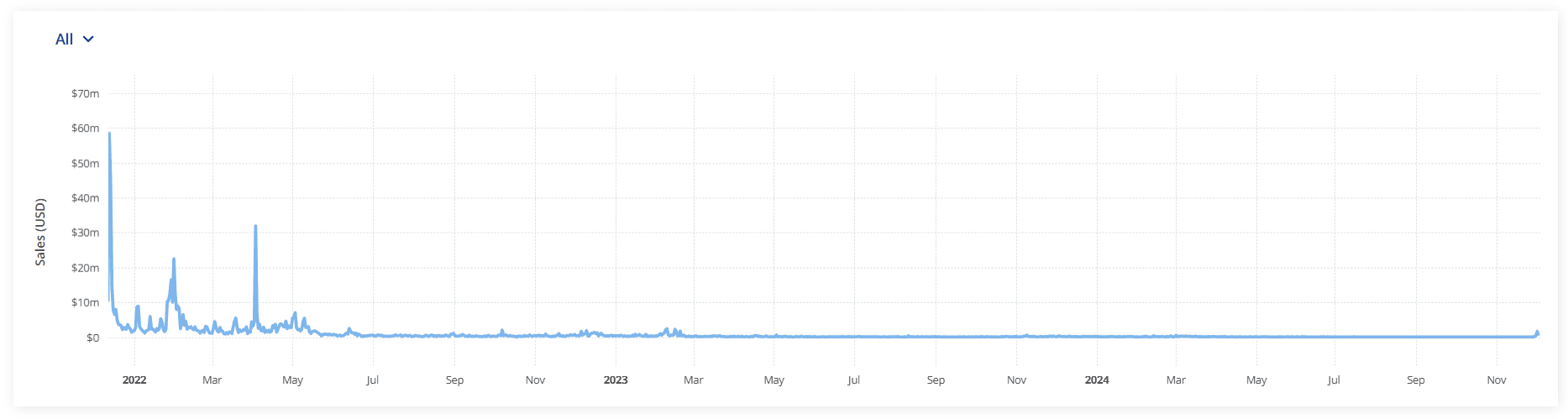
Объем торгов NFT-коллекцией CloneX. Источник: CryptoSlam.

Закрытие и реакция комьюнити

Слухи о том, что Nike планирует свернуть деятельность подразделения, появились еще в марте 2024 года. Соучредитель RTFKT прокомментировал ситуацию со скепсисом и попытался развенчать их:

Seems like we missed the memo on our shutdown 🤔🤣 Stay tuned for the next episode of Rumours from the Cryptoverse

— Zaptio RTFKT (@Zaptio) March 18, 2024

Однако, как следует из официального заявления студии, эти слухи не были беспочвенными. В релизе указано, что компания планирует полностью свернуть деятельность к концу января 2025 года.

Перед закрытием студия планирует представить еще один проект — MNLTH X с Blade Drop. Подробности о нем на момент написания неизвестны.

При этом Nike не сворачивает деятельность в сфере Web3 полностью. Платформа компании под названием .Swoosh продолжит работать. Она была запущена в ноябре 2022 года.

В сентябре 2024 года в официальном блоге проекта была опубликована запись о планах по его дальнейшему развитию. В ней, в том числе, напрямую указывалось, что Nike не будет запускать новые NFT-коллекции в ближайшее время.

Ситуация вызвала преимущественно непонимание у членов сообщества. Пользователей интересует то, что будет с NFT из коллекции CloneX, и причины закрытия подразделения.

Lecturas Relacionadas

24/5 Settlement Is Here for US Stocks, but Cryptocurrency Didn't Get a Ticket

The U.S. National Securities Clearing Corporation (NSCC), a subsidiary of the Depository Trust & Clearing Corporation (DTCC), has announced the implementation of 24-hour clearing operations on weekdays. This move, approved by the SEC and being rolled out in phases, fundamentally challenges a core narrative of the cryptocurrency industry: that digital assets offer a unique advantage with their 7x24 trading availability, unlike traditional markets that close at 4 p.m. The transition to near-continuous clearing for stocks and other traditional assets diminishes this perceived crypto edge. While crypto markets still operate on weekends, the article notes that DTCC could potentially expand to weekend clearing in the future if demand warrants. The development is presented as another instance where DTCC has disappointed crypto enthusiasts. Despite frequent speculation from communities supporting Ethereum, XRP Ledger, and others that DTCC would integrate public blockchains, the clearing giant consistently opts for private, permissioned distributed ledger solutions for its projects, such as its Ion platform and a recent U.S. Treasury tokenization initiative on the Canton network. The article concludes that the successful launch of this traditional finance "always-on" market relied entirely on existing mature infrastructure, with the cryptocurrency industry failing to secure a role or "admission ticket" in its implementation.

Foresight NewsHace 16 min(s)

24/5 Settlement Is Here for US Stocks, but Cryptocurrency Didn't Get a Ticket

Foresight NewsHace 16 min(s)

Karpathy's Genius Strikes Again, Challenging RAG, Turning Your Notes into a Second Brain

Andrej Karpathy has proposed a revolutionary concept for managing personal knowledge: treating notes as immutable "source code" and using LLMs as "compilers" to build a structured, interlinked wiki. This approach fundamentally shifts the cognitive workflow away from the limitations of RAG (Retrieval-Augmented Generation), which merely retrieves and pieces together fragments, leading to contradictions and "digital mummies"—unused, decaying notes. The LLM-Wiki framework introduces a three-layer architecture: the **Raw Layer** for original, immutable notes; the **Schema Layer** defining rules for structuring knowledge; and the **Wiki Layer**, where the LLM continuously compiles and maintains a coherent, cross-referenced knowledge base. Key operations are **Ingest** (adding new material, which triggers updates across related pages), **Query** (asking the compiled wiki, with answers that can become new pages), and **Lint** (periodic AI audits to find contradictions, outdated claims, or gaps). This system automates the tedious maintenance—updating links, resolving conflicts, keeping summaries fresh—that has historically made large-scale personal knowledge management unsustainable. It realizes Vannevar Bush's 1945 "Memex" vision by finally solving the maintenance problem. Karpathy's proposal represents a third piece in human-AI collaboration, following "Vibe Coding" and "Agentic Engineering." It liberates human attention from organizational drudgery, refocusing it on what matters: deciding what to read and deriving meaning.

marsbitHace 25 min(s)

Karpathy's Genius Strikes Again, Challenging RAG, Turning Your Notes into a Second Brain

marsbitHace 25 min(s)

Claude Science Completes Two Years' Work in a Few Weeks, Is 10x Research Acceleration Really Here?

Claude Science, a new AI workbench from Anthropic, is being tested by scientists, reportedly accelerating specific research workflows by up to 10x. A neuro-scientist at the Allen Institute completed a lengthy literature review in weeks instead of nearly two years using the tool, which automates tasks like citation verification. The platform is an integrated environment for macOS and Linux, connecting to local or remote computing resources. It streamlines the fragmented research process—literature analysis, computation, visualization, and drafting—into a single, auditable workflow. A key feature is its emphasis on reproducibility: every chart generated includes the exact code, environment, and history used to create it. Claude Science uses a multi-agent system. A coordinator manages over 60 pre-configured skills for life sciences (genomics, proteomics, etc.) and can spawn specialized agents. A dedicated reviewer agent checks citations and calculations for accuracy, creating a form of internal AI peer review. The system operates with a human-in-the-loop, requiring user approval for major steps. Initial applications are in life sciences. Examples include target identification for biotech company Manifold Bio and germline variant analysis for glioma research at UCSF, completing analyses in roughly one-tenth the previous time. The approach contrasts with competitors: Google focuses on proprietary models like AlphaFold, while OpenAI is advancing models' scientific reasoning with benchmarks like GeneBench-Pro. Claude Science differentiates by automating and integrating the practical research pipeline, not just the model's intelligence, aiming to make AI-aided science more reproducible and integrated into daily lab work.

marsbitHace 29 min(s)

Claude Science Completes Two Years' Work in a Few Weeks, Is 10x Research Acceleration Really Here?

marsbitHace 29 min(s)

Trading

Spot
活动图片