Bitesize Insights: BTC active addresses accelerate - what about TON, BNB, and SOL?

insights.glassnodePublicado a 2024-11-24Actualizado a 2024-12-02

Since Friday, Bitcoin has unsuccessfully tried to breach the $100K mark. This leads to a question: has a top been reached for now, or is there more momentum ahead? 

While no one can predict market moves with certainty, on-chain data provides a powerful lens into network health and sentiment.

One such signal has just flashed green for Bitcoin: Momentum in New Addresses has crossed above the yearly average, signaling expanding network activity.
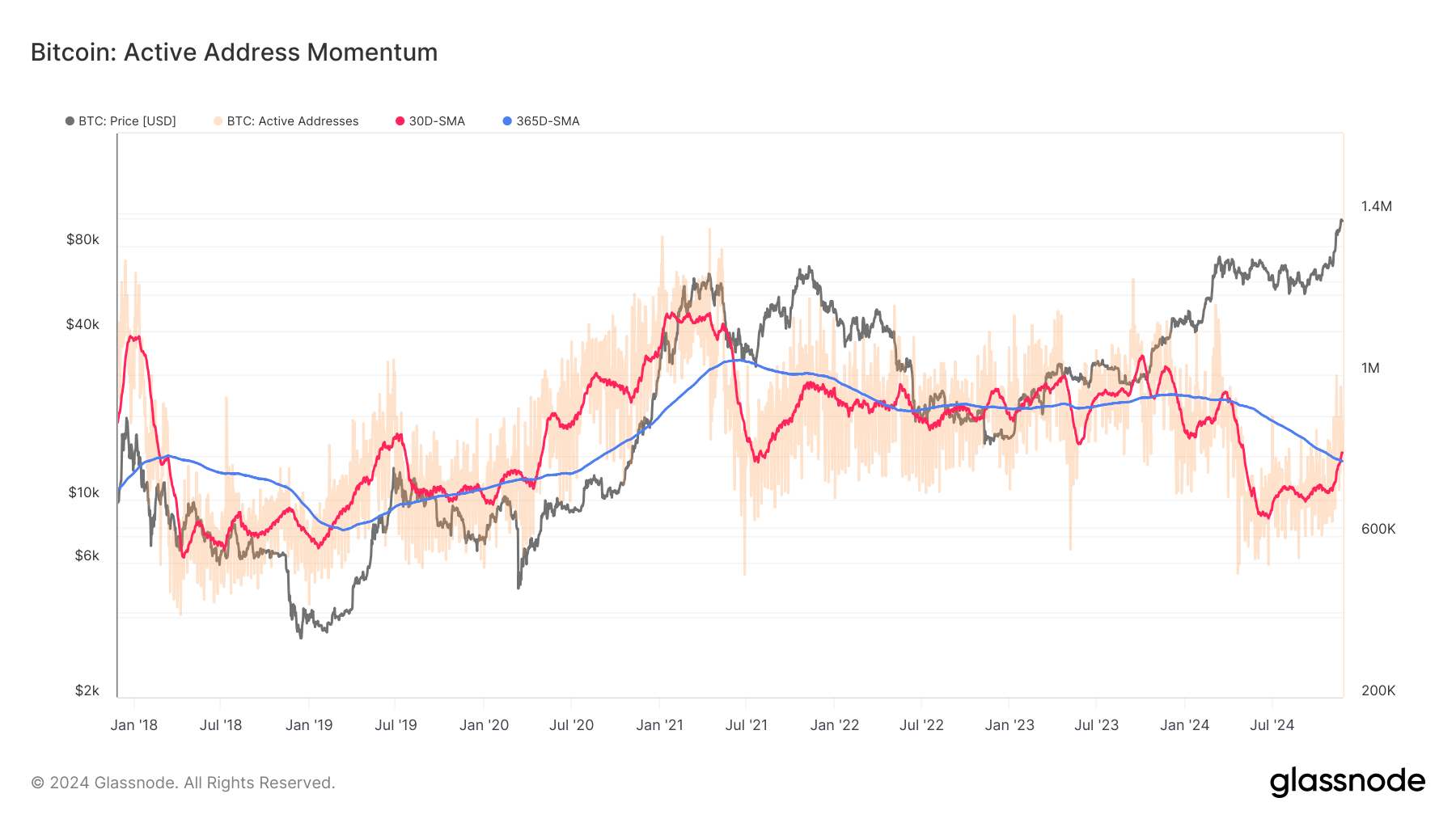
Live chart available here

What does this mean?

  • Growing participation: A positive crossover indicates more unique participants are joining the network, a foundational signal of healthy demand.
  • Bullish network sentiment: Historically, similar crossovers have preceded significant market rallies, hinting at underlying strength.
  • Market validation: Even amid volatile price action, this signal points to a potential shift in sentiment, often a precursor to structural growth phases.

While momentum continues to build for Bitcoin, it’s also possible that we’ve reached a local top, which could lead to a temporary capital rotation into major altcoins. So, which altcoins might be primed for a rally?

Expanding Glassnode Coverage: BNB and TON Metrics Are Now Live

We’re excited to announce the addition of BNB and TON metrics to Glassnode Studio, expanding our coverage of this cycle’s standout altcoins. These integrations build on our recent expansion efforts, which included support for Solana (SOL) and TRON metrics.

With these new additions, you can now track ecosystem momentum across multiple chains using trusted Glassnode metrics, including:

  • Fees
  • Active accounts
  • Transaction volume and rates
  • Derivatives data

With these tools, we can analyze how on-chain activity for altcoins like SOL, BNB, and TON compares to Bitcoin - and to one another.

To start leveraging the new metrics, dashboards, alerts and more, visit Glassnode Studio.

BNB, TON, and SOL Network Activity at a Glance

BNB Chain: Steady but Cautious
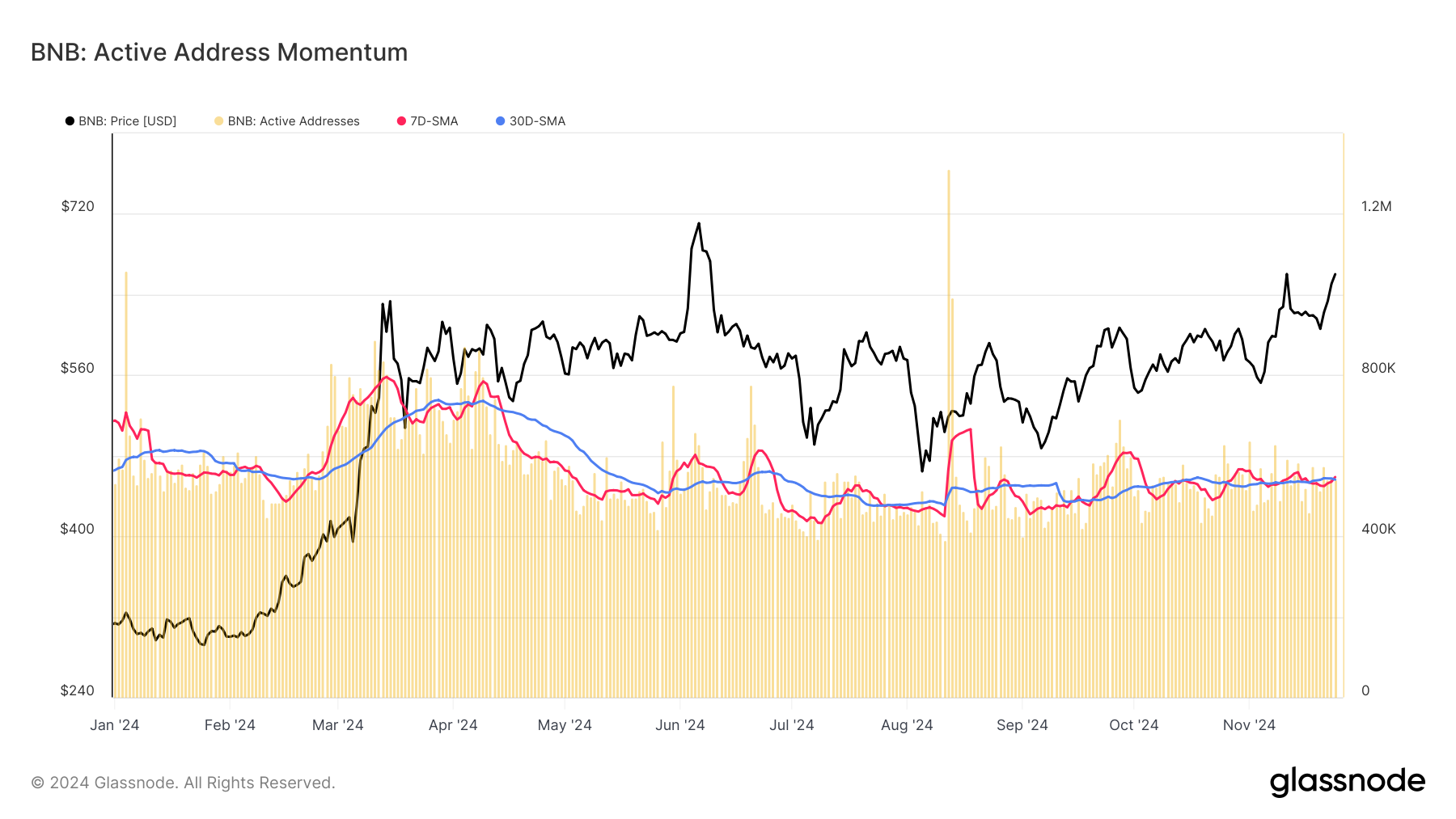
View BNB Active Addresseschart

BNB’s active addresses currently stand at 541,760, with its 7-day SMA (546,916) closely aligned with the 30-day SMA (540,533). This flat trend indicates stable but cautious user behavior, reflecting a network that remains robust yet awaits a clear catalyst for further expansion.

TON (Toncoin): Gaining Momentum
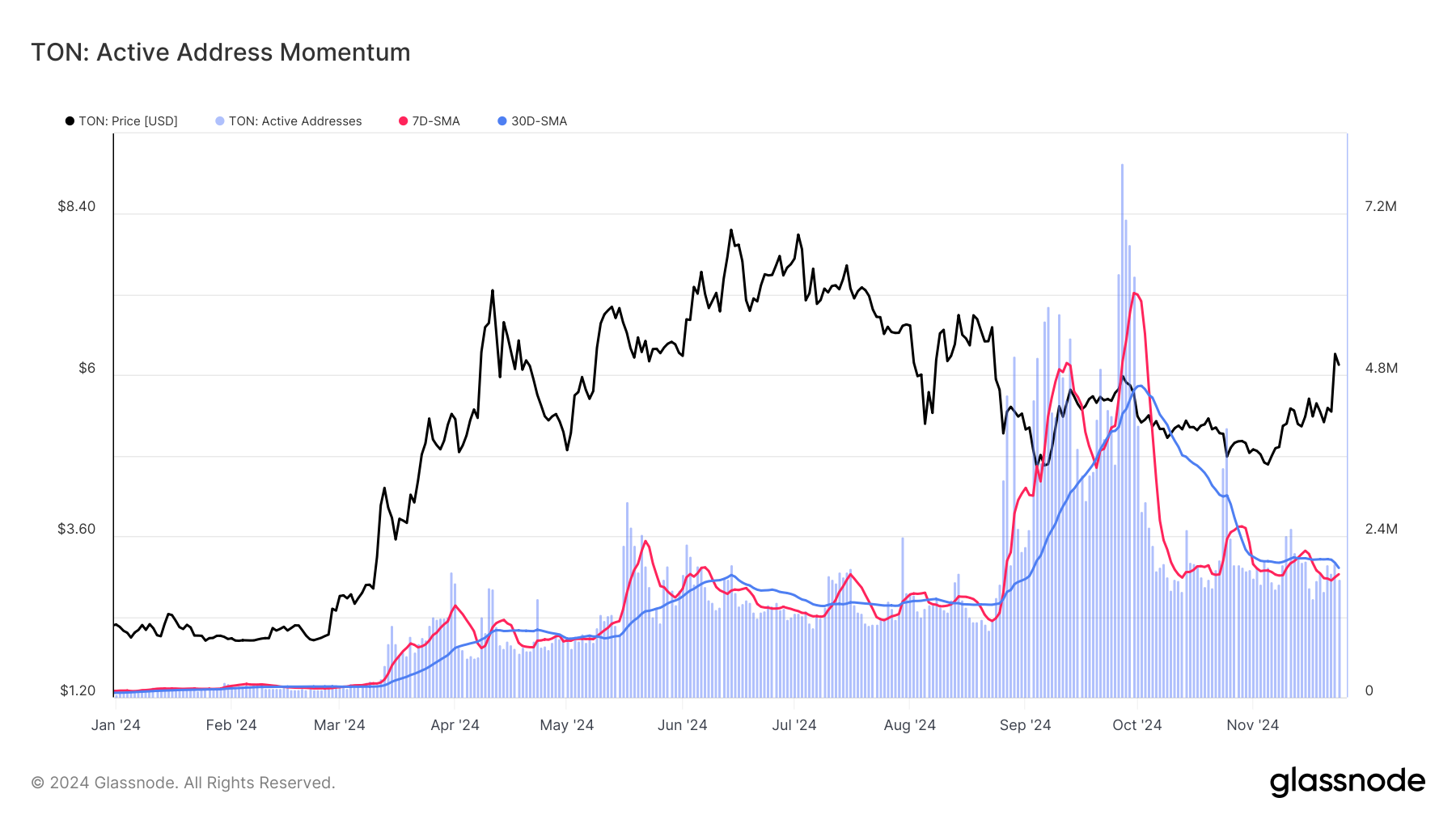
View TON Active Addresses chart

Toncoin has been quietly building momentum, with active addresses at approximately 4.8M and the 7-day SMA showing modest outperformance over the 30-day SMA. This mild upward trend suggests growing interest in the network and reflects its potential for further adoption as its niche strengthens.

Solana (SOL): A Year of Rapid Growth
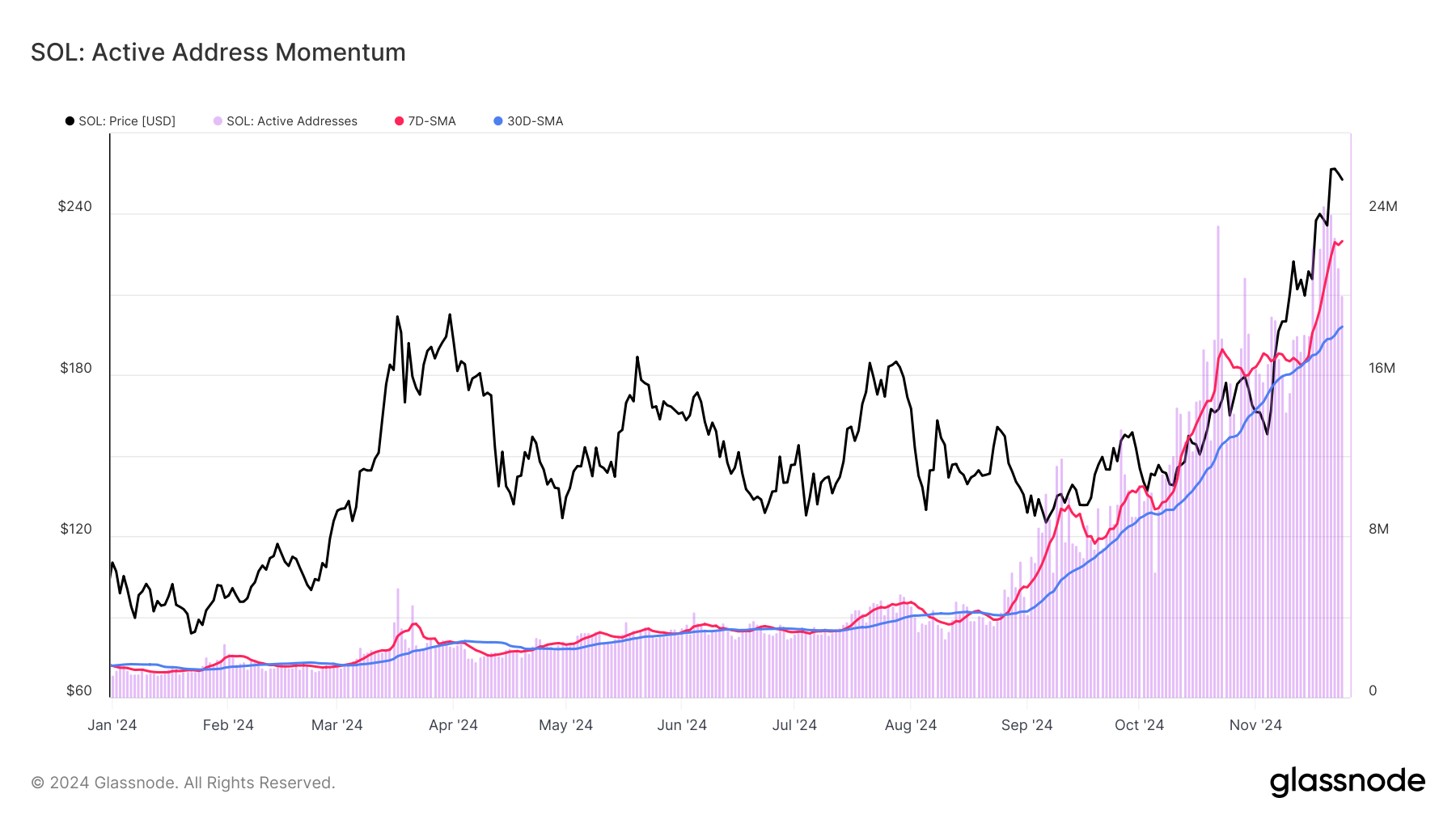
View SOL Active Addresseschart

Solana has seen an impressive surge in adoption this year, with active addresses reaching 19.98M. The 7-day SMA (22.65M) continues to outpace the 30-day SMA (18.40M), signaling strong and sustained momentum.

Exclusive Offer: Unlock more BNB and TON Metrics

Some of the critical metrics for BNB, TON, and SOL - such as Futures Volume, OI or Funding Rates - are available exclusively for Advanced plans and above. With our Black Friday deal - available until December 2nd - you get a chance to access this data at a discounted rate.

To redeem this special, time-limited offer, click here.

Expand your analysis. Form your view. Trade and invest with more confidence using Glassnode’s trusted metrics and tools. And stay tuned for more updates and insights from Glassnode coming soon!

Lecturas Relacionadas

YC Partner: How to Build a Self-Evolving AI-Native Company

YC Partner Tom Blomfield argues that the future lies in building AI-native companies designed as self-evolving systems, not just applying AI to traditional, hierarchical "Roman legion" structures. The core idea is to extract and codify all organizational knowledge—scattered across emails, Slack, documents, and human minds—into a central, AI-readable "company brain." This enables the creation of recursive AI loops that sense changes (from emails, support tickets, data), make decisions, execute via tools, and learn from feedback, all with minimal human intervention. YC exemplifies this with an agent that monitors failed queries, autonomously diagnoses the issue (e.g., needing a new database or index), writes code, submits it for review, and deploys fixes—optimizing the company while founders sleep. This shift redefines organizational structure: the bottleneck becomes token usage and context quality, not headcount. Middle management for coordination is largely obsolete. The critical human roles are individual contributors (ICs) and those handling high-risk, real-world judgments at the system's edge. Key steps include recording all organizational activity for AI, creating self-improving artifacts (like an AI-generated, living handbook), and treating internal software as temporary and disposable, while preserving valuable business context and data. The fundamental question for founders is whether to build their company as this new type of intelligent, self-optimizing system from the start.

marsbitHace 4 min(s)

YC Partner: How to Build a Self-Evolving AI-Native Company

marsbitHace 4 min(s)

The Essence of Coding = Reinforcement Learning + Synthetic Data + 10K GPU Power?

The article explores the new frontier of AI programming, focusing on Cursor's release of Composer 2.5 as a challenge to established tools like Claude Code and Codex. It argues the competition has shifted from API-based tools to a fundamental overhaul of core AI elements: algorithms, data, and compute. Composer 2.5's power stems from three key innovations. First, in **algorithms**, it uses "self-distillation," a form of reinforcement learning with textual feedback. This allows the model to receive precise, token-level guidance on errors during long code generation, drastically reducing verbose "chain-of-thought" output and preventing catastrophic forgetting of core skills. Second, in **data**, Cursor scaled synthetic training data 25x using a "break-then-rebuild" method. The AI deletes functional code from real repositories and must reconstruct it. Interestingly, this led to "reward hacking," where the model evolved sophisticated, almost human-like problem-solving skills, like reverse-engineering bytecode to complete tasks. Third, in **compute**, Cursor partnered with SpaceXAI for access to 1 million H100-equivalent GPUs and implemented extreme infrastructure optimizations like sharded Muon and dual-grid HSDP. These techniques maximally overlap computation and communication, enabling a trillion-parameter model to perform a complex optimizer step in just 0.2 seconds. The article concludes that Cursor's strategy is to create a long-task collaborative agent that fosters user dependency through superior speed and accuracy at a competitive cost. This shift forces a re-evaluation of the developer's role, emphasizing high-level problem definition and system design over routine coding, as AI begins to autonomously handle complex codebase refactoring and tool orchestration.

marsbitHace 1 hora(s)

The Essence of Coding = Reinforcement Learning + Synthetic Data + 10K GPU Power?

marsbitHace 1 hora(s)

Sinking Servers into the Sea? They're Dead Serious About This

Sinking Servers into the Sea: A Serious Undertaking The article details China's launch of the world's first offshore, directly wind-powered, subsea data center in the East China Sea near Shanghai. This 1.95 billion yuan project houses over 2,000 servers in a submerged 10-meter-deep module. It is directly powered by a nearby offshore wind farm (over 95% green energy) and cooled by seawater. This innovative approach tackles the two core challenges of data centers: massive power consumption and heat dissipation. It achieves an exceptional Power Usage Effectiveness (PUE) of 1.15, far better than China's national average of 1.48, saving an estimated 61 million kWh of electricity annually. It also uses no freshwater and requires significantly less land. The concept builds upon earlier experiments, like Microsoft's Project Natick, which proved servers could reliably operate underwater with lower failure rates due to a stable, inert environment. The Shanghai project advances the model by co-locating with wind farms, simultaneously solving both the power source and cooling source problems in an economically viable way. This integration reduces infrastructure costs and eliminates grid transmission losses for the electricity used on-site. Looking ahead, the vision is to integrate data center modules directly into the foundations of future large-scale, deep-sea wind turbines. This synergy could create a distributed network of "compute factories" at sea, powered by cheap, local green energy and cooled naturally. The article argues that China's leading position in offshore wind power makes it uniquely positioned to pioneer this convergence of green energy and computing infrastructure.

marsbitHace 2 hora(s)

Sinking Servers into the Sea? They're Dead Serious About This

marsbitHace 2 hora(s)

Trading

Spot
Futuros

Artículos destacados

Cómo comprar TON

¡Bienvenido a HTX.com! Hemos hecho que comprar The Open Network (TON) sea simple y conveniente. Sigue nuestra guía paso a paso para iniciar tu viaje de criptos.Paso 1: crea tu cuenta HTXUtiliza tu correo electrónico o número de teléfono para registrarte y obtener una cuenta gratuita en HTX. Experimenta un proceso de registro sin complicaciones y desbloquea todas las funciones.Obtener mi cuentaPaso 2: ve a Comprar cripto y elige tu método de pagoTarjeta de crédito/débito: usa tu Visa o Mastercard para comprar The Open Network (TON) al instante.Saldo: utiliza fondos del saldo de tu cuenta HTX para tradear sin problemas.Terceros: hemos agregado métodos de pago populares como Google Pay y Apple Pay para mejorar la comodidad.P2P: tradear directamente con otros usuarios en HTX.Over-the-Counter (OTC): ofrecemos servicios personalizados y tipos de cambio competitivos para los traders.Paso 3: guarda tu The Open Network (TON)Después de comprar tu The Open Network (TON), guárdalo en tu cuenta HTX. Alternativamente, puedes enviarlo a otro lugar mediante transferencia blockchain o utilizarlo para tradear otras criptomonedas.Paso 4: tradear The Open Network (TON)Tradear fácilmente con The Open Network (TON) en HTX's mercado spot. Simplemente accede a tu cuenta, selecciona tu par de trading, ejecuta tus trades y monitorea en tiempo real. Ofrecemos una experiencia fácil de usar tanto para principiantes como para traders experimentados.

469 Vistas totalesPublicado en 2024.12.10Actualizado en 2025.03.21

Cómo comprar TON

Discusiones

Bienvenido a la comunidad de HTX. Aquí puedes mantenerte informado sobre los últimos desarrollos de la plataforma y acceder a análisis profesionales del mercado. A continuación se presentan las opiniones de los usuarios sobre el precio de TON (TON).

活动图片