XRP Powers Through $1.7 Support: Can The Bulls Sustain The Momentum?

bitcoinistPublicado a 2024-12-01Actualizado a 2024-12-02

Resumen

XRP has broken past the $1.7 level, signaling a renewed push by the bulls to dominate the market. This critical...

XRP has broken past the $1.7 level, signaling a renewed push by the bulls to dominate the market. This critical move has sparked excitement among traders, fueling speculation about its capability for further gains. As momentum builds, the spotlight shifts to whether the altcoin can sustain this strength and continue its upward trajectory.

This article examines XRP’s surge above the $1.7 resistance, exploring the factors bolstering its bullish momentum. It assesses the cryptocurrency’s potential for continued growth, considering technical indicators, resistance levels, and market trends to determine whether the rally can be sustained or if a reversal is imminent.

Analyzing The Break Above $1.7 Resistance

On the 4-hour chart, XRP is pushing to extend its gains toward its next resistance level of $1.9, maintaining a solid position above the $1.7 support level and the 100-day Simple Moving Average (SMA). Staying above these key levels underscores its strength and signals the potential for continued upward movement. As long as the asset maintains this strength, the next target will likely be higher resistance levels, driving the price even more toward $ 1.9 and beyond.

XRP
XRP holding firm above $1.7 and the 100-day SMA | Source: XRPUSDT on Tradingview.com

The 4-hour Relative Strength Index (RSI) at 80% indicates strong positive movement for the altcoin, signaling sustained buying pressure. While this suggests continued demand, the RSI approaching the overbought zone means traders will closely monitor for any signs of overextension or pullbacks, which could lead to a short-term correction before the rally resumes.

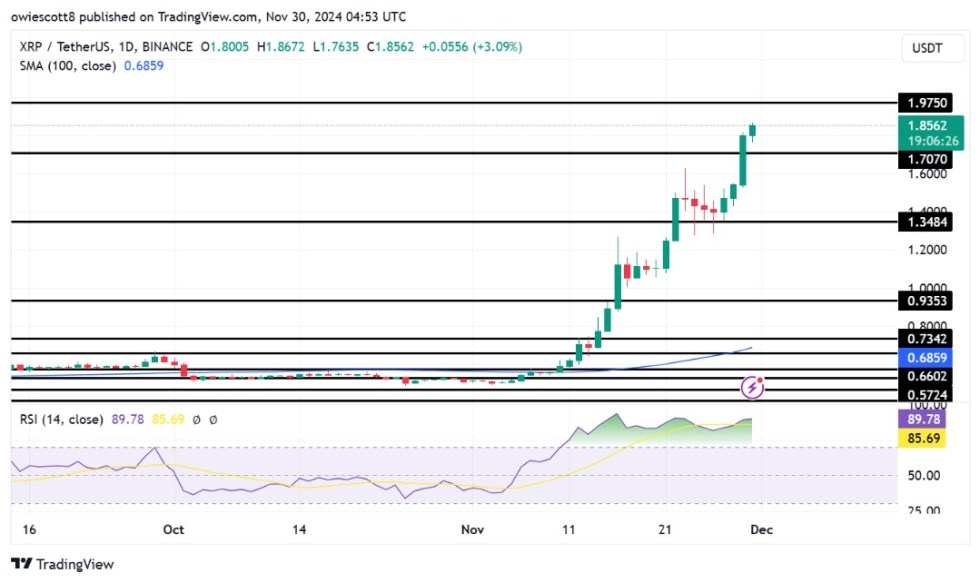
XRP is showing continued upward momentum on the daily timeframe after breaking through the key $1.7 resistance level and holding above the 100-day SMA as it advances to the $1.9 mark. This solid performance underscores sustained bullish strength, suggesting that the token is well-positioned for additional price growth. The 100-day SMA reinforces the possibility of continued upward movement.
XRP
$1.9 level in sight | Source: XRPUSDT on Tradingview.com

Furthermore, the daily RSI has increased to 89%, well above the 50% threshold, reflecting strong upbeat strength for the asset. Significantly, this implies upside pressure and sustained buying activity, with no signs of slowing down. While entering the overbought zone, the RSI highlights the rally’s intensity, implying a persistent rise, though traders will remain cautious for possible corrections.

Price Outlook: Can XRP Secure Long-Term Momentum Above $1.7?

XRP’s price outlook is closely tied to its ability to hold above the $1.7 level. Staying above this support could provide a strong foundation for an extended upside, with the next target being its all-time high of $1.9. A successful breakout above this level could open the door to new record highs.

However, if the cryptocurrency reaches the $1.9 level and fails to break through, a pullback to the $1.7 support is likely. Furthermore, a break below this support could lead to further losses, with the $1.3 level as the next target, potentially followed by even lower levels.

XRP
XRP trading at $1.9 on the 1D chart | Source: XRPUSDT on Tradingview.com
Featured image from Adobe Stock, chart from Tradingview.com
Godspower Owie

Godspower Owie

Godspower Owie is my name, and I work for the news platforms NewsBTC and Bitcoinist. I sometimes like to think of myself as an explorer since I enjoy exploring new places, learning new things, especially valuable ones, and meeting new people who have an impact on my life, no matter how small. I value my family, friends, career, and time. Really, those are most likely the most significant aspects of every person's existence. Not illusions, but dreams are what I pursue.

Lecturas Relacionadas

TechFlow Intelligence Report: Xiaomi Announces 200 Billion HKD Stock Buyback Plan, Spot Gold Falls Nearly 1%

TechFlow Report: Xiaomi announced a HK$200 billion stock buyback plan, while spot gold fell nearly 1%. A wider range of tech headlines includes Google unveiling its powerful video editing model Gemini Omni and the original "Attention is All You Need" authors advocating for a move beyond Transformer architecture. In other AI news, IBM reported its first successful use of a quantum computer to train an AI model, and Qwen3.5 released uncensored local model versions. The crypto/Web3 sector saw discussions on opaque stablecoin products and DEX fee changes. Major tech companies are under scrutiny: Uber's COO publicly questioned the ROI of AI investments, Motorola was accused of hijacking Amazon app links for affiliate codes, and Google faced criticism for using web data to fuel its AI. U.S. markets are focused on high S&P 500 valuations (31.8x P/E) and an intense concentration of capital in semiconductor stocks, with warnings about the sustainability of the AI data center boom. Geopolitical tensions, featuring simultaneous U.S. airstrikes on Iran and peace talks, caused significant oil price volatility. Other notable developments include Ferrari's first pure EV priced at 4.35 million yuan and Boston Dynamics' Atlas robot learning soccer from videos. The underlying theme suggests the AI narrative is shifting from boundless potential to requiring tangible results, while traditional geopolitical risks remain a powerful force in markets.

marsbitHace 2 min(s)

TechFlow Intelligence Report: Xiaomi Announces 200 Billion HKD Stock Buyback Plan, Spot Gold Falls Nearly 1%

marsbitHace 2 min(s)

Coin & Stock Barometer: Bitcoin Miner MARA Holdings Spends Over $860,000 on Bulletproof Vehicle Services for Executives; Bitmine Included in Preliminary List for FTSE Russell 1000 Index (May 19)

Crypto Market Wrap & Key Corporate Updates (May 19) The crypto market saw a decline followed by a minor rebound, while U.S. crypto-related stocks fell broadly. In corporate news: **MARA Holdings**, a Bitcoin miner, disclosed spending over $869,000 on vehicle ballistic armor services for its CEO and CFO under its security program. The board cited higher risks associated with the company's public disclosure of holding substantial Bitcoin assets. According to BitcoinTreasuries.NET, Elon Musk's **SpaceX and Tesla** collectively hold 30,221 BTC ($2.3B), which would rank them as the fifth-largest public company holder if combined. **DDC Enterprise Limited** increased its Bitcoin holdings by 200 BTC, bringing its total to 2,583 BTC. The firm stated it plans to continue accumulating BTC based on liquidity, not short-term price movements. Bitcoin treasury company **Nakamoto** announced a 1-for-40 reverse stock split to regain compliance with Nasdaq's minimum bid price requirement. The company reported a Q1 2026 net loss of $238.8M, partly due to a $102.5M unrealized loss on its Bitcoin holdings. **Tether** acquired SoftBank's stake in **Twenty One Capital (XXI)**, increasing its control. Tether's CEO expressed strengthened confidence in XXI's long-term Bitcoin strategy. Fundstrat's **Tom Lee** stated that **Bitmine (BMNR)** has been included in the preliminary list for the FTSE Russell 1000 Index. Concurrently, two new wallets suspected to be linked to Bitmine withdrew 60,000 ETH ($126M) from Bitgo and Kraken. Solana treasury company **Solmate Infrastructure** announced a registered direct offering of shares to raise approximately $11.4 million. **AI Financial**, a WLFI treasury company, reported a Q1 2026 net loss of $271.5M and raised substantial doubt about its ability to continue as a going concern, partly due to unrealized losses on its WLFI token holdings. **SUI Group** disclosed it holds over 108.7 million SUI tokens (~$115M), with its market cap to net asset value ratio at 0.91x. *Disclaimer: This summary is for informational purposes only and does not constitute investment advice.*

marsbitHace 18 min(s)

Coin & Stock Barometer: Bitcoin Miner MARA Holdings Spends Over $860,000 on Bulletproof Vehicle Services for Executives; Bitmine Included in Preliminary List for FTSE Russell 1000 Index (May 19)

marsbitHace 18 min(s)

China's AI Fronts: From Yan'an to Midway

This article analyzes the competitive landscape of China's AI industry through a dual-front war analogy: the "Eastern Front" of business model competition and the "Western Front" of global strategic positioning. **The Eastern Front: The Scramble for Supply Lines and Monetization** The "Eastern Front" examines the contrasting strategies of three Chinese tech giants—Tencent, Alibaba, and ByteDance—in the face of AI's high marginal costs. Tencent integrates AI as a catalyst within its existing ecosystems (advertising, gaming, cloud) for monetization, prioritizing high-value scenarios over user growth. Alibaba bets on a full-stack, self-developed approach from chips to applications, aiming to control costs and ecosystem, though this requires immense patience and resources. ByteDance, with Doubao as its flagship, pursues a traditional traffic-driven, "super app" strategy but faces severe monetization challenges as its massive user base incurs unsustainable operational costs. The central challenge for all is building a reliable "supply line" (sustainable funding/profit) and achieving efficient monetization, moving beyond being mere "token factories." **The Western Front: "Preserving Land" vs. "Preserving People"** The "Western Front" frames a global strategic divergence. The U.S. model ("preserving land") focuses on closed-source, high-premium models (e.g., Anthropic) targeting lucrative enterprise markets. China's strategy ("preserving people") leverages open-source models (e.g., Alibaba's Qwen, DeepSeek) and extremely low pricing to attract global developers and capture long-tail markets, akin to a "surround the cities from the countryside" approach. The goal is to make Chinese models the default infrastructure, locking in future ecosystem value. However, the critical test is whether this open-source ecosystem can achieve a commercial闭环, converting developer adoption into tangible revenue (e.g., via cloud services), and bridging the monetization gap with Western models that charge for value, not just tokens. **Conclusion: The Long March from Factory to Brand** The article concludes that China's AI industry possesses technology, users, and scenarios but must integrate them to create and capture value. Its ultimate success depends on navigating both fronts: companies must establish sustainable monetization on the Eastern Front, while the industry's Western strategy must evolve from simply "preserving people" (developer adoption) to truly "preserving both people and land" — transforming open-source ecosystem dominance into commercial success and premium brand value. This journey from being a "token factory" to a "value highland" will require strategic patience and the ability to outlast competitors in a prolonged contest.

marsbitHace 49 min(s)

China's AI Fronts: From Yan'an to Midway

marsbitHace 49 min(s)

A History of Technological Evolution Powered by Electricity: Aluminum, Bitcoin, and AI

The journey from the Rockdale aluminum smelter in Texas to space-based data centers illustrates a core economic principle: whoever controls the cheapest electricity dictates the use of computing power. The evolution is clear. Old industrial sites with pre-existing, high-capacity power grids are being repurposed. In Rockdale, a former Alcoa plant now houses vast Bitcoin mining rigs, which are increasingly being replaced by AMD chips for AI training. The logic is purely financial: while smelting aluminum yields $0.17–0.27 per kWh and Bitcoin mining $0.05–0.11, AI inference on H100 GPUs generates $1.27–3.67 per kWh. Recent deals confirm the rush for power infrastructure. Riot Platforms leases space to AMD; TeraWulf bought an old Kentucky aluminum plant for its grid; NYDIG secured a New York site for its cheap hydropower to mine Bitcoin. As AI giants like Anthropic, Microsoft, Google, and Amazon aggressively expand, they now directly compete with crypto miners for the same industrial power resources, often outbidding them. This has led to a decline in Bitcoin's global hash rate and a wave of miner conversions to AI data centers. This "digital resource curse" extends globally. Gulf nations, long offering subsidized power to attract heavy industry like aluminum, are now pivoting to become AI and cloud computing hubs—exporting computational power instead of physical commodities. Similarly, Bhutan halted its sovereign Bitcoin mining to sell hydropower directly to India for a steadier return. The frontier is space. Projects like Starcloud plan orbital solar-powered data centers, leveraging constant sunlight and natural cooling, with Bitcoin mining as a secondary use for surplus power. Even consumer brands are transforming; Allbirds shifted from footwear to AI infrastructure, causing its stock to surge. Meanwhile, crypto projects like Bittensor, Render, and Akash propose a decentralized alternative, creating markets to aggregate distributed, idle computing resources from individual hardware. The underlying infrastructure—the power grid—remains constant. As profit margins shift, the facilities built upon it will continue to evolve, from aluminum to Bitcoin to AI and beyond, always chasing the highest yield per kilowatt-hour, whether in Texas, Abu Dhabi, or low Earth orbit.

marsbitHace 59 min(s)

A History of Technological Evolution Powered by Electricity: Aluminum, Bitcoin, and AI

marsbitHace 59 min(s)

Conquering is easy, governing is hard: Polymarket must bow to regulations to plant its flag globally

Polymarket, a decentralized prediction market platform, faces significant regulatory hurdles in its global expansion. Its "permissionless" model, which bypasses traditional identity and financial controls, has led to widespread crackdowns. India recently blocked the site, categorizing it as illegal online gambling under new 2025 laws. Brazil also banned it and similar platforms, though it simultaneously authorized a regulated, investor-only version on its national exchange. Across Europe, countries like France, Portugal, and the Netherlands are enforcing bans based on existing gambling and financial regulations. To enter key markets, Polymarket is adopting a pragmatic, compliant approach. In the U.S., it paid a $1.12 million fine, acquired a CFTC-licensed exchange, and now operates a regulated, KYC-mandatory platform for American users. It also secured a major investment from Intercontinental Exchange (ICE), which will distribute its prediction data to institutional investors. In Japan, where gambling laws are strict, Polymarket has begun a long-term lobbying effort, aiming for legalization by 2030 through building institutional partnerships and community presence. Despite these challenges, the prediction market industry is booming, with global volume projected to surge from $51 billion to potentially $1 trillion by 2030. Polymarket's core dilemma remains: adapting its decentralized, anonymous model to fit within sovereign regulatory frameworks focused on licensing, consumer protection, and anti-money laundering rules. Its survival in each market depends on navigating this complex political and legal landscape.

marsbitHace 1 hora(s)

Conquering is easy, governing is hard: Polymarket must bow to regulations to plant its flag globally

marsbitHace 1 hora(s)

Trading

Spot
Futuros

Artículos destacados

Qué es XRP 2.0

XRP 2.0: Una Nueva Frontera en el Panorama de las Criptomonedas Introducción a XRP 2.0 En el siempre cambiante ámbito de las criptomonedas, nuevos proyectos surgen continuamente, compitiendo por atención y adopción. Una de estas iniciativas prometedoras es XRP 2.0, un nuevo proyecto de criptomoneda diseñado para aprovechar la tecnología blockchain avanzada y metodologías de encriptación robustas. Aunque el nombre establece paralelismos con el XRP de Ripple, es crucial señalar que XRP 2.0 opera de manera independiente, enfocándose en mejorar la seguridad de las transacciones, la privacidad y la escalabilidad. A medida que el panorama financiero digital abraza cada vez más soluciones descentralizadas, XRP 2.0 busca contribuir de manera significativa a web3 y a la expansión general de los proyectos de criptomonedas. ¿Qué es XRP 2.0? En esencia, XRP 2.0 es un proyecto de criptomoneda que busca crear un ecosistema de moneda digital seguro y descentralizado. Su tecnología fundamental integra principios avanzados de blockchain con técnicas de encriptación de vanguardia. El objetivo principal de XRP 2.0 es establecerse como una plataforma confiable y eficiente que permita la ejecución rápida de transacciones mientras prioriza la protección de la privacidad de sus usuarios. El proyecto se promociona como una solución a muchas limitaciones enfrentadas por las criptomonedas existentes, proponiendo un sistema que puede manejar un mayor volumen de transacciones con mejor velocidad y privacidad. Esta versatilidad posiciona a XRP 2.0 como un competidor significativo en un mercado plagado de diversas monedas digitales. ¿Quién es el Creador de XRP 2.0? La identidad del creador detrás de XRP 2.0 ha sido señalada como 'Wilbur.' Sin embargo, los detalles completos sobre Wilbur o su entidad asociada siguen siendo elusivos. La anonimidad de muchos creadores de criptomonedas no es un fenómeno poco común en la industria, a menudo diseñado para mantener un grado de privacidad y seguridad. ¿Quiénes son los Inversores de XRP 2.0? Hasta ahora, la información específica relacionada con las fundaciones o organizaciones de inversión que apoyan a XRP 2.0 no está disponible públicamente. En el sector de las criptomonedas, el respaldo de inversores respetables puede influir significativamente en la credibilidad y el éxito de un proyecto, sin embargo, la transparencia sobre los patrocinadores financieros de XRP 2.0 no se ha establecido. ¿Cómo Funciona XRP 2.0? XRP 2.0 se destaca al emplear una combinación de tecnología blockchain y algoritmos de encriptación avanzados que aseguran transacciones seguras y descentralizadas. Su estructura innovadora incluye características únicas diseñadas para fomentar el compromiso del usuario y ampliar las funcionalidades más allá de las transacciones convencionales de criptomonedas. Entre estas características, XRP 2.0 incorpora capacidades impulsadas por IA, como funcionalidades de texto a imagen y de texto a voz. Estas adiciones están diseñadas para mejorar la experiencia interactiva de los usuarios, promoviendo una mayor aplicabilidad en diversos sectores. Al unir avances tecnológicos con un diseño centrado en el usuario, XRP 2.0 busca captar la atención de una amplia gama de individuos y empresas que buscan integrar soluciones de criptomonedas en sus marcos operativos. Cronología de XRP 2.0 Entender XRP 2.0 requiere examinar los hitos que han definido su viaje hasta ahora: 23 de julio de 2023: Se presenta XRP 2.0 como un nuevo proyecto de criptomonedas, con el objetivo de revolucionar las capacidades de transacciones seguras y descentralizadas en el ámbito de blockchain. 8 de septiembre de 2023: Se lanza otro proyecto, XRP20, marcando la aparición de un token ERC-20 en la blockchain de Ethereum que no guarda relación con XRP 2.0. 13 de noviembre de 2023: El Libro Mayor de XRP experimenta una actualización significativa con el lanzamiento de la versión 2.0.0 del software del servidor rippled. Es esencial señalar que este desarrollo está desconectado del proyecto de criptomonedas XRP 2.0. Puntos Clave sobre XRP 2.0 Para destilar la esencia de XRP 2.0, surgen varios factores críticos: Características Únicas: La inclusión de características como texto a imagen y texto a voz impulsadas por IA diversifica aún más las aplicaciones potenciales de XRP 2.0. Tecnología Blockchain: El marco utiliza mecanismos avanzados de blockchain y protocolos de encriptación, asegurando un entorno seguro y descentralizado para las transacciones. Escalabilidad y Privacidad: XRP 2.0 prioriza la protección mejorada de la privacidad en los procesos de transacción y la escalabilidad necesaria para acomodar una base de usuarios creciente. No Afiliación con Ripple: Es importante destacar que, a pesar de su nombre, XRP 2.0 no tiene ninguna lealtad ni colaboración con el XRP de Ripple, diferenciando su marco operativo y objetivos dentro del ecosistema de criptomonedas. Conclusión XRP 2.0 representa una ambiciosa aventura en la esfera de las criptomonedas, buscando ofrecer una combinación de seguridad, privacidad y eficiencia en las transacciones digitales. Al integrar tecnologías sofisticadas y características amigables para el usuario, el proyecto se propone ampliar los horizontes de lo que la criptomoneda puede lograr en la economía digital de hoy. Si bien la anonimidad de su creador y la falta de inversores revelados pueden generar cuestionamientos para algunos, el enfoque de XRP 2.0 en funcionalidades avanzadas y descentralización realza su atractivo en un mercado de criptomonedas cada vez más abarrotado. A medida que el paisaje de las criptomonedas sigue evolucionando, XRP 2.0 podría emerger como un jugador crucial en la expansión de soluciones blockchain seguras y escalables.

174 Vistas totalesPublicado en 2024.04.05Actualizado en 2024.12.03

Qué es XRP 2.0

Cómo comprar XRP

¡Bienvenido a HTX.com! Hemos hecho que comprar XRP (XRP) sea simple y conveniente. Sigue nuestra guía paso a paso para iniciar tu viaje de criptos.Paso 1: crea tu cuenta HTXUtiliza tu correo electrónico o número de teléfono para registrarte y obtener una cuenta gratuita en HTX. Experimenta un proceso de registro sin complicaciones y desbloquea todas las funciones.Obtener mi cuentaPaso 2: ve a Comprar cripto y elige tu método de pagoTarjeta de crédito/débito: usa tu Visa o Mastercard para comprar XRP (XRP) al instante.Saldo: utiliza fondos del saldo de tu cuenta HTX para tradear sin problemas.Terceros: hemos agregado métodos de pago populares como Google Pay y Apple Pay para mejorar la comodidad.P2P: tradear directamente con otros usuarios en HTX.Over-the-Counter (OTC): ofrecemos servicios personalizados y tipos de cambio competitivos para los traders.Paso 3: guarda tu XRP (XRP)Después de comprar tu XRP (XRP), guárdalo en tu cuenta HTX. Alternativamente, puedes enviarlo a otro lugar mediante transferencia blockchain o utilizarlo para tradear otras criptomonedas.Paso 4: tradear XRP (XRP)Tradear fácilmente con XRP (XRP) en HTX's mercado spot. Simplemente accede a tu cuenta, selecciona tu par de trading, ejecuta tus trades y monitorea en tiempo real. Ofrecemos una experiencia fácil de usar tanto para principiantes como para traders experimentados.

1.3k Vistas totalesPublicado en 2024.12.10Actualizado en 2025.03.21

Cómo comprar XRP

Discusiones

Bienvenido a la comunidad de HTX. Aquí puedes mantenerte informado sobre los últimos desarrollos de la plataforma y acceder a análisis profesionales del mercado. A continuación se presentan las opiniones de los usuarios sobre el precio de XRP (XRP).

活动图片