Elon Musk Says He’s Not Actively Involved In Crypto, Then Why Is He So Bullish On Dogecoin?

bitcoinistPublicado a 2024-10-21Actualizado a 2024-10-21

Resumen

Tesla and SpaceX Chief Executive Officer (CEO), Elon Musk has been known to be significantly bullish on Dogecoin (DOGE), often...

Tesla and SpaceX Chief Executive Officer (CEO), Elon Musk has been known to be significantly bullish on Dogecoin (DOGE), often posting humorous tweets about the popular meme coin. However, recently the SpaceX CEO announced that he is not actively involved in cryptocurrency. This appears to contradict his very public adoration for Dogecoin, the king of meme coins, raising the question of why he continues to favor Dogecoin over other cryptocurrencies. 

Elon Musk Steps Back From Crypto

In a recent video shared by a popular Dogecoin supporter account called ‘CEO’ on X (formerly Twitter), Musk publicly declared that he is not actively involved in cryptocurrencies. This statement could come as a shock to many in the crypto community, considering the SpaceX CEO’s past involvement in cryptocurrencies. 

Being known to be the biggest backer of Dogecoin, the top meme coin, Musk’s influence has been constantly revered as a bullish factor that could drive DOGE to new levels. Earlier in April 2019, the Tesla CEO tweeted about Dogecoin, calling it his favorite cryptocurrency. Subsequently, Musk announced in January 2022 that he would begin accepting DOGE payments for merchandise on Tesla. 

The billionaire entrepreneur was also the primary contributor to Dogecoin’s massive fame, and value increase due to his occasional humorous comments about the meme coin. These numerous involvements with the DOGE meme coin certainly contradict Musk’s declaration of stepping back from actively participating in cryptocurrency. 

The possible reason behind the SpaceX CEO’s reluctance to engage in cryptocurrency may be due to previous challenges faced, as he was sued for allegedly promoting DOGE. In June 2023, Musk was accused of insider trading by investors, leading to a $258 billion lawsuit. Fast forward to August 2024, the SpaceX CEO had won the dismissal of the lawsuit and while this was a major victory, the hassles from the lawsuit may have spurred on his recent step back from crypto. 

Despite not being actively involved in cryptocurrency like he says, Musk’s companies still utilize it as payment and hold a considerable amount of Bitcoin. Tesla has adopted Dogecoin payment and currently owns 9,720 BTC, worth $667.7 million, while SpaceX holds 8,285 BTC, valued at $572.05 million. 

Musk’s Support For Dogecoin Still Bullish

While Musk has taken a step back from actively engaging in cryptocurrencies, the Tesla CEO appears to be notably bullish on DOGE. In the earlier X video, Musk expressed his affection for Dogecoin, citing its playful dog-themed humour as part of his reason for his continued enthusiasm. 

He explained that he frequently made jokes about Dogecoin because he felt that the meme coin had the best sense of humor, with its fun dog-themed memes. Moreover, the Tesla CEO also played a key role in Dogecoin’s over 10% surge last week after he mentioned his new proposal, “The Department Of Government Efficiency (D.O.G.E).”

Dogecoin price chart from Tradingview.com
DOGE price still holding $0.14 | Source: DOGEUSDT on Tradingview.com
Featured image created with Dall.E, chart from Tradingview.com
Scott Matherson

Scott Matherson

Scott Matherson is a leading crypto writer at Bitcoinist, who possesses a sharp analytical mind and a deep understanding of the digital currency landscape. Scott has earned a reputation for delivering thought-provoking and well-researched articles that resonate with both newcomers and seasoned crypto enthusiasts. Outside of his writing, Scott is passionate about promoting crypto literacy and often works to educate the public on the potential of blockchain.

Criptos en tendencia

Lecturas Relacionadas

Xing Bo Strikes Again: Last Time 'Critiquing' World Models, This Time It's Agents' Turn

Xing Bo, President of MBZUAI and professor at Carnegie Mellon University, along with co-authors Mingkai Deng and Jinyu Hou, has released a new paper, "Critique of Agent Model," critiquing the current state of artificial intelligence agents. The paper draws a crucial distinction between "agentic" systems, which rely on external toolchains, prompts, and workflows, and truly "agentive" systems capable of genuine autonomy driven by internal decision-making structures. To illustrate this, it references a real-world incident where an AI programming assistant, following an external prompt but lacking internalized judgment, caused a catastrophic data deletion. The authors propose a detailed analysis and a new framework, "Goal-Identity-Configurator" (GIC), for building truly autonomous agents. This framework systematically addresses five key dimensions where current "Agent" designs fall short: 1. **Goal:** Moving from step-by-step human instruction to a system capable of autonomously decomposing a single long-term goal and adapting sub-goals based on new information. 2. **Identity:** Evolving self-assessment updated by experience, rather than a static description in a system prompt. 3. **Decision Making:** Replacing textual Chain-of-Thought reasoning with "simulative reasoning" that uses a dedicated world model to predict real-world consequences before selecting actions. 4. **Cognitive Control:** Introducing a separate "System III" metacognitive module that dynamically decides when to deliberate, stick to a plan, or act quickly. 5. **Learning:** Enabling "continual autonomous learning," where the agent itself decides when to act, practice in simulation, or update its world model and self-perception. The GIC architecture integrates six components—a belief encoder, goal decomposer, identity evolver, configurator (System III), simulation-based planner (System II), and executor (System I)—to embody these principles. The paper argues that a growth path akin to pilot training (ground theory, simulator practice, real deployment) should be underpinned by a unified cognitive architecture, not separate workflows. On safety, the authors contend that the GIC framework's modular, explicit design enhances inspectability, allowing problematic behavior to be traced to specific components (e.g., flawed goal or poorly trained module) rather than emerging opaquely. However, they acknowledge that ultimate safety depends on correctly training these modules in the first place. In conclusion, the paper challenges the loose application of the term "Agent," asserting that task completion alone does not equal true autonomy. True autonomy requires goals, identity, and judgment to be genuinely internalized within the agent's architecture, not merely enforced by external scripts.

marsbitHace 3 min(s)

Xing Bo Strikes Again: Last Time 'Critiquing' World Models, This Time It's Agents' Turn

marsbitHace 3 min(s)

How Collector Crypt Uses 'Recirculating Buybacks' to Create an Illusion of Growth

Title: How Collector Crypt Creates a Growth Illusion with "Buyback Loops" Key Findings: Collector Crypt's (CC) net take rate has halved from 11.2% in Q3 2025 to 5.6% in Q2 2026, while GMV grew 4.7x. This growth is driven by higher-tier card packs ($250, $1,000, $2,500) which have lower platform dollar retention rates. The newly launched $2,500 Mythic tier captured 36.7% of June GMV within 13 days. Growth is fueled by a small cohort of high-spending, high-frequency wallets rather than broad user base expansion. The economic model faces pressure from three key areas: 1) **Shifting GMV Mix**: Pushing users towards larger, lower-retention card packs increases GMV but reduces overall profitability. 2) **Physical Redemptions**: Card redemptions for physical items remove reusable inventory from the system, creating costly replenishment needs. In May, redemptions consumed 41.6% of pre-redemption net income. Only 75 wallets drove redemptions in June. 3) **B2B/API Strategy**: Partner revenue remains negligible (cumulatively $1.83M) and dependent on CC for inventory, vaulting, and buyback services, failing to create a scalable, asset-light recurring revenue stream. The core product is a repetitive pack-buyback loop with limited secondary market activity and token value accrual. Sensitive modeling shows CC's economics turn negative when any two of the following pressures coincide: replenishment costs near market price, redemption rates exceeding 9%, or high-tier buyback rates around 93%. While CC operates in a large and growing collectibles market, its current growth levers—bigger packs, high buyback rates, and capital recycling by a few wallets—create a volume illusion without demonstrating sustainable collector engagement, deep secondary markets, or a viable path to improved margins. Future proof points include broadening collector participation, deepening secondary trading, and developing true asset-light B2B revenue channels.

Foresight NewsHace 26 min(s)

How Collector Crypt Uses 'Recirculating Buybacks' to Create an Illusion of Growth

Foresight NewsHace 26 min(s)

Grayscale's Latest Research: What is Solana's Next Growth Engine?

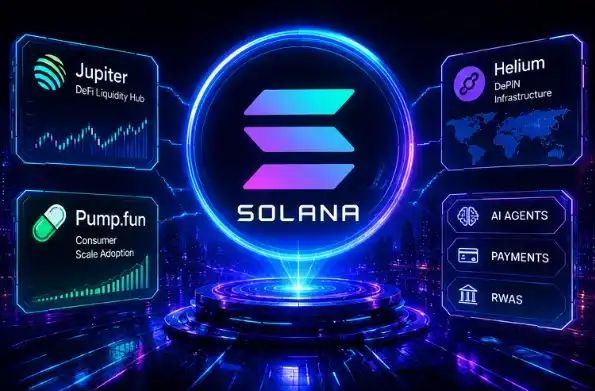
Grayscale's latest report, "Solana: Crypto's Financial Bazaar," signals a shift in how the market views Solana, moving beyond its high-performance and meme-centric reputation. The report frames Solana as an evolving application platform for large-scale economic activity, akin to a bustling digital marketplace. The analysis highlights that public chain competition has moved past raw throughput (TPS) to focus on genuine economic activity—daily users, transaction volume, and real revenue. Solana's metrics, such as over 1,000 dApps, 100M+ daily transactions, and ~4.3M daily active users, showcase this shift toward application-layer prosperity. The report identifies three key growth drivers: 1. **Jupiter**: Evolving from a DEX aggregator to a core liquidity hub and comprehensive financial platform for Solana's DeFi. 2. **Pump.fun**: Demonstrates Solana's capacity for consumer-scale applications, attracting millions of users and generating significant, sustainable revenue, validating network stability under high load. 3. **Helium & DePIN**: Represents expansion into real-world infrastructure, connecting blockchain to physical resources like wireless networks and positioning services, opening new long-term use cases. Solana Foundation's recent focus aligns with this broader vision, emphasizing AI Agents (for machine-to-machine transactions), payments, stablecoins, and Real-World Assets (RWA) to build a sustainable growth model beyond cyclical trends. While challenges remain—such as value capture for SOL and maintaining ecosystem sustainability beyond hot trends—institutional interest is growing due to Solana's maturing application business models, expanding payment/stablecoin ecosystem, and persistent developer activity. The competition is no longer about speed alone, but about which network can foster the most vibrant and valuable digital economy.

marsbitHace 47 min(s)

Grayscale's Latest Research: What is Solana's Next Growth Engine?

marsbitHace 47 min(s)

Trading

Spot

Artículos destacados

Cómo comprar ELON

¡Bienvenido a HTX.com! Hemos hecho que comprar Dogelon Mars (ELON) sea simple y conveniente. Sigue nuestra guía paso a paso para iniciar tu viaje de criptos.Paso 1: crea tu cuenta HTXUtiliza tu correo electrónico o número de teléfono para registrarte y obtener una cuenta gratuita en HTX. Experimenta un proceso de registro sin complicaciones y desbloquea todas las funciones.Obtener mi cuentaPaso 2: ve a Comprar cripto y elige tu método de pagoTarjeta de crédito/débito: usa tu Visa o Mastercard para comprar Dogelon Mars (ELON) al instante.Saldo: utiliza fondos del saldo de tu cuenta HTX para tradear sin problemas.Terceros: hemos agregado métodos de pago populares como Google Pay y Apple Pay para mejorar la comodidad.P2P: tradear directamente con otros usuarios en HTX.Over-the-Counter (OTC): ofrecemos servicios personalizados y tipos de cambio competitivos para los traders.Paso 3: guarda tu Dogelon Mars (ELON)Después de comprar tu Dogelon Mars (ELON), guárdalo en tu cuenta HTX. Alternativamente, puedes enviarlo a otro lugar mediante transferencia blockchain o utilizarlo para tradear otras criptomonedas.Paso 4: tradear Dogelon Mars (ELON)Tradear fácilmente con Dogelon Mars (ELON) en HTX's mercado spot. Simplemente accede a tu cuenta, selecciona tu par de trading, ejecuta tus trades y monitorea en tiempo real. Ofrecemos una experiencia fácil de usar tanto para principiantes como para traders experimentados.

185 Vistas totalesPublicado en 2024.12.12Actualizado en 2025.03.21

Cómo comprar ELON

Discusiones

Bienvenido a la comunidad de HTX. Aquí puedes mantenerte informado sobre los últimos desarrollos de la plataforma y acceder a análisis profesionales del mercado. A continuación se presentan las opiniones de los usuarios sobre el precio de ELON (ELON).

活动图片