Toncoin рискует вылететь из топ-10, Tron продолжает рост

cryptonews.ruPublicado a 2024-04-28Actualizado a 2024-08-28

Рыночная капитализация Toncoin (TON) снижается, и позиция токена в топ-10 криптовалют находится под угрозой. Он рискует вылететь из этого рейтинга

Флагманская монета «Телеграма»Toncoin (TON) уступила свою позицию в рейтинге рыночной капитализации токену Tron (TRX). Это произошло после недавней коррекции цены на фоне ареста основателя «Телеграма» Павла Дурова.

Флагман «Телеграма» спасовал перед Tron

До событий воскресенья рыночная капитализация TON составляла $17,20 млрд. Тем временем рыночная капитализация Tron превысила $14 млрд после того, как монета обогнала Cardano. Теперь же рыночная капитализация Toncoin упала до $13,47 млрд, сократившись на $4 млрд за последние три дня. Падение цены TON напрямую способствовало этому снижению.

Между тем Tron (TRX) находится в более выгодном положении. За последние 30 дней цена TON упала на 18%, а стоимость TRX увеличилась на ту же величину. Позитивная динамика TRX в основном связана с запуском площадки для создания мемкоинов SunPump, представленной основателем блокчейна Джастином Саном.
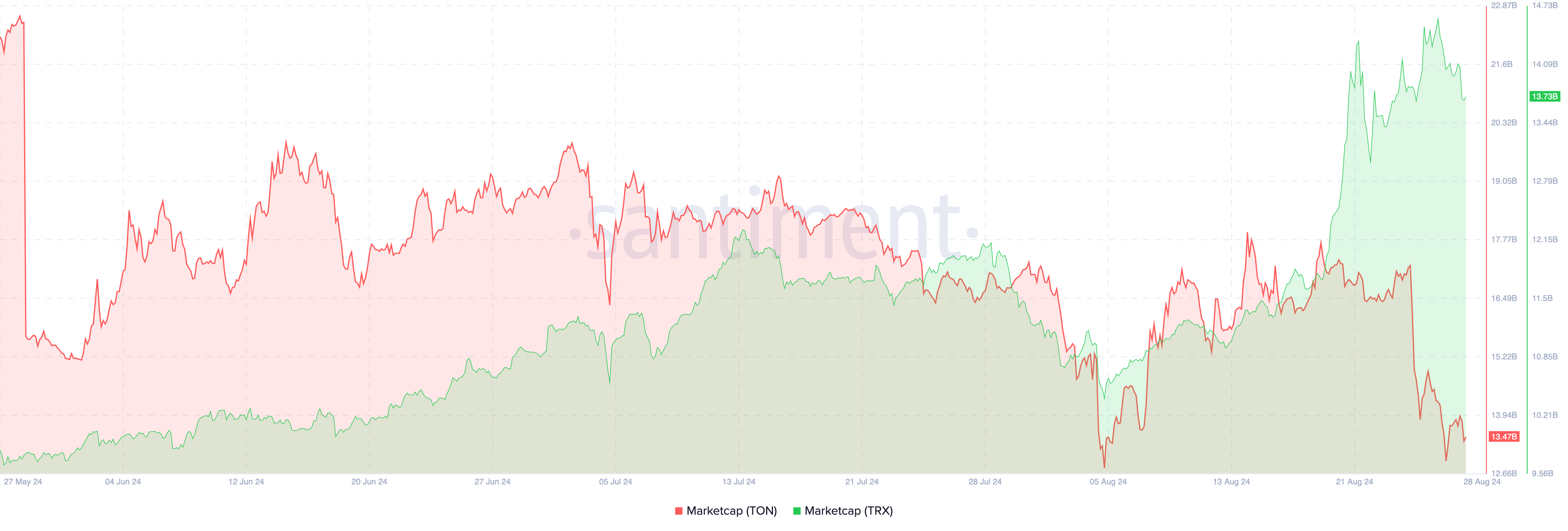
Toncoin против рыночной капитализации Tron. Источник: Santiment

Проект Toncoin тоже активно развивался до недавнего времени, привлекая к себе большое внимание. Однако продолжающиеся продажи и нерешенная ситуация с Дуровым предполагают, что цена и рыночная капитализация токена могут упасть еще больше.

Читайте подробнее: Что такое TON. Обзор проекта и криптовалюты Toncoin

Показатель чистого потока средств в сегменте крупных держателей (Large Holders Inflow) уменьшился на 95% за последние семь дней. Крупные держатели — это адреса, на которых хранится более 1% оборотного предложения актива. Чистый поток измеряет разницу между количеством монет, купленных этими крупными держателями (приток) и проданных ими (отток) за определенный период.

Когда показатель резко вырастает, это бычий сигнал. Он указывает на то, что киты накапливают актив. И наоборот, снижение означает усиление оттока средств с адресов крупных игроков. Это чревато потенциальным давлением продаж и снижением цены. В случае с TON снижение показателя свидетельствует о том, что крупные инвесторы остаются осторожными и не покупают токены по текущей цене.
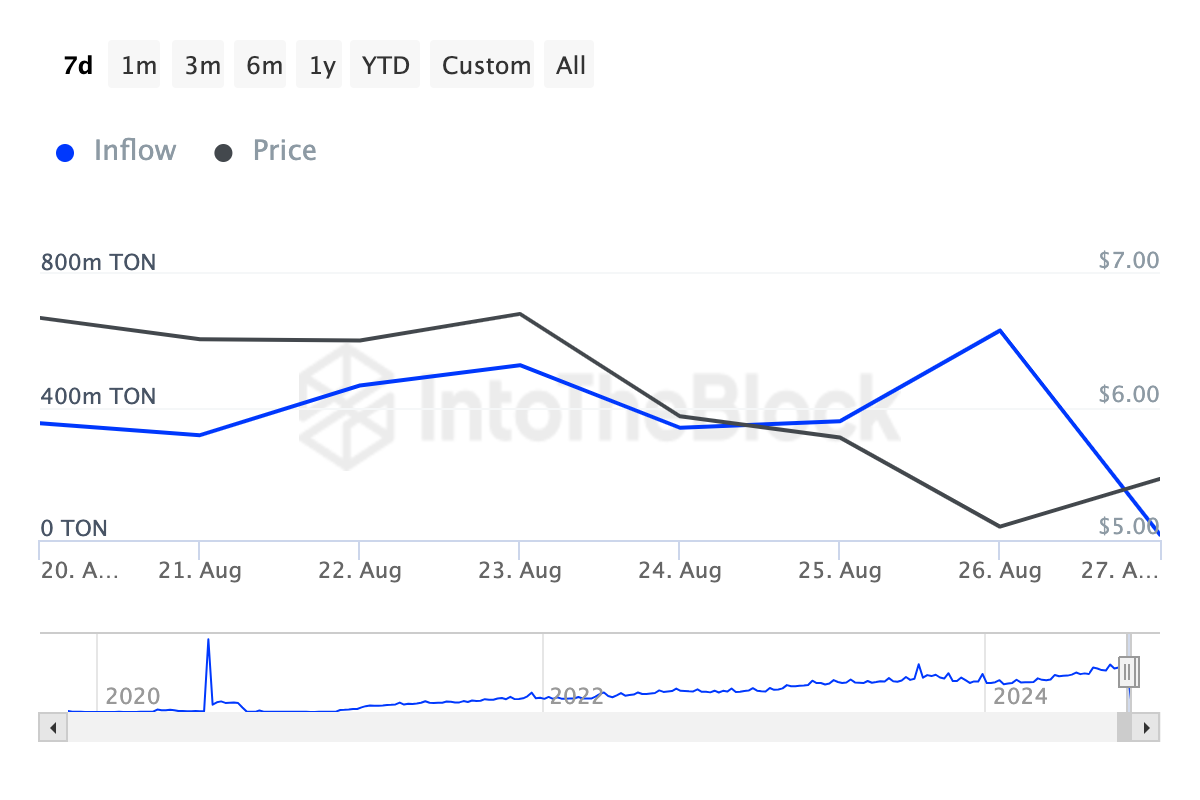
Киты: чистые потоки капитала. Источник: IntoTheBlock

Если ситуация не изменится, монете может быть сложно компенсировать недавние потери. В итоге она рискует лишиться и 10-го места в рейтинге самых капитализированных криптовалют, уступив его Cardano (ADA).

Читайте также: Как арест Павла Дурова повлиял на курс и перспективы Toncoin (TON)

Прогноз TON: готовимся к новому снижению

На дневном графике цена TON остается под значительным давлением. Например, вчера монета пыталась достичь $6, но на момент написания упала до $5,32 — вероятно, из-за сегодняшнего общего снижения рынка.

Кроме того, индекс относительной силы (RSI) для TON снизился, отражая текущий медвежий импульс. Для Toncoin это может означать возможное дальнейшее снижение цены.

Тем временем уровень Фибоначчи 38,2% недавно стал зоной сопротивления для TON. Это может затруднить формирование повышающихся максимумов. Чтобы получить шанс на рост, токен должен преодолеть этот уровень.
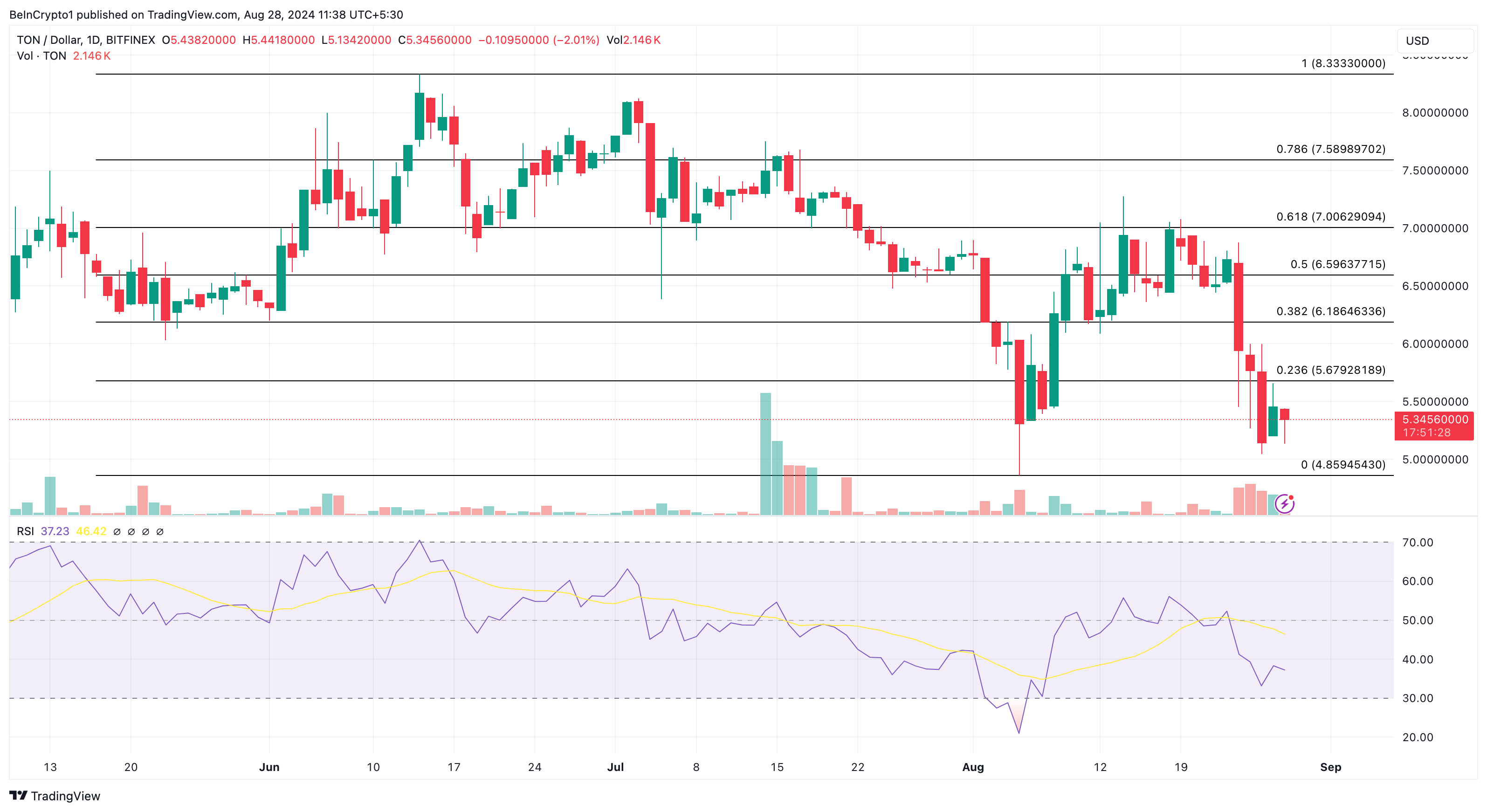
Дневной анализ Toncoin. Источник: TradingView

Если цены на рынке продолжат падать, TON может опуститься ниже $5, возможно, до $4,85. Однако в случае роста числа транзакций с Toncoin покупательское давление может потенциально поднять цену до $5,67.


Lecturas Relacionadas

CLARITY Act Countdown: How Will the Crypto Market Fare If It Doesn't Pass Before the August Recess?

The CLARITY Act, a major US crypto market structure bill, faces a tight deadline before the Senate's August 10 recess. It must overcome final hurdles—negotiations on ethics provisions and law enforcement concerns—to secure the 60 votes needed for passage. Analysts warn that missing this window significantly lowers its chances in 2026, with prediction markets giving only a 40% probability of success this year. If the act fails to pass by the recess, the market is expected to react not with a crash but with continued "slow bleeding," particularly in premium products like ETFs. June saw record net outflows from US Bitcoin spot ETFs, partly attributed to this legislative uncertainty. Assets like XRP, which would receive permanent commodity classification under the act, stand to lose a "regulatory premium" on further delays. Bitcoin and Ethereum, already classified as commodities by regulators, face less direct impact, but DeFi innovation and institutional capital inflows would remain stifled by regulatory ambiguity. The path forward includes passing before the recess (a major catalyst), postponement to 2027 (prolonging uncertainty), or failure, requiring the bill to be reintroduced in the next Congress. Despite the stalled negotiations, the bill's advancement this far signals the US is closer than ever to resolving crypto regulatory clarity.

marsbitHace 50 min(s)

CLARITY Act Countdown: How Will the Crypto Market Fare If It Doesn't Pass Before the August Recess?

marsbitHace 50 min(s)

The Impact of OUSD on Circle, Tether, and Paxos: Not a Simple Negative, but a More Complex Competitive Landscape

OUSD's Impact on Circle, Tether, and Paxos: A Nuanced Competitive Reshuffle The launch of OUSD, a new stablecoin initiative, has complex implications for the stablecoin market. For Circle (CRCL), the initial 15-20% stock drop reflects legitimate competitive concerns but is not a "death sentence." Circle retains deep liquidity, existing integrations, and first-mover advantages. A potential restructuring or termination of its Coinbase partnership could even double its net revenue in the short term, providing more competitive freedom. However, OUSD, backed by Stripe's engineering and product strengths, could become the default stablecoin within the Stripe ecosystem for new adopters, challenging USDC's position. OUSD does not solve the core barrier for corporate adoption: it remains a credit exposure to its issuer (likely a Bridge-related entity), which, like Circle, is not an investment-grade entity. Large banks and asset managers could still capture the most lucrative enterprise use cases. Circle must accelerate its payment/fintech product development and consider defensive M&A. For Tether, OUSD targets a different market segment. Tether will continue focusing on distribution channels not prioritized by Stripe or Circle. Its market share may decline over time, but within a significantly growing total market. Paxos faces the greatest pressure. OUSD undermines the key selling points of its USDG stablecoin, and Paxos's regulatory advantages may diminish as frameworks mature. This poses a more existential challenge, explaining Paxos's recent shift back to its brokerage-as-a-service business.

marsbitHace 54 min(s)

The Impact of OUSD on Circle, Tether, and Paxos: Not a Simple Negative, but a More Complex Competitive Landscape

marsbitHace 54 min(s)

OUSD's Impact on Circle, Tether, and Paxos: Not a Simple Negative, but a More Complex Competitive Reshuffle

This article analyzes the impact of the newly announced stablecoin OUSD, backed by a consortium including Stripe, on major incumbents like Circle (USDC), Tether (USDT), and Paxos (USDG). For Circle, the announcement is not a simple negative. While the initial market reaction was rational, it's not a "death sentence." Circle retains deep liquidity, existing integrations, and first-mover advantage. A potential restructuring or termination of its exclusive revenue-sharing deal with Coinbase could even near-double its net income in the short term, providing more competitive flexibility. However, within the Stripe ecosystem, OUSD, with its strong engineering and product focus, could become the default choice, displacing USDC for new integrations. Circle must accelerate its own fintech product development and consider defensive M&A. OUSD does not directly threaten Tether's core markets, which focus on different distribution channels. Tether's market share may decline over time but within a significantly growing overall market. Paxos faces the greatest pressure. OUSD undermines the primary value proposition of its USDG stablecoin, and Paxos's regulatory advantages may erode as frameworks mature, posing a more existential challenge. This explains Paxos's recent strategic pivot towards brokerage-as-a-service. A fundamental unresolved issue for enterprise adoption remains: if issued by a Bridge-related entity, OUSD, like USDC, still represents a credit exposure to a non-investment-grade issuer, unless a parent company guarantee is provided. Large banks and asset managers entering the space later could still compete for the most lucrative enterprise use cases.

链捕手Hace 55 min(s)

OUSD's Impact on Circle, Tether, and Paxos: Not a Simple Negative, but a More Complex Competitive Reshuffle

链捕手Hace 55 min(s)

Trading

Spot
活动图片