Эксперт спрогнозировал «безумный сезон» биткоина с целью в $150 000

cryptonews.ruPublicado a 2024-04-27Actualizado a 2024-08-27

Первая криптовалюта скоро вступит в «сезон безумия», в ходе которого котировки взлетят до $150 000 к концу 2024 года. Об этом заявил аналитик Real Vision Джейми Коуттс.

Unless something fundamentally has changed, we are entering what @RaoulGMI refers to as the 🍌zone, or what I would describe as #Bitcoin batshit season. pic.twitter.com/pMxk49ATtq

— Jamie Coutts CMT (@Jamie1Coutts) August 26, 2024

Специалист отметил перспективы вхождения цены в так называемую «банановую зону» — таким термином основатель и CEO фирмы Раулем Палом обозначает эйфорию. Это произойдет, «если ничего принципиально не изменится», добавил эксперт.

На графике Коуттс отметил, что в предыдущих двух бычьих циклах биткоин обновлял исторический максимум в течение 365 дней после прохождения пика индексом доллара США.

Согласно расчетам, при сохранении предыдущих моделей, рост цифрового золота может превысить 100% с $64 000 и достичь $150 000 к концу 2024 года.

CEO Trendstorm Филипп Свифт обратил внимание на возврат спотовой цены первой криптовалюты выше средней стоимости покупки краткосрочными инвесторами, что следует воспринимать как сигнал для продолжения восходящей динамики.

Back where we belong.$BTC now back above Short-Term Holder Realized Price, the cost basis of short-term investors. Bullish. pic.twitter.com/9EYt9FPlOU

— Philip Swift (@PositiveCrypto) August 26, 2024

Аргументы медведей

В CryptoQuant усомнились в реализации бычьего сценария в ближайшее время ввиду активизации крупных медведей, ориентированных на краткосрочную перспективу.

Согласно наблюдениям аналитиков, на фоне ралли на предыдущей неделе, некоторые «застойные метрики» снова начали проявлять признаки оживления.

«Спекулянты с удержанием монет в диапазоне от недели до месяца перевели 33 155 BTC. Замедление роста цены говорит, что котировки способны перейти к свободному откату», — написали специалисты.

Эксперты предложили «проявлять особую осторожность» из-за рисков усиления потенциальной распродажи.

Рынок биткоин-фьючерсов также демонстрирует осторожность трейдеров. Премия по двухмесячным контрактам к спотовой цене в течение последнего месяца в пересчете на годовые темпы оставалась на уровне около 6%, отражая неготовность к наращиванию левериджа.
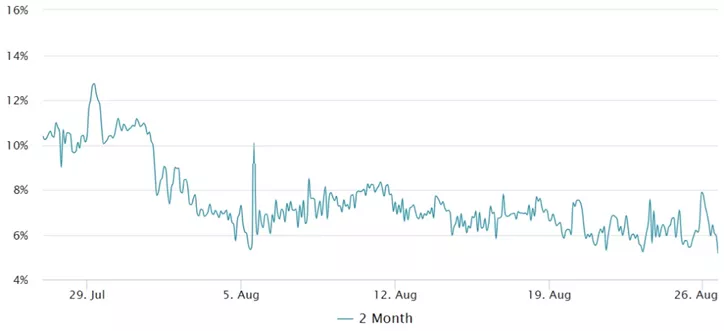
Данные: Laevitas.

Напомним, в QCP Capital спрогнозировали, что курс первой криптовалюты останется в узком коридоре от $62 000 до $67 000 в ближайшей перспективе, о чем говорит нерешительность в опционах.

Ранее аналитики зафиксировали значительные покупки декабрьских коллов.

Lecturas Relacionadas

CLARITY Act Countdown: How Will the Crypto Market Fare If It Doesn't Pass Before the August Recess?

The CLARITY Act, a major US crypto market structure bill, faces a tight deadline before the Senate's August 10 recess. It must overcome final hurdles—negotiations on ethics provisions and law enforcement concerns—to secure the 60 votes needed for passage. Analysts warn that missing this window significantly lowers its chances in 2026, with prediction markets giving only a 40% probability of success this year. If the act fails to pass by the recess, the market is expected to react not with a crash but with continued "slow bleeding," particularly in premium products like ETFs. June saw record net outflows from US Bitcoin spot ETFs, partly attributed to this legislative uncertainty. Assets like XRP, which would receive permanent commodity classification under the act, stand to lose a "regulatory premium" on further delays. Bitcoin and Ethereum, already classified as commodities by regulators, face less direct impact, but DeFi innovation and institutional capital inflows would remain stifled by regulatory ambiguity. The path forward includes passing before the recess (a major catalyst), postponement to 2027 (prolonging uncertainty), or failure, requiring the bill to be reintroduced in the next Congress. Despite the stalled negotiations, the bill's advancement this far signals the US is closer than ever to resolving crypto regulatory clarity.

marsbitHace 30 min(s)

CLARITY Act Countdown: How Will the Crypto Market Fare If It Doesn't Pass Before the August Recess?

marsbitHace 30 min(s)

The Impact of OUSD on Circle, Tether, and Paxos: Not a Simple Negative, but a More Complex Competitive Landscape

OUSD's Impact on Circle, Tether, and Paxos: A Nuanced Competitive Reshuffle The launch of OUSD, a new stablecoin initiative, has complex implications for the stablecoin market. For Circle (CRCL), the initial 15-20% stock drop reflects legitimate competitive concerns but is not a "death sentence." Circle retains deep liquidity, existing integrations, and first-mover advantages. A potential restructuring or termination of its Coinbase partnership could even double its net revenue in the short term, providing more competitive freedom. However, OUSD, backed by Stripe's engineering and product strengths, could become the default stablecoin within the Stripe ecosystem for new adopters, challenging USDC's position. OUSD does not solve the core barrier for corporate adoption: it remains a credit exposure to its issuer (likely a Bridge-related entity), which, like Circle, is not an investment-grade entity. Large banks and asset managers could still capture the most lucrative enterprise use cases. Circle must accelerate its payment/fintech product development and consider defensive M&A. For Tether, OUSD targets a different market segment. Tether will continue focusing on distribution channels not prioritized by Stripe or Circle. Its market share may decline over time, but within a significantly growing total market. Paxos faces the greatest pressure. OUSD undermines the key selling points of its USDG stablecoin, and Paxos's regulatory advantages may diminish as frameworks mature. This poses a more existential challenge, explaining Paxos's recent shift back to its brokerage-as-a-service business.

marsbitHace 33 min(s)

The Impact of OUSD on Circle, Tether, and Paxos: Not a Simple Negative, but a More Complex Competitive Landscape

marsbitHace 33 min(s)

OUSD's Impact on Circle, Tether, and Paxos: Not a Simple Negative, but a More Complex Competitive Reshuffle

This article analyzes the impact of the newly announced stablecoin OUSD, backed by a consortium including Stripe, on major incumbents like Circle (USDC), Tether (USDT), and Paxos (USDG). For Circle, the announcement is not a simple negative. While the initial market reaction was rational, it's not a "death sentence." Circle retains deep liquidity, existing integrations, and first-mover advantage. A potential restructuring or termination of its exclusive revenue-sharing deal with Coinbase could even near-double its net income in the short term, providing more competitive flexibility. However, within the Stripe ecosystem, OUSD, with its strong engineering and product focus, could become the default choice, displacing USDC for new integrations. Circle must accelerate its own fintech product development and consider defensive M&A. OUSD does not directly threaten Tether's core markets, which focus on different distribution channels. Tether's market share may decline over time but within a significantly growing overall market. Paxos faces the greatest pressure. OUSD undermines the primary value proposition of its USDG stablecoin, and Paxos's regulatory advantages may erode as frameworks mature, posing a more existential challenge. This explains Paxos's recent strategic pivot towards brokerage-as-a-service. A fundamental unresolved issue for enterprise adoption remains: if issued by a Bridge-related entity, OUSD, like USDC, still represents a credit exposure to a non-investment-grade issuer, unless a parent company guarantee is provided. Large banks and asset managers entering the space later could still compete for the most lucrative enterprise use cases.

链捕手Hace 35 min(s)

OUSD's Impact on Circle, Tether, and Paxos: Not a Simple Negative, but a More Complex Competitive Reshuffle

链捕手Hace 35 min(s)

Trading

Spot
活动图片