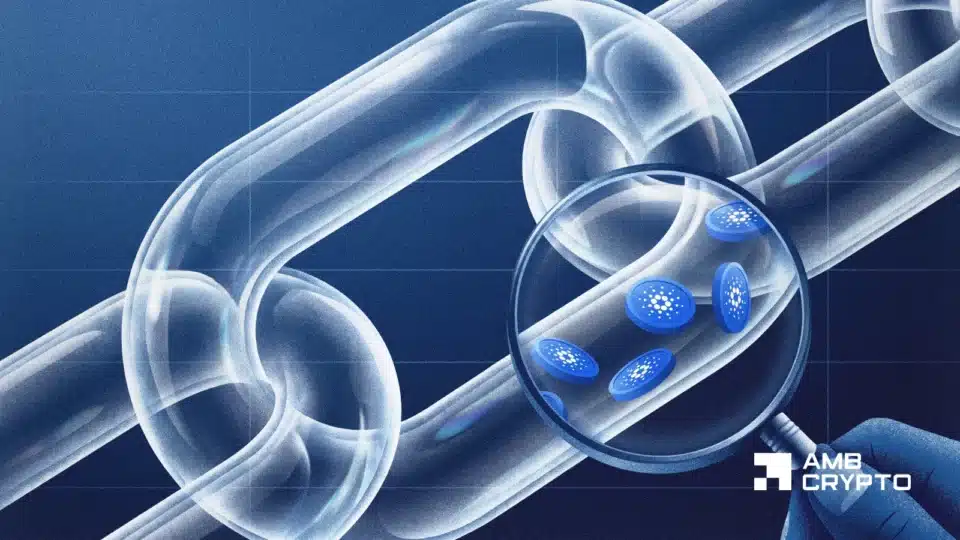
卡尔达诺今天为什么起床?ADA 6%的反弹

币界网Publicado a 2024-08-22Actualizado a 2024-08-23

币界网报道:
    截至发稿时,卡尔达诺在0.3172美元的关键支撑位上方交易。ADA的利润持有者也转为看涨。

卡尔达诺[ADA]在经历了长时间的衰退后开始出现生命迹象。山寨币在过去24小时内飙升了6.31%,在过去一周内飙升了11.39%,令人印象深刻。

这一激增使ADA的市值增加到134亿美元,增长了6.26%。

根据CoinMarketCap的数据,卡尔达诺的交易量也飙升了29.6%,达到3.516亿美元。这表明投资者重新燃起了兴趣。

支撑水平保持强劲

从最近的价格走势来看,截至发稿时,ADA的交易价格高于0.3172美元左右的关键支撑位。事实证明,这一水平具有弹性,是当前反弹的跳板。

如果ADA保持这种支持,它可能会经历持续的上涨。

图表显示了一系列更高的低点,这通常意味着上升趋势的延续。

随机RSI也显示了一个超买区,这表明ADA可能会在看涨延续之前出现短期回调。

ADA描绘了一幅看涨的图景

深入研究链上数据,发现了一些积极的迹象。大型交易增长了14%,因此,机构投资者或鲸鱼表现出了更大的兴趣。

当价格反弹之前有高价值的转移时,这种情况经常发生。

此外,盈利股东的数量增长了7%,达到21.51%。虽然仍然很低,但这一改善意味着投资者情绪正在逐渐改善。

除上述情况外,卡尔达诺的总价值锁定(TVL)最近出现了上升趋势。这一趋势表明,人们对卡尔达诺的DeFi系统的信任度越来越高,为乐观的ADA情绪增添了更多动力。

ADA最近的表现表明,市场情绪可能正在发生变化。不断增长的大额交易、持有人盈利能力的提高和技术突破的结合是指向未来增长的一些积极因素。

然而,更广泛的加密货币行业仍然存在很多不确定性,ADA远未达到历史最高水平。


阅读卡尔达诺的[ADA]价格预测2024-25


期待张硬叉?

张的硬分叉可能在ADA最近的表现中发挥了关键作用。

正如Altcoin Daily在推特上发布的那样,即将于8月27日进行的网络升级将引入Plutus V3和链上治理等功能,旨在提高平台的可扩展性。

Criptos en tendencia

Lecturas Relacionadas

In the AI Era, What's Left for Bitcoin?

As Bitcoin falls below $60,000, the author reflects on the relationship between AI and Bitcoin, seeing them as two sides of the same coin. In the AI era, the cost of generating content has plummeted, making fake text, images, and videos increasingly easy and cheap to produce. This has led to a fundamental shift: while AI dramatically lowers the cost of information production, it also undermines trust and authenticity online. What becomes truly valuable is not more content, but the ability to verify what is real—"verifiability." This perspective offers a new lens for Bitcoin. Its massive energy consumption, often criticized as wasteful, is reinterpreted. While AI burns energy to enhance "capability" and efficiency, Bitcoin burns energy to produce "verifiability." Its purpose is not to be trusted but to enable a system where no trust in intermediaries—banks, platforms, or developers—is needed. Every transaction and the entire ledger's history is secured by cryptography and a decentralized network of nodes, making it independently verifiable. AI cannot forge a transaction on the Bitcoin network because the system is designed for proof, not generation. The author draws a historical parallel to the Renaissance: the printing press drastically reduced the cost of copying knowledge, while double-entry bookkeeping reduced the cost of trust in commerce. Today, AI is the new printing press, reducing content creation costs to near zero. Blockchain, and Bitcoin as its pioneer, may be the modern equivalent of double-entry bookkeeping—a foundational technology for verifying digital asset ownership and historical records without centralized authorities. Thus, AI and blockchain are not competitors. AI lowers the cost of creation; blockchain lowers the cost of verification. In an age where AI can generate anything, true scarcity may lie not in more content, but in independently verifiable facts. Whether the market will reprice Bitcoin accordingly remains uncertain, but its core value proposition as a "machine for producing verifiability" becomes strikingly relevant.

marsbitHace 19 min(s)

In the AI Era, What's Left for Bitcoin?

marsbitHace 19 min(s)

In the Age of AI, What's Left for Bitcoin?

Author: Sevclub, Seven Research Amid Bitcoin's recent drop below $60k, the author reflects on a growing sense that AI and Bitcoin are two sides of the same coin. Today, encountering any content triggers a new default question: "Was this made by AI?" The cost of generating convincing text, images, and video is now negligible. While the internet lowered information *distribution* costs, AI is crashing information *production* costs to near zero. The consequence is a flood of content where truth and falsehood are increasingly indistinguishable. In this environment, what becomes truly valuable is not more information, but the ability to verify what is real—"verifiability." This reframes the common criticism that Bitcoin "wastes electricity." AI consumes power to produce "capability" (e.g., more powerful models). Bitcoin consumes power to produce something else: "verifiability." Bitcoin's core purpose isn't about belief or trust in any institution, developer, or even its creator. It's about enabling independent verification. Every bitcoin's origin, every transaction, and the integrity of the entire ledger are secured by mathematics, cryptography, and a global network of nodes. AI can fabricate convincing media, but it cannot falsify a transaction on the Bitcoin network. The expended energy makes篡改历史 (tampering with history) prohibitively expensive, purchasing a globally verifiable ledger. The author draws a historical parallel to the Renaissance. The printing press drastically reduced the cost of copying knowledge, while double-entry bookkeeping reduced the cost of trust in commerce—one enabled creation, the other verification. Today, AI is the new printing press, driving content production costs toward zero. The question becomes: what is this era's "double-entry bookkeeping"? Blockchain appears to be the leading candidate. It doesn't verify which news is true or which image is real, but it provides a foundational layer for independently verifying asset ownership and historical records in the digital realm without centralized authorities. Therefore, AI and blockchain are not in competition. AI lowers the cost of *generation*. Blockchain (and Bitcoin as a prime example) lowers the cost of *verification*. One creates, the other proves. Whether Bitcoin ultimately succeeds remains uncertain, facing potential challenges from quantum computing, regulation, and technical evolution. However, the author now sees it less as a "machine for making bitcoin" and more as a "machine for making verifiability." In an age where AI can generate anything, true scarcity may no longer be "more content," but "more independently verifiable facts." Whether the market will price this accordingly is a separate question.

链捕手Hace 27 min(s)

In the Age of AI, What's Left for Bitcoin?

链捕手Hace 27 min(s)

Trading

Spot

Artículos destacados

Cómo comprar ADA

¡Bienvenido a HTX.com! Hemos hecho que comprar Cardano (ADA) sea simple y conveniente. Sigue nuestra guía paso a paso para iniciar tu viaje de criptos.Paso 1: crea tu cuenta HTXUtiliza tu correo electrónico o número de teléfono para registrarte y obtener una cuenta gratuita en HTX. Experimenta un proceso de registro sin complicaciones y desbloquea todas las funciones.Obtener mi cuentaPaso 2: ve a Comprar cripto y elige tu método de pagoTarjeta de crédito/débito: usa tu Visa o Mastercard para comprar Cardano (ADA) al instante.Saldo: utiliza fondos del saldo de tu cuenta HTX para tradear sin problemas.Terceros: hemos agregado métodos de pago populares como Google Pay y Apple Pay para mejorar la comodidad.P2P: tradear directamente con otros usuarios en HTX.Over-the-Counter (OTC): ofrecemos servicios personalizados y tipos de cambio competitivos para los traders.Paso 3: guarda tu Cardano (ADA)Después de comprar tu Cardano (ADA), guárdalo en tu cuenta HTX. Alternativamente, puedes enviarlo a otro lugar mediante transferencia blockchain o utilizarlo para tradear otras criptomonedas.Paso 4: tradear Cardano (ADA)Tradear fácilmente con Cardano (ADA) en HTX's mercado spot. Simplemente accede a tu cuenta, selecciona tu par de trading, ejecuta tus trades y monitorea en tiempo real. Ofrecemos una experiencia fácil de usar tanto para principiantes como para traders experimentados.

1.5k Vistas totalesPublicado en 2024.12.10Actualizado en 2026.06.02

Cómo comprar ADA

Discusiones

Bienvenido a la comunidad de HTX. Aquí puedes mantenerte informado sobre los últimos desarrollos de la plataforma y acceder a análisis profesionales del mercado. A continuación se presentan las opiniones de los usuarios sobre el precio de ADA (ADA).

活动图片