ADA几次暴跌0.3都撑住了、同时也是大多机构和鲸鱼的进场位置、可以抄底吗?

金色财经Publicado a 2024-08-15Actualizado a 2024-08-15

卡尔达诺 [ADA]在跌至 0.27 美元后创下 2024 年年度新低,打破了 6 月份创下的 0.31 美元低点记录。不过,ADA 在 6 月和 8 月的反弹均发生在图表上的 0.3 美元以上。 

在一些艰难的价格走势的推动下,ADA 在 8 月 7 日星期二上涨了 6%。事实上,在撰写本文时,它在 24 小时图上上涨了 0.15 %,加密货币交易价格为 0.33 美元。简而言之,它似乎已准备好进一步推动整体市场的复苏。 

因此,问题是:在复苏反弹过程中需要关注的关键水平是什么? 

需要考虑的关键 ADA 水平
B6ZEjM188KuTt46hUnWzB9D7Xe4XY6Ruk05Eq8Jh.jpeg

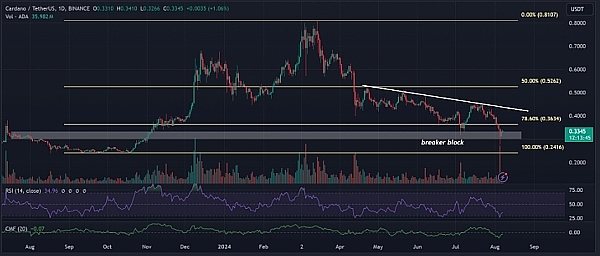
就像 6 月份的 ADA 暴跌一样,最近的暴跌在每周突破区(标记为白色)附近有所缓解,接近 0.3 美元。这证实了价格水平是多头关注的关键区域,就像 2023 年 11 月和最近的 2024 年一样。 

如果 ADA 继续反弹,则有两个直接看涨目标需要考虑。第一个目标是 78.6% 斐波那契水平(0.36 美元),如果触及该水平,则可能带来约 9% 的收益。其次,趋势线阻力的重新测试可能会从突破阻力中产生 29% 的收益。 

然而,截至发稿时,关键技术图表读数较弱,如 RSI(相对强弱指数)和 CMF(Chaikin 资金流)所示。这意味着购买力和资本流入仍低于平均水平。 

简而言之,保守的复苏目标将是 78.6% 斐波那契水平,除非比特币进一步突破 60,000 美元。 

然而,跌破需求和突破 0.3 美元的阻滞也可能加速 ADA 的抛售。 

大多数地址以 0.3 美元左右的价格购买了 ADA

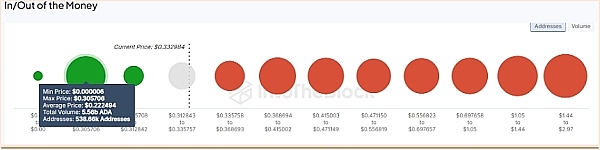
跌破 0.3 美元可能会加速大屠杀,因为大多数地址以 0.3 美元的价格购买了山寨币。近 54 万个地址持有 5.56 ADA,在 0.3 美元至 0.22 美元之间购买了山寨币。因此,跌破支撑位将引发大量用户恐慌性抛售以减少损失。 
7zwOSSMuCXneV7OP1sT6Dla3XBP6vajUazon90wI.jpeg

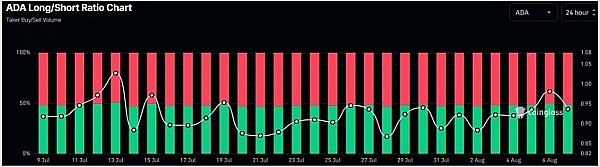
与此同时,期货市场的投机者,尤其是那些持有杠杆多头仓位的投机者,已经将 ADA 风险敞口降至最低。

根据 Coinglass 的多头/空头比率,8 月 2 日至 6 日期间,杠杆多头仓位数量从 46% 增加到 49%。 

相反,截至发稿时,该数字略有下降,表明期货市场对 ADA 并不那么看好。

简而言之,ADA 可能会缓慢复苏,但 0.3 美元的支撑仍然至关重要。
w0e338NJZLZfCm2wtOcuuoOMCE9BWUb7lyEKJoVw.jpeg

Criptos en tendencia

Lecturas Relacionadas

Sam Altman's Personal Alchemy of Wealth: Investing in 400 Companies, Over 10 Deeply Tied to OpenAI

The article investigates Sam Altman's personal wealth strategy, centered around his investments in approximately 400 companies while serving as OpenAI's CEO. Despite not holding direct equity in OpenAI, Altman has built a vast portfolio, with at least 10 of his investments having commercial ties or ongoing negotiations with OpenAI. This creates a complex network of potential conflicts of interest, drawing scrutiny from U.S. congressional committees and state attorneys general. Key investments highlighted include the anti-aging startup Retro Biosciences (valued at $258 million for his stake as of late last year) and the chipmaker Cerebras, whose value soared following an OpenAI procurement deal. His most significant financial gain is linked to the nuclear fusion company Helion, where a recent funding round reportedly increased his stake's value to at least $4.1 billion. The article details a decade-long relationship between Altman, Helion, and OpenAI, including a controversial non-binding power purchase agreement and Altman's efforts to secure investments from OpenAI and its backer SoftBank for Helion. Other points include internal investigations at Tools for Humanity (developer of Worldcoin) and OpenAI's massive contracts with tech giants like Nvidia. According to Forbes, Altman's net worth is around $3.4 billion, ranking him 1251st globally—a rise of over 1400 places since 2024. OpenAI's board states that Altman's external dealings are transparent and potential conflicts are carefully managed.

Odaily星球日报Hace 17 min(s)

Sam Altman's Personal Alchemy of Wealth: Investing in 400 Companies, Over 10 Deeply Tied to OpenAI

Odaily星球日报Hace 17 min(s)

Former SpaceX Engineer Reconstructs Financial Execution System Using First Principles

Former SpaceX engineer Lex Li applies "First Principles Thinking" to financial infrastructure with Plan Execution Lab, recently raising angel funding at a $50M post-money valuation. The team argues that the core function of finance is capital allocation, and the critical gap is not in trading but in execution, which remains highly manual and fragmented. While assets, liquidity, and settlement have migrated on-chain, execution workflows (monitoring, risk management, liquidity coordination) are still human-native. In an era of accelerating AI agents, strategy decay is rapid, shifting the competitive edge from having the best strategy to having the most robust execution network. Plan Execution Lab introduces two core components: 1. **PlanX**: A Financial Execution Protocol designed as infrastructure for the migration from CEX to DEX, providing on-chain execution capabilities, liquidity access, risk management, and capital orchestration. 2. **Xgent**: An Autonomous Financial Runtime. Users define investment intents, risk preferences, and constraints; Xgent automatically constructs an execution graph, verifies it, and handles ongoing execution and optimization—streamlining the process from Intent to Autonomous Execution. The long-term vision is to create the "Bloomberg Terminal for Autonomous Finance"—a shared operating environment and execution network built collectively by participants like execution nodes, liquidity providers, and autonomous agents. The future of finance, they contend, belongs not to isolated algorithms but to open, collaborative execution networks.

marsbitHace 51 min(s)

Former SpaceX Engineer Reconstructs Financial Execution System Using First Principles

marsbitHace 51 min(s)

Former SpaceX Engineer Reconstructs Financial Execution System from First Principles

Plan Execution Lab, a financial infrastructure project founded by former SpaceX engineer Lex Li, has raised angel funding at a $50M post-money valuation. The startup is applying "first principles thinking" from Li's SpaceX experience to rethink financial market execution. Their analysis posits that while assets, liquidity, and settlement have moved on-chain, the execution layer remains fundamentally human-dependent and fragmented. In the era of AI Agents, strategy advantages decay rapidly, shifting the competitive edge from isolated algorithms to robust **execution networks**. Plan Execution Lab's solution is a two-part system: **PlanX**, a Financial Execution Protocol designed to facilitate the migration from centralized exchanges (CEX) to on-chain markets by providing core on-chain execution capabilities; and **Xgent**, an Autonomous Financial Runtime. Xgent allows users to define investment goals and constraints, then autonomously constructs and manages the execution logic—moving from **Intent to Execution Graph to Verification to Autonomous Execution**. The long-term vision is to create the "Bloomberg Terminal for Autonomous Finance"—an operating environment not for humans, but for agents and execution nodes. The future financial system, they argue, will be a collaborative network built by diverse participants contributing execution capabilities, not secret strategies. The core competition will shift to who builds the most powerful and adaptive execution network.

链捕手Hace 52 min(s)

Former SpaceX Engineer Reconstructs Financial Execution System from First Principles

链捕手Hace 52 min(s)

First Long-Horizon Doc2Repo Training Dataset: Code Agents Move Beyond Bug Fixing and Begin Creating Repositories

With the advancement of LLM Code Agents, the research focus is shifting towards long-horizon, real-world tasks, moving beyond simple bug fixes to full repository generation. To address this, researchers from Renmin University of China introduced the DeNovoSWE dataset. This dataset focuses on long-term software engineering tasks, specifically the "document-to-repository" challenge—generating an entire, executable code repository from a task description. The DeNovoSWE construction method employs a Divide & Conquer approach. It breaks down target repositories into core capabilities and uses a multi-agent Draft-Critic-Repair workflow to automatically generate high-quality, evaluation-aligned task documents. The dataset also implements difficulty-aware filtering to balance quality and diversity. The result is a high-quality, anti-leakage dataset of 4,818 instances. Experiments show that models trained on DeNovoSWE achieve significant improvements in long-horizon repository generation. For instance, Qwen3-30B-A3B-Instruct's performance on the BeyondSWE-Doc2Repo benchmark increased from 5.8% to 47.2%, and on NL2RepoBench from 4.3% to 23.0%. Similar gains were observed with stronger backbones, demonstrating that dedicated long-horizon training data is crucial for advancing Code Agents from maintainers to architects capable of planning and building complete software projects from scratch.

marsbitHace 1 hora(s)

First Long-Horizon Doc2Repo Training Dataset: Code Agents Move Beyond Bug Fixing and Begin Creating Repositories

marsbitHace 1 hora(s)

Trading

Spot
Futuros

Artículos destacados

Cómo comprar ADA

¡Bienvenido a HTX.com! Hemos hecho que comprar Cardano (ADA) sea simple y conveniente. Sigue nuestra guía paso a paso para iniciar tu viaje de criptos.Paso 1: crea tu cuenta HTXUtiliza tu correo electrónico o número de teléfono para registrarte y obtener una cuenta gratuita en HTX. Experimenta un proceso de registro sin complicaciones y desbloquea todas las funciones.Obtener mi cuentaPaso 2: ve a Comprar cripto y elige tu método de pagoTarjeta de crédito/débito: usa tu Visa o Mastercard para comprar Cardano (ADA) al instante.Saldo: utiliza fondos del saldo de tu cuenta HTX para tradear sin problemas.Terceros: hemos agregado métodos de pago populares como Google Pay y Apple Pay para mejorar la comodidad.P2P: tradear directamente con otros usuarios en HTX.Over-the-Counter (OTC): ofrecemos servicios personalizados y tipos de cambio competitivos para los traders.Paso 3: guarda tu Cardano (ADA)Después de comprar tu Cardano (ADA), guárdalo en tu cuenta HTX. Alternativamente, puedes enviarlo a otro lugar mediante transferencia blockchain o utilizarlo para tradear otras criptomonedas.Paso 4: tradear Cardano (ADA)Tradear fácilmente con Cardano (ADA) en HTX's mercado spot. Simplemente accede a tu cuenta, selecciona tu par de trading, ejecuta tus trades y monitorea en tiempo real. Ofrecemos una experiencia fácil de usar tanto para principiantes como para traders experimentados.

1.5k Vistas totalesPublicado en 2024.12.10Actualizado en 2026.06.02

Cómo comprar ADA

Discusiones

Bienvenido a la comunidad de HTX. Aquí puedes mantenerte informado sobre los últimos desarrollos de la plataforma y acceder a análisis profesionales del mercado. A continuación se presentan las opiniones de los usuarios sobre el precio de ADA (ADA).

活动图片