英伟达股价在创纪录高点后大幅下跌

币界网Publicado a 2024-08-08Actualizado a 2024-08-08

币界网报道:

一直处于人工智能前沿的领先芯片制造商英伟达的股价在今年早些时候飙升至历史新高后大幅下跌。这家曾经拥有2万亿美元市值,甚至超过3万亿美元的公司现在面临着高度的市场波动。

此后,Nvidia的市值大幅下降,下降了9000亿美元。英伟达的股价在6月18日突破135.58美元,此前该公司进行了10比1的股票分割,并取得了令人印象深刻的财务业绩。
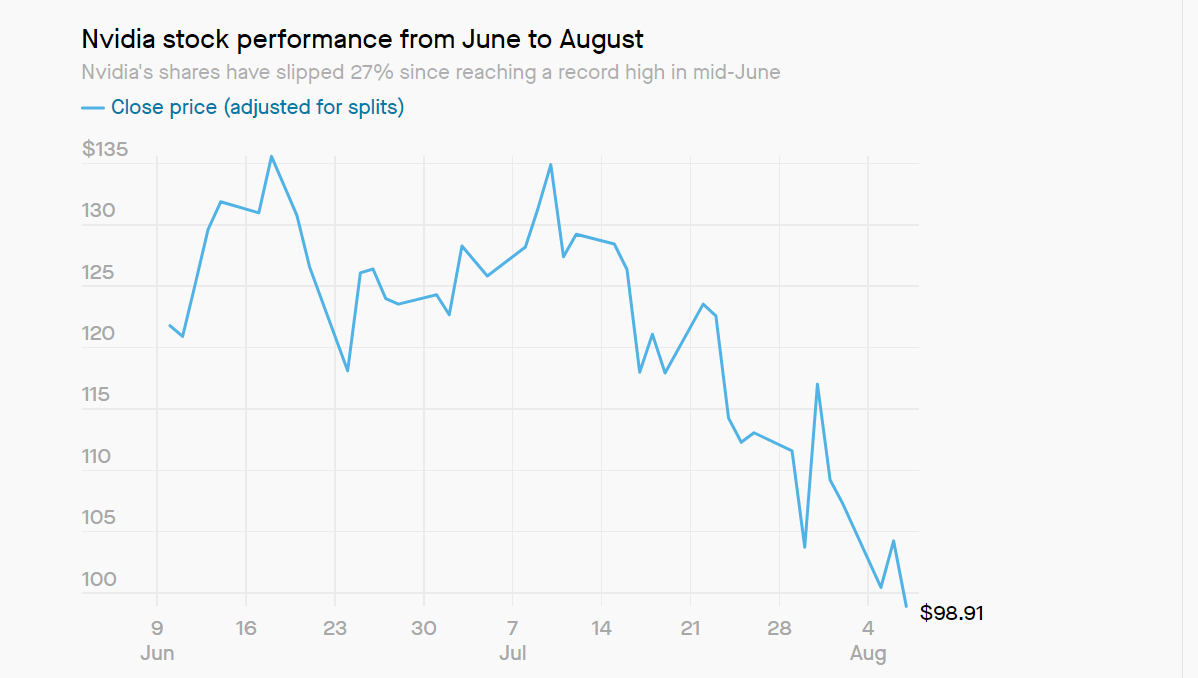
英伟达股价经历大幅波动和回调

该公司2025财年第一季度的收入为260亿美元,比上一年增长了262%。这是由于对Nvidia芯片的高需求。然而,在这一快速上涨之后,英伟达的股价大幅下跌,此后英伟达股价从峰值下跌了27%。

英伟达的市值在创下新高后一周内也大幅下降,该公司在三个交易日内市值损失了5000多亿美元。这种下降也影响了欧洲和亚洲的芯片制造商。

这家芯片制造商面临着来自监管机构的几项挑战,监管机构一直非常关注市场竞争。Nvidia目前占据了人工智能(AI)芯片市场约90%的份额。

地缘政治紧张局势导致英伟达股价近期下跌

7月,包括英伟达在内的全球芯片股下跌,此前有报道称美国可能对中国实施出口限制。有报道称,拜登政府计划限制向中国出口先进的芯片制造设备。

此外,出售是由美国前总统唐纳德·特朗普关于台湾的言论引发的。杰富瑞和美国银行的分析师指出,市场对这些地缘政治风险过于乐观。

英伟达的股票本周早些时候也下跌了。该公司的股价在开盘时下跌,此前有报道称,由于设计问题,其Blackwell AI平台的发货可能会延迟至少三个月。今年早些时候,在5月英伟达2025财年第一季度电话财报会议上,首席执行官黄仁勋表示,“我们今年将看到Blackwell的大量收入。”

英伟达将于8月28日公布其2025财年第二季度的盈利报告,这可能会让人们更多地了解该公司的财务状况和计划。

Lecturas Relacionadas

The $6.4 Billion CRO Accumulation Plan of Trump Media Group Falls Apart

A $6.4 billion plan to create a publicly-listed CRO treasury company, announced a year ago by Trump Media & Technology Group (DJT), Crypto.com, and SPAC Yorkville, has been terminated. The ambitious deal, which aimed to accumulate approximately 6.3 billion CRO tokens (nearly 20% of supply at the time), never progressed beyond a framework agreement. Related plans for a prediction market integrated into Truth Social and ETF custody services by Crypto.com were also shelved, scaled back to a simple marketing partnership. The collaboration followed significant political alignment, with Crypto.com donating to Trump's inauguration and a pro-Trump super PAC, and its CEO meeting with Trump. The SEC also closed an investigation into the exchange shortly before the deal was announced, raising conflict-of-interest concerns. Officially, the termination was attributed to an unfavorable market environment. CRO's price has fallen roughly 70% since the announcement, and the broader market for publicly-traded digital asset treasuries has cooled significantly, with Bitcoin nearly halving from its late-2025 peak. The only completed transaction from the 2025 agreements remains intact: Trump Media's ~$105 million CRO purchase and Crypto.com's $50 million purchase of DJT stock. The termination aligns with DJT's strategic pivot away from crypto; the company is now pursuing a multi-billion dollar all-stock merger with nuclear fusion firm TAE Technologies, shifting its focus to clean energy.

marsbitHace 15 min(s)

The $6.4 Billion CRO Accumulation Plan of Trump Media Group Falls Apart

marsbitHace 15 min(s)

Tiger Research: The $43 Million Gray Area of Asian Prediction Markets

Tiger Research: Asia's $43 Million Grey Zone in Prediction Markets Western jurisdictions have created regulatory pathways for prediction markets through derivatives law (like the U.S. CFTC framework) or flexible gambling licenses (like the UK's "betting intermediary" category). In contrast, Asia lacks a comparable regulatory architecture. The absence of a general gambling license framework adaptable to private operators, coupled with closed financial product definitions (e.g., positive lists of assets in Korea and Japan), leaves prediction markets in a regulatory grey area. This lack of a clear classification—whether as gambling, financial derivatives, or a novel third category—has not stopped market activity. Significant liquidity, evidenced by over $52 million tied to a single South Korean election, flows to offshore platforms. However, this results in forgone tax revenue (estimated at $4-43 million annually per major Asian market), no consumer protection, and no oversight for market integrity. The core issue is not cultural opposition to gambling, which exists legally in many Asian markets, but a missing institutional design. Without a deliberate regulatory pathway, authorities are left with suboptimal options: expanding criminal sanctions or blocking access, which fail to address the underlying economic activity or achieve key policy goals. Establishing a regulatory foundation requires initiating a formal public discourse to first define prediction markets' legal status and societal value, a foundational step that has yet to occur in most Asian jurisdictions.

marsbitHace 24 min(s)

Tiger Research: The $43 Million Gray Area of Asian Prediction Markets

marsbitHace 24 min(s)

How Singapore's Retail Giant Masters the Gold Trade: Selling Thousands of Pounds Monthly Without Betting on Price, Gold Leasing Inspires RWA Income Design on Chain

A Singapore retail giant, Mustafa Centre, sells around 1,100 pounds of gold jewelry monthly, holding nearly a ton of inventory valued over $100 million, yet avoids gold price speculation. They achieve this by maintaining a constant inventory—buying back the exact amount of gold sold each day, earning only from sales margins, not price movements. This practice is enabled by the century-old gold leasing market. Retailers borrow physical gold to meet inventory needs without tying up capital or bearing price risk, paying a lease rate. Lenders earn yield on otherwise idle gold. This real-economy demand, driven by operational needs rather than speculation, provides a stable income stream. The article highlights how this traditional leasing model inspires on-chain Real World Asset (RWA) protocols like thUSD and thGOLD. These protocols channel gold lease yields—generated from borrowers like Mustafa—to token holders. The key challenge has been access, not yield availability. Platforms like Libeara, with institutional backing (e.g., SC Ventures), facilitate this by tokenizing funds (e.g., the MG 999 Gold Fund) that lend to vetted commercial borrowers, making this off-chain yield accessible on-chain. Thus, gold leasing demonstrates a proven, non-speculative revenue source for crypto protocols seeking sustainable "real yield," connecting physical trade finance to decentralized finance.

marsbitHace 35 min(s)

How Singapore's Retail Giant Masters the Gold Trade: Selling Thousands of Pounds Monthly Without Betting on Price, Gold Leasing Inspires RWA Income Design on Chain

marsbitHace 35 min(s)

Trading

Spot
活动图片