24-Year-Old "Wall Street Newcomer" Portfolio Adjustments Revealed: Shorts Chips Heavily in Q1, Bullish on Energy and AI Infrastructure

marsbitPublicado a 2026-05-19Actualizado a 2026-05-19

Resumen

A 24-year-old Wall Street prodigy, Leopold Aschenbrenner, has disclosed the Q1 portfolio adjustments for his fund, Situational Awareness LP. The fund's assets under management skyrocketed from $5.52 billion to $13.7 billion. The most significant move was a massive bearish bet on the semiconductor sector. The fund established $8.46 billion in put options, targeting chipmakers like NVIDIA ($1.6B in puts) and the VanEck Semiconductor ETF (SMH, $2B in puts). This bearish stance extended to Broadcom, Oracle, AMD, Micron, ASML, Intel, Corning, and TSMC. However, the fund made a selective bullish exception, adding shares and call options for memory chip maker SanDisk. The fund maintained its core bullish thesis on energy and AI infrastructure. Bloom Energy remained its largest long equity holding. It also increased stakes in cryptocurrency mining/data center firms like CleanSpark, Riot Platforms, Applied Digital, and IREN Limited, viewing them as providers of critical ready-to-use infrastructure—land, power, and grid permits—for AI expansion. The 13F filing was submitted one day late. Overall, the fund's strategy involves substantial bearish semiconductor bets while maintaining concentrated, high-volatility investments in selective tech, computing, and infrastructure plays aligned with AI growth.

Source: Cailian Press

On Monday Eastern Time, the eagerly awaited Q1 US stock portfolio adjustment report (13F) for the fund "Situational Awareness LP," managed by the much-watched Wall Street newcomer, 24-year-old Leopold Aschenbrenner, was finally released. (Related Reading: Liquidated NVIDIA, Frenzied Buying of Fuel Cells: The 'Physical Arbitrage' Logic of a 24-Year-Old Investment Prodigy)

As described in our previous report, as the world's youngest manager of a mega-fund, Leopold Aschenbrenner foresaw the importance of AI infrastructure "logistics" as early as 2024, making significant investments in power, land, and infrastructure, propelling his fund to massive expansion in less than two years since its inception.

This belated report shows that the market value of the fund managed by Leopold Aschenbrenner has surged from $5.52 billion in the previous quarter to $13.7 billion—and just under two years ago, the fund's initial AUM was only $255 million.
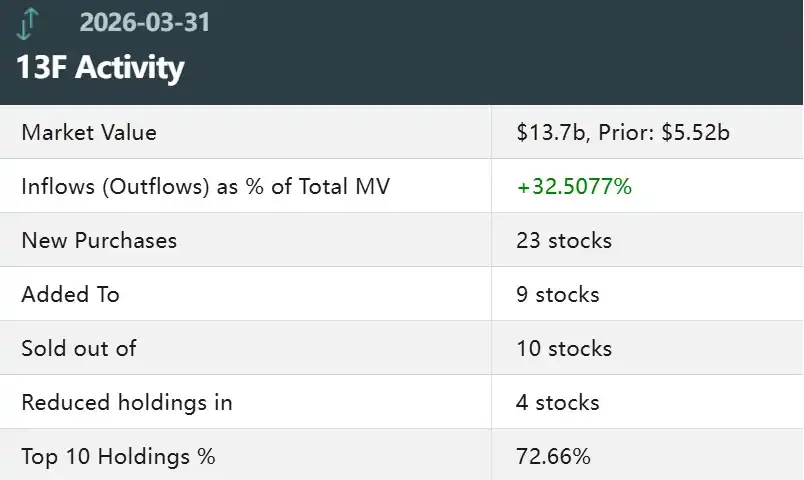
Such a rocket-like surge in assets under management indicates that the "Situational Awareness" fund has clearly become a star fund highly sought after on Wall Street—in fact, Leopold Aschenbrenner's portfolio moves have already become one of the most closely watched sources for "copying homework" among Wall Street institutions and retail investors in recent quarters.

Let's take a closer look at what this Wall Street star has done in the first quarter of this year.

Heavily Buys Short Positions in Chipmakers

From this adjustment report, the most significant move made by Leopold Aschenbrenner in Q1 was heavily shorting chipmakers.

As of the end of Q1, the fund aggressively purchased put options with a notional value of up to $8.46 billion, covering numerous chipmaker stocks, including a $2 billion put option on the VanEck Semiconductor ETF (ticker: SMH) and a $1.6 billion put option on AI giant NVIDIA.
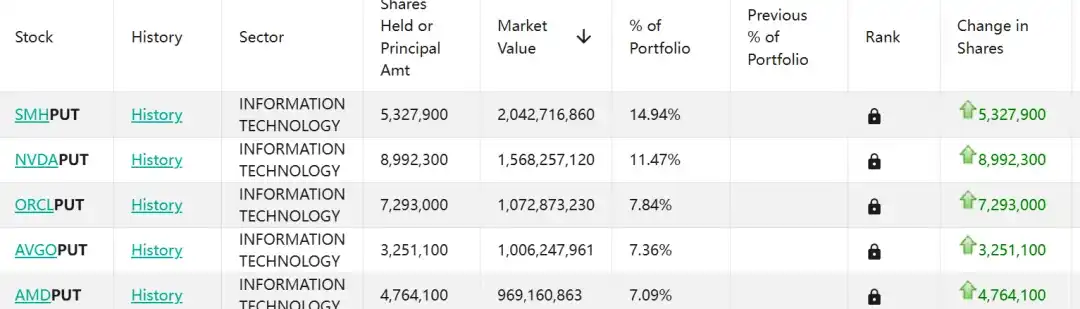
Massive Purchase of Chip Put Options

Additionally, the fund established put option positions on Broadcom, Oracle, AMD, Micron Technology, ASML, Intel, Corning, and TSMC.

These bearish options are not only among the fund's top five purchases for Q1 but also rank among its top five holdings. This undoubtedly highlights Leopold Aschenbrenner's pessimistic outlook on the prospects of chip stocks.

However, Leopold Aschenbrenner is not bearish on all chip stocks.

In Q1, the fund slightly increased its holdings of memory giant SanDisk by 80,000 shares and established a SanDisk call value option position worth $380 million, possibly hinting that it expects the memory boom to continue and that the fund is making selective bets within the semiconductor industry.

Still Heavily Betting on Energy and AI Infrastructure

As of the end of Q1, US biofuel company Bloom Energy (ticker: BE) remained Aschenbrenner's largest bullish bet on an individual stock. His fund holds 6.5 million shares of Bloom Energy, valued at $879 million, and holds 409,000 Bloom Energy call options with a notional value of $55 million.

Furthermore, Situational Awareness increased its holdings in cryptocurrency mining/data center operators CleanSpark (ticker: CLSK), Riot Platforms (ticker: RIOT), Applied Digital (ticker: APLD), and IREN Limited (ticker: IREN).

As we previously analyzed, Aschenbrenner's bet on Bitcoin miners is not for cryptocurrency speculation but for the ready-to-use land, power, and grid permits held by these miners. In the era of massive AI infrastructure expansion, these resources are equivalent to "ready-made" AI infrastructure, saving years of approval time.

A Belated 13F Report

It is worth noting that Aschenbrenner's 13F filing was originally due last Friday—according to regulations, all institutional investment management companies holding securities over $100 million must submit this disclosure document to the U.S. Securities and Exchange Commission within 45 days after the quarter ends—but Situational Awareness did not submit the report until Monday morning.

Typically, late or missed 13F filings can lead to civil penalties at the SEC's discretion, ranging from small fines to a maximum of $750,000.

However, investors' attention is certainly focused on Aschenbrenner's specific portfolio adjustments.

Overall, while he aggressively established semiconductor put option positions in Q1, his fund still holds a significant amount of highly volatile tech stocks and continues to make selective investments in computing, memory, and data center infrastructure. This adjustment trend might be worth investors' reference.


Preguntas relacionadas

QWho is the 24-year-old fund manager mentioned in the article and what is the name of his fund?

AThe fund manager is Leopold Aschenbrenner, and his fund is called 'Situational Awareness LP'.

QWhat was the most significant action taken by Situational Awareness LP in Q1 regarding the semiconductor industry?

AThe fund's most significant action was establishing a large short position in chipmakers by purchasing put options with a notional value of $8.46 billion against companies like Nvidia and the VanEck Semiconductor ETF (SMH).

QDespite the broad short position, which specific semiconductor stock did the fund show bullish sentiment towards in Q1?

AThe fund showed selective bullishness towards SanDisk by increasing its stock holdings by 80,000 shares and establishing $380 million in call options on the company.

QWhat is the fund's largest long stock position as of the end of Q1?

AThe fund's largest long stock position is in Bloom Energy (BE), holding 6.5 million shares valued at $879 million.

QWhy does the fund invest in Bitcoin mining companies like CleanSpark and Riot Platforms, according to the article's analysis?

AThe fund invests in Bitcoin mining companies not for cryptocurrency speculation, but for their valuable physical infrastructure assets like land, power supply, and grid permits, which are seen as 'ready-made' AI infrastructure that can save years of approval time.

Lecturas Relacionadas

The Verdict in Choi Tae-won's Divorce Case: Revealing the Inheritance Undercurrent Behind SK Hynix's Trillion-Won Empire

SK Group Chairman Chey Tae-won's high-profile divorce case, involving a record 1.38 trillion won settlement, has drawn attention to the succession plans for Korea's second-largest conglomerate, especially its crown jewel, SK hynix. Unlike traditional chaebol scripts centered on the eldest son, Chey's three children from his marriage to former President Roh Tae-woo's daughter, Roh Soh-yeong, are carving distinct, non-traditional paths. Eldest daughter Chey Yun-jung (b. 1989) is seen as the most evident successor. With a scientific and consulting background, she holds executive roles at SK bioscience and SK Inc.'s growth support department, focusing on future strategy and biopharma. Her marriage is to an AI infrastructure entrepreneur, not a traditional business alliance. Second daughter Chey Min-jung (b. 1991) took a unique route, voluntarily serving as a South Korean naval officer, including an anti-piracy deployment. She later worked on policy and strategy for SK hynix in Washington D.C. before co-founding an AI-driven healthcare startup. She married a former U.S. Marine Corps officer, connecting her to U.S. defense and policy circles—networks crucial for a global semiconductor giant. The only son, Chey In-geun (b. 1995), who studied physics like his father, worked briefly at SK E&S before joining McKinsey. Despite fitting the traditional "heir" profile as the eldest son, he remains silent and holds no public position or shares in SK, suggesting the old succession playbook is obsolete. As SK hynix's valuation soars, becoming a geopolitical asset in the AI era, the heirs' legitimacy is no longer automatic. They must prove themselves in fields like AI biotech, global policy, and strategic consulting. Their marriages also reflect new elite networks in tech and defense, not old political alliances. Their inheritance is the complex challenge of navigating a globalized, tech-driven world, not just a corporate throne.

marsbitHace 2 hora(s)

The Verdict in Choi Tae-won's Divorce Case: Revealing the Inheritance Undercurrent Behind SK Hynix's Trillion-Won Empire

marsbitHace 2 hora(s)

From OpenSea to OpenRouter: Is Alex Atallah Repeating His 'Exit at the Peak' Playbook?

From OpenSea to OpenRouter: Is Alex Atallah Repeating His "Exit at the Peak" Playbook? According to the Wall Street Journal, payments giant Stripe is in talks to acquire the AI model aggregation platform OpenRouter in a potential deal valuing the company near $100 billion. This would mark founder Alex Atallah's second creation of a company reaching a $100 billion valuation, following his co-founding of NFT marketplace OpenSea. OpenRouter, founded just over three years ago, has grown rapidly by acting as a unified gateway for developers to access over 400 AI models. It currently has about 10 million users and processes over 200 trillion tokens monthly. While the platform's annualized revenue is around $50 million, its valuation has skyrocketed from $1.3 billion in March 2026. The potential acquisition by Stripe, a company OpenRouter's founder once likened it to, represents a major expansion into AI infrastructure for the payments leader. This move echoes Atallah's previous timing with OpenSea, where he departed before the NFT market's significant downturn. For OpenRouter, selling now may be strategic. Despite its scale, its business model—charging a 5-5.5% fee on AI inference calls—faces pressure from competition, open-source models, and potential price wars among model providers, limiting its profitability narrative for an IPO. A key asset for potential acquirers like Stripe is OpenRouter's vast repository of real-world AI usage data, which offers unique insights into model performance and developer preferences that are difficult to replicate. Whether this potential deal signifies a new valuation benchmark for AI infrastructure or another market peak signal remains to be seen.

链捕手Hace 3 hora(s)

From OpenSea to OpenRouter: Is Alex Atallah Repeating His 'Exit at the Peak' Playbook?

链捕手Hace 3 hora(s)

Trading

Spot
活动图片




