2026 Crypto Financing Reshuffle: Gaming and DePIN Are Dead, Two Prediction Market Deals Gobble Up 18% of Yearly Funding

marsbitPublicado a 2026-05-09Actualizado a 2026-05-09

Resumen

Crypto Funding Shakeup in 2026: Gaming & DePIN Fade, Prediction Markets Dominate Analysis of crypto funding from January 1 to May 6, 2026, reveals a major sectoral shift. The industry raised $8.65 billion across 305 deals. However, a March surge to $4.57 billion was largely due to two mega-deals: BVNK's $1.8 billion acquisition and a $1 billion raise by Kalshi. Excluding these, monthly funding is a sluggish ~$1 billion. Capital concentration is extreme. The Payments ($3.74B) and Consumer ($2.48B) sectors absorbed 72% of all funds. Within Consumer, prediction markets were dominant: Kalshi's $1B and Polymarket's $600M raises together accounted for 18% of the year's total, surpassing all 47 DeFi deals combined ($1.06B). In contrast, Gaming and DePIN sectors saw funding nearly vanish. A strategic pivot is underway. Merger & Acquisition (M&A) activity reached 48 deals, nearly matching the 57 seed-stage rounds. This indicates capital is increasingly flowing toward acquiring established leaders rather than betting on new ideas. The most active investors so far in 2026 are Coinbase Ventures (18 deals), Tether (13 deals), Animoca Brands (11 deals), and GSR (11 deals). Notably, a16z's pace has slowed significantly compared to its 2021-2026 average.

Author: Memento Research

Compilation: TechFlow Deep Tides

Deep Tides Intro: Crypto financing data from the first four months of 2026 reveals a brutal reality: funding for the gaming and DePIN sectors has nearly dried up, while Kalshi and Polymarket, two prediction market companies, have taken more money than all DeFi projects combined for the entire year. More alarmingly, the number of M&A deals has caught up with seed rounds, indicating that capital is shifting from betting on new ideas to acquiring existing industry leaders.

Financing Overview: The March Surge Was Just an Illusion

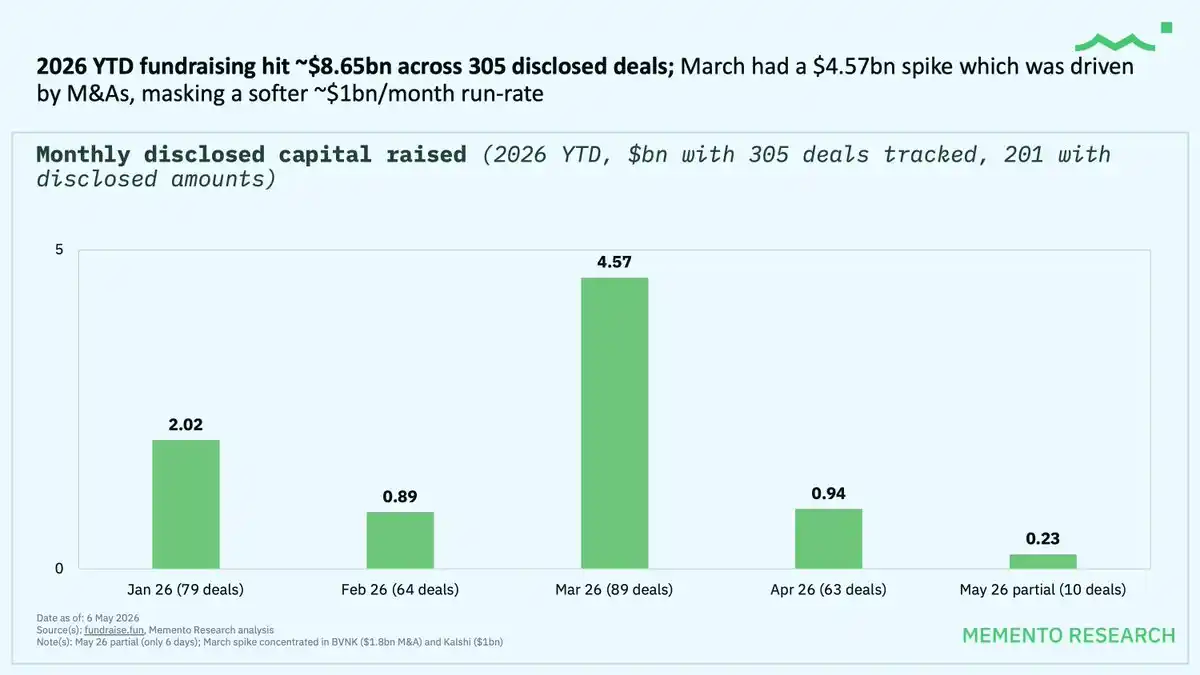
From January 1 to May 6, 2026, the crypto industry completed 305 financing rounds, totaling $8.65 billion. However, the "surge" of $4.57 billion in March was essentially just two mega M&A deals: BVNK's $1.8 billion and Kalshi's $1 billion.

Excluding these two, the real financing pace is about $1 billion per month, which is even weaker than at the end of 2025.

Fund Flow: Payments and Consumer Gobble Up 72%

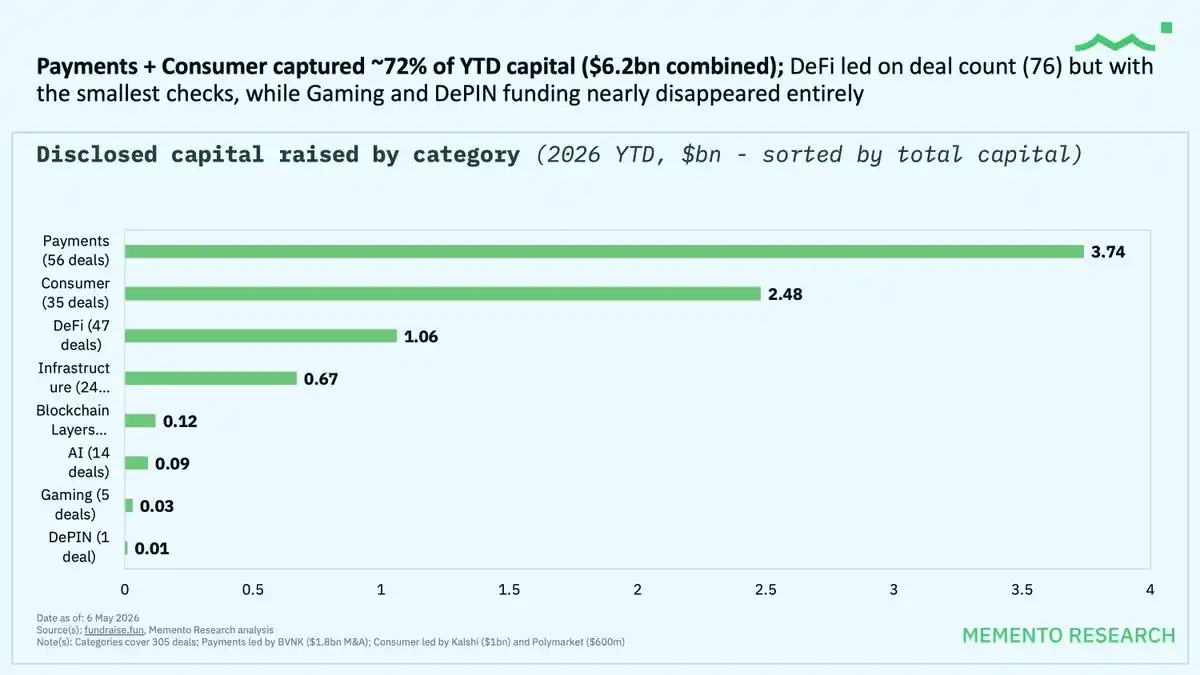
By sector:

Payments: $3.74 billion (56 deals)

Consumer: $2.48 billion (35 deals)

DeFi: $1.06 billion (47 deals, the highest number of transactions)

The payments and consumer sectors together account for 72% of the year's funding. Financing for gaming and DePIN has almost vanished.

Prediction Markets Dominate the Consumer Sector

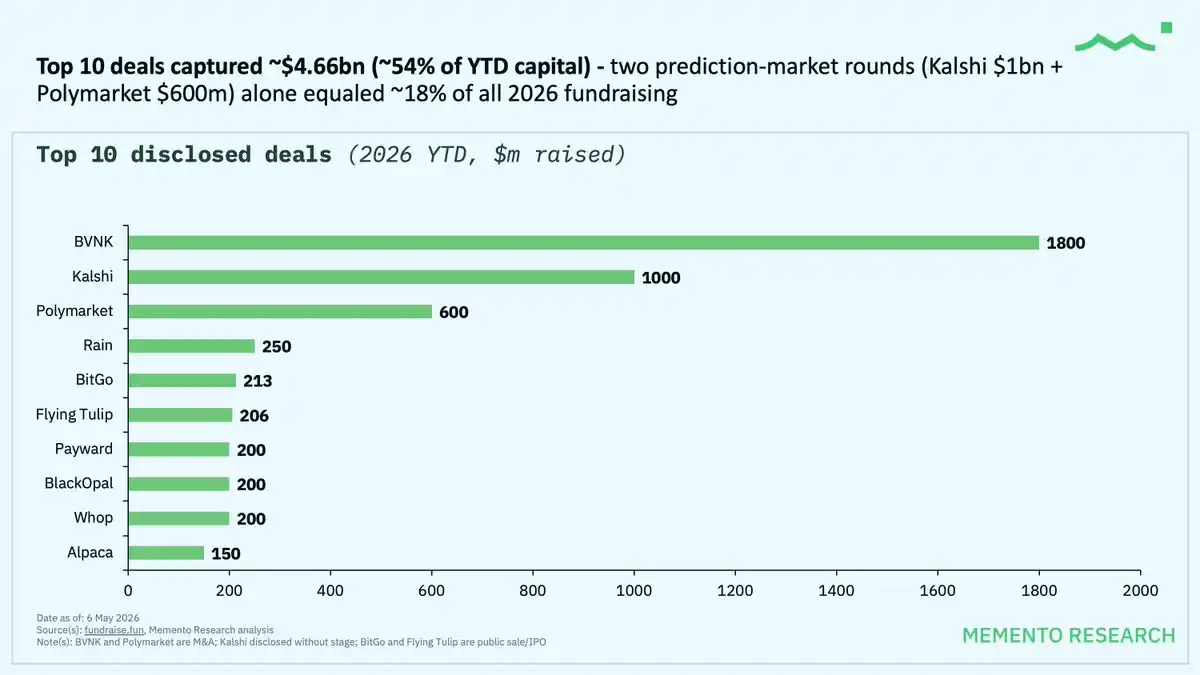
The two prediction market companies accounted for 18% of the year's total funding:

Kalshi: $1 billion

Polymarket: $600 million

These two deals total $1.6 billion, exceeding the combined total of all 47 DeFi financing rounds.

M&A Becomes Mainstream

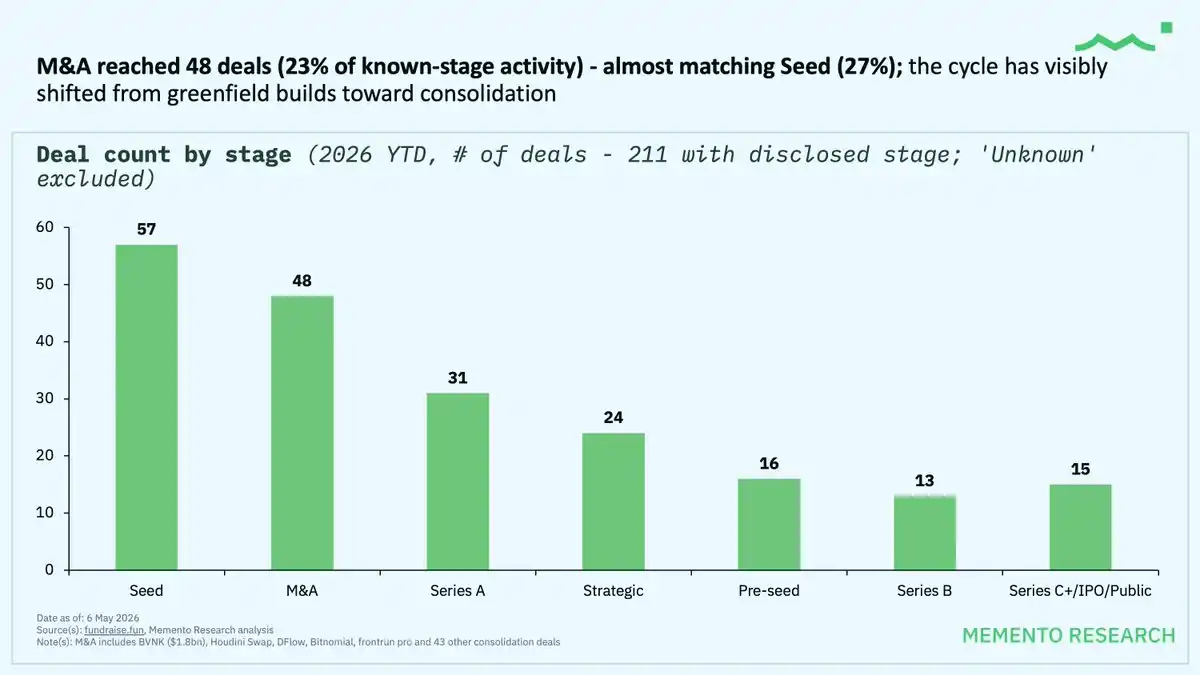
M&A deals reached 48 (23% of known-stage transactions), almost on par with 57 seed rounds (27%). This cycle has shifted from the early stage of investing in new ideas to acquiring industry leaders.
Investor Rankings Reshuffled

Most active funds in 2026:

Coinbase Ventures: 18 deals (Ranked 2nd during 2021-26)

Tether: 13 deals (New top lead investor)

Animoca Brands: 11 deals (Ranked 1st during 2021-26)

GSR: 11 deals

a16z: 7 deals (Significantly down from ~200 deals during 2021-26)

Preguntas relacionadas

QWhat were the two major M&A deals that dominated the funding figures for March 2026, and what were their values?

AThe two major M&A deals were BVNK, which raised $1.8 billion, and Kalshi, which raised $1 billion.

QWhich two sectors accounted for 72% of total funding in early 2026, and what were the respective funding amounts?

AThe Payments and Consumer sectors accounted for 72% of total funding. Payments raised $3.74 billion across 56 deals, while Consumer raised $2.48 billion across 35 deals.

QHow much funding did the prediction market companies Kalshi and Polymarket receive collectively, and what percentage of the year's total funds does this represent?

AKalshi and Polymarket collectively received $1.6 billion in funding, which represents 18% of the total funds raised in early 2026.

QWhat significant trend is highlighted by the number of M&A transactions (48) nearly matching the number of seed rounds (57) in early 2026?

AThe trend highlights a market shift where capital is moving away from funding new ideas (seed-stage investments) and towards acquiring existing market leaders (M&A).

QAccording to the article, which were the most active investment funds in early 2026 by number of deals?

AThe most active funds were Coinbase Ventures with 18 deals, Tether with 13 deals, and Animoca Brands and GSR with 11 deals each.

Lecturas Relacionadas

The Verdict in Choi Tae-won's Divorce Case: Revealing the Inheritance Undercurrent Behind SK Hynix's Trillion-Won Empire

SK Group Chairman Chey Tae-won's high-profile divorce case, involving a record 1.38 trillion won settlement, has drawn attention to the succession plans for Korea's second-largest conglomerate, especially its crown jewel, SK hynix. Unlike traditional chaebol scripts centered on the eldest son, Chey's three children from his marriage to former President Roh Tae-woo's daughter, Roh Soh-yeong, are carving distinct, non-traditional paths. Eldest daughter Chey Yun-jung (b. 1989) is seen as the most evident successor. With a scientific and consulting background, she holds executive roles at SK bioscience and SK Inc.'s growth support department, focusing on future strategy and biopharma. Her marriage is to an AI infrastructure entrepreneur, not a traditional business alliance. Second daughter Chey Min-jung (b. 1991) took a unique route, voluntarily serving as a South Korean naval officer, including an anti-piracy deployment. She later worked on policy and strategy for SK hynix in Washington D.C. before co-founding an AI-driven healthcare startup. She married a former U.S. Marine Corps officer, connecting her to U.S. defense and policy circles—networks crucial for a global semiconductor giant. The only son, Chey In-geun (b. 1995), who studied physics like his father, worked briefly at SK E&S before joining McKinsey. Despite fitting the traditional "heir" profile as the eldest son, he remains silent and holds no public position or shares in SK, suggesting the old succession playbook is obsolete. As SK hynix's valuation soars, becoming a geopolitical asset in the AI era, the heirs' legitimacy is no longer automatic. They must prove themselves in fields like AI biotech, global policy, and strategic consulting. Their marriages also reflect new elite networks in tech and defense, not old political alliances. Their inheritance is the complex challenge of navigating a globalized, tech-driven world, not just a corporate throne.

marsbitHace 6 hora(s)

The Verdict in Choi Tae-won's Divorce Case: Revealing the Inheritance Undercurrent Behind SK Hynix's Trillion-Won Empire

marsbitHace 6 hora(s)

From OpenSea to OpenRouter: Is Alex Atallah Repeating His 'Exit at the Peak' Playbook?

From OpenSea to OpenRouter: Is Alex Atallah Repeating His "Exit at the Peak" Playbook? According to the Wall Street Journal, payments giant Stripe is in talks to acquire the AI model aggregation platform OpenRouter in a potential deal valuing the company near $100 billion. This would mark founder Alex Atallah's second creation of a company reaching a $100 billion valuation, following his co-founding of NFT marketplace OpenSea. OpenRouter, founded just over three years ago, has grown rapidly by acting as a unified gateway for developers to access over 400 AI models. It currently has about 10 million users and processes over 200 trillion tokens monthly. While the platform's annualized revenue is around $50 million, its valuation has skyrocketed from $1.3 billion in March 2026. The potential acquisition by Stripe, a company OpenRouter's founder once likened it to, represents a major expansion into AI infrastructure for the payments leader. This move echoes Atallah's previous timing with OpenSea, where he departed before the NFT market's significant downturn. For OpenRouter, selling now may be strategic. Despite its scale, its business model—charging a 5-5.5% fee on AI inference calls—faces pressure from competition, open-source models, and potential price wars among model providers, limiting its profitability narrative for an IPO. A key asset for potential acquirers like Stripe is OpenRouter's vast repository of real-world AI usage data, which offers unique insights into model performance and developer preferences that are difficult to replicate. Whether this potential deal signifies a new valuation benchmark for AI infrastructure or another market peak signal remains to be seen.

链捕手Hace 7 hora(s)

From OpenSea to OpenRouter: Is Alex Atallah Repeating His 'Exit at the Peak' Playbook?

链捕手Hace 7 hora(s)

Trading

Spot
活动图片