Some analysts say that Web3 0 will subvert Web2.0 from the perspectives of openness, privacy and co construction 0 Internet, create a decentralized world dominated by user communities, and reconstruct the value paradigm of Internet traffic.
Web3. The openness of 0 is reflected in the full freedom and low threshold of users' access in a certain "field" of Internet applications. For example, users can log in to the application on the chain with one account address, without secondary registration license, and the operation is convenient.
This topic will take ens, mask network, polkdot and GRT as examples to explain the significance of openness.
ENS
DNS (domain name system) is a traditional web2 An important part of 0. When the user accesses the Internet, the server will parse the user's URL request into an IP address and return it to the user. This more readable domain name system reduces the difficulty for users to visit the website, which is web2 0 has made important contributions to the construction of. DNS solves web2 0, but it also brings the problem that users need a large number of website accounts to visit different websites. In response to this problem,
Web3. 0, login can rely on decentralized identity, did (decentralized identity).
In the domain name system built on Ethereum, ENS (Ethereum name service) connects the wallet address with the domain name to log in to various dapps.
Recently, vitalik buterin said in an interview: "Ethereum domain name service ENS is by far the most successful non-financial Ethereum application, which can basically be compared to a decentralized phone book".
On October 9, 2021, an unknown wallet purchased the Ethereum domain name param. With 420 eth Eth, this is the largest ENS domain name transaction so far.
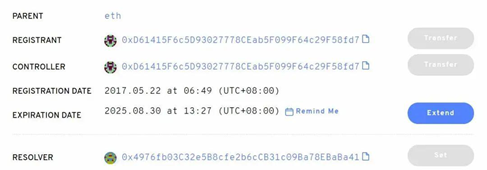
Spending so much money on a domain name shows the significance of HTC.
The full name of ENS is Ethereum name service. It is a distributed domain name service based on Ethereum. It provides a safe and decentralized way to resolve simple human readable domain names into address resources on and off the chain.
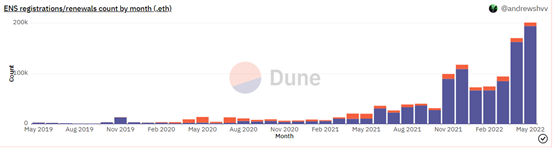
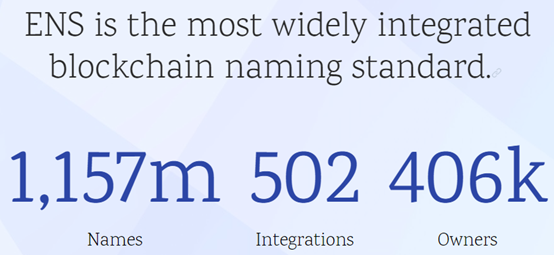
Since the launch of ENS, the number of users has increased rapidly, and the maximum number of registrations per month is only 3066 and 3052 in May 2019 and 2020. By may 2021 and April 2022, the number increased to 10959 and 162978. The year-on-year growth rate can reach 259% and 1387% respectively. In May 2022, it continued to grow to 194562, with a total of 1.157 billion registered user names and 406000 address owners.
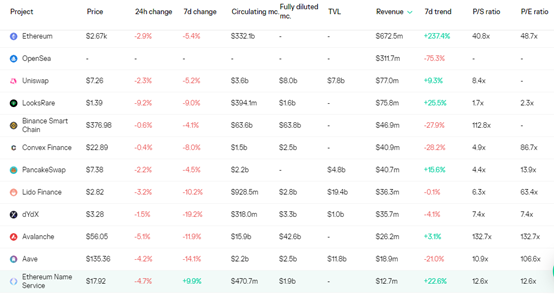
From the data of income and valuation, among the top 12 projects, the cumulative income scale of ENS is not high, but the valuation is reasonable and the growth potential is predictable.
In terms of income, the top four projects have a large income space, which are respectively US $672 million, US $311 million, US $77 million and US $75.8 million of eth, opensea, uniswap and looksrare. ESN earned $12.7 million. In terms of valuation, the PE valuation of ENS reached 12.6 times. Among the top 12 items, the characteristics of undervalued value are obvious, ranking the third in undervalued value items. Only lower than dydx and looksrare.
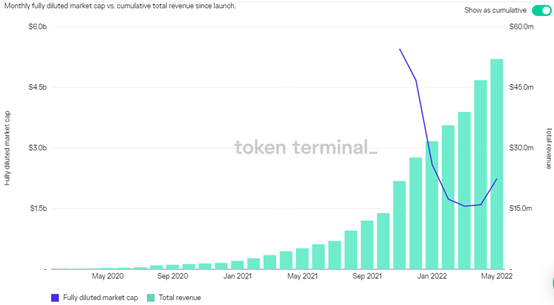
Since its release, the revenue growth of ENS has maintained a very clear growth trend, while the market value fluctuates greatly. Affected by the overall market adjustment, the decline of market value further suggests the opportunity of low absorption.
In terms of revenue, the monthly revenue of ENS increased by 93 times from US $550000 in February 2020 to US $52.1 million in May 2022.
In terms of market value, the monthly market value performance of ENS decreased from US $5.5 billion in November 2021 to US $1.6 billion in March 2022, and then reversed. At present, it is around us $2.2 billion.
The rare ENS domain name has become a new favorite of investment, Web3 Is the positive of 0 released in advance?
Similar to the early Internet domain name boom, ENS domain names with fewer letters are easier to read, spell and search.
The minimum number of digits of ENS domain name is 3, and the sales of 3-digit and 4-digit domain names have suddenly increased sharply. In the early stage, it was reported that Alisha, head of ENS community Eth suggested that the secondary sales of ENS NFT on opensea reached a staggering 446 Ethereum (about $1.3 million).
But this domain name boom is different from that in the 1990s. Nowadays, many users are interested in the ENS name of digital class, such as 123 eth。 Many three digit ENS domain names sell for more than 6 eth each.
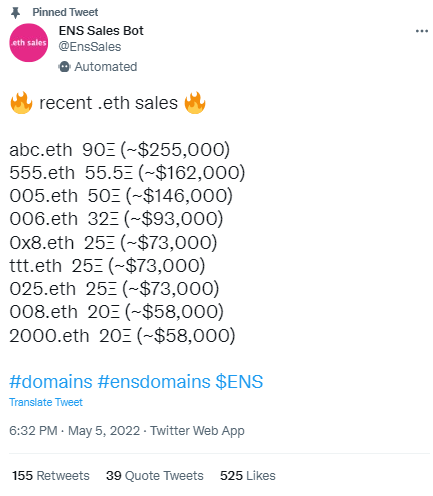
Some people buy at the corresponding amount according to the number contained in the ENS domain name itself, such as 555.5 eth Eth, worth nearly $149000. Ens sales BOT shows that 25eth can purchase 025 Eth, 20eth can buy 2000 eth。
It is worth noting that the ENS domain name is created through the ENS registrar contract, and users need to pay the fees of registration (creating domain name) and renewal (retaining domain name). Ens charging is an anti encroachment mechanism designed to ensure that no one will hold domain names forever.
Therefore, the price of the ENS domain name will vary according to the length of the domain name:
• Domain name with length of 5 + characters: 5 dollars per year;
• 4-character domain name: 160 dollars per year;
• 3-character domain name: $640 per year.
The ENS agreement earns revenue through both domain name registration and domain name renewal. It should be pointed out here that the number of short domain names is limited, which is more attractive to users or investors. In the future, whether it is investment or use, its value is immeasurable.





