比特币生态热度不减,老项目们如何借势重焕生机?

Odaily星球日报Publicado a 2023-12-20Actualizado a 2023-12-20

Resumen

比特币生态是今年的主流叙事,老项目如何在比特币生态扩展业务,Bounce、Nostr、ALEX、Magic Eden、Uniswap走在了前列。

原文作者:蒋海波,PANews

比特币的兴起与铭文生态的蓬勃发展构成了今年加密货币世界的主流叙事。比特币的上涨得益于链上生态的繁荣、现货 ETF 的通过预期、减半预期以及美联储的降息预期,同时受到机构投资者入场的巨大推动,这些因素共同促成了其在今年的显著增长。

此外,铭文生态,尤其是以 Ordinals 为代表的非同质化代币(NFT)和同质化代币(FT),不仅为比特币生态系统带来了新的活力和关注点,也外溢到其它公链,几乎所有头部公链都开发了一套铭文玩法。旧的项目不断加入,借势重焕生机。

Bounce 的比特币生态项目拍卖与 Layer 2 

Bounce Finance 是一个拍卖即服务(AaaS)协议,为项目提供一站式的代币发行服务。该平台支持多种区块链网络,为用户提供创建和参与各种类型拍卖的能力,包括代币和 NFT 拍卖、实物收藏品拍卖、广告位拍卖等。
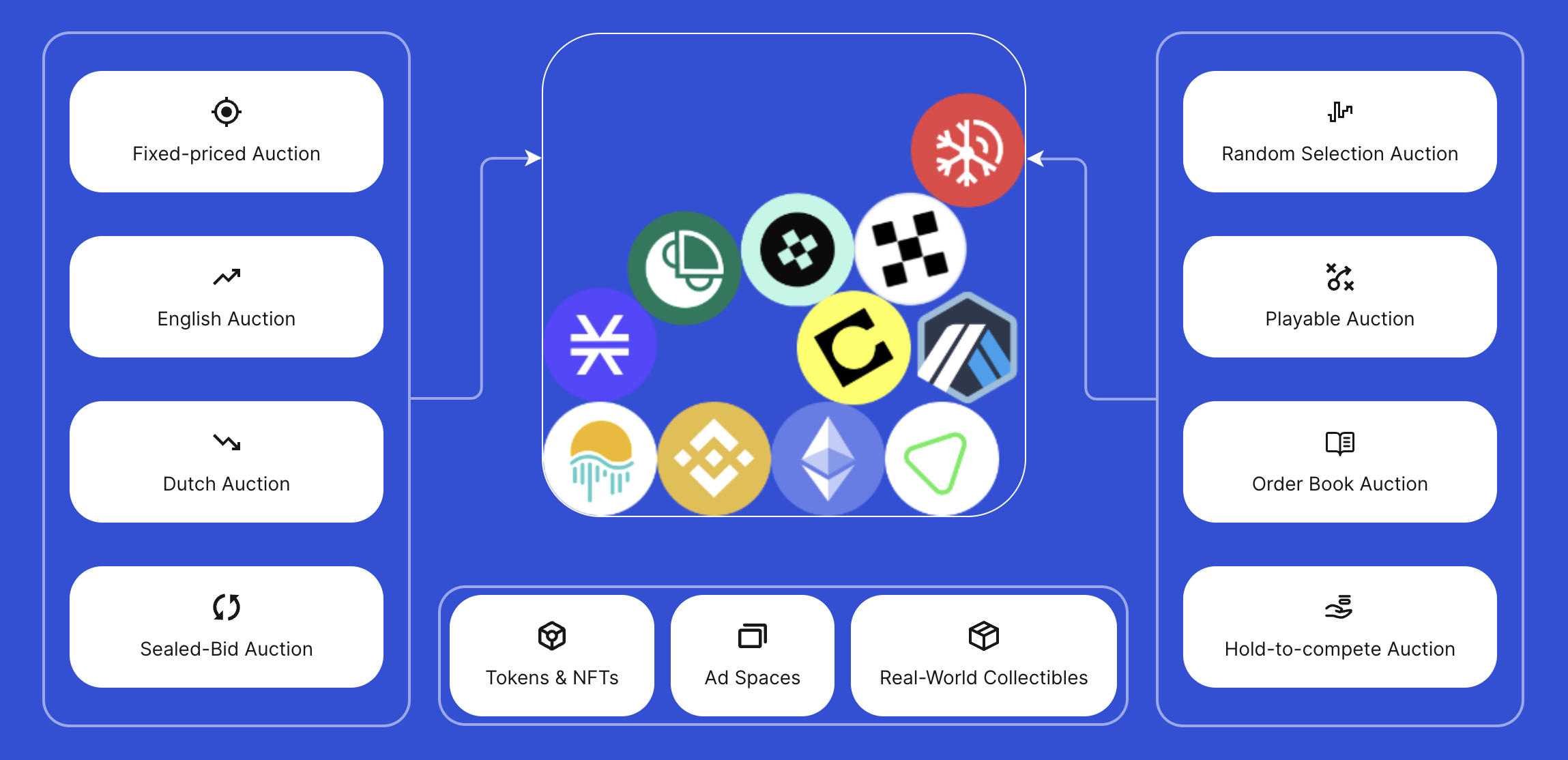
比特币生态热度不减,老项目们如何借势重焕生机?

近期,Bounce 上线了几个比特币生态项目的拍卖,一开始估值都比较低,后续的拍卖又可以用到前面项目的代币作为“铲子”,因此这些项目的表现都不错。由于自己的原生代币 AUCTION 也是拍卖中的金铲子,也导致 AUCTION 的价格走高。

以最近一期拍卖 GoDID 为例,GoDID 是去中心化身份 (DID) 的市场聚合器,为 ENS、Space ID 和比特币 Ordinals DID 提供服务。GoDID 的代币为 BDID,其中 20% 分配给使用 AUCTION 购买抽奖券的用户, 40% 分配给 AUCTION 质押者, 20% 分配给前一期 Launch 项目 BitStable 所发行的美元稳定币 DAII 的质押者, 5% 分配给使用 MUBI、BSSB、AUCTION、WBTC 的空投挖矿参与者,其中 MUBI、BSSB 均为前几期的拍卖项目。

12 月,Bounce 还宣布了一个专为比特币生态系统设计的区块链解决方案 BounceBit,这是一个基于币安比特币 BTCB 和 AUCTION 的比特币 Layer 2 ,这一产品计划于 2024 年推出。

Uniswap 扩展到 Rootstock

Uniswap 是一个领先的去中心化交易所(DEX),随着时间的推移,Uniswap 已推出了多个版本,也扩展到了多条链上。

上周,GFX Labs 通过 Oku 将 Uniswap V3部署到了比特币侧链 Rootstock 上,这一举动也被视为 Uniswap 向比特币生态的扩展。GFX Labs 获得了 Uniswap 基金会的资助,用于构建基于 Uniswap V3的交易前端 Oku。Oku 具有订单簿、价格走势图表、交易记录、限价订单等功能。
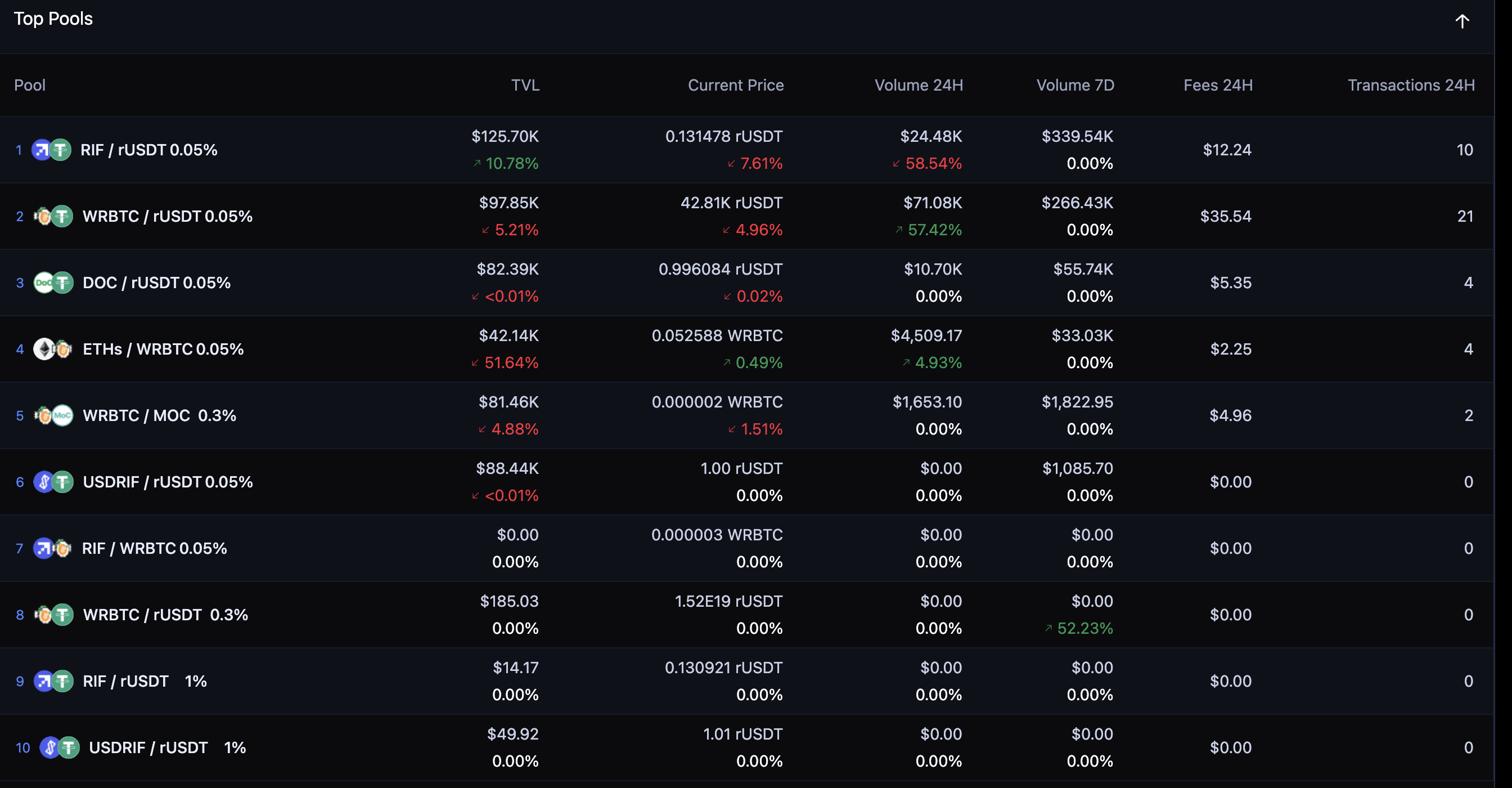
比特币生态热度不减,老项目们如何借势重焕生机?

Rootstock(RSK)是一个基于比特币网络的侧链,与以太坊虚拟机(EVM)兼容,通过与比特币的合并挖矿来保障安全性,有与比特币 1: 1 锚定的 SBTC。RSK 引入了一个联合保证人模型,这是一组被社区信任的实体,负责管理从比特币到 RSK 的资产转移。这些保证人提供了额外的安全层,确保资产在两个网络之间安全地转移。

截至 12 月 19 日,Oku 上的流动性为 53.5 万美元。

NFT 市场 Magic Eden

Magic Eden 是一个主要针对 Solana 区块链的 NFT 市场。它在 Solana 生态系统中具有较大的影响力,提供了一个用户友好的界面,使艺术家、收藏家和 NFT 爱好者能够轻松买卖和探索 NFT。它的特点包括低交易费、高速交易和多样化的 NFT 藏品,这使得它成为 Solana 生态系统中最受欢迎的 NFT 市场之一。

今年 3 月,伴随着 Ordinals NFT 的兴起,Magic Eden 宣布扩展到比特币生态,作为其多链愿景的重要一步,这进一步加强了其在多链 NFT 市场的地位。

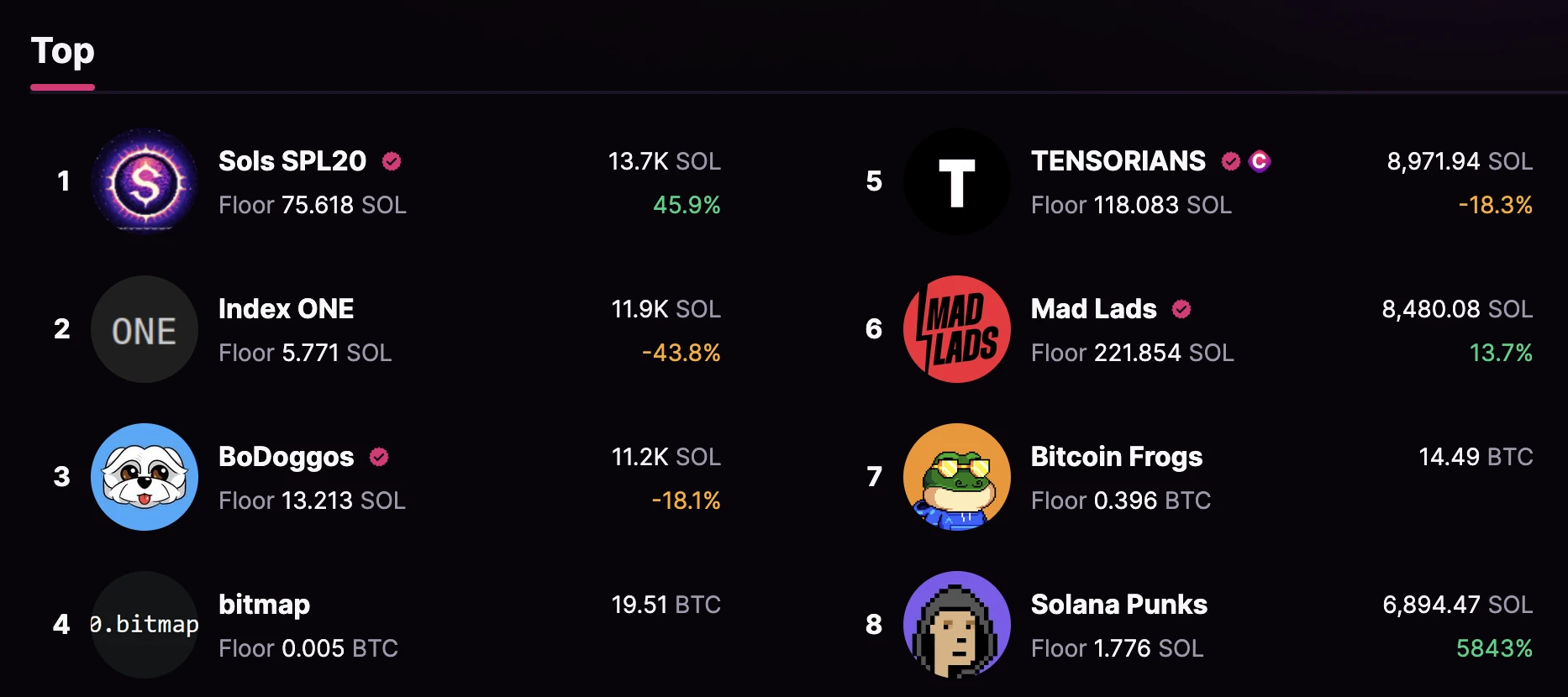
如下图所示,如今 bitmap、Bitcoin Frogs 等比特币生态 NFT 的交易额也在 Magic Eden 中位于前列。
比特币生态热度不减,老项目们如何借势重焕生机?

Nostr 去中心化社交与小额支付的结合

Nostr 是一个去中心化社交协议,得到了推特联合创始人 Jack Dorsey 的支持。它的概念起源于 2020 年 11 月,旨在建立一个全球性、去中心化、抗审查的通信网络。

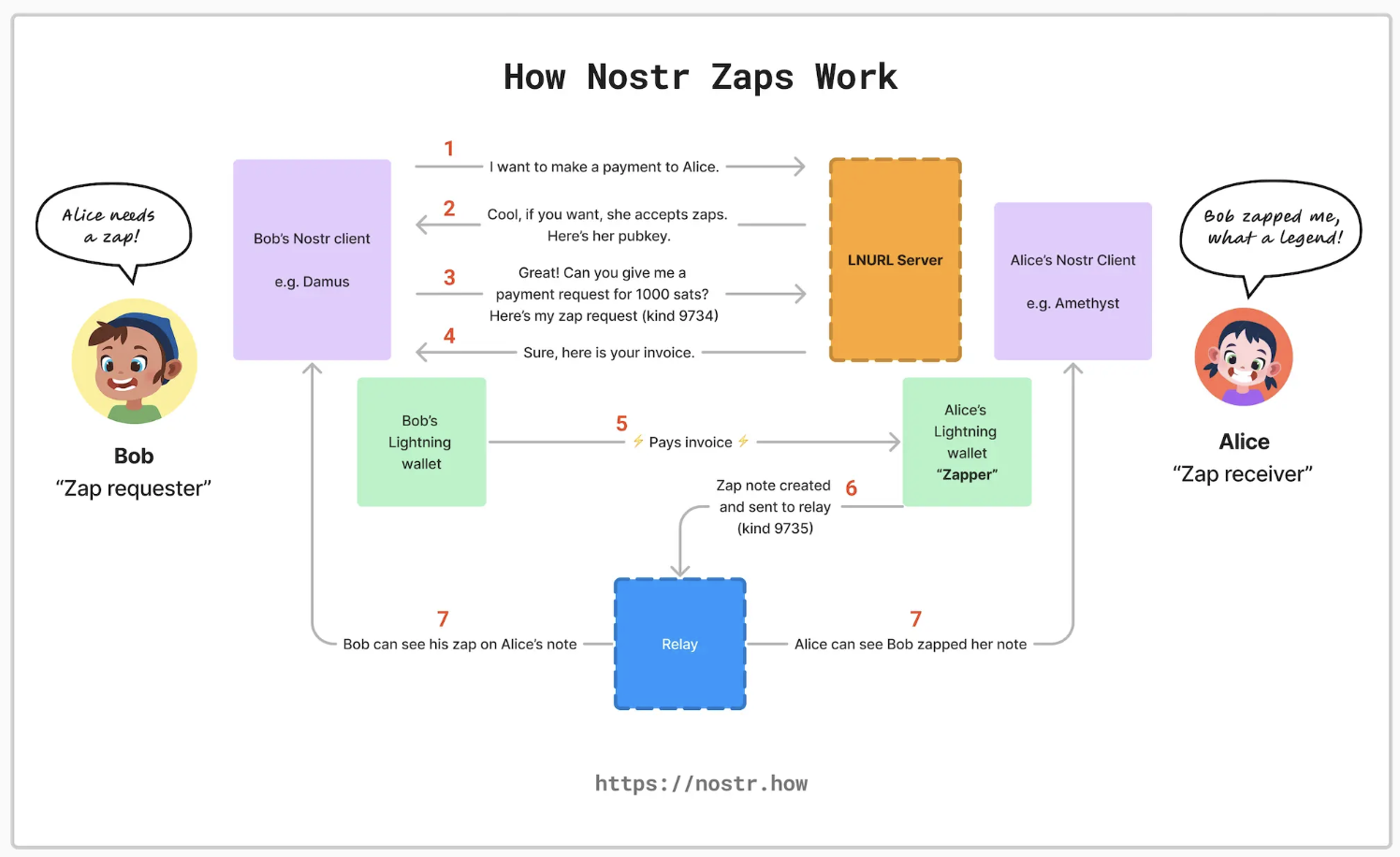
今年 9 月,Nostr 进行了 NIP-57 升级,增加了小额支付功能“Zaps”,允许用户通过 Nostr 客户端进行小额打赏或支付,从而能在 Nostr 生态系统中实现快速、低成本支付。Zaps 主要通过闪电网络(Lightning Network)实现,其过程高效且成本较低。
比特币生态热度不减,老项目们如何借势重焕生机?

用户在 Nostr 客户端发起 Zap 请求后,如果接收方的闪电钱包支持 Zaps,LNURL 服务器会响应并确认接收方的公钥。接着,客户端随后会创建一个 Zap 请求,包含了支付中的关键数据,LNURL 服务器会回应并提供所需的发票。一旦用户完成支付,就会直接将金额支付给接收方的闪电钱包。

到目前为止,Zap 的付款数量已超过 5 万笔。

ALEX 的 B 20 和预言机

ALEX 原本就是 Stacks 上的一个 DeFi(去中心化金融)平台。它的主要产品是一个 DEX,还有 Launchpad、跨链桥、质押、挖矿、彩票等功能。DefiLlama 数据显示,ALEX 的 TVL 为 3880 万美元,约占 Stacks TVL 的 82.3% 。如果仅以一个公链头部 DEX 的定位进行评判,那么 ALEX 的估值是很受限制的,尤其是流动性和交易量也不高。

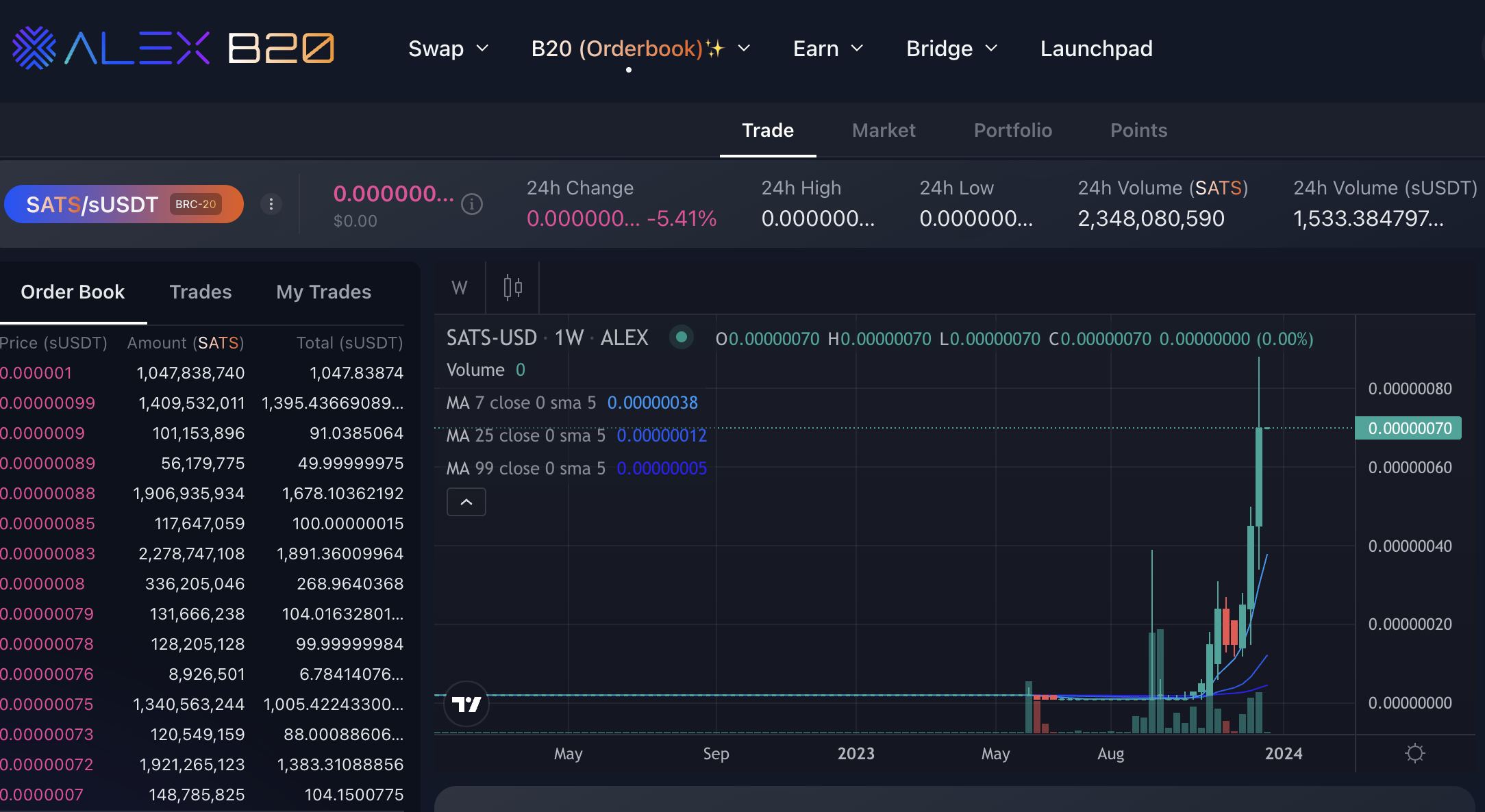
在铭文火爆之后,ALEX 开发了一个名为 B 20 的去中心化交易所,专门用于交易 BRC 20 代币,ALEX 还为新加入者提供了 STX 代币以支付生态系统的燃料费。在 B 20 中,这些 BRC 20 代币可以用 sUSDT 作为基础货币进行交易,sUSDT 是从 BNB 链跨链到 Stacks 的 USDT。
比特币生态热度不减,老项目们如何借势重焕生机?

此外,ALEX 还计划推出针对 BRC 20 代币的首个比特币预言机,这项工作是与 BRC 20 的创造者及 ALEX 顾问@domodata 以及包括 BestinSlot、OKX、Hiro、Unisat 等在内的关键现有链下索引器一起进行的。它希望利用 Stacks 的可编程性和读取比特币状态来引领 BRC 20 索引的去中心化共识,也被称为“索引器的索引器”。比特币预言机的目标是验证每个 BRC 20 事件,并更新去中心化的、链上合约中的全球余额。

各个公链铭文争鸣

以 Ordinals 为代表的铭文在比特币上盛行,ORDI 和 SATS 的市值均超过 10 亿美元。Ordinals 等项目允许用户将数据(如文本、图像等)附加到交易的特定部分,从而将这些数据与特定的“聪”关联起来。当这样的交易被打包到区块链上时,特定的聪就携带了用户附加的数据。这些特定的聪可以被视为独特的数字资产,用户可以将它们交易给别人,从而实现特定资产的转移。

如果说铭文让原本不支持智能合约的比特币新增了一种资产发行方式,那么在其它链上流行的铭文是否还有意义呢?具不完全统计已发布和准备发布铭文的公链超过 30 个,如以太坊的 ETHS、Solana 的 SOLS、Avalanche 的 AVAV,铸造铭文的过程甚至导致 ArbitrumTONIOST 等多个网络短时出现宕机。

12 月 19 日晚,Injective 上首个铭文 INJS 的铸造引发了一场闹剧。由于 INJS 的每次铸造都需要向合约部署者支付 0.03 INJ 的费用,该项目引起了铭文玩家的不满。当 INJS 开始铸造时,Injective 官方推特发布推文让用户不要参加,并称该铭文团队收取费用的做法并不恰当。之后 INJS 宣布停止铸造,后续将让用户免费参与。这也反应了用户对铭文免费启动(Free Launch)的追求。

智能合约链上的铭文转移和通过智能合约转账有什么区别呢?以以太坊上的铭文项目 Ethscriptions 为例,Ethscriptions 的转移手续费相比普通的智能合约转账可能会更低,因为它们通过使用 calldata 和避免传统的智能合约存储和执行来减少交易成本。这使得 Ethscriptions 成为执行区块链上操作的更经济有效的方式。

但是绕过传统的智能合约存储和执行可能会引入新的安全漏洞或不可预见的行为,特别是在处理复杂的数据结构或逻辑时。另外,如果仅使用 calldata,Ethscriptions 可能无法利用智能合约提供的所有功能和灵活性,可能限制它们在某些应用中的实用性。

小结

在比特币生态的发展中,Bounce 独特的拍卖玩法带来了很好的造富效应,还计划开发比特币 Layer 2 ;Nostr 将去中心化社交与小额支付结合;ALEX 开发了 BRC 20 交易市场,还计划推出首个去中心化比特币预言机;Uniswap 和 Magic Eden 分别将交易业务扩展到了比特币生态。

铭文成功扩展到了几乎所有值得关注的公链,对于比特币这样的非智能合约链,铭文更为重要;对于以太坊,铭文减少了传统智能合约中的链上存储和执行成本,但也可能引入新的安全问题,功能性也不如智能合约灵活。
Lecturas Relacionadas

US Government Suddenly Halts Anthropic's Strongest Model, "Quasi-IPO Stock Price" Plunges 3.7% Overnight

U.S. Government Halts Anthropic's Top AI Models, 'Pre-IPO' Price Drops 3.7% On June 12, the U.S. government ordered Anthropic to shut down access to its two most powerful AI models, Claude Fable 5 and Claude Mythos 5, citing national security concerns. The directive, issued by the Department of Commerce, required Anthropic to block access for all foreign nationals, leading the company to disable the models globally for all users. Anthropic strongly opposed the move, arguing the government's basis was a "narrow jailbreak vulnerability" and warning that applying such a standard industry-wide would effectively halt all frontier model deployments. The news impacted Anthropic's implied valuation in speculative markets. The Anthropic perpetual contract on Hyperliquid fell approximately 3.7% to around $1,627, down from highs above $1,800 following the models' release. Unauthorized tokenized products linked to Anthropic on Solana also saw significant declines. The models, launched just days earlier on June 9, represented a major capability leap for Anthropic. Fable 5 was its first public release of a "Mythos"-tier model above its flagship Claude Opus. The shutdown creates an ironic situation for Anthropic, a company founded on "AI safety" principles, and adds uncertainty to its ongoing IPO preparations. The company is actively engaging with regulators to resolve what it calls a "misunderstanding" and restore service.

marsbitHace 8 min(s)

US Government Suddenly Halts Anthropic's Strongest Model, "Quasi-IPO Stock Price" Plunges 3.7% Overnight

marsbitHace 8 min(s)

SpaceX IPO Creates Trillion-Dollar Billionaire: Musk's Wealth Equals Half of Crypto Market

SpaceX's record-breaking IPO has propelled Elon Musk to become the first modern billionaire with a personal net worth exceeding $1 trillion, reaching $1.11 trillion according to Bloomberg. This staggering wealth surpasses the total market capitalization of all cryptocurrencies excluding Bitcoin and equals roughly half of the entire crypto market's value. The milestone highlights extreme wealth concentration and the significant devaluation of the altcoin market, whose total cap has nearly halved since late 2025 as capital flows into large tech stocks. SpaceX's Nasdaq debut saw its valuation hit $2.2 trillion, with shares soaring from a $135 offer price to close at $161. Its first-day trading volume of $85 billion set a new global IPO record. Musk owns 42% of the company. Despite his wealth dwarfing the altcoin sector, Musk maintains deep ties to digital assets. He personally holds Bitcoin, Ethereum, and Dogecoin, while his companies, SpaceX and Tesla, collectively hold over 30,000 Bitcoin, ranking among the top corporate BTC holders globally. His acquisition and integration of financial data tools into X (formerly Twitter) further connect his ecosystem to the markets. Ultimately, Musk's trillion-dollar status underscores the immense wealth controlled by tech founders, though this fortune remains largely tied to volatile stock prices rather than liquid assets.

Foresight NewsHace 15 min(s)

SpaceX IPO Creates Trillion-Dollar Billionaire: Musk's Wealth Equals Half of Crypto Market

Foresight NewsHace 15 min(s)

Hardcore First Look | Ocean Embodied Intelligence Company 'Shihang Intelligence' Secures Record-Breaking 1 Billion in Funding, Zhu Xiaohu, Temasek Place Bets

Breaking News | Ocean Embodied Intelligence company "Shihang Intelligent" secures a record-breaking 1 billion RMB (approximately 10 billion yuan) in Series A financing, with investment from Zhu Xiaohu and Temasek. Author: Qiu Xiaofen | Editor: Yuan Silai Ocean Embodied Intelligence company "Shihang Intelligent" has completed its Series A funding round, raising over 1 billion RMB. This marks the largest single funding round in the global marine robotics field to date. Investors include upstream momentum funds from chip companies "Moore Thread" and "Kunlunxin," Singapore's state-owned investment platform Vertex Growth, and listed company Dyneo, among others. Existing investors like GSR Ventures (whose founder Zhu Xiaohu has invested for the fifth time), Vertex Ventures China, Hua Ying Capital, and Long Capital also significantly increased their investments. Founder and CEO Chen Xiaobo, a 1989-born alumnus of Harbin Engineering University, is a long-time expert in underwater robotics. He received the National Defense Science and Technology Progress Award at age 28 (the youngest recipient) and led the development of China's first commercial underwater cleaning robot. The funds will be used for core technology R&D, global market expansion, and building the industry chain ecosystem to scale the application of marine robots in complex underwater scenarios. The ocean is considered one of the most challenging environments for robotics due to low light, high turbidity, complex currents, limited communication, high pressure, and corrosion. "Shihang Intelligent" focuses on developing core underlying technologies for marine robots, covering six key systems: power, control, sensing, navigation, sealing, and deployment. Its robots are capable of operating at depths from 0 to 10,000 meters with full degrees of freedom, performing complex maneuvers, autonomous navigation, and multi-robot collaboration. Applications include ship cleaning, underwater security, offshore wind power, marine ranching, and seabed inspection. The company's order value for the first half of 2026 alone has exceeded 1 billion RMB. Its "Orca Robot" is used by major shipping companies and has performed maintenance on over a thousand large vessels. In April of this year, the company launched its ocean embodied large model "Cangqiong CEORION." Unlike traditional remote-controlled or pre-programmed robots, this model integrates environmental perception, task understanding, and action generation into a single end-to-end architecture. Trained on millions of hours of commercial operation data and simulation data, it covers 12 major underwater operation scenarios. In simulations, it achieved over 90% task success rate and over 70% zero-shot adaptation capability to unseen environments. A built-in physics reasoning module reduces collision risk by 80%, enabling autonomous operation even with weak or no communication. Recently, "Shihang Intelligent" was selected as a core technology partner for Singapore's Maritime and Port Authority national hull inspection and cleaning program. These advancements indicate marine robotics is moving from pilot projects to scaled applications, with real-world operations generating valuable data to continuously improve robot capabilities. CEO Chen Xiaobo stated the company will continue investing in core marine robotics technology, the embodied intelligence model, and global application scenarios to expand into more high-risk, high-difficulty, and high-value underwater operations.

marsbitHace 41 min(s)

Hardcore First Look | Ocean Embodied Intelligence Company 'Shihang Intelligence' Secures Record-Breaking 1 Billion in Funding, Zhu Xiaohu, Temasek Place Bets

marsbitHace 41 min(s)

Three Months, 35 Billion Yuan: Investors Rush to Grab the OpenAI of the Physical World

Investors flock to a physical AI startup as the race for the "OpenAI of the physical world" heats up. Ji Jia Shi Jie (GigaWorld), a company dedicated to developing Artificial General Intelligence (AGI) for the physical world, has raised 3.5 billion RMB (approximately $490 million) in just three months, according to a report from investment media outlet Touzijie. The latest B2 funding round of 1 billion RMB attracted a wide range of top-tier investors, including sovereign wealth funds, industrial capital, and financial institutions. This brings the total funding for the young company, now valued over 10 billion RMB, to 3.5 billion RMB across three recent rounds. The company is led by Huang Guan, a post-90s Tsinghua University PhD with extensive experience in AI, autonomous driving, and entrepreneurship. Its core innovation is a "dual-pyramid" system comprising a five-layer data pyramid (from internet videos to real-world robot data) and a three-layer algorithm pyramid focused on world simulation, action alignment, and reinforcement learning. This system underpins its key models: the "World Action Model" (e.g., GigaBrain series for robot control) and the "World Generation Model" (e.g., GigaWorld series for simulating and understanding the physical world). Its models have reportedly achieved top rankings in global robotics benchmarks. Ji Jia Shi Jie argues that while current digital AGI excels in information processing, the next frontier is physical AGI—systems that can understand and interact with the real world. The company believes the field is approaching its "GPT-3 moment," a key inflection point in capability scaling. To achieve this, the company is pursuing a dual-market strategy. For the consumer (C) market, it launched the "SeeLight" brand and its S1 general-purpose humanoid robot, which has secured initial orders for deployment in real homes. For the business (B) market, it focuses on industrial automation with its Maker series robots, having signed agreements for large-scale deployment in factories, and its DriveDreamer world model for autonomous driving, which is already in use with over 30 automakers and tech companies. The report concludes that by bridging the gap between digital intelligence and physical action, Ji Jia Shi Jie aims to unlock a new wave of productivity, ultimately bringing physical AGI into everyday life.

marsbitHace 1 hora(s)

Three Months, 35 Billion Yuan: Investors Rush to Grab the OpenAI of the Physical World

marsbitHace 1 hora(s)

What's the Connection Between Pinduoduo's Huang Zheng and Blockchain?

This text explores the unexpected connection between Pinduoduo founder Colin Huang and blockchain, as suggested in his article *Turning Capitalism Upside Down*. Huang argues Pinduoduo's core business is about managing "uncertainty." He posits that wealth flows to the rich because they absorb life's uncertainties (e.g., illness, job loss) that devastate the poor, who pay a premium for certainty through insurance or stable prices. Pinduoduo's model attempts a "reverse insurance": by aggregating consumer demand via group-buying and flash sales, it creates a large, predictable order for manufacturers. This certainty allows factories to remove risk premiums, passing savings back as lower prices, thus partially reversing the wealth flow. The key obstacle, Huang notes, is that an individual's buying intent is an unreliable promise. He then asks if blockchain is the natural solution for this "reverse insurance." The text elaborates that blockchain, through smart contracts with binding deposits, could transform casual intent into a costly-to-break, enforceable commitment. This replaces interpersonal trust with coded rules, making promises credible, pricable, and resistant to fraud. Finally, the author draws a parallel to Bitcoin, framing two paths to creating certainty: the "Pinduoduo path" of aggregating decentralized will into scale, and the "Bitcoin path" of locking rules into immutable code. Both sacrifice something—personal freedom or system flexibility—to manufacture trust and predictability.

链捕手Hace 2 hora(s)

What's the Connection Between Pinduoduo's Huang Zheng and Blockchain?

链捕手Hace 2 hora(s)

Trading

Spot
Futuros
活动图片