SpaceX IPO Creates Trillion-Dollar Billionaire: Musk's Wealth Equals Half of Crypto Market

Foresight NewsPublicado a 2026-06-15Actualizado a 2026-06-15

Resumen

SpaceX's record-breaking IPO has propelled Elon Musk to become the first modern billionaire with a personal net worth exceeding $1 trillion, reaching $1.11 trillion according to Bloomberg. This staggering wealth surpasses the total market capitalization of all cryptocurrencies excluding Bitcoin and equals roughly half of the entire crypto market's value. The milestone highlights extreme wealth concentration and the significant devaluation of the altcoin market, whose total cap has nearly halved since late 2025 as capital flows into large tech stocks. SpaceX's Nasdaq debut saw its valuation hit $2.2 trillion, with shares soaring from a $135 offer price to close at $161. Its first-day trading volume of $85 billion set a new global IPO record. Musk owns 42% of the company. Despite his wealth dwarfing the altcoin sector, Musk maintains deep ties to digital assets. He personally holds Bitcoin, Ethereum, and Dogecoin, while his companies, SpaceX and Tesla, collectively hold over 30,000 Bitcoin, ranking among the top corporate BTC holders globally. His acquisition and integration of financial data tools into X (formerly Twitter) further connect his ecosystem to the markets. Ultimately, Musk's trillion-dollar status underscores the immense wealth controlled by tech founders, though this fortune remains largely tied to volatile stock prices rather than liquid assets.


Author: Oluwapelumi Adejumo

Compiled by: Saoirse, Foresight News


Key Takeaways


  • After SpaceX's public listing, Elon Musk becomes the first person in modern history with a personal net worth exceeding $1 trillion.
  • His total wealth of $1.11 trillion already surpasses the total market capitalization of all cryptocurrencies excluding Bitcoin, highlighting extreme wealth concentration and the ongoing valuation contraction of altcoins.
  • This wealth milestone remains highly dependent on stock price volatility; meanwhile, several of Musk's companies hold Bitcoin, and he himself remains an active, public figure in the digital asset space.


Elon Musk has become the first person in modern history with a personal net worth exceeding the $1 trillion mark. Last week's record-breaking public listing of SpaceX propelled him past this historic wealth threshold.


According to the Bloomberg Billionaires Index, the total wealth of this tech entrepreneur now stands at $1.11 trillion.


To put the unprecedented scale of this capital into perspective: Musk's personal net worth is already higher than the total market capitalization of the global cryptocurrency market excluding Bitcoin. If the world's largest digital asset, Bitcoin, is included in the statistics, his wealth is exactly equal to half the total market capitalization of the entire crypto industry.
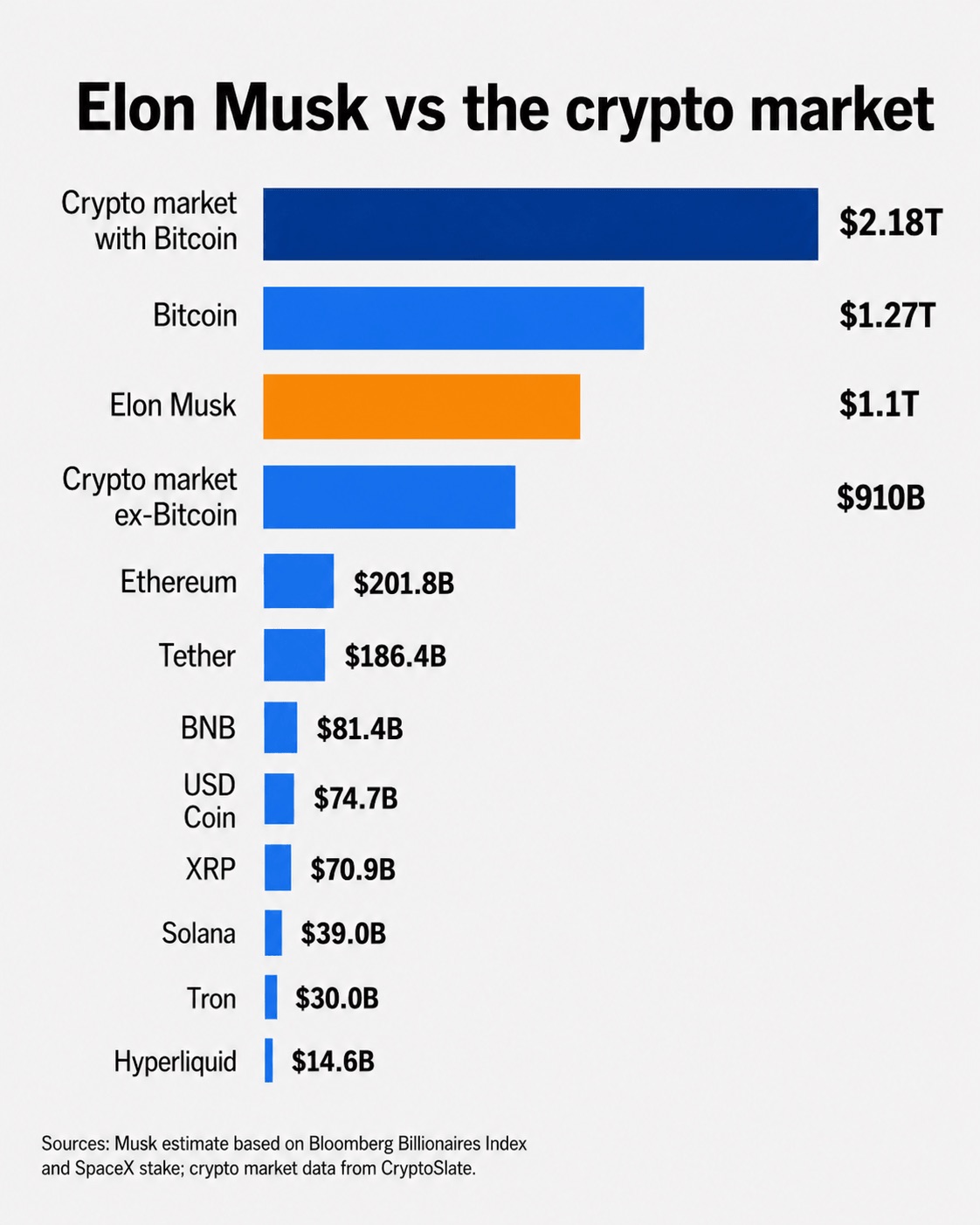


This wealth milestone quickly sparked global discussions about wealth concentration, with the scale of Musk's controlled wealth even exceeding the gross domestic product of several developed nations.


SpaceX IPO Shatters Multiple Records


The direct catalyst for Musk's wealth surge was the highly anticipated Nasdaq listing of SpaceX.


The company, which focuses on rocket development, communication services, and artificial intelligence, reached a staggering valuation of $2.2 trillion post-listing.


Underwriters initially set the offering price at $135 per share, successfully raising $75 billion before trading began.


However, market enthusiasm for the commercial space sector and Musk-related companies was unprecedented. The stock opened at $150, surged to a session high of $176.50 during the day, and ultimately closed at $161 last Friday.


Market observers noted that the stock listing brought unprecedented market liquidity.


Bloomberg ETF analyst Eric Balchunas pointed out that the stock's trading volume on its first day reached $85 billion. This figure set a new global record for single-day IPO trading volume and ranked among the top ten historical single-day trading volumes for any individual stock, surpassing Apple's highest daily trading volume over the past 40 years.
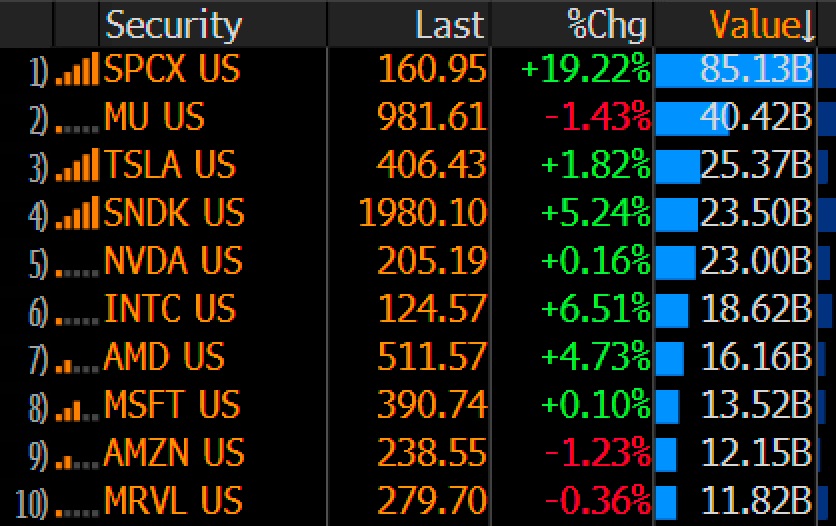

SpaceX Initial Public Offering Trading Volume (Source: Eric Balchunas)


Musk holds a 42% stake in the Hawthorne, California-based company, granting him near-unilateral voting control over its operations and strategic decisions.


Musk's Connection to Cryptocurrency


Comparing Musk's wealth scale to the digital asset market clearly reveals the significant shift in global capital allocation over the past year.


Data from the TradingView TOTAL2 index shows that the total market capitalization of all altcoins (excluding stablecoins) is approximately $880 billion. Musk's $1.11 trillion paper wealth easily surpasses this figure.


Even using the broader statistical scope of data platform CoinGecko—which puts the total global crypto market cap at about $2.27 trillion, with Bitcoin's market cap at $1.28 trillion—the combined value of all remaining altcoins after excluding Bitcoin still falls short of the personal net worth of the SpaceX CEO.


This market cap gap intuitively reflects the significant valuation contraction of mainstream altcoins compared to previous cycles. Data from Tradingview shows that in October 2025, the total market cap of crypto assets excluding Bitcoin once exceeded $1.7 trillion.
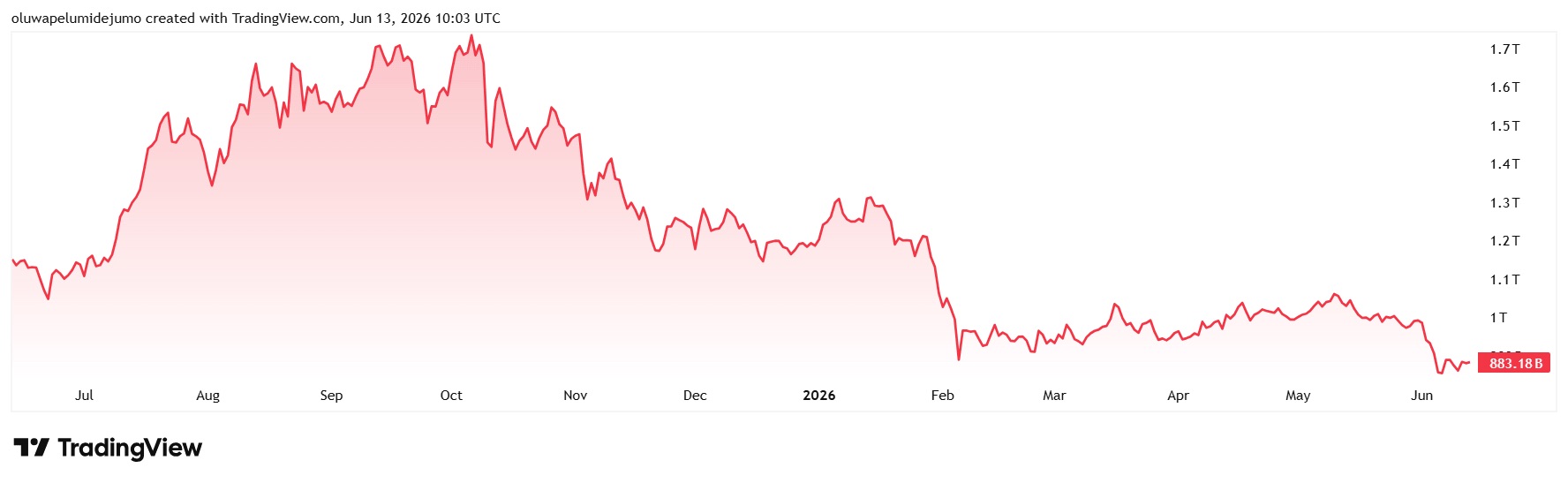

Total Cryptocurrency Market Cap Excluding Bitcoin (Source: Tradingview)


Today, that value has nearly halved. Behind this is the continued liquidity drain in the digital asset market, with institutional capital broadly exiting the crypto sector and flowing into large-cap tech stocks and artificial intelligence-related equities.


Despite his personal wealth now dwarfing the entire altcoin market, Musk remains deeply intertwined with the digital asset ecosystem, both in terms of personal holdings and corporate balance sheets.


Musk has publicly confirmed that he holds Bitcoin, Ethereum, and Dogecoin. Apart from mentioning a gift of 0.25 Bitcoin in 2018, he has never disclosed his full personal portfolio. However, several of his companies hold institutional-scale positions in the crypto market.


Post-listing regulatory filings show that SpaceX's corporate treasury holds 18,712 Bitcoin, with a market value exceeding $1.3 billion. His electric vehicle company Tesla follows a similar strategy, maintaining a long-term holding of 11,509 Bitcoin as part of its corporate liquid reserves.


If the holdings of both companies were combined, the total Bitcoin held would rank fifth globally among listed companies.
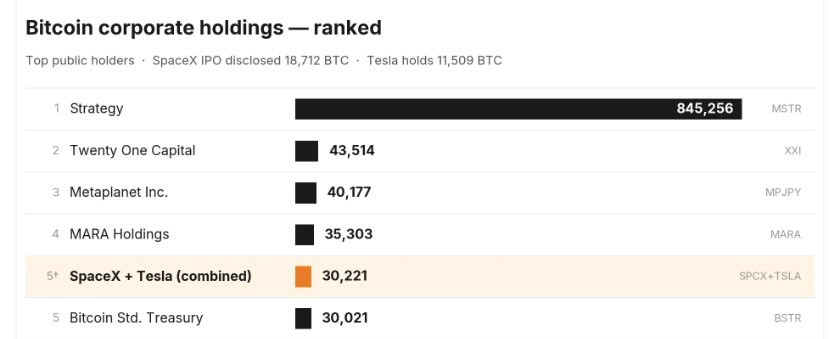

Bitcoin Holdings of SpaceX and Tesla (Source: Bitcoin Treasuries)


Furthermore, Musk's $44 billion acquisition of the social platform X (formerly Twitter) and the embedding of financial data tools within the platform have integrated financial markets directly into the public information stream. The platform's built-in cash tag function displays real-time prices for traditional stocks and various digital assets.


X's official statement clarifies that the platform serves solely as a market data tool and does not directly act as a securities broker or cryptocurrency exchange. Nonetheless, this feature further intertwines Musk's media and commercial ecosystem with the daily operations of financial markets.


Ultimately, Musk's staggering wealth scale reveals the severe concentration of private wealth within founder-controlled tech giants; it is also important to note that this trillion-dollar fortune is essentially tied to stock market prices and is not freely accessible cash assets.


Preguntas relacionadas

QWhat event made Elon Musk the first person in modern history to surpass a $1 trillion net worth?

ASpaceX's record-breaking public listing (IPO) propelled Elon Musk's net worth to over $1 trillion.

QHow does Elon Musk's current wealth compare to the total market capitalization of the cryptocurrency market excluding Bitcoin?

AElon Musk's net worth of $1.11 trillion is greater than the total market capitalization of all cryptocurrencies excluding Bitcoin, which is approximately $880 billion.

QWhich of Elon Musk's companies hold Bitcoin on their balance sheets, and what are their approximate holdings?

ABoth SpaceX and Tesla hold Bitcoin. SpaceX holds 18,712 BTC and Tesla holds 11,509 BTC, giving them a combined holding of over 30,000 BTC.

QWhat was the remarkable trading volume statistic for SpaceX's stock on its first day of public trading?

AOn its first day of public trading, SpaceX's stock reached a trading volume of $85 billion, setting a new record for IPO trading volume.

QWhat broader societal and market trend is highlighted by the comparison between Musk's wealth and the altcoin market's value?

AIt highlights both the extreme concentration of private wealth in founder-led tech giants and the significant valuation decline/contraction (nearly halved) in the altcoin market as capital has flowed towards large-cap tech and AI stocks.

Lecturas Relacionadas

Microsoft Announces Commercial-Grade Quantum Computer to be Completed in Three Years: Will the Boots Land?

Microsoft announces plans to build a commercially viable quantum computer by 2029, a significant acceleration from the previous industry consensus of a decade. The breakthrough is fueled by their new Majorana 2 quantum chip, which boasts a record-breaking average qubit lifetime of 20 seconds—a 1,000-fold reliability improvement over its predecessor. This leap was achieved by leveraging topological qubits, a theoretically more stable technology using Majorana zero modes, and switching the core superconducting material from aluminum to lead. Crucially, Microsoft's "Discovery" agentic AI platform accelerated the R&D process. AI agents autonomously analyzed vast experimental data, optimized manufacturing parameters (like the lead alloy composition), and solved issues like "ghost noise," dramatically speeding up experimentation. While the 20-second coherence time is a landmark, challenges remain: scaling from 12 qubits to the millions needed for practical applications, managing compilation costs, and verifying quantum results. Skeptics call for peer-reviewed data, and questions persist about whether even 20 seconds is sufficient for complex algorithms like breaking RSA encryption. The race is on with other approaches (superconducting, trapped ions), but Microsoft's confidence in its topological roadmap signals a potential shortcut to a scalable quantum future.

marsbitHace 13 min(s)

Microsoft Announces Commercial-Grade Quantum Computer to be Completed in Three Years: Will the Boots Land?

marsbitHace 13 min(s)

Is There Really a "World Cup Curse" in the Market?

Is there really a "World Cup Curse" affecting markets? Historical data shows global equity markets often underperform during the tournament. The S&P 500 has averaged negative returns of -1.5% to -2.11% across 19 World Cups since 1950, with declines in 58% of events. China's Shanghai Composite fell in 71% of tournaments since 1994. Studies confirm reduced trading activity during matches, with volumes dropping significantly, especially when a home nation plays. A team's loss can also lead to negative sentiment and selling pressure in its domestic market the next day. However, the "curse" may be partly attributed to seasonal weakness. Many tournaments are held in June-July, a historically weaker period for stocks ("Sell in May and go away"). The 2022 Qatar World Cup, held in November-December, saw a smaller drop in trading volume compared to summer events, suggesting timing plays a role. The cryptocurrency market's performance during World Cups has been mixed and largely driven by its own major catalysts (e.g., Mt. Gox hack, FTX collapse, halving cycles) rather than the tournament. Investment opportunities have shifted over time. Traditional beneficiaries like TV manufacturers have seen fading returns as streaming platforms become the core viewing channel. Classic consumer plays like beer and sportswear face challenges from changing consumption trends. Newer digital assets, like fractionalized collectible player cards on blockchain, have seen explosive growth. While gambling is a traditional sector, prediction markets are emerging. In conclusion, while a statistical correlation exists, the World Cup's direct impact on markets is likely limited and intertwined with seasonal patterns. With lower liquidity during the event, the simplest strategy for many might be to step back from trading and enjoy the games.

marsbitHace 20 min(s)

Is There Really a "World Cup Curse" in the Market?

marsbitHace 20 min(s)

Why 'AI Service Subscription' Is Destined to Die Out?

"Why 'AI Service Subscription Models' Are Doomed to Disappear" The article argues that the flat-rate subscription model for AI services is fundamentally unsustainable. It points to recent industry shifts, such as Anthropic limiting access to its flagship Claude Fable 5 model for subscribers after just 14 days, and GitHub and OpenAI moving towards credit-based or usage-based billing. The core problem is that subscription models rely on a capped human consumption limit—like watching videos or listening to music—which keeps costs predictable. However, the rise of autonomous AI agents shatters this premise. Agents can consume 5 to 30 times more computing resources (tokens) than a human chatting, and they operate continuously without user presence. This removes the natural usage cap, making fixed-price plans financially unviable as heavy users incur massive costs. Attempts to patch the model with higher tiers or usage caps have failed, often leading to "adverse selection" where only the heaviest users subscribe. The industry's solution is to hollow out subscriptions, replacing "unlimited" access with prepaid credits charged per token, akin to a utility meter. While chat-based subscriptions may linger, the real value and revenue are shifting to pay-as-you-go models. The current period represents a final, heavily subsidized phase for users. The conclusion is that the soul of subscription—a fixed price for worry-free use—is dying, soon to be replaced by pure usage-based pricing where everyone pays for their own "electricity meter."

marsbitHace 21 min(s)

Why 'AI Service Subscription' Is Destined to Die Out?

marsbitHace 21 min(s)

Trading

Spot
Futuros
活动图片