
Report: $1.3 Billion in Crypto Stolen in Q1 2022, 97% Stemmed From Defi Exploits

newsbtcPublicado a 2022-04-28Actualizado a 2022-05-09

Resumen

According to a research report, $1.3 billion in digital currencies have been stolen during the first quarter of 2022.

Report: $1.3 Billion in Crypto Stolen in Q1 2022, 97% Stemmed From Defi Exploits

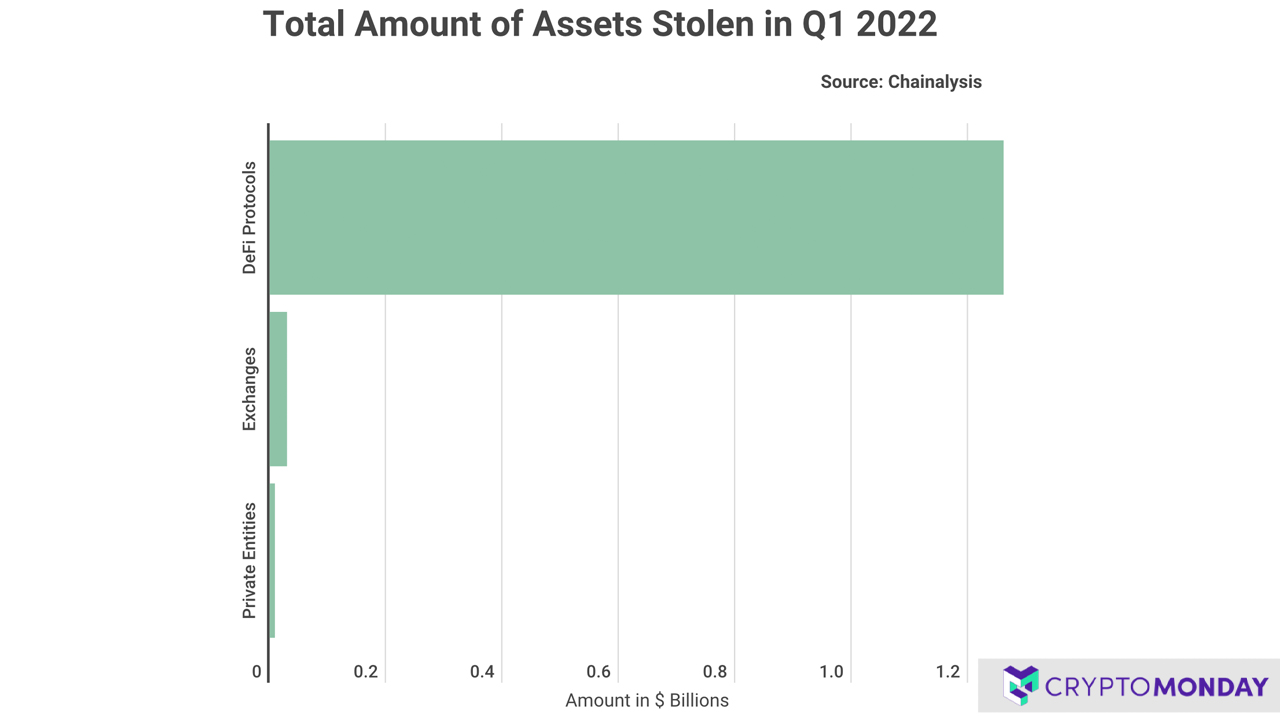
According to a research report, $1.3 billion in digital currencies have been stolen during the first quarter of 2022. The study, published by cryptomonday.de researchers, further highlights that 97% of the stolen funds derived from decentralized finance (defi) protocol exploits.

Defi Exploits Account for Lion’s Share of Stolen Crypto This Year

2022 is already breaking records in terms of stolen cryptocurrencies from hacks and exploits. Last year, $3.2 billion in digital currencies were stolen and so far, 2022 has recorded over 40% of 2021’s aggregate during the first quarter alone. The recorded stolen crypto data stems from a report published by cryptomonday.de and the study’s author, Elizabeth Kerr. The report’s author says “the numbers signify a major spike.”
Report: $1.3 Billion in Crypto Stolen in Q1 2022, 97% Stemmed From Defi Exploits

For instance, out of the $1.3 billion in digital currencies stolen this year, 97% of the funds were taken from defi protocols. In Q1 2021, only 72% of the stolen funds derived from defi and in 2020, the number was as low as 30%. Moreover, most of the theft in 2022 came from faulty code exploits where smart contract errors have been used to siphon stolen money from defi protocols. The author says that because the defi environment is open source, anyone can search for vulnerabilities and errors within a defi project’s codebase.

Centralized Exchange Hacks Drop Significantly

The research further details that in previous years, centralized exchanges were popular honeypots, but attacks on centralized trading platforms has declined. “[Centralized exchange attacks] now only account for less than 15% of the [stolen] cryptos,” Kerr writes. The report also notes that common defi protocol hacks came in the form of flash loan attacks and security breaches. The report’s author further mentions the Ronin bridge attack, which saw a loss of over $600 million.

“Hackers and cyber criminals made away with more than $3.2 billion last year and we just might have a higher amount being stolen this year, if the first quarter is anything to go by. The need for tighter security measures grows by the day, especially since more people are coming aboard,” Jonathan Merry, CEO at Cryptomonday explained in a statement.


Lecturas Relacionadas

Why Is the World Nervous About Japan Raising Interest Rates?

In June 2026, the Bank of Japan raised its policy rate to 1%, marking its first hike to this level since 1995. While this rate remains low compared to global peers like the US and Europe, the move signals a profound shift for a nation that has been a global source of ultra-cheap funding for decades. Japan's long-standing near-zero or negative interest rates had facilitated massive "yen carry trades," where international investors borrowed low-cost yen to invest in higher-yielding assets worldwide, such as US tech stocks and emerging market bonds. This made Japan a critical, often overlooked, source of global liquidity. Japan's ultra-loose policy stemmed from structural challenges post-1990s asset bubble: aging demographics, chronic low inflation/deflation, and high public debt. Recent shifts, including sustained wage growth (exceeding 5% in recent years) and inflation consistently above the 2% target, have created a "wage-price spiral" possibility, prompting the policy normalization. The global market's concern lies not in the absolute rate but in the potential unwinding of the yen carry trade. As Japanese borrowing costs rise, the economics of these leveraged global investments change, potentially triggering deleveraging and capital outflows from risk assets. Market anxiety focuses on the end of a thirty-year consensus that Japan would perpetually provide cheap funding. Ultimately, the global impact will depend on the interplay with US monetary policy. While Japan is tightening, the significant interest rate differential with the US remains. The key future dynamic is whether simultaneous Japanese hikes and eventual US rate cuts will narrow this gap, forcing a major recalibration of global capital flows and asset pricing built on an era of abundant, cheap yen liquidity.

marsbitHace 2 hora(s)

Why Is the World Nervous About Japan Raising Interest Rates?

marsbitHace 2 hora(s)

Research Report Analysis: MRVL's Optical AI Booming, Why High Valuation Keeps Morgan Stanley's Star Analyst Sidelined?

Report Recap: MRVL Optical AI Boom - Why High Valuation Led Morgan Stanley's Star Analyst to Stay Neutral? Morgan Stanley analyst Joseph Moore maintained an "Equal-weight" (Neutral) rating on Marvell Technology (MRVL) on May 28, raising the price target from $172 to $195, below the trading price. This stance comes despite Marvell reporting a record quarter and significantly raising its full-year outlook (FY27 revenue ~$11.5B, up ~40%). Moore's neutral view is based on valuation. The $195 target implies ~40x CY2027 P/E. He contrasts MRVL with NVDA: both trade near ~$200, but Nvidia's forward EPS is more than double Marvell's. For MRVL's valuation to hold, it needs consistent earnings upgrades, proof of networking market share gains, or certainty on large-scale custom AI chip shipments—none of which are confirmed yet. Growth is driven by two pillars: **1) Optical Interconnect** (the faster runner): Moore raised FY27 growth expectations to >70%, with the optical module product line nearing a $1B annualized run rate. **2) Custom AI Chips** (the climber): Confidence in FY28 is growing, but a major new customer project only ramps in FY28, with no current revenue visibility. Key risks are the underperforming Storage, Enterprise, and legacy Networking segments. Moore acknowledges the real AI opportunity but believes the current price already reflects it. For the stock to work from here, investors need to see the optical business hit its targets, custom chips ramp as planned, and a recovery in the weaker business units.

marsbitHace 3 hora(s)

Research Report Analysis: MRVL's Optical AI Booming, Why High Valuation Keeps Morgan Stanley's Star Analyst Sidelined?

marsbitHace 3 hora(s)

Trading

Spot
Futuros
活动图片