Congress Advances CBDC Ban Until 2030 Through Major Housing Reform Bill

TheNewsCryptoPublicado a 2026-06-17Actualizado a 2026-06-17

Resumen

Congress has passed the 21st Century Road to Housing Act, a bipartisan bill primarily focused on housing reform to improve affordability and supply. Included within it is a significant provision that bans the Federal Reserve from issuing a central bank digital currency (CBDC) or "digital dollar" before December 31, 2030. The measure defines a CBDC as a dollar-denominated digital asset, a direct liability of the Fed, accessible to all Americans. Proponents argue the ban allows more time to study a digital dollar's impacts and addresses concerns about privacy, financial surveillance, and government overreach in digital payments. The provision specifically targets a retail CBDC but does not restrict permissionless blockchain networks. This crypto-related language, embedded in broader housing legislation, has drawn considerable attention for its potential to shape the future of digital assets and payments in the U.S. The bill's final passage will determine if the ban takes effect for the next decade.

Legislators have passed a bill aimed at pushing housing reforms that feature a temporary ban on a Federal Reserve CBDC. The ban forms one of the many proposals included in the bipartisan bill, the 21st Century Road to Housing Act. The bill seeks to improve affordable housing, boost the supply of houses, and bring about various reforms.

A proposal in the bill bans the Federal Reserve from creating a digital dollar before December 31, 2030. Lawmakers inserted the provision into the broader housing bill rather than introducing it as a standalone crypto-related measure. Under the proposal, lawmakers classify a CBDC as a dollar-denominated digital asset. This serves as a direct liability of the Federal Reserve and remains accessible to all Americans.
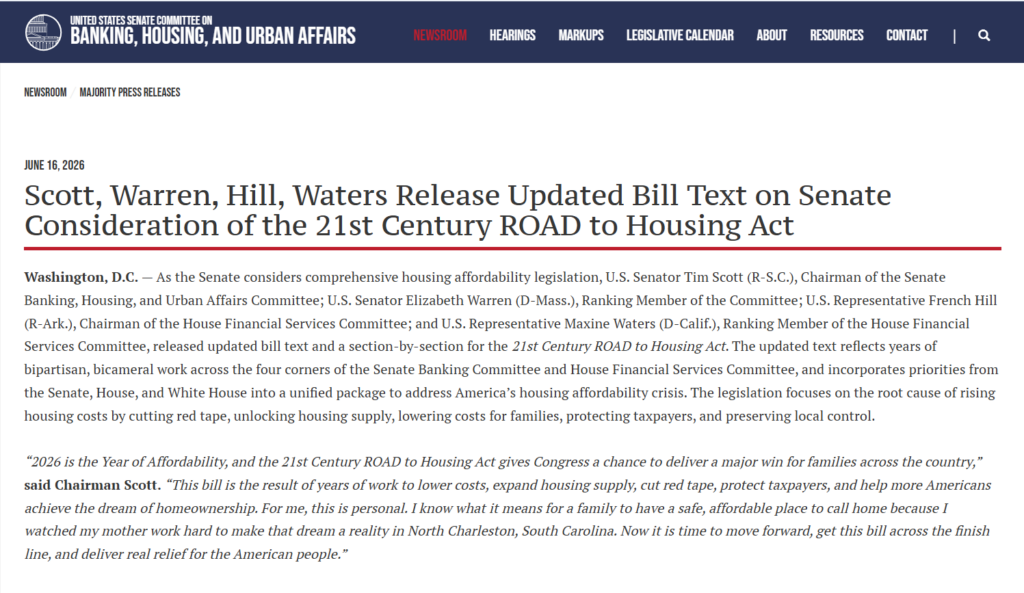
Supporters of the provision argue that it gives policymakers additional time to evaluate the potential impacts of a digital dollar. The ban also reflects concerns that some lawmakers have raised about privacy, financial surveillance, and government involvement in digital payment systems. On the other hand, this proposal does not impose restrictions on permissionless blockchain networks.

Focus on Crypto Policy in Housing Legislation

Lawmakers designed the housing legislation to address housing supply challenges through permitting reforms, regulatory changes, and expanded financing opportunities. Nevertheless, it is the CBDC policy language that caught much attention in the cryptocurrency community. Since it impacts the issuance of the digital dollar in the future. The language was adopted in Congress in light of further discussions. This was regarding the place of digital assets in the country’s financial system.

In accordance with the language, the ban applies to the efforts of the Federal Reserve to issue a retail CBDC regardless of whether it will be issued directly by the institution or by means of intermediaries. In addition, there are some drafts of the bill that have an exception in the case when private digital dollars retain privacy traits comparable to those of physical dollars.

The market analysts are continuing to watch the developments since the legislation could affect further discussions about digital payments and cryptocurrencies. Although the housing bill is what lawmakers are concentrating on, the clause regarding CBDCs can be seen as an important factor in terms of the cryptocurrency sector. The next few steps in the legislation process will decide whether or not the ban will be enforced within the next decade.

Highlighted Crypto News:

Ethereum Advances Glamsterdam Upgrade Ahead of Planned 2026 Launch

TagsBlockchainCBDCcrypto legislationFederal ReserveU.S Congress

Criptos en tendencia

Preguntas relacionadas

QWhat is the main purpose of the 21st Century Road to Housing Act as mentioned in the article?

AThe main purpose of the 21st Century Road to Housing Act is to improve affordable housing, boost the supply of houses, and bring about various reforms.

QWhat specific restriction does the bill place on the Federal Reserve regarding a Central Bank Digital Currency (CBDC)?

AThe bill bans the Federal Reserve from creating a digital dollar, or retail CBDC, before December 31, 2030.

QWhy did supporters of the CBDC provision include it in the bill according to the text?

ASupporters argue the provision gives policymakers additional time to evaluate the potential impacts of a digital dollar and reflects concerns about privacy, financial surveillance, and government involvement in digital payment systems.

QHow does the article describe the focus of the housing legislation versus the attention it received?

AWhile the housing legislation is designed to address housing supply challenges, it was the CBDC policy language within the bill that caught much attention in the cryptocurrency community.

QAccording to the bill's language, does the CBDC ban apply to private, permissionless blockchain networks?

ANo, the proposal does not impose restrictions on permissionless blockchain networks. Some drafts of the bill even have an exception for private digital dollars that retain privacy traits comparable to physical dollars.

Lecturas Relacionadas

The Entire Internet Hails Noam's Joining, But OpenAI's Loss Bill Just Got Thicker

While the AI community celebrates Noam Shazeer, co-author of the "Attention Is All You Need" paper, joining OpenAI as Head of Architectural Research, the company's audited financials reveal a starkly different reality. In 2025, OpenAI reported $13.07 billion in revenue but a massive $20.92 billion operating loss. Even excluding a one-time accounting charge, the cash burn is severe, with $3.7 billion consumed in Q1 2026 alone. This high-profile hiring occurs against a backdrop of significant internal research talent drain, with key founders and researchers departing as the company's focus shifts from exploratory research to product iteration. Meanwhile, OpenAI's fundamental business model faces a deep crisis. It paid Microsoft $10.59 billion for compute in 2025, while its vast user base of 9 billion weekly actives includes only 50 million paying customers, making growth a direct driver of escalating costs. The article argues Shazeer's recruitment is less about technical necessity and more about crafting a compelling narrative for OpenAI's upcoming IPO, aiming to justify a rumored $1 trillion valuation to future public market investors. It contrasts OpenAI's strategy with Anthropic's reported path to profitability, which relies on a strong enterprise customer base and cost control, rather than star-powered narratives. Ultimately, the piece concludes that while Shazeer's architectural work may take 1-2 years to materialize, OpenAI's financial clock is ticking much faster, with its massive losses undercutting the celebratory headlines.

marsbitHace 43 min(s)

The Entire Internet Hails Noam's Joining, But OpenAI's Loss Bill Just Got Thicker

marsbitHace 43 min(s)

Market Trend (June 19): US-Iran Deal Drives Out Geopolitical Premium; Chip Stocks Soar to New Highs; Energy Sector Leads Declines

U.S. Market Trends (June 19): U.S.-Iran Deal Eases Tensions, Chip Stocks Soar, Energy Sector Leads Declines. U.S. stocks rallied on Thursday as the signing of a temporary U.S.-Iran deal in Geneva de-escalated Middle East tensions, with Saudi oil tankers transiting the Strait of Hormuz. This geopolitical relief helped markets recover from recent Fed-driven volatility. The S&P 500 rose over 1%, the Nasdaq gained nearly 2%, and the Dow Jones Industrial Average closed at another record high. The Philadelphia Semiconductor Index surged over 6% to a historic peak. Chip stocks were the standout performers. Reports of an Apple-Intel design and foundry deal for certain products, alongside mentions of potential Nvidia and SpaceX collaborations with Intel, propelled the sector. Intel surged ~10.5%, while memory chip makers like Micron also saw significant gains, highlighting sustained confidence in long-term AI capital expenditure. In contrast, the energy sector was the day's sole loser, with the S&P 500 energy sub-index declining as WTI crude fell ~2% to around $74.29/barrel. The reopening of key shipping routes erased prior geopolitical risk premiums. SpaceX extended losses for a second day on news of a potential large bond offering. Market volatility (VIX) dropped sharply, indicating a swift reversal of post-Fed jitters. Treasury yields dipped slightly but remained elevated. The focus now shifts to upcoming economic data, including next week's PCE inflation report and Micron's earnings, which will serve as a key test for the AI trade's durability.

marsbitHace 1 hora(s)

Market Trend (June 19): US-Iran Deal Drives Out Geopolitical Premium; Chip Stocks Soar to New Highs; Energy Sector Leads Declines

marsbitHace 1 hora(s)

Will MicroStrategy Fall Into a Death Spiral? How Will the Macro Outlook Evolve in the Second Half of the Year?

**Summary:** The discussion centers on recent Bitcoin price declines and the evolving financial strategy of MicroStrategy (MSTR). The core argument is that the primary pressure is not from one-off Bitcoin sales by MSTR, but from the market's new expectation that MSTR may need to engage in *sustained, small-scale* Bitcoin sales to cover cash flow obligations for its growing portfolio of preferred shares and debt instruments (like STRC). This shift is driven by its stated goal of maintaining "bitcoins per share neutrality." The market is now testing whether it can absorb this potential ongoing selling pressure without entering a severe "death spiral" with Bitcoin's price. A resolution may involve MSTR softening its approach to avoid damaging both its stock and Bitcoin. The conversation then explores the parallel rise of AI-related stocks. The guest posits that AI is fundamentally restructuring labor, with "tokens" (representing access to AI models/compute) becoming a new form of capital and a substitute for human execution. This drives corporate efficiency and profits, benefiting upstream hardware providers (semiconductors, data centers), which explains the sustained rally. This represents the early stages of a "machine economy." Regarding crypto exchanges offering US stock trading, this is seen as a natural evolution. With few crypto-native assets generating lasting value, exchanges are pivoting to distribute valuable real-world assets (RWAs). This doesn't necessarily harm crypto's long-term prospects, as blockchain infrastructure may become crucial for future machine-to-machine economies. The analysis concludes that the era of rampant altcoin speculation is likely over, heavily damaged by the liquidity shock of the "1011" event (likely referring to a major market crash). Meme-driven capital has largely migrated to US equities. Looking ahead, macroeconomic uncertainty is rising due to potential large IPOs (e.g., SpaceX) and the US elections. While short-term market corrections are possible, the long-term trends of AI-driven productivity gains and the maturation of blockchain towards real-world utility and institutional adoption remain intact.

marsbitHace 1 hora(s)

Will MicroStrategy Fall Into a Death Spiral? How Will the Macro Outlook Evolve in the Second Half of the Year?

marsbitHace 1 hora(s)

Trading

Spot
Futuros

Artículos destacados

Cómo comprar BAN

¡Bienvenido a HTX.com! Hemos hecho que comprar Comedian (BAN) sea simple y conveniente. Sigue nuestra guía paso a paso para iniciar tu viaje de criptos.Paso 1: crea tu cuenta HTXUtiliza tu correo electrónico o número de teléfono para registrarte y obtener una cuenta gratuita en HTX. Experimenta un proceso de registro sin complicaciones y desbloquea todas las funciones.Obtener mi cuentaPaso 2: ve a Comprar cripto y elige tu método de pagoTarjeta de crédito/débito: usa tu Visa o Mastercard para comprar Comedian (BAN) al instante.Saldo: utiliza fondos del saldo de tu cuenta HTX para tradear sin problemas.Terceros: hemos agregado métodos de pago populares como Google Pay y Apple Pay para mejorar la comodidad.P2P: tradear directamente con otros usuarios en HTX.Over-the-Counter (OTC): ofrecemos servicios personalizados y tipos de cambio competitivos para los traders.Paso 3: guarda tu Comedian (BAN)Después de comprar tu Comedian (BAN), guárdalo en tu cuenta HTX. Alternativamente, puedes enviarlo a otro lugar mediante transferencia blockchain o utilizarlo para tradear otras criptomonedas.Paso 4: tradear Comedian (BAN)Tradear fácilmente con Comedian (BAN) en HTX's mercado spot. Simplemente accede a tu cuenta, selecciona tu par de trading, ejecuta tus trades y monitorea en tiempo real. Ofrecemos una experiencia fácil de usar tanto para principiantes como para traders experimentados.

575 Vistas totalesPublicado en 2024.12.11Actualizado en 2026.06.02

Cómo comprar BAN

Discusiones

Bienvenido a la comunidad de HTX. Aquí puedes mantenerte informado sobre los últimos desarrollos de la plataforma y acceder a análisis profesionales del mercado. A continuación se presentan las opiniones de los usuarios sobre el precio de BAN (BAN).

活动图片