谁在"掌控"Uniswap?轮番上演「纸牌屋」的 DeFi 何去何从?

白话区块链Publicado a 2023-02-06Actualizado a 2023-02-06

Resumen

2 月 5 日,a16z 向 BNB Chain 上部署 Uniswap V3 的最终提案提出反对票,导致 Uniswap 登陆 BNB Chain 的计划搁浅。

2 月 5 日,a16z 向 BNB Chain 上部署 Uniswap V3 的最终提案提出反对票,导致 Uniswap 登陆 BNB Chain 的计划搁浅。

社区KOL直接发问质疑,称「Uniswap 由 a16z 控制?」,并引用有关 a16z 疑似出于个体利益的猜测:「a16z 之所以使用其全部投票权重来反对 Uniswap 使用 Wormhole 跨链桥在 BNB Chain 上启动 Uniswap 协议的提议,是因为它是 Wormhole 竞争对手 LayerZero 的大投资者」。
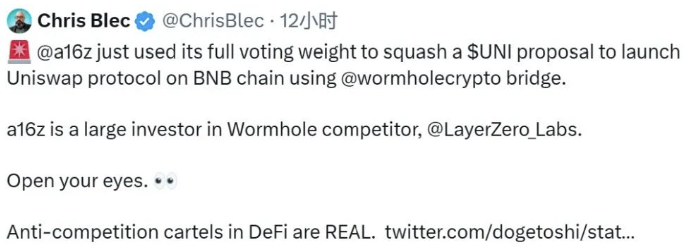
DeFi 协议背后的 VC 身影

事实上,a16z 确实是 Uniswap 背后拥有举足轻重影响力的关键人物:Bubblemaps 统计显示,a16z 可以通过 11 个地址控制 4150 万枚 UNI,这占 UNI 供应量的 4.15%。
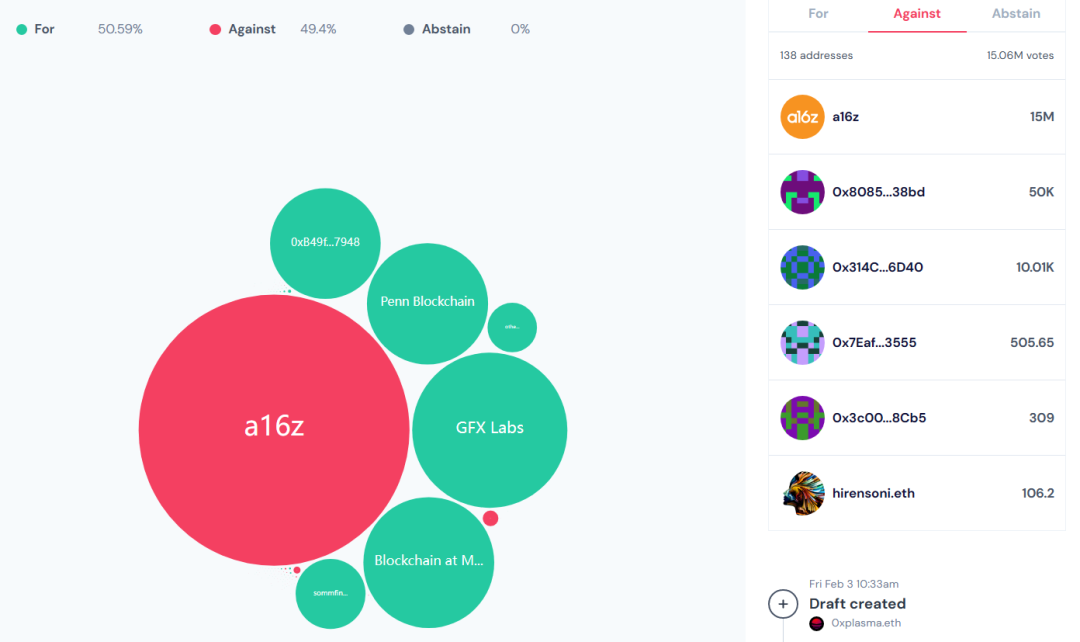
而此次投票截止目前为止,a16z 仅仅动用 1500 枚 UNI 的权重就已占据优势,这也意味着 a16z 的 UNI 权重是通过任何 UNI 提案所必不可少的投票势力。

其实 a16z 并非是不愿意将 Uniswap 部署至 BNB Chain——毕竟在 Uniswap 决定是否部署在 Polygon、Celo 和 zkSync 中时,a16z 是投了「赞成票」的。

按照赵长鹏转推的具体说法,这场斗争的核心,是 a16z 不愿意用 Wormhole 做跨链桥来作为 Uniswap 登陆 BNB Chain 的跨链选择。

这就涉及风险投资公司 a16z 和 Jump 的直接对战——它们分别支持 LayerZero 和 Wormhole两个跨链桥。

其实 DeFi 协议因为背后向其提供资本支持的 VC 影响,而或主动或被动选边站队的情况,并不鲜见——早在 2021 年 8 月,SushiSwap 就曾透露为什么它选择使用 Arbitrum 而不是 Optimism 作为其最先布局的的 Layer2 扩展解决方案。

其中 SushiSwap 直言是因为 Optimism 给了 Uniswap 优惠待遇,推动 Uniswap 率先上线:尽管「SushiSwap 已经到Optimism的Kovan测试网上完成部署,但最后被告知 Uniswap 将获得这个机会,Optimism 非常直接地告知 Uniswap 必须先部署」。

而按照 SushiSwap 的说法,Optimism 之所以青睐 Uniswap,是因为受到了投资者 a16z 和 Paradigm 的影响,并直言这两家风险投资公司可能「串通一气」,以影响他们的既得项目并使其受益。

区块链世界的治理游戏

太阳底下没有新鲜事,在更早的 2021 年 11 月,也曾上演了一场另一个 DeFi 龙头协议 Curve 的精彩「纸牌屋」剧情。

首先我们需要回顾下 Convex-Curve 的机制设计:

CVX 是 Convex 的原生Token,持有 CVX 便相当于拥有了对 Convex 的控制权——CVX 作为 Convex 平台的治理Token,通过锁定 CVX 便可以让 LP 对 Convex 的 veCRV 治理决策进行投票:

Convex 利用更具吸引力的 cvxCRV 激励,换取了用户的 CRV;

Convex 把这部分 CRV 统统进行四年锁定,换取最大的 Curve 投票权(veCRV);

而 Convex 在获得大量 veCRV 后,就等同于控制了 Curve;

也就是说控制了 CVX,就是控制了 Convex,而控制了 Convex,就等同于控制了 Curve。这时它可以为具体的某个稳定币池子增加激励权重,这就导致很多有意思的事情——譬如稳定币项目方的贿选行为等。

而2021 年 11 月份,Mochi 稳定币 USDM 团队利用 Convex 对 Curve 发起了一场「劣币兑换良币」的「治理攻击」:

首先,Mochi 推出了治理Token MOCHI,并在 Curve 推出 USDM 稳定币(抵押铸造,MOCHI 就为抵押品之一)的流动性池激励;

然后,Mochi 项目方利用持有的大量 MOCHI 印了大量的 USDM,然后去 Curve 上换为 DAI ;

接着,Mochi 项目方使用换来的 DAI 购买大量的 CVX (约 6000 个 ETH),然后进行投票,并成功提高了 Curve 上 USDM 流动性挖矿池子的收益率(CRV 奖励的分配);

最后,在高收益率的吸引下更多的流动性提供者参与其中,直至USDM 稳定币的流动性池内达到 1 亿美元的流动性,项目方将 MOCHI 铸造成 USDM 并在池子中兑换成 DAI ,直接套现跑路,造成高达 3000 万美元的损失;

整个过程堪称围绕劣质稳定币、Curve、Convex 治理逻辑的教科书级案例,这也从侧面表明了 Convex 通过对 Curve 的「控制」,在整个加密市场发挥越来越重要的影响力。

区块链世界的治理游戏

太阳底下没有新鲜事,在更早的 2021 年 11 月,也曾上演了一场另一个 DeFi 龙头协议 Curve 的精彩「纸牌屋」剧情。

首先我们需要回顾下 Convex-Curve 的机制设计:

CVX 是 Convex 的原生Token,持有 CVX 便相当于拥有了对 Convex 的控制权——CVX 作为 Convex 平台的治理Token,通过锁定 CVX 便可以让 LP 对 Convex 的 veCRV 治理决策进行投票:

Convex 利用更具吸引力的 cvxCRV 激励,换取了用户的 CRV;

Convex 把这部分 CRV 统统进行四年锁定,换取最大的 Curve 投票权(veCRV);

而 Convex 在获得大量 veCRV 后,就等同于控制了 Curve;

也就是说控制了 CVX,就是控制了 Convex,而控制了 Convex,就等同于控制了 Curve。这时它可以为具体的某个稳定币池子增加激励权重,这就导致很多有意思的事情——譬如稳定币项目方的贿选行为等。

而2021 年 11 月份,Mochi 稳定币 USDM 团队利用 Convex 对 Curve 发起了一场「劣币兑换良币」的「治理攻击」:

首先,Mochi 推出了治理Token MOCHI,并在 Curve 推出 USDM 稳定币(抵押铸造,MOCHI 就为抵押品之一)的流动性池激励;

然后,Mochi 项目方利用持有的大量 MOCHI 印了大量的 USDM,然后去 Curve 上换为 DAI ;

接着,Mochi 项目方使用换来的 DAI 购买大量的 CVX (约 6000 个 ETH),然后进行投票,并成功提高了 Curve 上 USDM 流动性挖矿池子的收益率(CRV 奖励的分配);

最后,在高收益率的吸引下更多的流动性提供者参与其中,直至USDM 稳定币的流动性池内达到 1 亿美元的流动性,项目方将 MOCHI 铸造成 USDM 并在池子中兑换成 DAI ,直接套现跑路,造成高达 3000 万美元的损失;

整个过程堪称围绕劣质稳定币、Curve、Convex 治理逻辑的教科书级案例,这也从侧面表明了 Convex 通过对 Curve 的「控制」,在整个加密市场发挥越来越重要的影响力。

小结

在经历了 2020 年的寒武纪大爆发和 2021、2022 年的触顶下跌之后,目前 DeFi 世界的场景创新基本已经达到饱和,后续如何进一步完善治理机制、提高加密经济模型在整个协议机制中的作用,才是打开下半场的关键所在。

总的来看,DeFi 世界无论是「治理演进」还是Token经济模型的创新,仍旧路漫漫其修远兮,究竟会何去何从,让我们拭目以待。

Lecturas Relacionadas

From 'Old Dogs' to 'New Darlings': How AI is Revaluing Old Infrastructure, from Dell to Nokia

"Old Dogs" Become AI's New Darlings: Revaluing Legacy Infrastructure The AI investment narrative is shifting. Beyond the spotlight on core chipmakers like Nvidia, a new wave of interest is rising for legacy tech companies—Dell, HPE, Nokia, Cisco, Corning, Western Digital—once labeled as slow-growth, outdated stories. This resurgence stems from AI's evolution from model development to real-world deployment, creating massive demand for physical infrastructure. As AI moves into data center construction and enterprise adoption, the focus turns to who can actually build and deliver complex systems. These established players hold decades of experience in supply chains, integration, networking, and enterprise delivery—assets now critical for scaling AI. The revaluation can be grouped into three key infrastructure areas: 1. **Servers & Integration (e.g., Dell, HPE):** They are becoming essential system integrators, transforming GPUs into full-scale AI servers with networking, power, and cooling, then delivering them to clients. Strong recent earnings and AI-specific revenue/order growth for Dell and HPE underscore this shift. 2. **Networking & Connectivity (e.g., Corning, Nokia, Cisco):** As AI clusters grow, high-speed data transfer becomes paramount. Corning benefits from fiber demand for data center links, Nokia is exploring AI-integrated wireless networks (AI-RAN), and Cisco sees surging orders for data center switches—all critical for efficient AI operations. 3. **Storage (e.g., Western Digital, Seagate):** The AI data explosion requires vast capacity. Beyond high-speed memory (HBM), there's growing need for high-capacity HDDs to store training data, logs, video, and cold/archival data cost-effectively. This revaluation, however, is not a blanket endorsement. True reassessment requires concrete proof: AI-driven orders and revenue growth, upward revisions to company guidance, and sustainable improvements in profit quality, not just top-line sales. In essence, AI is not turning all old tech firms into high-growth stocks; it is selectively re-pricing the "old assets" of companies that are mission-critical for building the new AI infrastructure, transforming their legacy capabilities into renewed growth engines.

marsbitHace 2 min(s)

From 'Old Dogs' to 'New Darlings': How AI is Revaluing Old Infrastructure, from Dell to Nokia

marsbitHace 2 min(s)

Probability in the Price: How World Cup Odds Are Calculated

**The Probability in the Price: How World Cup Odds Are Calculated** Two major systems released their "championship probabilities" before the 2026 World Cup, and they disagreed on the favorite. Prediction market aggregators listed France at around **17%**, while the Opta supercomputer gave European champion Spain **16.1%**. These numbers look similar, but their production methods are fundamentally different. The market's **17%** is the **price** that clears after hundreds of millions of dollars in trading across platforms like Polymarket and Kalshi, where contracts trade between 0 and 100 cents, directly representing implied probability. This liquidity is provided by crypto-native market makers like Wintermute, though the market still has "the liquidity profile of an early-stage" asset class. In contrast, Opta's **16.1%** is a **simulated frequency**. Its model uses team data (including betting market odds as an input) to estimate match probabilities, then runs **10,000 full tournament simulations**, counting how often each team wins. Which is more accurate? There is **no rigorous, cross-tournament academic study** directly comparing their track records. However, a persistent **longshot bias**—where low-probability outcomes are systematically overvalued—observed in traditional betting for nearly a century, has also been found in modern crypto prediction markets. Research shows low-price contracts on Kalshi/Polymer less likely to pay out than their implied odds suggest. Unlike traditional bookmakers, prediction markets operate on **public blockchain ledgers**, making every transaction auditable and enabling such research. However, price formation is also influenced by **regulatory uncertainty**, as seen in recent US state-level bans and legal battles over jurisdiction. In summary, the "probability" you see is either a **market-clearing price** subject to behavioral biases and liquidity constraints, or a **model-simulated frequency** that partially incorporates market data. The question of which method is more reliable remains open, highlighting the importance of asking: **How was this number produced?**

marsbitHace 31 min(s)

Probability in the Price: How World Cup Odds Are Calculated

marsbitHace 31 min(s)

Trading

Spot
Futuros

Artículos destacados

Cómo comprar UNI

¡Bienvenido a HTX.com! Hemos hecho que comprar Uniswap (UNI) sea simple y conveniente. Sigue nuestra guía paso a paso para iniciar tu viaje de criptos.Paso 1: crea tu cuenta HTXUtiliza tu correo electrónico o número de teléfono para registrarte y obtener una cuenta gratuita en HTX. Experimenta un proceso de registro sin complicaciones y desbloquea todas las funciones.Obtener mi cuentaPaso 2: ve a Comprar cripto y elige tu método de pagoTarjeta de crédito/débito: usa tu Visa o Mastercard para comprar Uniswap (UNI) al instante.Saldo: utiliza fondos del saldo de tu cuenta HTX para tradear sin problemas.Terceros: hemos agregado métodos de pago populares como Google Pay y Apple Pay para mejorar la comodidad.P2P: tradear directamente con otros usuarios en HTX.Over-the-Counter (OTC): ofrecemos servicios personalizados y tipos de cambio competitivos para los traders.Paso 3: guarda tu Uniswap (UNI)Después de comprar tu Uniswap (UNI), guárdalo en tu cuenta HTX. Alternativamente, puedes enviarlo a otro lugar mediante transferencia blockchain o utilizarlo para tradear otras criptomonedas.Paso 4: tradear Uniswap (UNI)Tradear fácilmente con Uniswap (UNI) en HTX's mercado spot. Simplemente accede a tu cuenta, selecciona tu par de trading, ejecuta tus trades y monitorea en tiempo real. Ofrecemos una experiencia fácil de usar tanto para principiantes como para traders experimentados.

429 Vistas totalesPublicado en 2024.12.12Actualizado en 2026.06.02

Cómo comprar UNI

Discusiones

Bienvenido a la comunidad de HTX. Aquí puedes mantenerte informado sobre los últimos desarrollos de la plataforma y acceder a análisis profesionales del mercado. A continuación se presentan las opiniones de los usuarios sobre el precio de UNI (UNI).

活动图片













