1-Minute Breakdown of Quantitative Models: High Rollers Hunt Down Trading Bots

marsbitPublicado a 2026-01-21Actualizado a 2026-01-21

Resumen

In the emerging prediction markets, a mysterious trader known as a4385 executed a sophisticated attack against quantitative trading bots, netting $280,000 in 48 hours. These markets allow users to bet on short-term price movements of assets like XRP—for example, predicting whether the price will rise or fall within 15 minutes. Quant algorithms typically profit by exploiting散户情绪 and market inefficiencies with毫秒级 precision. On January 17, 2026, a4385 placed a "rise" bet in an XRP market when the price was below the starting price and the probability of success was only 36%. In the final minute before settlement, a4385 executed large market buy orders, artificially pumping XRP’s price just above the starting threshold at the exact moment of settlement—ensuring his bet paid out. The strategy relied on shallow order book depth (due to weekend trading and XRP’s lower liquidity), allowing a4385 to move the market with relatively modest volume (~$569,000 in the final minute. Each operation cost about $6,200 in fees, but yielded returns as high as $40,218 per round. To hedge against post-settlement price drops, a4385 held short positions of equivalent size, ensuring overall portfolio stability. This required significant capital—over a million dollars—highlighting that this was not luck or a散户 victory, but a calculated exploit of market structure, liquidity conditions, and quantitative model behavior.

In today's stock market, where quantitative trading is all the rage, most people see these cold, algorithmic bots as Wall Street's ruthless harvesting machines, constantly siphoning off the hard-earned money of retail investors through emotional misjudgments or information asymmetry at millisecond speeds.

However, in a nascent market over the past 48 hours, the near-perfect profit curves of several top quantitative bots collectively snapped, while a mysterious account named a4385 raked in $280,000 from the chaos.

This market is called the prediction market, and it is here that a trader known as a4385 showcased a meticulously orchestrated hunt targeting quantitative bots.

Financial "Heads or Tails": The Arbitrage Paradise for Quantitative Models

Everyone understands heads or tails, and prediction markets have a similar game.

For example, if you bet on "up" in "Will the price of gold rise or fall tomorrow?" and the price indeed rises tomorrow, then regardless of the magnitude of the increase, your "up" position will be settled for profit according to the odds at the time of betting, where the odds themselves correspond to the probability of the event occurring. Conversely, if the price falls, no matter how much it drops, your position will be wiped to zero.

"XRP up or down in 15 minutes" is a typical representative of the many markets in prediction markets. Each 15-minute market opens with a starting price; 15 minutes later, if XRP's price is above the starting price, traders who wagered on "up" profit, and vice versa for those who bet on "down".
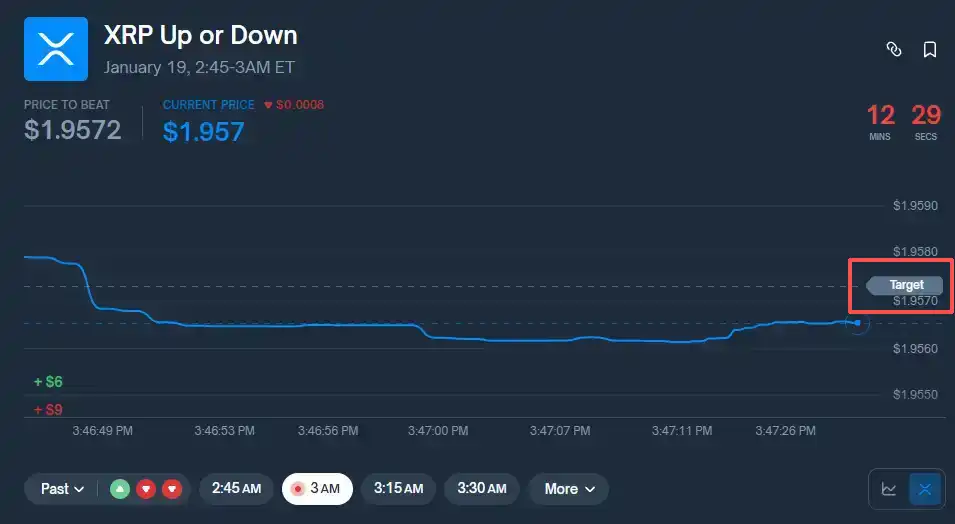
This real-time mechanism makes this particular market a paradise for quantitative bots: algorithms use sophisticated statistical models to capture pricing deviations caused by retail investor emotions, information delays, remaining time, and other factors, perfectly蚕食ing steady profits through automated trading.
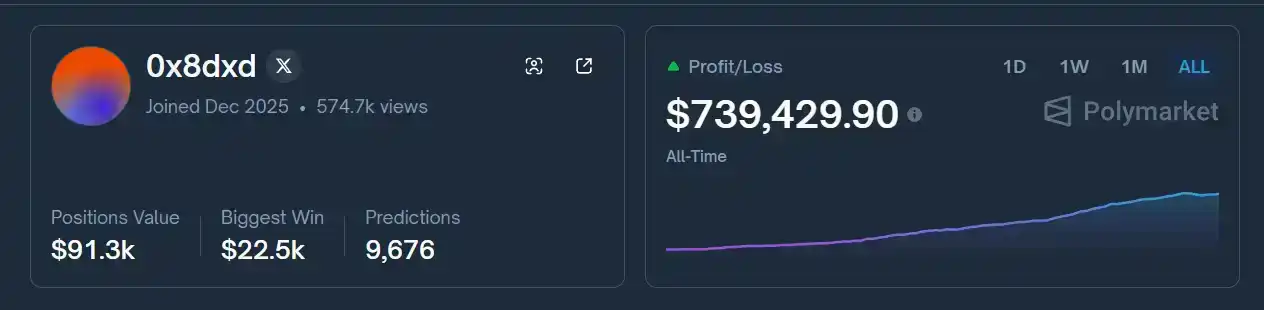
XRP Soars Right at Settlement, "Lucky Big Spender" Doubles Their Money

On the afternoon of January 17, 2026, a4385 bet on "up" in the "XRP up or down in 15 minutes" market.

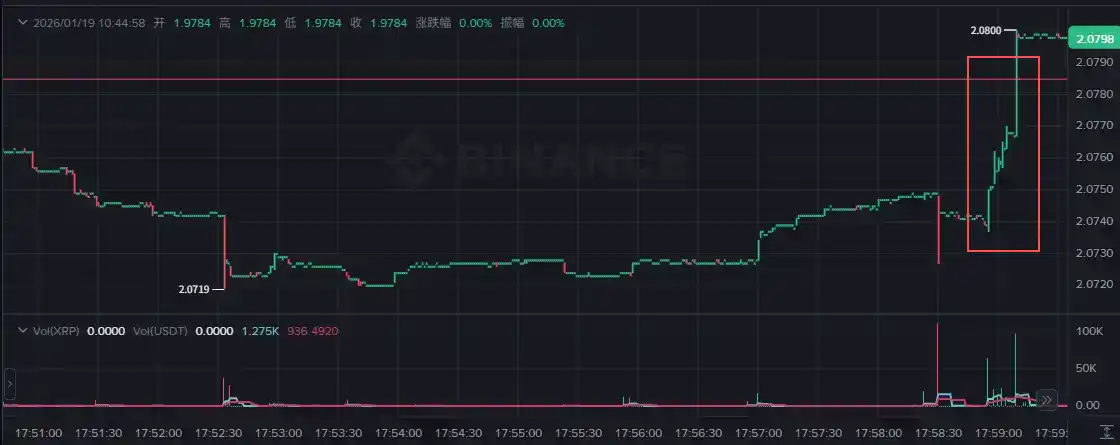
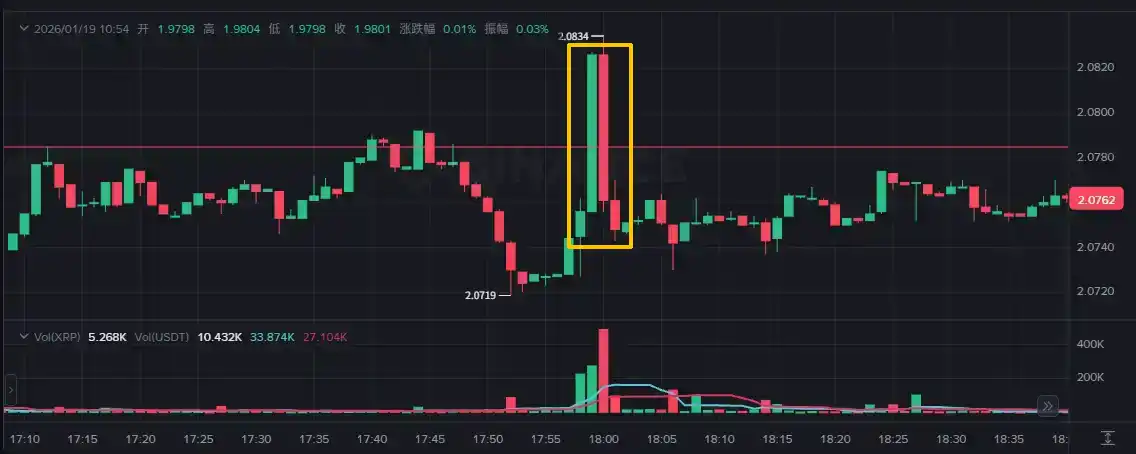
The starting price for XRP in this market was $2.0784, and as late as 17:58:54 (66 seconds remaining until settlement), XRP's price was still hovering around $2.0737, with a corresponding probability of rising of only 36%—market consensus suggested it would be difficult for XRP to rise above the starting price in the mere minute remaining.

But in the next minute, XRP suddenly began a sustained climb, and the market settlement price was fixed at $2.0817—just clearing the starting price.

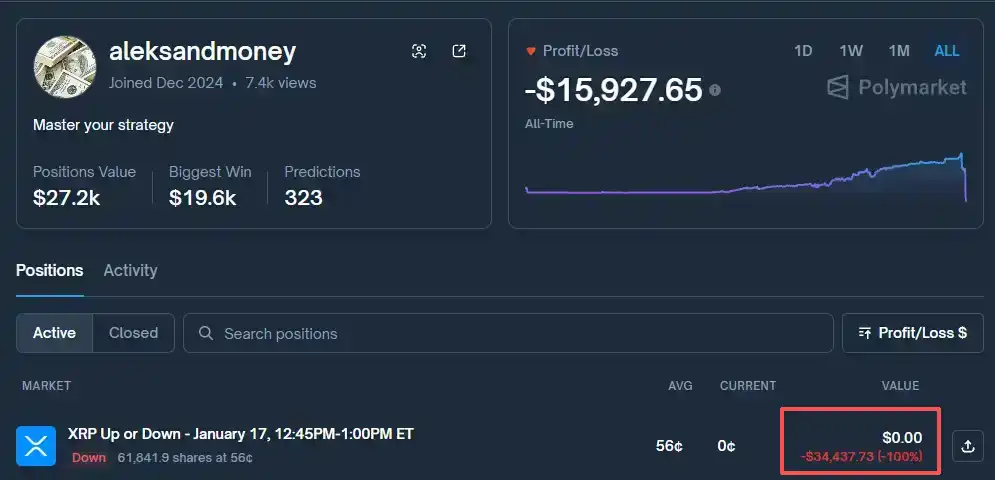
This meant a4385's position, from entry to settlement, realized huge profits, while quantitative bots, like the one in the chart below, spewed out all their historical profits, and even suffered additional losses, just from this single market.
Meticulous Manipulation Behind Repeated "Luck"

After this market settled, people discovered that a4385 subsequently replicated this "incredible luck" several more times: in multiple markets, about one minute before settlement, the XRP price suddenly spiked, only to quickly fall back the very second after settlement.

This led to suspicions that his "luck" might not be coincidental but rather a precise snipe targeting quantitative bots.

In theory, a4385 could first bet on "up" when the real-time XRP price is below the starting price, then, in the minute before settlement, place large market orders to buy XRP, artificially pushing the price up to ensure it exceeds the starting price at settlement, thus locking in profits.

At this point, all previously seemingly insignificant details become crucial: the 17th was a weekend, meaning the order book depth provided by market makers for XRP was insufficient to buffer large, short-term trades.

Choosing XRP, a less popular asset compared to Bitcoin, further ensured shallower order book depth, guaranteeing the manipulator could move the price with less capital in a short time.

This gave a4385 a perfect, brief window for manipulation:
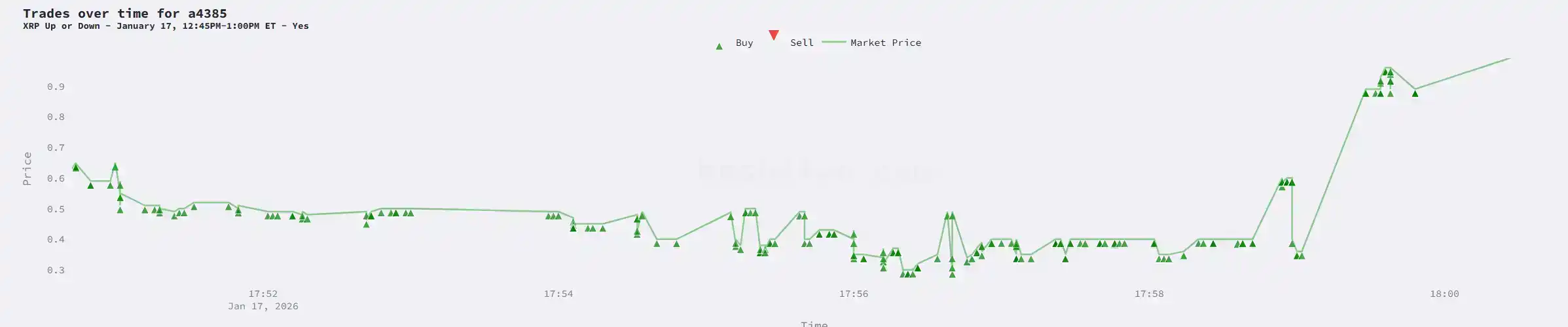
If we assume all market buy orders at 17:59 came from a4385, then based on the trading volume of $569,000 in that one-minute candle, with an exchange fee of 0.32%, the total cost for buying and subsequently selling would be approximately $6,200.

His profit from betting "up" in this market was $40,218. By repeatedly replicating this strategy, he made nearly $300,000 within 48 hours.
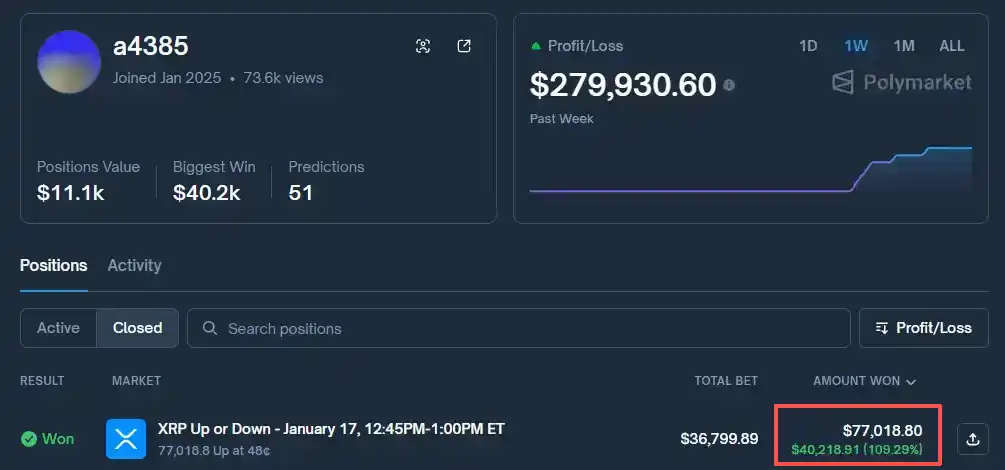
While marveling at a4385's seemingly money-printing operation, we must also account for the costs behind this seemingly "retail revenge"热血 story.

Buying to pump the price not only incurs thousands in fee磨损 but also leads to massive losses when selling off after settlement due to the price falling back.

Therefore, while pumping, he also needs to hold an equivalent 1x short position. Only then can his total asset value remain stable, no matter how violently the spot XRP price in his hands fluctuates.

This means, besides bearing the fee磨损, he requires over a million dollars in liquid capital to ensure the feasibility of this strategy.

So, this is not a gambler's game of luck, nor is it a狂欢 for the average retail investor.

Behind the legendary stories of casino-like huge profits, perhaps the one laughing last is never luck itself, but the inevitable outcome of precisely calculated capital, structure, and rules.


Criptos en tendencia

Preguntas relacionadas

QWhat is the core strategy used by the mysterious account a4385 to profit from quantitative trading bots in the prediction market?

AThe account a4385 executed a strategy where they placed a bet on 'up' in the 'XRP 15-minute up or down' market when the real-time price was below the starting price. Then, in the final minute before settlement, they used large market buy orders to artificially pump the price of XRP above the starting price, ensuring their bet would win. They simultaneously held a corresponding short position to hedge against price fluctuations in their purchased XRP, making the outcome a calculated result rather than a gamble.

QWhy was the XRP market specifically chosen for this strategy against quantitative models?

AXRP was chosen because it is a less popular asset compared to Bitcoin, resulting in a shallower order book depth. This meant that a large market order could move its price significantly with less capital, especially on a weekend when market maker liquidity was lower, creating a perfect window for a short-term price manipulation.

QWhat was the estimated cost and profit for a4385 in a single market operation described in the article?

AFor a single market operation, the estimated cost based on the trading volume and a 0.32% exchange fee was approximately $6,200. The profit from the successful 'up' bet in that market was $40,218.

QWhat crucial risk management technique did a4385 employ to protect against losses from the price volatility of the XRP they bought to pump the price?

ATo hedge against the volatility and potential loss from the XRP they purchased, a4385 held an equivalent 1x short position. This ensured that their overall asset value remained stable regardless of the price movement of the spot XRP after the settlement.

QAccording to the article, what does the success of a4385's strategy ultimately depend on, beyond mere chance?

AThe success ultimately depended on precise calculations of market structure and rules, a deep understanding of quantitative model behaviors, and, most importantly, access to over a million dollars in liquid capital to fund the large trades and hedging positions required for the strategy.

Lecturas Relacionadas

Breaking: Google Earth Urgently Pulls Back Nano Banana 2 Image Generation Feature!

Google Earth's newly launched "Create image" feature, powered by the Nano Banana 2 AI image generation model, was abruptly withdrawn shortly after its release due to being "played" by users. The feature allowed users to generate and overlay AI-created visuals directly onto real-world satellite and 3D maps in Google Earth. The tool enabled creative applications like historical recreations (e.g., visualizing ancient Pompeii), generating informational graphics for landmarks, and envisioning architectural projects or futuristic cityscapes on real terrain. It operated under "geospatial grounding," meaning the AI respected the underlying geography, topography, and perspective of the chosen map view. The model also integrated with Gemini to retrieve relevant factual information. However, upon release, users quickly tested its limits. A prominent example involved reimagining Philadelphia's historic Independence Hall as a post-apocalyptic ruin overrun by "happy" zombies, evil clowns, and giant alien mechs. This highlighted both the feature's playful potential and its risks regarding the generation of inappropriate or misleading content on realistic maps, leading to its swift temporary removal. Google stated it would re-release the feature after implementing "enhanced guardrails." Analysts note this move strategically leverages Google's vast proprietary geospatial data, positioning its AI not just for artistic generation but for spatially accurate world visualization—a unique advantage in the competitive AI image generation landscape.

marsbitHace 14 min(s)

Breaking: Google Earth Urgently Pulls Back Nano Banana 2 Image Generation Feature!

marsbitHace 14 min(s)

Altman Admits: Overestimated AI Snatching Jobs! Huang Renxun: The Unemployment Narrative Is Completely Backwards

Sam Altman has revised his earlier predictions about AI rapidly replacing jobs, admitting he overestimated the speed at which AI would eliminate entry-level white-collar roles. Speaking on the "Invest Like the Best" podcast, he stated that people do not truly want an AI CEO, as accountability and human connection remain critical. He found that individuals prefer interacting with people who can be held responsible for decisions. Similarly, NVIDIA's Jensen Huang argued that the narrative of AI destroying jobs is misguided. He distinguishes between tasks and jobs, noting that while AI can automate specific tasks, entire jobs—encompassing communication, judgment, coordination, and accountability—are not eliminated. He cited examples like radiologists and software engineers, where demand for these roles has increased as AI handles repetitive tasks, allowing for business expansion and the creation of more positions. Data from a University of Maryland and LinkUp study supports this, showing that U.S. job postings for new graduates have actually risen, countering the fear of vanishing entry-level roles. However, a significant shift is occurring: the traditional entry-level tasks that help newcomers gain experience are being automated, making initial career access more challenging. The key insight is that as AI takes over standardized tasks, the enduring value of human work shifts toward areas of responsibility, trust-building, and final decision-making—aspects that AI cannot replicate. The real "moat" for professionals lies in these irreplaceable human elements.

marsbitHace 20 min(s)

Altman Admits: Overestimated AI Snatching Jobs! Huang Renxun: The Unemployment Narrative Is Completely Backwards

marsbitHace 20 min(s)

Weekly Editor's Picks (0725-0731)

Weekly Editor's Picks (0725-0731) provides a curated selection of deep analysis, filtering out market noise. Key themes from this week include: **Macro & Policy:** The Federal Reserve's upcoming meeting is marked by high uncertainty, balancing cooling inflation data against persistent price pressures. Meanwhile, the U.S. crypto regulatory Clarity Act faces critical political hurdles, with its 2026 passage probability seen as low. **Investing & Crypto:** Analysis suggests long-term crypto success depends on conviction through volatile cycles, focusing on assets like Bitcoin and core smart contract platforms. A trend noted is the increasing similarity between global equity markets (especially tech) and crypto, driven by narrative and leverage. Several major crypto protocols show strong revenue growth, but this isn't always translating to token price appreciation due to sell pressure and structural factors. **AI & Semiconductors:** Nvidia's rising credit default swap rates signal market concern over AI infrastructure financing risks. The storage sector experienced volatility as markets began pricing in potential 2027 oversupply. Despite a record profitable quarter, SK Hynix's results were deemed "below expectations," reflecting heightened investor demands for future growth visibility. **Markets & DeFi:** TradeXYZ demonstrated remarkable accuracy in pre-market pricing for a major A股 listing. The token ONDO saw gains, linked to its growing role in the on-chain tokenized stock ecosystem. **Ethereum:** Post-Pectra upgrade, a major structural shift is underway as Lido begins migrating millions of ETH to new validator architectures designed for capital efficiency. **Also Highlighted:** Butian's bullish stock market move; OpenAI's Altman promising major advances; Samsung and SK Hynix securing large AI chip deals; Apple reaching a $5T market cap; and ongoing discussions around exchange security following Poolin's bankruptcy case.

marsbitHace 54 min(s)

Weekly Editor's Picks (0725-0731)

marsbitHace 54 min(s)

Low Investment Isn't Apple's Immunity Pass

While Meta and Google face investor scrutiny over ballooning AI capital expenditures, Apple's minimal AI investment has paradoxically become a strength. Its market cap recently reclaimed the global top spot, surpassing $5 trillion. The irony is deep: Apple's own AI efforts have lagged, with "Apple Intelligence" delayed and core talent lost, forcing reliance on partners like Google Gemini and Alibaba's Qianwen. Its Q3 FY2026 (Q2 CY) earnings initially seemed stellar. Revenue hit $109.4B (up 16% YoY), with iPhone and Mac sales, growing 22% and 29% respectively, driving most of the growth. However, the stock fell over 8% post-earnings. The primary concern was a weaker Q4 revenue growth forecast of 9-11%, below expectations, due to looming supply chain constraints. Apple is feeling the indirect cost of the AI boom. Soaring memory and chip prices, fueled by massive data center investments from Microsoft, Amazon, and others, are forcing Apple to raise Mac and iPad prices significantly. The upcoming iPhone launch is also expected to see substantial price hikes. Despite avoiding heavy AI infrastructure spending—its capital expenditures are actually down 28%—Apple cannot escape the industry-wide supply and cost pressures. While Apple's operating cash flow remains robust, its substantial R&D spending (up 32% YoY) has yet to yield major AI breakthroughs. As Tim Cook prepares to step down as CEO, Apple faces a challenging transition: balancing its premium hardware success against the strategic and cost pressures of the AI era it has so far cautiously navigated.

marsbitHace 1 hora(s)

Low Investment Isn't Apple's Immunity Pass

marsbitHace 1 hora(s)

Trading

Spot

Artículos destacados

Cómo comprar PEOPLE

¡Bienvenido a HTX.com! Hemos hecho que comprar ConstitutionDAO (PEOPLE) sea simple y conveniente. Sigue nuestra guía paso a paso para iniciar tu viaje de criptos.Paso 1: crea tu cuenta HTXUtiliza tu correo electrónico o número de teléfono para registrarte y obtener una cuenta gratuita en HTX. Experimenta un proceso de registro sin complicaciones y desbloquea todas las funciones.Obtener mi cuentaPaso 2: ve a Comprar cripto y elige tu método de pagoTarjeta de crédito/débito: usa tu Visa o Mastercard para comprar ConstitutionDAO (PEOPLE) al instante.Saldo: utiliza fondos del saldo de tu cuenta HTX para tradear sin problemas.Terceros: hemos agregado métodos de pago populares como Google Pay y Apple Pay para mejorar la comodidad.P2P: tradear directamente con otros usuarios en HTX.Over-the-Counter (OTC): ofrecemos servicios personalizados y tipos de cambio competitivos para los traders.Paso 3: guarda tu ConstitutionDAO (PEOPLE)Después de comprar tu ConstitutionDAO (PEOPLE), guárdalo en tu cuenta HTX. Alternativamente, puedes enviarlo a otro lugar mediante transferencia blockchain o utilizarlo para tradear otras criptomonedas.Paso 4: tradear ConstitutionDAO (PEOPLE)Tradear fácilmente con ConstitutionDAO (PEOPLE) en HTX's mercado spot. Simplemente accede a tu cuenta, selecciona tu par de trading, ejecuta tus trades y monitorea en tiempo real. Ofrecemos una experiencia fácil de usar tanto para principiantes como para traders experimentados.

517 Vistas totalesPublicado en 2024.12.12Actualizado en 2026.06.02

Cómo comprar PEOPLE

Discusiones

Bienvenido a la comunidad de HTX. Aquí puedes mantenerte informado sobre los últimos desarrollos de la plataforma y acceder a análisis profesionales del mercado. A continuación se presentan las opiniones de los usuarios sobre el precio de PEOPLE (PEOPLE).

活动图片