In today's stock market, where quantitative trading is all the rage, most people see these cold, algorithmic bots as Wall Street's ruthless harvesting machines, constantly siphoning off the hard-earned money of retail investors through emotional misjudgments or information asymmetry at millisecond speeds.
However, in a nascent market over the past 48 hours, the near-perfect profit curves of several top quantitative bots collectively snapped, while a mysterious account named a4385 raked in $280,000 from the chaos.
This market is called the prediction market, and it is here that a trader known as a4385 showcased a meticulously orchestrated hunt targeting quantitative bots.
Financial "Heads or Tails": The Arbitrage Paradise for Quantitative Models
Everyone understands heads or tails, and prediction markets have a similar game.
For example, if you bet on "up" in "Will the price of gold rise or fall tomorrow?" and the price indeed rises tomorrow, then regardless of the magnitude of the increase, your "up" position will be settled for profit according to the odds at the time of betting, where the odds themselves correspond to the probability of the event occurring. Conversely, if the price falls, no matter how much it drops, your position will be wiped to zero.
"XRP up or down in 15 minutes" is a typical representative of the many markets in prediction markets. Each 15-minute market opens with a starting price; 15 minutes later, if XRP's price is above the starting price, traders who wagered on "up" profit, and vice versa for those who bet on "down".
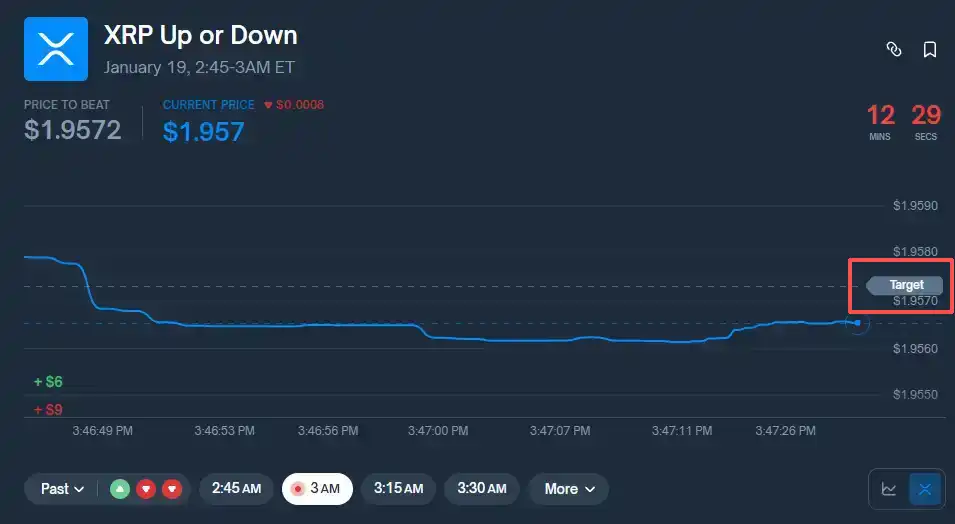
This real-time mechanism makes this particular market a paradise for quantitative bots: algorithms use sophisticated statistical models to capture pricing deviations caused by retail investor emotions, information delays, remaining time, and other factors, perfectly蚕食ing steady profits through automated trading.
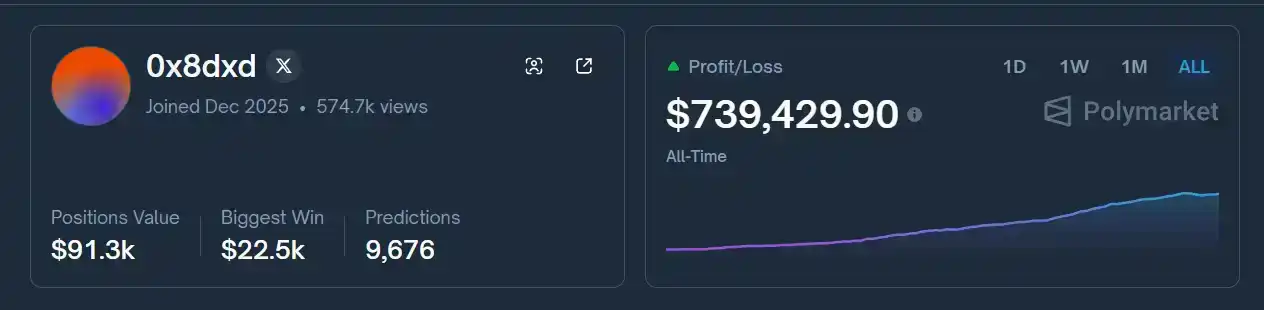
XRP Soars Right at Settlement, "Lucky Big Spender" Doubles Their Money
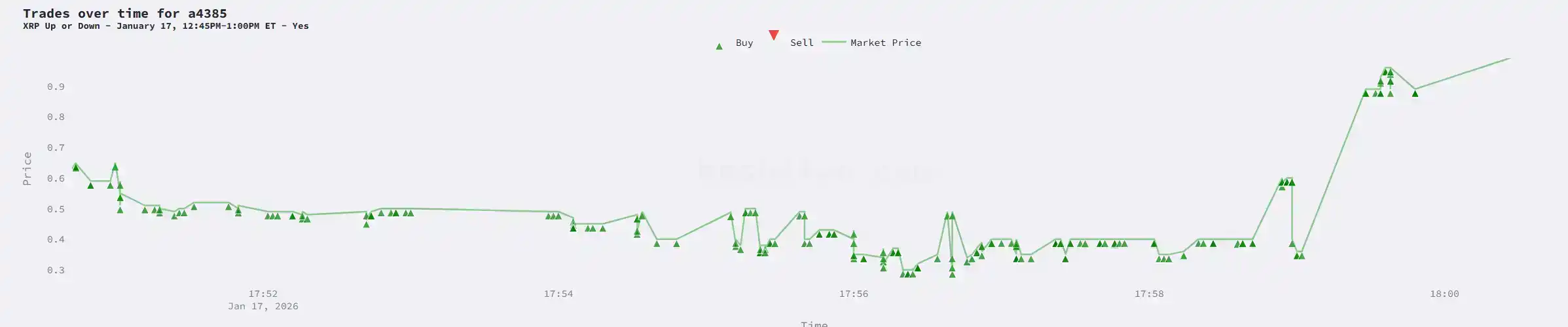
On the afternoon of January 17, 2026, a4385 bet on "up" in the "XRP up or down in 15 minutes" market.
The starting price for XRP in this market was $2.0784, and as late as 17:58:54 (66 seconds remaining until settlement), XRP's price was still hovering around $2.0737, with a corresponding probability of rising of only 36%—market consensus suggested it would be difficult for XRP to rise above the starting price in the mere minute remaining.
But in the next minute, XRP suddenly began a sustained climb, and the market settlement price was fixed at $2.0817—just clearing the starting price.
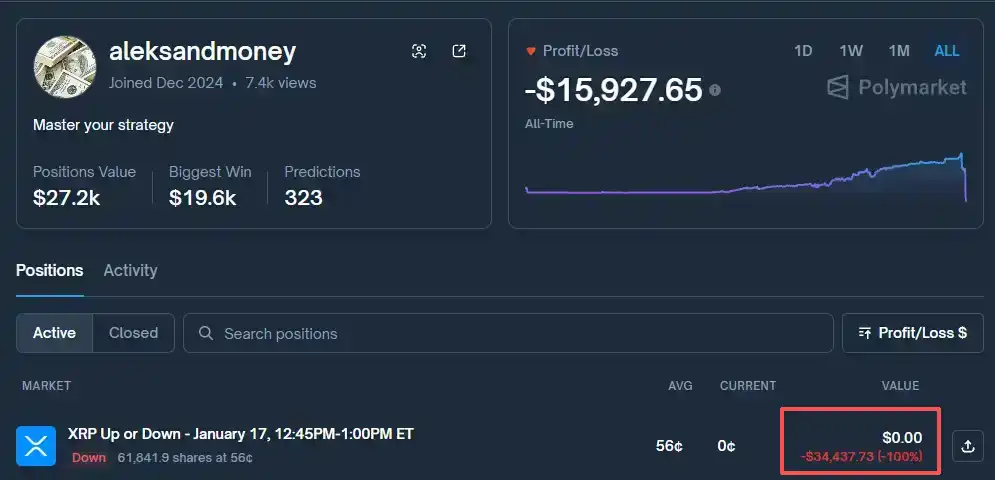
This meant a4385's position, from entry to settlement, realized huge profits, while quantitative bots, like the one in the chart below, spewed out all their historical profits, and even suffered additional losses, just from this single market.
Meticulous Manipulation Behind Repeated "Luck"
After this market settled, people discovered that a4385 subsequently replicated this "incredible luck" several more times: in multiple markets, about one minute before settlement, the XRP price suddenly spiked, only to quickly fall back the very second after settlement.
This led to suspicions that his "luck" might not be coincidental but rather a precise snipe targeting quantitative bots.
In theory, a4385 could first bet on "up" when the real-time XRP price is below the starting price, then, in the minute before settlement, place large market orders to buy XRP, artificially pushing the price up to ensure it exceeds the starting price at settlement, thus locking in profits.
At this point, all previously seemingly insignificant details become crucial: the 17th was a weekend, meaning the order book depth provided by market makers for XRP was insufficient to buffer large, short-term trades.
Choosing XRP, a less popular asset compared to Bitcoin, further ensured shallower order book depth, guaranteeing the manipulator could move the price with less capital in a short time.
This gave a4385 a perfect, brief window for manipulation:
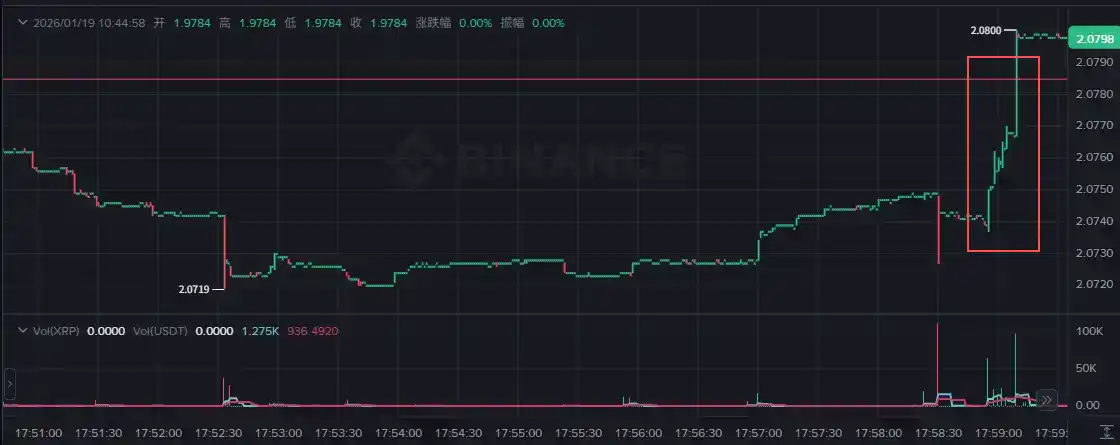
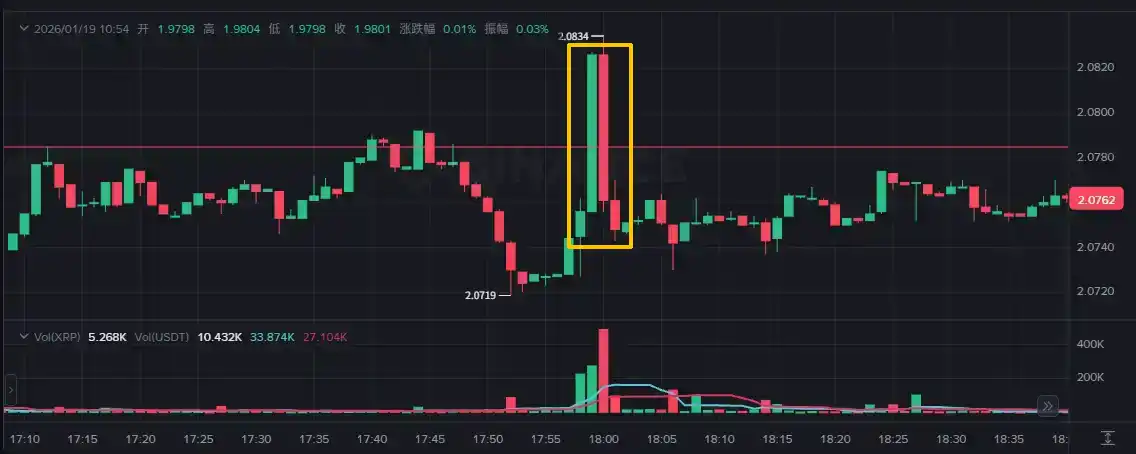
If we assume all market buy orders at 17:59 came from a4385, then based on the trading volume of $569,000 in that one-minute candle, with an exchange fee of 0.32%, the total cost for buying and subsequently selling would be approximately $6,200.
His profit from betting "up" in this market was $40,218. By repeatedly replicating this strategy, he made nearly $300,000 within 48 hours.
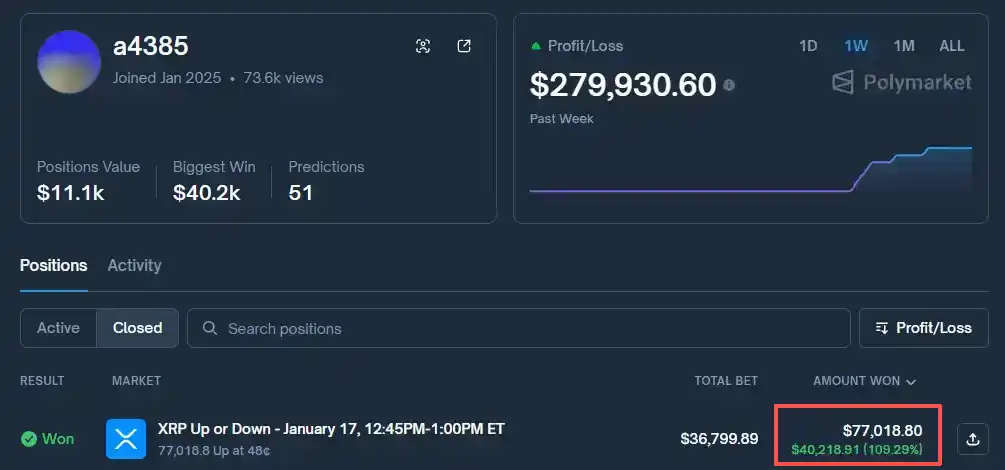
While marveling at a4385's seemingly money-printing operation, we must also account for the costs behind this seemingly "retail revenge"热血 story.
Buying to pump the price not only incurs thousands in fee磨损 but also leads to massive losses when selling off after settlement due to the price falling back.
Therefore, while pumping, he also needs to hold an equivalent 1x short position. Only then can his total asset value remain stable, no matter how violently the spot XRP price in his hands fluctuates.
This means, besides bearing the fee磨损, he requires over a million dollars in liquid capital to ensure the feasibility of this strategy.
So, this is not a gambler's game of luck, nor is it a狂欢 for the average retail investor.
Behind the legendary stories of casino-like huge profits, perhaps the one laughing last is never luck itself, but the inevitable outcome of precisely calculated capital, structure, and rules.




















