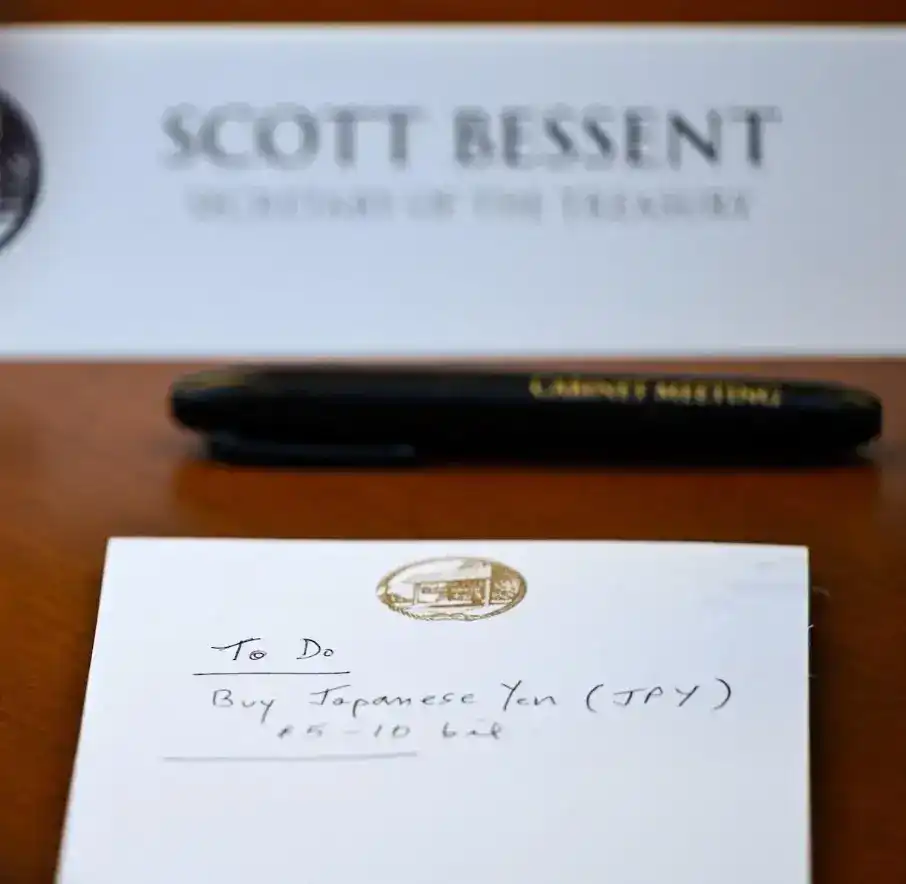
Sell Nvidia, Buy Power Plants: A 24-Year-Old Unconventional AI Investor Made $5 Billion in a Year

marsbitPublicado a 2026-03-06Actualizado a 2026-03-06

Resumen

Leopold Aschenbrenner, a 24-year-old former OpenAI researcher, achieved a 14x return in 12 months, growing his fund to $5.517 billion by investing unconventionally in AI infrastructure. Instead of popular AI stocks, he focused on physical constraints like power and hardware. Key holdings include Bloom Energy (fuel cells for power generation), CoreWeave (GPU cloud services), Intel (U.S. chip manufacturing), and Bitcoin miners (cheap power and data center space). He also invested in Lumentum (optical components) and SanDisk (data storage). Aschenbrenner sold top AI performers like Nvidia, betting that AI's real bottleneck is electricity, not algorithms. His strategy stems from a 165-page manifesto predicting AGI by 2027, emphasizing compute and energy demands. Despite market panic during the DeepSeek shock, he held firm, arguing efficiency gains would fuel, not reduce, demand. His approach combines deep AI insight with real-world infrastructure analysis, capitalizing on mispriced opportunities in the AI value chain.

By|Sleepy.txt

In February 2026, hedge fund Situational Awareness LP filed its quarterly holdings report, showing that as of the end of the fourth quarter of 2025, the total market value of the fund's U.S. stock holdings was $5.517 billion.

Wall Street manages tens of trillions of dollars in assets, and $5.5 billion is just a drop in the bucket. But this fund had less than $400 million in assets under management just 12 months ago, and its founder and chief investment officer is a young man born in 1999.

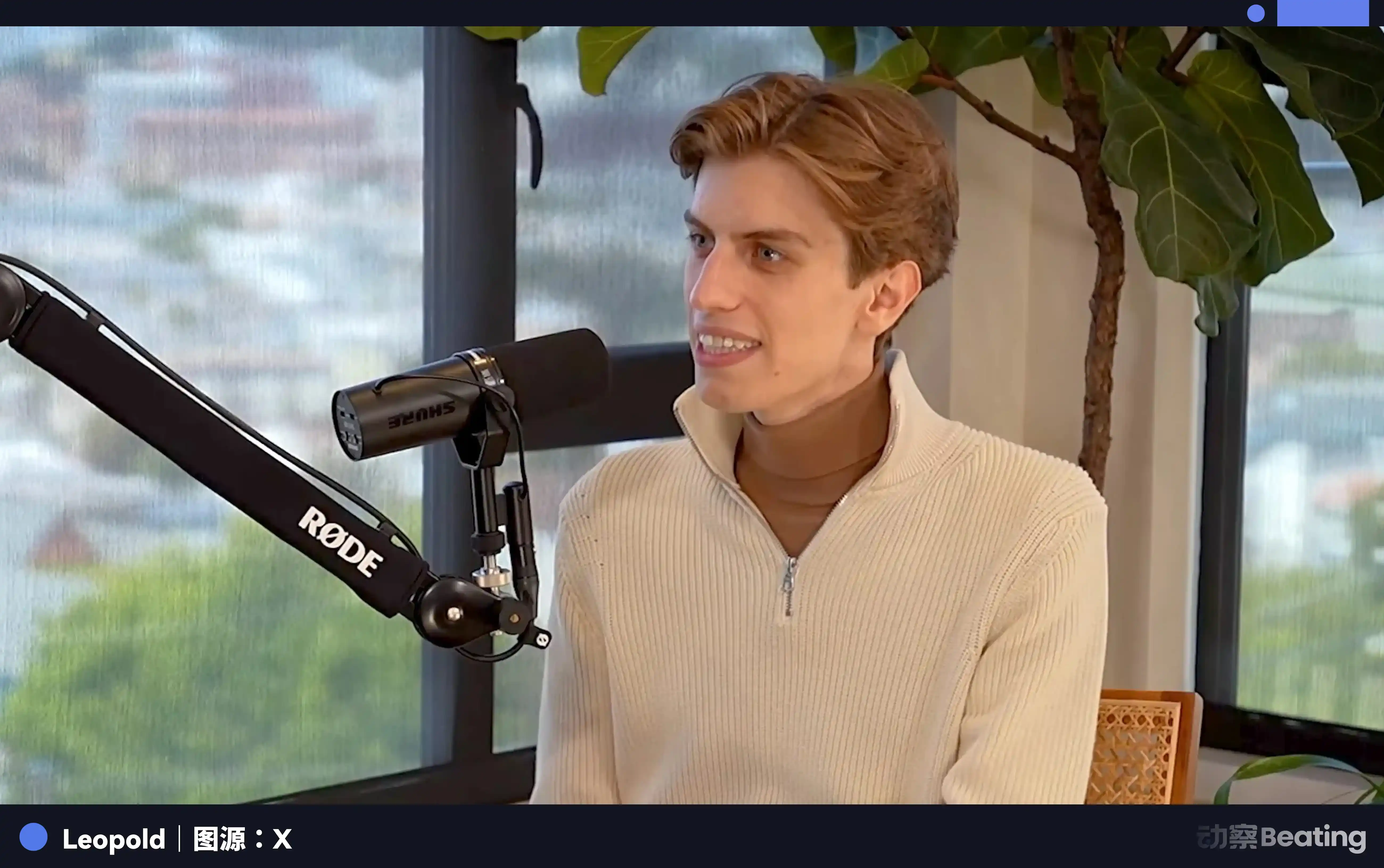
His name is Leopold Aschenbrenner. 24 years old.

In 12 months, he grew this fund from $383 million to $5.517 billion, an increase of over 14 times. During the same period, the S&P 500 gained only single digits.

What's even more surprising is his holdings. Opening the quarterly holdings report, you won't find any of the AI star companies you always see in financial news headlines. Instead, there are companies making fuel cells, Bitcoin miners that have just crawled back from the brink of bankruptcy, and a chip giant being abandoned by the entire market.

He says his fund invests in AI, but this doesn't look like an AI fund's portfolio at all. It looks more like a madman's shopping list.

But this madman happens to be one of the earliest and deepest thinkers in the world on how AI will change the world. Before joining Wall Street, he was a researcher at OpenAI, responsible for thinking about how to ensure AI doesn't go rogue when it becomes smarter than humans; later, he was kicked out for saying the wrong things and wrote a 165-page manifesto predicting a future that most people find absurd.

Later, he went all-in with his entire net worth.

Deconstructing $5.5 Billion: What Did He Actually Buy?

The most direct way to understand how brilliant Leopold Aschenbrenner is at investing is to open his holdings report and read it line by line.

His largest holding is Bloom Energy. Holding value: $876 million, representing 15.87% of the portfolio.

This company makes fuel cells. More precisely, it makes something called "solid oxide fuel cells," which convert natural gas directly into electricity with extremely high efficiency. Founder KR Sridhar was formerly an engineer on NASA's Mars exploration program and was named by Fortune magazine as "one of the five top futurists creating the future today."
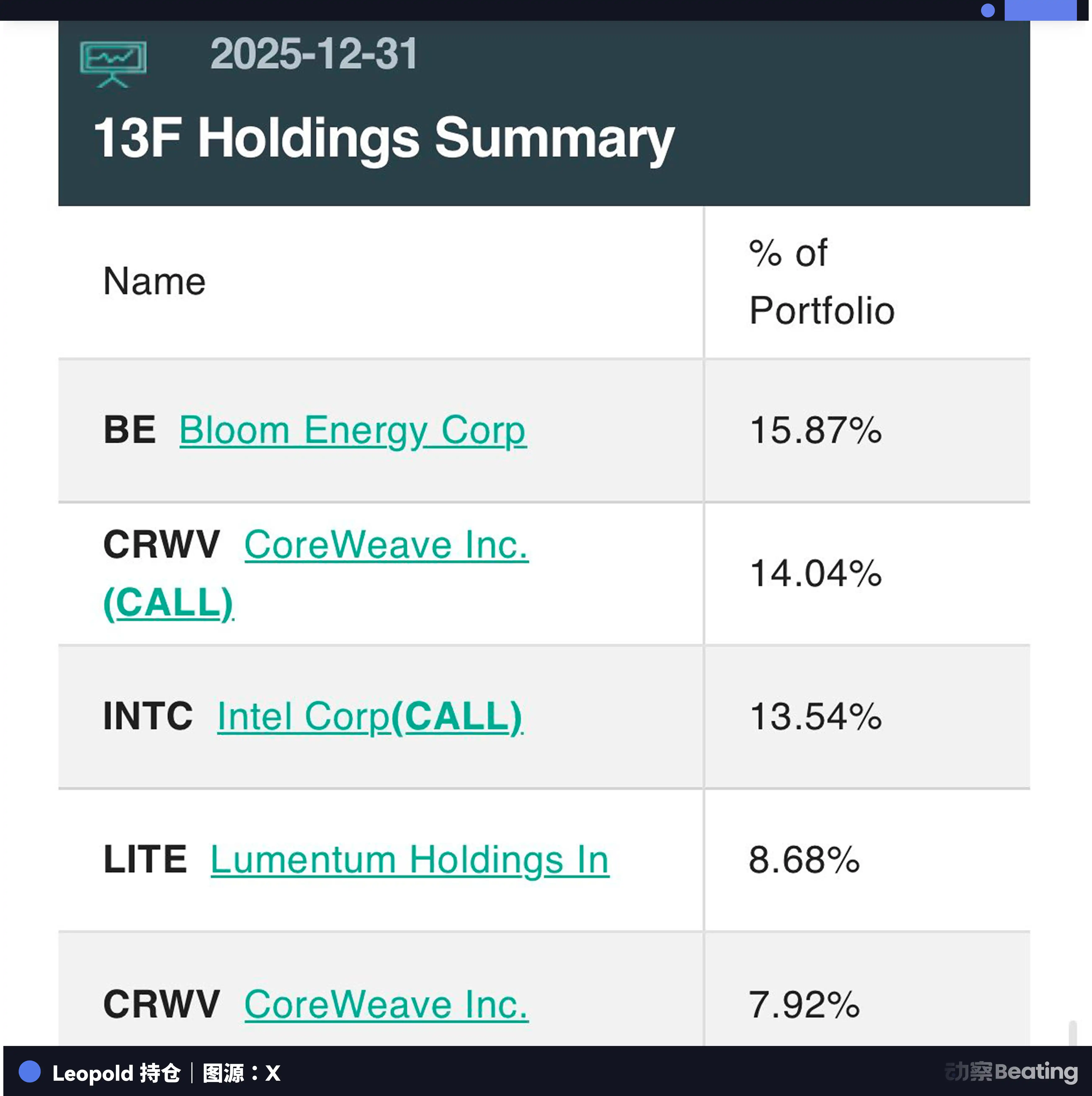
An AI fund placed its biggest bet on a power generation company.

According to Gartner's predictions, the global electricity consumption of AI-optimized servers will skyrocket from 93 terawatt-hours in 2025 to 432 terawatt-hours in 2030, nearly quintupling in five years. The U.S. data center grid power demand will nearly triple by 2030, reaching 134.4 gigawatts. And the average age of the U.S. power infrastructure is already over 25 years, with many components between 40 and 70 years old, far exceeding their design lifespan.

In other words, AI needs more electricity than the entire grid can provide. And the grid itself is so old it's falling apart.

The scarcest resource in the AI era is not chips; it's electricity.

Bloom Energy's fuel cells恰好 bypass this bottleneck. They don't need to connect to the grid; they generate power directly next to data centers, 24/7. In 2025, Bloom Energy secured a contract from CoreWeave to provide fuel cells for its AI data center in Illinois.

Speaking of CoreWeave, this is恰好 Leopold's second-largest holding.

He holds $774 million worth of CoreWeave call options, plus $437 million in common stock, totaling over $1.2 billion, representing 22% of the portfolio. CoreWeave is a GPU cloud service provider that transitioned from a cryptocurrency mining operation.

In 2017, Mike Intrator and Brian Venturo got together to mine Bitcoin. In 2018, the crypto market crashed, and mining became unsustainable. But they had a bunch of GPUs. In 2019, they had a brainstorm: GPUs aren't just for mining; they can also run AI.

So the company pivoted, from a mining operation to an AI compute arms dealer. On March 27, 2025, CoreWeave IPO'd on the Nasdaq, raising $1.5 billion at $40 per share. A company that crawled out of a mining operation became a core supplier of AI infrastructure.

Leopold was attracted to CoreWeave's massive GPU holdings and its deep ties to Nvidia. In an era where compute is productivity, whoever has GPUs is king.

But what's truly baffling is his third-largest holding: Intel. Holding value: $747 million,全部是 call options, representing 13.54% of the portfolio.

In 2025, Intel was one of Wall Street's least favored companies. Its stock price had halved from its 2024 high, its market share was being eroded by AMD and Nvidia, and CEOs were being replaced one after another. Almost every analyst was saying Intel was finished.

But Leopold偏偏 chose this moment to go heavily long with call options. This is an extremely aggressive move—soar if right, zero if wrong.

What is he betting on? Two words: foundry.

In November 2024, the U.S. Department of Commerce announced that Intel would receive up to $7.86 billion in direct funding support through the CHIPS and Science Act. The purpose of this money is singular: to make Intel a domestic U.S. chip foundry, competing with TSMC.

In the context of U.S.-China tech decoupling, the U.S. needs an "insider" to make chips. Intel, though落后, is the only choice. Leopold isn't betting on Intel's technology; he's betting on U.S. national will.

The following holdings are even more interesting. Core Scientific, holding $419 million; IREN, $329 million; Cipher Mining, $155 million; Riot Platforms, $78 million; Hut 8, $39.5 million.

These companies share a common characteristic: they are all Bitcoin mining companies.

Why would an AI fund invest in a bunch of Bitcoin miners?

Simple: because Bitcoin mining companies possess the cheapest electricity and the largest data center sites in the U.S.

Core Scientific has over 1,300 megawatts of power capacity. IREN plans to expand its capacity by 1.6 gigawatts in Oklahoma. To survive the intense computing competition, these miners have long since secured the world's cheapest electricity resources, signing long-term power purchase agreements.

And now, what AI data centers lack most is precisely electricity and sites.

In 2022, Core Scientific filed for bankruptcy due to the crypto crash. It completed restructuring in January 2024, reducing its debt by about $1 billion, and relisted on the Nasdaq. Then, it signed a 12-year contract with CoreWeave worth over $10.2 billion to convert its mining facilities into AI data centers. To focus fully on this shift, Core Scientific even plans to sell all its Bitcoin holdings.

IREN (formerly Iris Energy) signed a $9.7 billion AI contract with Microsoft, receiving a $1.9 billion prepayment. Cipher Mining signed a 15-year lease agreement with Amazon. Riot Platforms signed a 10-year, $311 million contract with AMD.

Overnight, Bitcoin miners became the landlords of the AI era.

Now, let's complete this puzzle.

Bloom Energy provides power, CoreWeave provides GPU compute, Bitcoin miners provide sites and cheap power, Intel provides domestic U.S. chip manufacturing capability. Add to that the fourth-largest holding Lumentum ($479 million, makes optical components, core for interconnecting AI data centers), the ninth-largest holding SanDisk ($250 million, data storage), and the eleventh-largest holding EQT Corp ($133 million, natural gas producer, provides fuel for fuel cells).

This is a complete AI infrastructure supply chain.

From power generation, to power transmission, to chip manufacturing, to GPU compute, to data storage, to fiber optic interconnection. He bought every link.

And the other thing he did simultaneously makes this logic even clearer. In Q4 2025, he completely sold off his positions in Nvidia, Broadcom, and Vistra. These three companies were恰恰 the biggest star performers of the 2024 AI rally.

He also shorted Infosys, one of India's largest IT outsourcing companies.

Sell the hottest AI chip stocks, buy the unwanted power plants and mining sites. Short traditional IT outsourcing because AI programming tools are making programmers more efficient, compressing outsourcing demand.

Every trade points to the same judgment: AI's bottleneck is not in software, but in hardware; not in algorithms, but in electricity; not in cloud models, but in the physical world.

So the question is: How did a 24-year-old form this set of beliefs?

From Son of an East German Doctor to OpenAI Rebel

Leopold Aschenbrenner was born in Germany; both his parents were doctors. His mother grew up in former East Germany, his father was from former West Germany; they met after the fall of the Berlin Wall. The family itself carries the imprint of a historical fracture—the Cold War, division, reunion. His later obsession with geopolitical competition might find its earliest seed here.

But Germany couldn't keep him. He later said in an interview: "I really wanted to leave Germany. If you're the most curious kid in class, wanting to learn more, the teachers don't encourage you; they get jealous and try to suppress you."

He called this phenomenon "tall poppy syndrome"—whoever stands tall gets cut down.

At age 15, he convinced his parents and flew alone to the U.S., entering Columbia University.

Attending university at 15 is an outlier anywhere. But Leopold's performance at Columbia turned "outlier" into "legend." He majored in a double degree in Economics and Mathematics-Statistics, won every possible award, like the Albert Asher Green Memorial Prize, the Romine Prize in Economics, and Junior Phi Beta Kappa.

At 17, he wrote a paper on economic growth and existential risk. Prominent economist Tyler Cowen read it and said: "When I read it, I couldn't believe it was written by a 17-year-old. I would have been impressed if it were an MIT PhD thesis."

At 19, he graduated from Columbia as Valedictorian. This is the highest honor for undergraduates at the university. In 2021, with the world still in the shadow of the pandemic, a 19-year-old German kid stood at Columbia's graduation ceremony, delivering the address on behalf of all graduates.
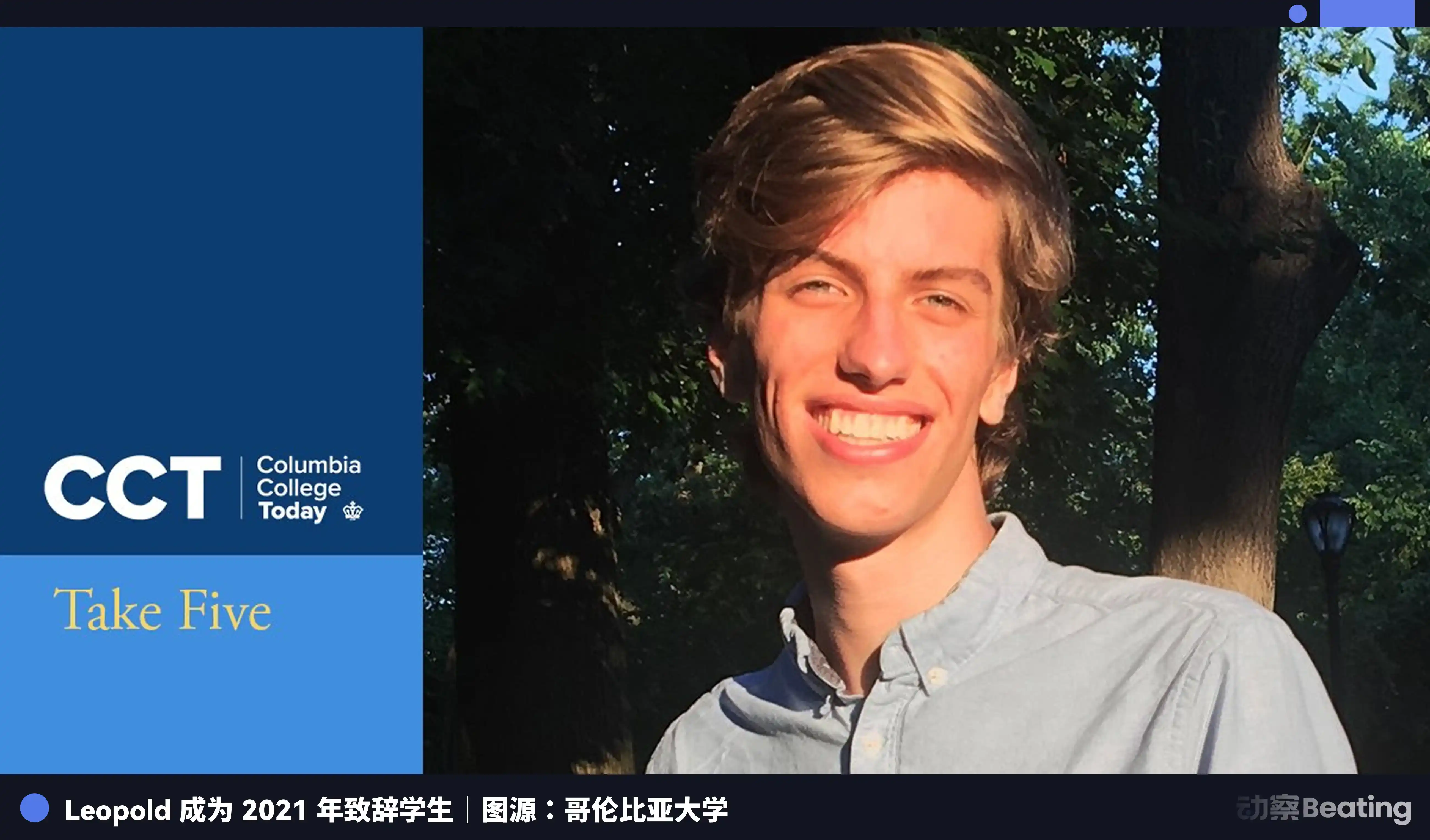
Tyler Cowen gave him a piece of advice: don't get a PhD in economics.

Cowen felt economics academia had become somewhat "decadent" and encouraged him to do bigger things. Cowen also introduced him to Silicon Valley's "Twitter weirdo" culture circle, a group obsessed with AI, effective altruism, and humanity's long-term fate.

After graduation, Leopold first went to the Forethought Foundation, researching long-term economic growth and existential risks. Then he joined the FTX Future Fund founded by SBF, working with core figures of the effective altruism movement, Nick Beckstead and William MacAskill. His title was "Economist affiliated with the University of Oxford's Global Priorities Institute."

This experience was important. It meant that before entering the AI industry, Aschenbrenner had spent years systematically thinking about one question: what kind of events can fundamentally alter the course of human civilization.

Then, he joined OpenAI.

The exact timing is unclear, but he joined a special team—the "Superalignment" team. This team was formed on July 5, 2023, co-led by OpenAI co-founder Ilya Sutskever and alignment team lead Jan Leike. The goal was to solve the superintelligence alignment problem within four years, i.e., ensuring an AI vastly smarter than humans would still listen to them.

OpenAI had承诺 to dedicate 20% of its compute to this team. But there was a chasm between promise and reality.

Leopold saw things inside OpenAI that made him uneasy. He submitted a security memo to the board, warning that the company's security measures were "grossly inadequate" to prevent foreign governments from stealing critical algorithmic secrets. The company's reaction surprised him. HR spoke to him, saying his concerns about espionage were "racist" and "unconstructive." Company lawyers grilled him on his views about AGI and his team's loyalty.

In April 2024, OpenAI fired him for "leaking confidential information."

The alleged "leak" was sharing a brainstorming document on AGI safety measures with three external researchers. Leopold said the document contained no sensitive information and that sharing such documents internally for feedback was standard practice.

A month later, Ilya Sutskever left OpenAI. Three days after that, Jan Leike left too. The Superalignment team was dissolved. OpenAI's承诺 20% compute was never delivered.

The irony of a team researching "how to control superintelligence" being disbanded by the company creating superintelligence cannot be overstated. But for Leopold, being fired became a form of liberation. He was no longer employed by anyone, no longer needed to carefully phrase internal memos. He could say what he truly wanted to say to the whole world.

On June 4, 2024, he published a 165-page article on a website called situational-awareness.ai. The title was simply "Situational Awareness: The Decade Ahead."

The 165-Page Prophecy

To understand Leopold's investment logic, you must first read this manifesto. Because that $5.5 billion portfolio is the financial translation of these 165 pages.

The core thesis of the manifesto can be summarized in one sentence: AGI (Artificial General Intelligence) has a very high probability of being realized by 2027.

This sounded like madness in June 2024. But Leopold's method of argumentation is direct: count the orders of magnitude.

From GPT-2 to GPT-4, AI's capabilities made a qualitative leap, from a preschooler to a smart high school student. Behind this leap was roughly a 100,000-fold (5 orders of magnitude) increase in effective computation. This growth came from stacking physical compute, improving algorithmic efficiency, and capability release through model "unbinding."

His prediction is that by 2027, growth of the same scale will happen again. In physical compute, the computational resources for training cutting-edge models will be 100 times greater than for GPT-4. In algorithmic efficiency, improvement is about 0.5 orders of magnitude per year, accumulating to about 100 times over four years. Add the gain from "unbinding," turning AI from a chatbot into a tool-using, autonomous agent, another order of magnitude jump.
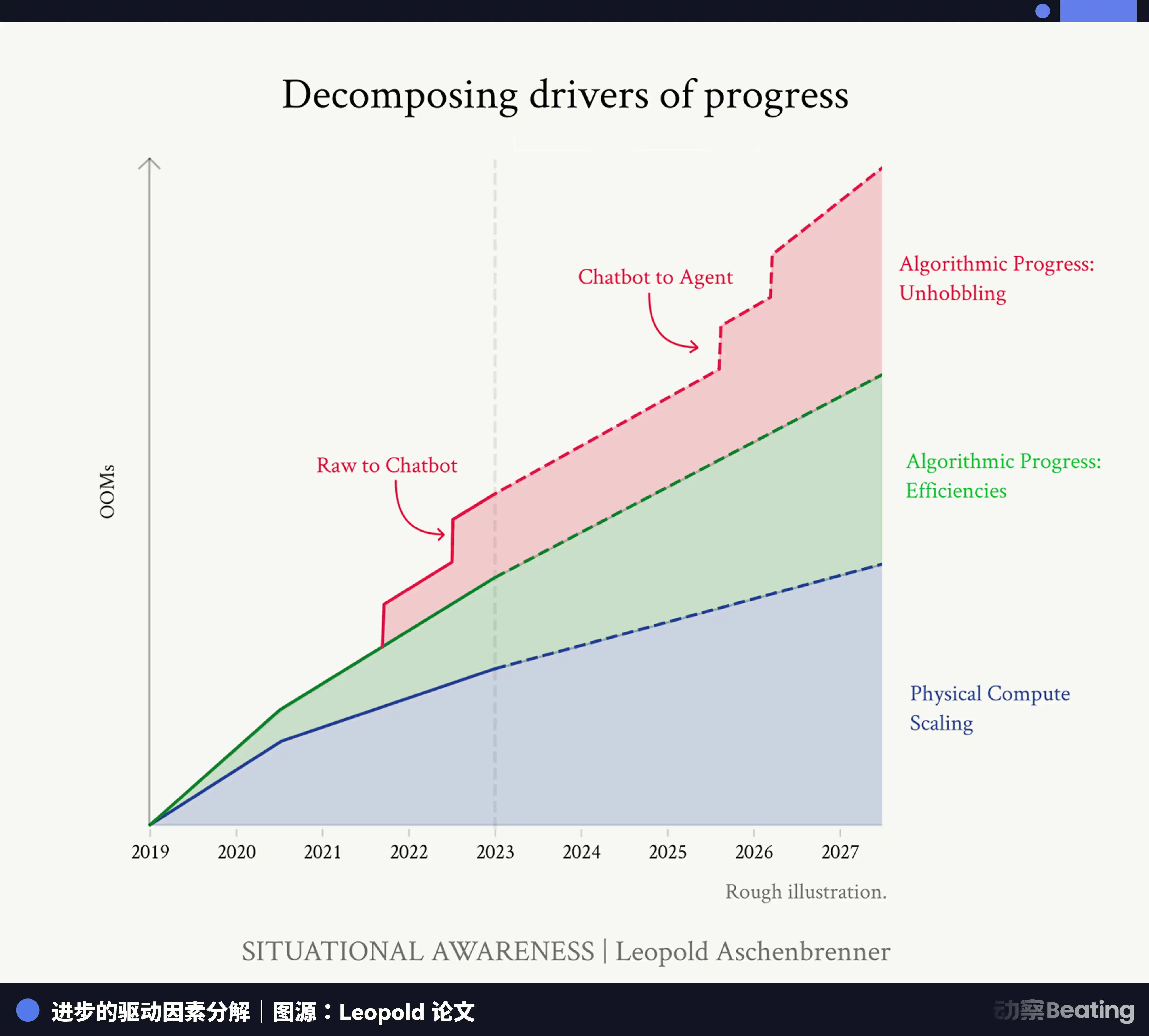
Three 100-fold increases叠加在一起 is another 100,000-fold, another qualitative leap. From a smart high school student to surpassing humans.

What truly made people sit up in this article were the series of consequences he derived from this prediction.

First consequence: Trillion-dollar compute clusters.

He wrote that in the past year, talk in Silicon Valley had shifted from $10 billion compute clusters to $100 billion clusters, and recently to trillion-dollar clusters. Every six months, the board's plans add a zero. By the end of this decade, hundreds of millions of GPUs will be in operation.

This prediction sounded exaggerated in June 2024. But in January 2025, the Trump administration announced the Stargate project, jointly invested in by SoftBank, OpenAI, Oracle, and MGX, planning to invest $500 billion over four years to build AI infrastructure in the U.S. The first deployment of funds was immediately $100 billion. Construction has already begun in Texas.

The "trillion-dollar clusters" he wrote about in the manifesto became an official White House plan half a year later.

Second consequence: Power crisis.

How much electricity do hundreds of millions of GPUs need? Leopold's answer: it requires increasing U.S. electricity production capacity by tens of percentage points.
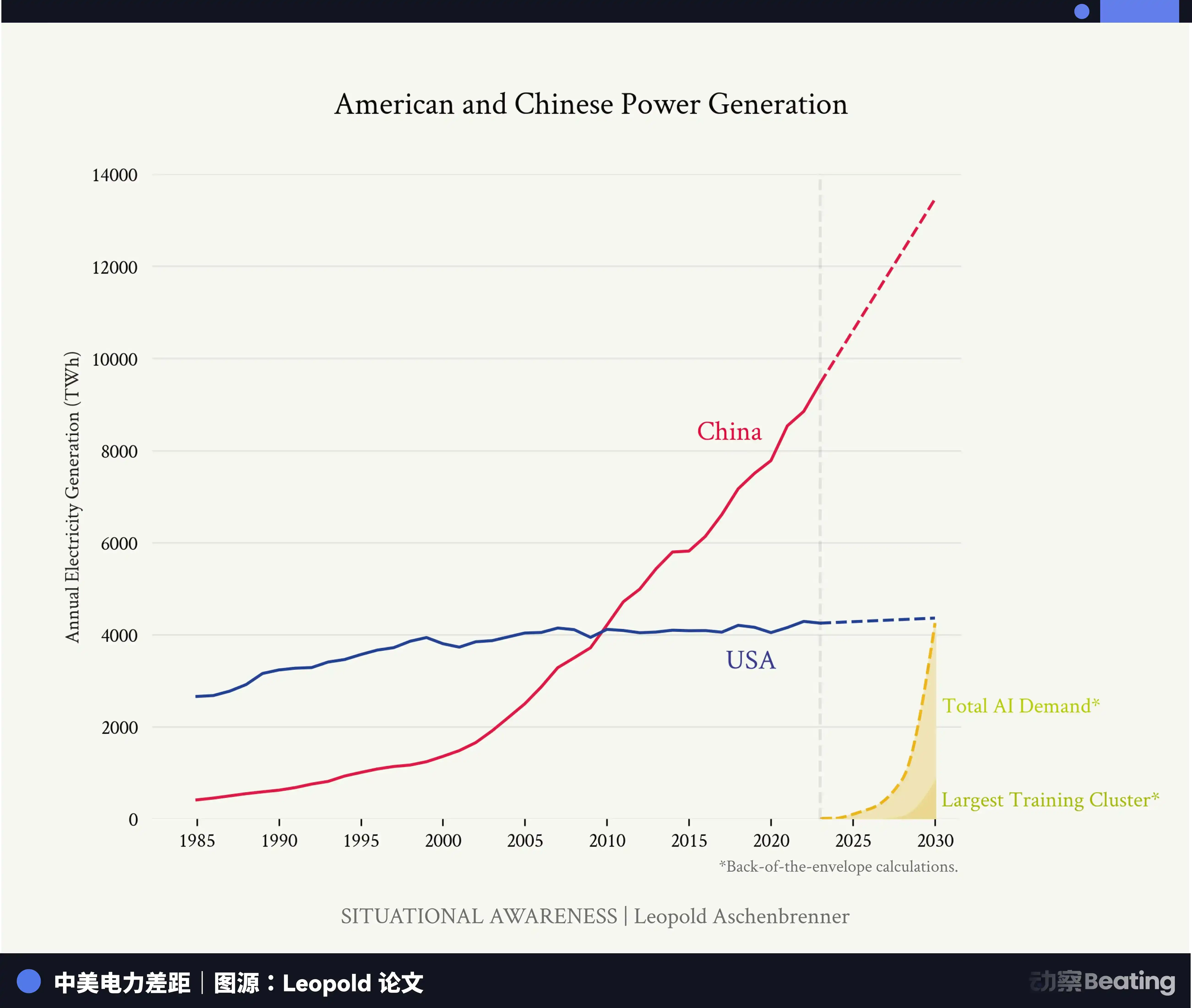
Data confirms his judgment. In 2024, the combined capital expenditure of Amazon, Microsoft, Google, and Meta exceeded $200 billion, a 62% increase from 2023. Amazon alone spent $85.8 billion, a 78% year-on-year increase. In 2025, Amazon's capex is expected to exceed $100 billion.

Most of this money was spent on data centers and power infrastructure.

Microsoft even did something unimaginable a decade ago: it signed a 20-year power purchase agreement with Constellation Energy to restart the Three Mile Island nuclear power plant.

Yes, that Three Mile Island, the site of the worst nuclear accident in U.S. history in 1979.

This nuclear plant will reopen in 2028, renamed the Crane Clean Energy Center, dedicated to powering Microsoft's data centers. Constellation Energy's CEO Joe Dominguez said: "Powering critical industries, including data centers, requires ample, carbon-free, and reliable energy every hour of every day, and nuclear power plants are the only ones that can consistently deliver on this promise."

When a software company starts restarting nuclear power plants, you know electricity has shifted from an infrastructure issue to a strategic resource issue.

Third consequence: Geopolitical competition.

The most controversial part of the manifesto is where Leopold, in near-Cold War language, defines the AGI race as a struggle for the survival of the "free world." He严厉批评 the security measures of top U.S. AI labs as mere formalities. He urgently called for AI algorithms and model weights to be treated as state secrets of the highest order.

He even predicted that the U.S. government would ultimately have to launch a national AGI project similar to the "Manhattan Project."

These arguments sparked fierce debate. Critics argued he oversimplified geopolitical complexity, using alarmist narratives to justify unconstrained acceleration.

But others felt he spoke the truth. Anthropic's Dario Amodei and OpenAI's Sam Altman also believe AGI will arrive soon.

The true value of the manifesto lies not in whether its predictions are 100% accurate, but in providing a complete, actionable thinking framework.

If AGI truly arrives around 2027, what does the world need before that? Massive amounts of compute.

What does compute need? GPUs.

What do GPUs need? Electricity.

Where does electricity come from? Power plants, nuclear plants, Bitcoin mining sites with cheap electricity.

Where are chips made? At TSMC.

But what if the U.S. and China decouple? Then you need Intel.

How do data centers interconnect? Need optical components—Lumentum.

Where is data stored? Need storage—SanDisk.

See, this is the logic of that holdings report.

The manifesto is the map; the holdings are the route. Leopold translated this 165-page macro prediction into an investment portfolio that could be bet on with real money. Every buy corresponds to a point in the manifesto. Every sell corresponds to an assumption he believes the market has mispriced.

But having a map isn't enough. In the real market, you need one more thing: the ability to keep believing you are right when everyone says you are wrong.

This ability was put to the most severe test on January 27, 2025.

The DeepSeek Shock

On January 27, 2025, the release of DeepSeek's DeepSeek-R1 model sent Wall Street into a panic. This model's performance was close to OpenAI's o1, but its usage cost was 20 to 50 times cheaper. Even more shocking, its predecessor model DeepSeek-V3 reportedly cost less than $6 million to train, using Nvidia H800 chips that were sanctioned and performance-limited by the U.S.

The market's logic instantly collapsed.

If the Chinese can train a top-tier model with $6 million and crippled chips, what does the hundreds of billions of dollars U.S. tech giants pour in every year count for? Are those trillion-dollar compute cluster plans still meaningful? Will GPU demand plummet?

Panic spread like plague. Nvidia's stock plummeted nearly 17%, losing $593 billion in market value in a single day, the largest single-day market cap loss in Wall Street history. The Philadelphia Semiconductor Index crashed 9.2%, its biggest single-day drop since the pandemic panic of March 2020. Broadcom fell 17.4%, Marvell fell 19.1%, Oracle fell 13.8%.

The decline started in Asia, spread to Europe, and finally exploded in the U.S. Nasdaq 100 index components alone lost nearly a trillion dollars in market value in one day.

Silicon Valley venture capital godfather Marc Andreessen called DeepSeek AI's "Sputnik moment" on Twitter, saying: "This is one of the most amazing and impressive breakthroughs I've ever seen, and as an open-source project, a gift to the world."

For Leopold's fund, this day should have been a disaster. His holdings were all AI infrastructure stocks, and the market was questioning the entire logic of AI infrastructure.

But according to a Fortune magazine report, an investor in Situational Awareness LP revealed that day, during the market's panic selling, a large tech fund called to inquire. The answer they got was five words:

"Leopold says it's fine."

Why was Leopold so calm? Because in his view, the emergence of DeepSeek did not推翻 his logic; it confirmed it.

His manifesto had a core argument: AI progress will not slow down; it will only accelerate.
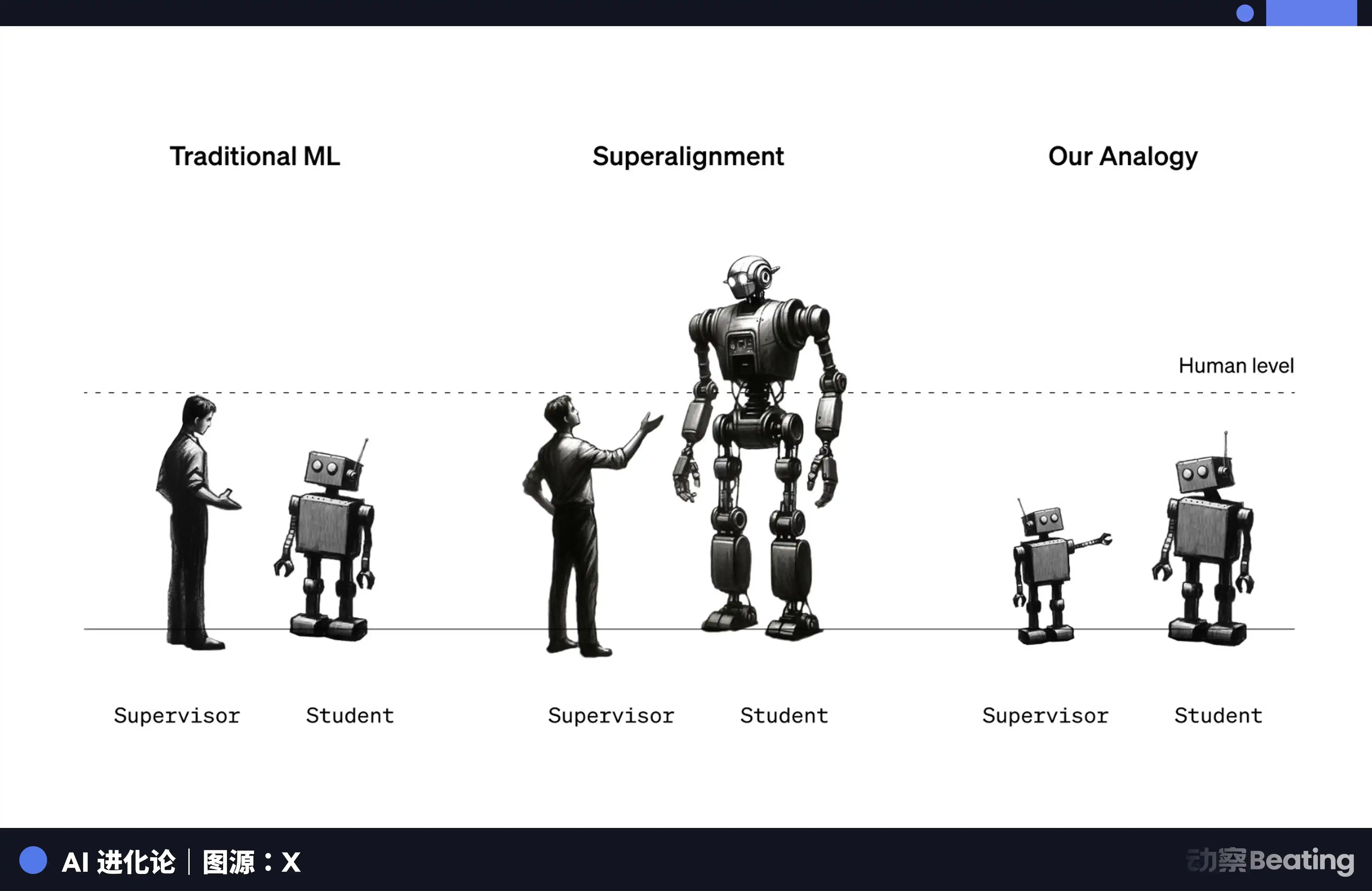
Improving algorithmic efficiency is one of the three engines driving AI development. DeepSeek training a stronger model with less money and weaker chips恰恰 proves algorithmic efficiency is improving rapidly. And the higher the algorithmic efficiency, the stronger the AI that can be produced with the same compute, which will stimulate more compute demand, not reduce it.

Using the framework of his manifesto: DeepSeek did not prove "we don't need that many GPUs"; it proved "every GPU becomes more valuable." When you can train a better model with less money, you don't stop; you train more, larger, stronger models.

Panic stems from the fear that "demand will disappear." But those who truly understand AI know that cost reduction never destroys demand; it only creates greater demand.

Leopold bought against the trend during the panic. The market soon proved him right. Nvidia and the entire AI sector quickly rebounded in the following weeks, returning to levels higher than before the crash.

In the world of investing, conviction is the scarcest asset. Not because forming conviction is hard, but because坚持 conviction when everyone says you're wrong is almost anti-human.

The End of the Physical World

The story of Leopold Aschenbrenner can, of course, be simplified into a爽文 about a天才少年 getting rich. But if you only see the money, you waste the true value of this story.

What he truly did right was to shift his gaze from the code and model parameters on the screen to the smokestacks of power plants, the substations of mining sites, and the fiber optic cables spanning the continent, while everyone else was staring at the screen.
In 2024, the whole world was discussing how powerful GPT-5 would be, how realistic Sora's videos would be, when AI would replace programmers. These discussions are important, of course. But Leopold asked a more fundamental question: how much electricity do these things need? Where does the electricity come from?

This question sounds too simple, but恰恰 this simple question points to the biggest investment opportunity of the AI era.

AI is growing at an exponential rate, while the physical infrastructure supporting it remains stuck in the last century. Leopold saw this crack. Then he traced along this crack all the way to the end of the physical world. Every step started from a physical bottleneck, found the company solving that bottleneck, and placed a bet.

The essence of this methodology isn't new. During the 19th-century California Gold Rush, the people who made the most money weren't the gold prospectors, but those selling shovels and jeans. Levi Strauss made his fortune then.

But knowing this道理 is one thing; executing it in the AI era is another.

Because to execute it, you need two abilities simultaneously: a deep understanding of technological trends, knowing AI's development path and resource needs; and a concrete认知 of the physical world, knowing where electricity comes from, how data centers are built, how fiber is laid.

The former requires you to have been in an OpenAI lab; the latter requires you to be willing to蹲下来 and study the power contracts of a bankrupt mining company.

Technical people understand AI but not electricity markets. Finance people understand markets but not AI's physical constraints. Leopold恰好 had both.

But more important than ability is perspective.

There's a line in his manifesto that is often quoted: "You can see the future first in San Francisco." The subtext of this sentence is: the future is not evenly distributed.

The essence of investing is finding price mismatches in a future that has arrived but is not yet evenly distributed.

Leopold亲眼 saw the AI capability curve in OpenAI's labs. He knew GPT-4 was not the end but the beginning. He knew there would be larger models, more compute, crazier capital investment. And the market was still discussing "is AI a bubble?"

This is the mismatch. What he did was turn this mismatch into $5.5 billion.

Preguntas relacionadas

QWhat was the core investment thesis behind Leopold Aschenbrenner's portfolio, and how did it differ from typical AI-focused funds?

ALeopold's core investment thesis was that the true bottleneck for AI advancement is not software or algorithms, but physical infrastructure—specifically electricity, compute hardware, and data center capacity. Unlike typical AI funds that invested heavily in high-profile AI software and chip companies like Nvidia, he focused on undervalued enablers: power generation (Bloom Energy), GPU cloud providers (CoreWeave), Bitcoin miners (for their cheap power and data center space), and semiconductor manufacturing (Intel). He believed AI's exponential growth would strain existing infrastructure, creating massive value for companies solving these physical constraints.

QHow did Leopold Aschenbrenner's background at OpenAI and his 'Situational Awareness' manifesto influence his investment strategy?

AHis work at OpenAI's 'Superalignment' team exposed him to the rapid pace of AI development and the resource-intensive nature of advanced models. His 165-page manifesto, 'Situational Awareness: The Decade Ahead,' predicted AGI by 2027 and outlined consequent infrastructure demands: trillion-dollar compute clusters, a looming electricity crisis, and geopolitical competition. This framework directly informed his investments—each position (e.g., Bloom Energy for power, CoreWeave for compute, Intel for chip sovereignty) was a bet on a specific bottleneck highlighted in his manifesto.

QWhy did Leopold invest heavily in Bitcoin mining companies, and how did they relate to AI infrastructure?

AHe invested in Bitcoin miners (e.g., Core Scientific, IREN) because they possessed two critical resources for AI: cheap, long-term power contracts and large-scale data center facilities. These companies had secured low-cost electricity and built infrastructure for mining, which could be repurposed for AI data centers. Post-crypto crash, many pivoted to AI, signing massive deals with tech giants (e.g., CoreWeave, Microsoft) to lease their power and space, effectively becoming 'landlords' for the AI era.

QHow did Leopold's fund react to the DeepSeek-R1 model release that caused a market panic in AI stocks?

ADuring the panic, when DeepSeek's low-cost, high-efficiency model triggered fears that AI infrastructure spending was overhyped, Leopold remained calm and even bought more. He argued that DeepSeek's efficiency gains validated his thesis: cheaper training costs would increase, not decrease, demand for compute and power, as it enables more and larger models. The event confirmed algorithmic progress was accelerating, reinforcing the need for the physical infrastructure he had invested in.

QWhat key risks or bottlenecks in AI development did Leopold identify that are not addressed by software or algorithms alone?

AHe identified electricity as the primary bottleneck—AI data centers require massive, reliable power, but aging grids cannot meet demand. Other physical bottlenecks included semiconductor manufacturing (especially U.S.-based production due to geopolitics), data center construction, optical networking (for inter-data center connectivity), and storage. His investments targeted these areas, emphasizing that AI's growth is constrained by code but by the tangible limits of the physical world.

Lecturas Relacionadas

Bajando las expectativas para el próximo ciclo alcista de BTC

**Resumen del artículo: "Bajar las expectativas para el próximo ciclo alcista de BTC" por Alex Xu** El autor, que tenía a Bitcoin como su mayor activo, ha reducido progresivamente su exposición durante el actual ciclo alcista: eliminó el apalancamiento a 70k y redujo su posición de un 100% a un 30% entre 100k-120k. Recientemente, vendió más a 78k-79k, argumentando una revisión a la baja de las expectativas para el próximo máximo alcista. Las razones principales son: 1. **Narrativa de adopción agotada:** El impulso de adopción masiva (de minorista a institucional vía ETFs) parece agotado. El siguiente paso, la adopción por bancos centrales o fondos soberanos importantes, se ve muy difícil a corto plazo. 2. **Coste de oportunidad:** El autor ha identificado otras oportunidades de inversión en empresas atractivas. 3. **Contracción del ecosistema crypto:** La mayoría de modelos de negocio Web3 (SocialFi, GameFi, DePIN) no han funcionado. Solo DeFi genera valor, pero se contrae por la falta de activos nativos de calidad, lo que reduce la base de usuarios y holders de BTC. 4. **Problemas del mayor comprador:** MicroStrategy, el mayor tenedor corporativo, enfrenta un coste de financiación creciente (11.5% para su préstamo perpetuo), lo que podría ralentizar su ritmo de compra y ejercer presión vendedora. 5. **Competencia del oro tokenizado:** El oro tokenizado ha cerrado la brecha en portabilidad y divisibilidad, erosionando la ventaja competitiva de BTC como "oro digital". 6. **Problema de seguridad:** La reducción de la recompensa por minado (halving) amenaza la seguridad de la red, ya que las nuevas fuentes de ingresos por fees (como las inscripciones) no han podido dar solución. Conclusión: El autor mantiene una posición significativa en BTC y espera que suba, pero es menos optimista sobre su potencial alcista. Vender en la reciente subida fue una decisión táctica. Si sus razones para ser bajista se invalidan, estaría abierto a recomprar, aceptando si se equivoca y el precio sube.

marsbit04/27 02:49

Bajando las expectativas para el próximo ciclo alcista de BTC

marsbit04/27 02:49

Trading

Spot
Futuros

Artículos destacados

Qué es GROK AI

Grok AI: Revolucionando la Tecnología Conversacional en la Era Web3 Introducción En el paisaje de la inteligencia artificial en rápida evolución, Grok AI se destaca como un proyecto notable que une los dominios de la tecnología avanzada y la interacción con el usuario. Desarrollado por xAI, una empresa liderada por el renombrado emprendedor Elon Musk, Grok AI busca redefinir cómo interactuamos con la inteligencia artificial. A medida que el movimiento Web3 continúa floreciendo, Grok AI tiene como objetivo aprovechar el poder de la IA conversacional para responder a consultas complejas, proporcionando a los usuarios una experiencia que no solo es informativa, sino también entretenida. ¿Qué es Grok AI? Grok AI es un sofisticado chatbot de IA conversacional diseñado para interactuar con los usuarios de manera dinámica. A diferencia de muchos sistemas de IA tradicionales, Grok AI abraza una gama más amplia de consultas, incluidas aquellas que normalmente se consideran inapropiadas o fuera de las respuestas estándar. Los objetivos centrales del proyecto incluyen: Razonamiento Fiable: Grok AI enfatiza el razonamiento de sentido común para proporcionar respuestas lógicas basadas en la comprensión contextual. Supervisión Escalable: La integración de asistencia de herramientas asegura que las interacciones de los usuarios sean tanto monitoreadas como optimizadas para la calidad. Verificación Formal: La seguridad es primordial; Grok AI incorpora métodos de verificación formal para mejorar la fiabilidad de sus resultados. Comprensión de Largo Contexto: El modelo de IA sobresale en retener y recordar un extenso historial de conversaciones, facilitando discusiones significativas y contextualizadas. Robustez Adversarial: Al centrarse en mejorar sus defensas contra entradas manipuladas o maliciosas, Grok AI busca mantener la integridad de las interacciones de los usuarios. En esencia, Grok AI no es solo un dispositivo de recuperación de información; es un compañero conversacional inmersivo que fomenta un diálogo dinámico. Creador de Grok AI La mente detrás de Grok AI no es otra que Elon Musk, una persona sinónimo de innovación en varios campos, incluidos el automotriz, los viajes espaciales y la tecnología. Bajo el paraguas de xAI, una empresa centrada en avanzar la tecnología de IA de maneras beneficiosas, la visión de Musk busca remodelar la comprensión de las interacciones de IA. El liderazgo y la ética fundacional están profundamente influenciados por el compromiso de Musk de empujar los límites tecnológicos. Inversores de Grok AI Si bien los detalles específicos sobre los inversores que respaldan Grok AI son limitados, se reconoce públicamente que xAI, el incubador del proyecto, está fundado y apoyado principalmente por el propio Elon Musk. Las empresas y participaciones anteriores de Musk proporcionan un respaldo robusto, reforzando aún más la credibilidad y el potencial de crecimiento de Grok AI. Sin embargo, hasta ahora, la información sobre fundaciones de inversión adicionales u organizaciones que apoyan a Grok AI no está fácilmente accesible, marcando un área para una posible exploración futura. ¿Cómo Funciona Grok AI? La mecánica operativa de Grok AI es tan innovadora como su marco conceptual. El proyecto integra varias tecnologías de vanguardia que facilitan sus funcionalidades únicas: Infraestructura Robusta: Grok AI está construido utilizando Kubernetes para la orquestación de contenedores, Rust para rendimiento y seguridad, y JAX para computación numérica de alto rendimiento. Este trío asegura que el chatbot opere de manera eficiente, escale efectivamente y sirva a los usuarios de manera oportuna. Acceso a Conocimiento en Tiempo Real: Una de las características distintivas de Grok AI es su capacidad para acceder a datos en tiempo real a través de la plataforma X—anteriormente conocida como Twitter. Esta capacidad otorga a la IA acceso a la información más reciente, permitiéndole proporcionar respuestas y recomendaciones oportunas que otros modelos de IA podrían pasar por alto. Dos Modos de Interacción: Grok AI ofrece a los usuarios la opción entre “Modo Divertido” y “Modo Regular”. El Modo Divertido permite un estilo de interacción más lúdico y humorístico, mientras que el Modo Regular se centra en ofrecer respuestas precisas y exactas. Esta versatilidad asegura una experiencia personalizada que se adapta a diversas preferencias de los usuarios. En esencia, Grok AI une rendimiento con compromiso, creando una experiencia que es tanto enriquecedora como entretenida. Cronología de Grok AI El viaje de Grok AI está marcado por hitos clave que reflejan sus etapas de desarrollo y despliegue: Desarrollo Inicial: La fase fundamental de Grok AI tuvo lugar durante aproximadamente dos meses, durante los cuales se llevó a cabo el entrenamiento y ajuste inicial del modelo. Lanzamiento Beta de Grok-2: En un avance significativo, se anunció la beta de Grok-2. Este lanzamiento introdujo dos versiones del chatbot—Grok-2 y Grok-2 mini—cada una equipada con capacidades para chatear, programar y razonar. Acceso Público: Tras su desarrollo beta, Grok AI se volvió disponible para los usuarios de la plataforma X. Aquellos con cuentas verificadas por un número de teléfono y activas durante al menos siete días pueden acceder a una versión limitada, haciendo la tecnología disponible para una audiencia más amplia. Esta cronología encapsula el crecimiento sistemático de Grok AI desde su inicio hasta el compromiso público, enfatizando su compromiso con la mejora continua y la interacción con los usuarios. Características Clave de Grok AI Grok AI abarca varias características clave que contribuyen a su identidad innovadora: Integración de Conocimiento en Tiempo Real: El acceso a información actual y relevante diferencia a Grok AI de muchos modelos estáticos, permitiendo una experiencia de usuario atractiva y precisa. Estilos de Interacción Versátiles: Al ofrecer modos de interacción distintos, Grok AI se adapta a diversas preferencias de los usuarios, invitando a la creatividad y la personalización en la conversación con la IA. Avanzada Infraestructura Tecnológica: La utilización de Kubernetes, Rust y JAX proporciona al proyecto un marco sólido para garantizar fiabilidad y rendimiento óptimo. Consideración de Discurso Ético: La inclusión de una función generadora de imágenes muestra el espíritu innovador del proyecto. Sin embargo, también plantea consideraciones éticas en torno a los derechos de autor y la representación respetuosa de figuras reconocibles—una discusión en curso dentro de la comunidad de IA. Conclusión Como una entidad pionera en el ámbito de la IA conversacional, Grok AI encapsula el potencial para experiencias transformadoras de usuario en la era digital. Desarrollado por xAI y guiado por el enfoque visionario de Elon Musk, Grok AI integra conocimiento en tiempo real con capacidades avanzadas de interacción. Se esfuerza por empujar los límites de lo que la inteligencia artificial puede lograr mientras mantiene un enfoque en consideraciones éticas y la seguridad del usuario. Grok AI no solo encarna el avance tecnológico, sino que también representa un nuevo paradigma de conversaciones en el paisaje Web3, prometiendo involucrar a los usuarios con tanto conocimiento hábil como interacción lúdica. A medida que el proyecto continúa evolucionando, se erige como un testimonio de lo que la intersección de la tecnología, la creatividad y la interacción similar a la humana puede lograr.

416 Vistas totalesPublicado en 2024.12.26Actualizado en 2024.12.26

Qué es GROK AI

Qué es ERC AI

Euruka Tech: Una Visión General de $erc ai y sus Ambiciones en Web3 Introducción En el panorama en rápida evolución de la tecnología blockchain y las aplicaciones descentralizadas, nuevos proyectos emergen con frecuencia, cada uno con objetivos y metodologías únicas. Uno de estos proyectos es Euruka Tech, que opera en el amplio dominio de las criptomonedas y Web3. El enfoque principal de Euruka Tech, particularmente su token $erc ai, es presentar soluciones innovadoras diseñadas para aprovechar las crecientes capacidades de la tecnología descentralizada. Este artículo tiene como objetivo proporcionar una visión general completa de Euruka Tech, una exploración de sus objetivos, funcionalidad, la identidad de su creador, posibles inversores y su importancia dentro del contexto más amplio de Web3. ¿Qué es Euruka Tech, $erc ai? Euruka Tech se caracteriza como un proyecto que aprovecha las herramientas y funcionalidades ofrecidas por el entorno Web3, centrándose en integrar la inteligencia artificial dentro de sus operaciones. Aunque los detalles específicos sobre el marco del proyecto son algo elusivos, está diseñado para mejorar la participación del usuario y automatizar procesos en el espacio cripto. El proyecto tiene como objetivo crear un ecosistema descentralizado que no solo facilite transacciones, sino que también incorpore funcionalidades predictivas a través de la inteligencia artificial, de ahí la designación de su token, $erc ai. La meta es proporcionar una plataforma intuitiva que facilite interacciones más inteligentes y un procesamiento de transacciones eficiente dentro de la creciente esfera de Web3. ¿Quién es el Creador de Euruka Tech, $erc ai? En la actualidad, la información sobre el creador o el equipo fundador detrás de Euruka Tech sigue sin especificarse y es algo opaca. Esta ausencia de datos genera preocupaciones, ya que el conocimiento del trasfondo del equipo es a menudo esencial para establecer credibilidad dentro del sector blockchain. Por lo tanto, hemos categorizado esta información como desconocida hasta que se disponga de detalles concretos en el dominio público. ¿Quiénes son los Inversores de Euruka Tech, $erc ai? De manera similar, la identificación de inversores u organizaciones de respaldo para el proyecto Euruka Tech no se proporciona fácilmente a través de la investigación disponible. Un aspecto crucial para los posibles interesados o usuarios que consideren involucrarse con Euruka Tech es la garantía que proviene de asociaciones financieras establecidas o respaldo de firmas de inversión reputadas. Sin divulgaciones sobre afiliaciones de inversión, es difícil llegar a conclusiones completas sobre la seguridad financiera o la longevidad del proyecto. De acuerdo con la información encontrada, esta sección también se encuentra en estado de desconocido. ¿Cómo Funciona Euruka Tech, $erc ai? A pesar de la falta de especificaciones técnicas detalladas para Euruka Tech, es esencial considerar sus ambiciones innovadoras. El proyecto busca aprovechar la potencia computacional de la inteligencia artificial para automatizar y mejorar la experiencia del usuario dentro del entorno de las criptomonedas. Al integrar la IA con la tecnología blockchain, Euruka Tech aspira a proporcionar características como operaciones automatizadas, evaluaciones de riesgos e interfaces de usuario personalizadas. La esencia innovadora de Euruka Tech radica en su objetivo de crear una conexión fluida entre los usuarios y las vastas posibilidades que presentan las redes descentralizadas. A través de la utilización de algoritmos de aprendizaje automático e IA, busca minimizar los desafíos que enfrentan los usuarios primerizos y agilizar las experiencias transaccionales dentro del marco de Web3. Esta simbiosis entre IA y blockchain subraya la importancia del token $erc ai, que actúa como un puente entre las interfaces de usuario tradicionales y las capacidades avanzadas de las tecnologías descentralizadas. Cronología de Euruka Tech, $erc ai Desafortunadamente, como resultado de la información limitada disponible sobre Euruka Tech, no podemos presentar una cronología detallada de los principales desarrollos o hitos en el viaje del proyecto. Esta cronología, que suele ser invaluable para trazar la evolución de un proyecto y comprender su trayectoria de crecimiento, no está actualmente disponible. A medida que la información sobre eventos notables, asociaciones o adiciones funcionales se haga evidente, las actualizaciones seguramente mejorarán la visibilidad de Euruka Tech en la esfera cripto. Aclaración sobre Otros Proyectos “Eureka” Es importante señalar que múltiples proyectos y empresas comparten una nomenclatura similar con “Eureka”. La investigación ha identificado iniciativas como un agente de IA de NVIDIA Research, que se centra en enseñar a los robots tareas complejas utilizando métodos generativos, así como Eureka Labs y Eureka AI, que mejoran la experiencia del usuario en educación y análisis de servicio al cliente, respectivamente. Sin embargo, estos proyectos son distintos de Euruka Tech y no deben confundirse con sus objetivos o funcionalidades. Conclusión Euruka Tech, junto con su token $erc ai, representa un jugador prometedor pero actualmente oscuro dentro del paisaje de Web3. Si bien los detalles sobre su creador e inversores siguen sin revelarse, la ambición central de combinar inteligencia artificial con tecnología blockchain se erige como un punto focal de interés. Los enfoques únicos del proyecto para fomentar la participación del usuario a través de la automatización avanzada podrían distinguirlo a medida que el ecosistema Web3 progresa. A medida que el mercado de criptomonedas continúa evolucionando, los interesados deben mantener un ojo atento a los avances en torno a Euruka Tech, ya que el desarrollo de innovaciones documentadas, asociaciones o una hoja de ruta definida podría presentar oportunidades significativas en el futuro cercano. Tal como están las cosas, esperamos más información sustancial que podría desvelar el potencial de Euruka Tech y su posición en el competitivo paisaje cripto.

455 Vistas totalesPublicado en 2025.01.02Actualizado en 2025.01.02

Qué es ERC AI

Qué es DUOLINGO AI

DUOLINGO AI: Integrando el Aprendizaje de Idiomas con la Innovación de Web3 y AI En una era donde la tecnología remodela la educación, la integración de la inteligencia artificial (IA) y las redes blockchain anuncia una nueva frontera para el aprendizaje de idiomas. Presentamos DUOLINGO AI y su criptomoneda asociada, $DUOLINGO AI. Este proyecto aspira a fusionar la capacidad educativa de las principales plataformas de aprendizaje de idiomas con los beneficios de la tecnología descentralizada Web3. Este artículo profundiza en los aspectos clave de DUOLINGO AI, explorando sus objetivos, marco tecnológico, desarrollo histórico y potencial futuro, manteniendo la claridad entre el recurso educativo original y esta iniciativa independiente de criptomoneda. Visión General de DUOLINGO AI En su esencia, DUOLINGO AI busca establecer un entorno descentralizado donde los aprendices puedan ganar recompensas criptográficas por alcanzar hitos educativos en la competencia lingüística. Al aplicar contratos inteligentes, el proyecto pretende automatizar los procesos de verificación de habilidades y asignación de tokens, adhiriéndose a los principios de Web3 que enfatizan la transparencia y la propiedad del usuario. El modelo se aparta de los enfoques tradicionales para la adquisición de idiomas al apoyarse en una estructura de gobernanza impulsada por la comunidad, permitiendo a los poseedores de tokens sugerir mejoras al contenido del curso y a la distribución de recompensas. Algunos de los objetivos notables de DUOLINGO AI incluyen: Aprendizaje Gamificado: El proyecto integra logros en blockchain y tokens no fungibles (NFTs) para representar niveles de competencia lingüística, fomentando la motivación a través de recompensas digitales atractivas. Creación de Contenido Descentralizada: Abre caminos para que educadores y entusiastas de los idiomas contribuyan con sus cursos, facilitando un modelo de reparto de ingresos que beneficia a todos los contribuyentes. Personalización Potenciada por IA: Al emplear modelos avanzados de aprendizaje automático, DUOLINGO AI personaliza las lecciones para adaptarse al progreso de aprendizaje individual, similar a las características adaptativas encontradas en plataformas establecidas. Creadores del Proyecto y Gobernanza A partir de abril de 2025, el equipo detrás de $DUOLINGO AI permanece seudónimo, una práctica frecuente en el paisaje descentralizado de criptomonedas. Esta anonimidad está destinada a promover el crecimiento colectivo y la participación de las partes interesadas en lugar de centrarse en desarrolladores individuales. El contrato inteligente desplegado en la blockchain de Solana señala la dirección de la billetera del desarrollador, lo que significa el compromiso con la transparencia en las transacciones a pesar de que la identidad de los creadores sea desconocida. Según su hoja de ruta, DUOLINGO AI tiene como objetivo evolucionar hacia una Organización Autónoma Descentralizada (DAO). Esta estructura de gobernanza permite a los poseedores de tokens votar sobre cuestiones críticas como implementaciones de características y asignaciones de tesorería. Este modelo se alinea con la ética de empoderamiento comunitario que se encuentra en varias aplicaciones descentralizadas, enfatizando la importancia de la toma de decisiones colectiva. Inversores y Alianzas Estratégicas Actualmente, no hay inversores institucionales o capitalistas de riesgo identificables públicamente vinculados a $DUOLINGO AI. En cambio, la liquidez del proyecto proviene principalmente de intercambios descentralizados (DEXs), marcando un contraste marcado con las estrategias de financiación de las empresas tradicionales de tecnología educativa. Este modelo de base indica un enfoque impulsado por la comunidad, reflejando el compromiso del proyecto con la descentralización. En su libro blanco, DUOLINGO AI menciona la formación de colaboraciones con “plataformas de educación blockchain” no especificadas, destinadas a enriquecer su oferta de cursos. Aunque aún no se han divulgado asociaciones específicas, estos esfuerzos colaborativos sugieren una estrategia para combinar la innovación blockchain con iniciativas educativas, ampliando el acceso y la participación de los usuarios en diversas vías de aprendizaje. Arquitectura Tecnológica Integración de IA DUOLINGO AI incorpora dos componentes principales impulsados por IA para mejorar su oferta educativa: Motor de Aprendizaje Adaptativo: Este sofisticado motor aprende de las interacciones del usuario, similar a los modelos propietarios de las principales plataformas educativas. Ajusta dinámicamente la dificultad de las lecciones para abordar desafíos específicos del aprendiz, reforzando áreas débiles a través de ejercicios específicos. Agentes Conversacionales: Al emplear chatbots impulsados por GPT-4, DUOLINGO AI proporciona una plataforma para que los usuarios participen en conversaciones simuladas, fomentando una experiencia de aprendizaje de idiomas más interactiva y práctica. Infraestructura Blockchain Construido sobre la blockchain de Solana, $DUOLINGO AI utiliza un marco tecnológico integral que incluye: Contratos Inteligentes de Verificación de Habilidades: Esta característica otorga automáticamente tokens a los usuarios que superan con éxito las pruebas de competencia, reforzando la estructura de incentivos para resultados de aprendizaje genuinos. Insignias NFT: Estos tokens digitales significan varios hitos que los aprendices logran, como completar una sección de su curso o dominar habilidades específicas, permitiéndoles intercambiar o exhibir sus logros digitalmente. Gobernanza DAO: Los miembros de la comunidad que poseen tokens pueden participar en la gobernanza votando sobre propuestas clave, facilitando una cultura participativa que fomenta la innovación en la oferta de cursos y características de la plataforma. Línea de Tiempo Histórica 2022–2023: Conceptualización Los cimientos de DUOLINGO AI comienzan con la creación de un libro blanco, destacando la sinergia entre los avances de IA en el aprendizaje de idiomas y el potencial descentralizado de la tecnología blockchain. 2024: Lanzamiento Beta Un lanzamiento beta limitado introduce ofertas en idiomas populares, recompensando a los primeros usuarios con incentivos en tokens como parte de la estrategia de participación comunitaria del proyecto. 2025: Transición a DAO En abril, se produce un lanzamiento completo de la mainnet con la circulación de tokens, lo que provoca discusiones comunitarias sobre posibles expansiones a idiomas asiáticos y otros desarrollos de cursos. Desafíos y Direcciones Futuras Obstáculos Técnicos A pesar de sus ambiciosos objetivos, DUOLINGO AI enfrenta desafíos significativos. La escalabilidad sigue siendo una preocupación constante, particularmente en el equilibrio de los costos asociados con el procesamiento de IA y el mantenimiento de una red descentralizada y receptiva. Además, garantizar la creación y moderación de contenido de calidad en medio de una oferta descentralizada plantea complejidades en el mantenimiento de estándares educativos. Oportunidades Estratégicas Mirando hacia adelante, DUOLINGO AI tiene el potencial de aprovechar asociaciones de micro-certificación con instituciones académicas, proporcionando validaciones de habilidades lingüísticas verificadas por blockchain. Además, la expansión entre cadenas podría permitir al proyecto acceder a bases de usuarios más amplias y a ecosistemas blockchain adicionales, mejorando su interoperabilidad y alcance. Conclusión DUOLINGO AI representa una fusión innovadora de inteligencia artificial y tecnología blockchain, presentando una alternativa centrada en la comunidad a los sistemas tradicionales de aprendizaje de idiomas. Aunque su desarrollo seudónimo y su modelo económico emergente traen ciertos riesgos, el compromiso del proyecto con el aprendizaje gamificado, la educación personalizada y la gobernanza descentralizada ilumina un camino hacia adelante para la tecnología educativa en el ámbito de Web3. A medida que la IA continúa avanzando y el ecosistema blockchain evoluciona, iniciativas como DUOLINGO AI podrían redefinir cómo los usuarios se relacionan con la educación lingüística, empoderando a las comunidades y recompensando la participación a través de mecanismos de aprendizaje innovadores.

443 Vistas totalesPublicado en 2025.04.11Actualizado en 2025.04.11

Qué es DUOLINGO AI

Discusiones

Bienvenido a la comunidad de HTX. Aquí puedes mantenerte informado sobre los últimos desarrollos de la plataforma y acceder a análisis profesionales del mercado. A continuación se presentan las opiniones de los usuarios sobre el precio de AI (AI).

活动图片