Original Author: Grayscale research team
Compiled by: Peggy, BlockBeats
Editor's Note: After years of high volatility and narrative-driven cycles, crypto assets are entering a distinctly different phase. Rising uncertainty in the fiat system, the gradual formation of regulatory frameworks, and the advancement of spot ETPs, stablecoin legislation, and institutional allocation are reshaping how capital enters the crypto market.
The core thesis of Grayscale's "2026 Digital Asset Outlook" is that the dominant force in the crypto market is shifting from retail cycles to institutional capital. Prices are no longer primarily dependent on emotional, explosive rallies but are increasingly driven by compliant channels, long-term capital, and sustainable fundamentals. The narrative of the "four-year cycle" is weakening.
This article systematically outlines ten potential investment themes that could shape the market in 2026, from value storage and stablecoins to asset tokenization, DeFi, AI, and privacy infrastructure, sketching a picture of a crypto ecosystem gradually integrating into the mainstream financial system. The report also clearly identifies which hot topics are more like "noise" rather than decisive variables in the short term.
The following is the original text:
Key Takeaways
We anticipate that 2026 will accelerate a structural shift in digital asset investment, primarily driven by two overarching themes: increased macro demand for alternative stores of value and significantly improved regulatory clarity. Combined, these are expected to introduce new sources of capital, broaden digital asset adoption (particularly among wealth management advisors and institutional investors), and drive a more comprehensive integration of public blockchains into mainstream financial infrastructure.
Based on these trends, we judge that digital asset valuations will generally trend higher in 2026, while the so-called "four-year cycle" (the theory that crypto market movements follow a fixed four-year rhythm) will come to an end. In our view, Bitcoin's price is highly likely to reach a new all-time high in the first half of the year.
Grayscale expects that bipartisan-supported structural legislation for crypto markets will formally become U.S. law in 2026. This will further deepen the convergence between public blockchains and traditional finance, promote the compliant trading of digital asset securities, and potentially allow startups and established companies to conduct on-chain offerings.
The outlook for the fiat system is becoming increasingly uncertain; in contrast, we can be almost certain that the 20 millionth Bitcoin will be mined in March 2026. Against the backdrop of rising fiat risks, digital currency systems like Bitcoin and Ethereum, which feature transparent, programmable, and ultimately scarce supply characteristics, are expected to see stronger demand.
We expect that more crypto assets will become available to investors through Exchange-Traded Products (ETPs) in 2026. These products have had a strong start, but many platforms are still conducting due diligence and integrating crypto assets into their asset allocation processes. As this process matures, slower-moving but substantial institutional capital is expected to continue entering the market throughout 2026.
We have also compiled ten key crypto investment themes for 2026, reflecting the emerging wide range of applications for public blockchain technology. Each theme corresponds to relevant crypto assets:
1. Dollar devaluation risks drive demand for monetary alternatives
2. Improved regulatory clarity supports digital asset adoption
3. Stablecoin influence continues post-GENIUS Act passage
4. Asset tokenization reaches a critical inflection point
5. Blockchain goes mainstream, increasing demand for privacy solutions
6. AI centralization calls for blockchain-based solutions
7. DeFi accelerates, led by lending
8. Mainstream adoption forces next-gen infrastructure upgrades
9. Increased focus on sustainable revenue models
10. Investors will "default" to seeking staking yields
Finally, we also point out two topics that are not expected to substantially impact crypto markets in 2026:
Quantum Computing: We believe research and preparation for post-quantum cryptography will continue, but it is unlikely to impact market valuations within the next year.
Digital Asset Treasuries (DATs): Despite significant media attention, we judge they will not be a key variable determining digital asset market trends in 2026.
2026 Digital Asset Outlook: The Dawn of the Institutional Era
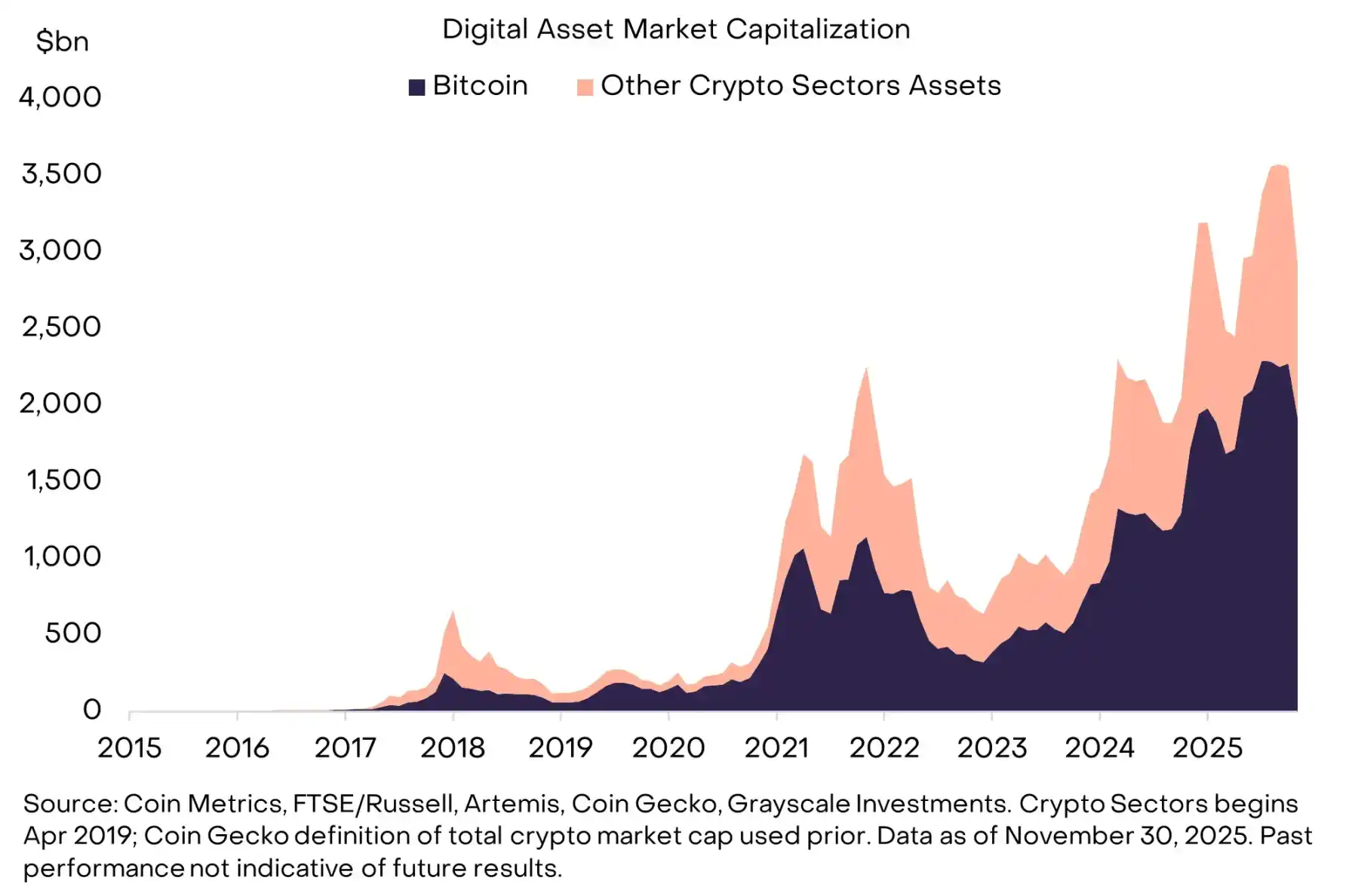
Fifteen years ago, cryptocurrency was still an experimental endeavor: there was only one asset, Bitcoin, with a market cap of approximately $1 million. Today, cryptocurrency has developed into a nascent industry and grown into a medium-sized alternative asset class, consisting of millions of tokens with a total market cap of around $3 trillion (see Chart 1).
As major economies gradually establish more complete regulatory architectures, the integration of public blockchains with the traditional financial system is deepening, continuously attracting long-term oriented capital into this market.
Chart 1: Crypto assets have grown into a medium-sized alternative asset class
Throughout the development of crypto assets, token valuations have experienced four major cyclical drawdowns, roughly following a four-year rhythm (see Chart 2). In three of these cases, the cyclical peaks occurred approximately 1 to 1.5 years after Bitcoin halving events; Bitcoin halvings themselves also occur on a four-year cycle.
The current bull market has lasted over three years, with the most recent Bitcoin halving occurring in April 2024, more than 1.5 years ago. Therefore, some market participants, based on historical patterns, judge that Bitcoin's price may have peaked in October, and 2026 could be a challenging year for crypto asset returns.
Chart 2: Rising valuations in 2026 would mark the end of the "four-year cycle" theory
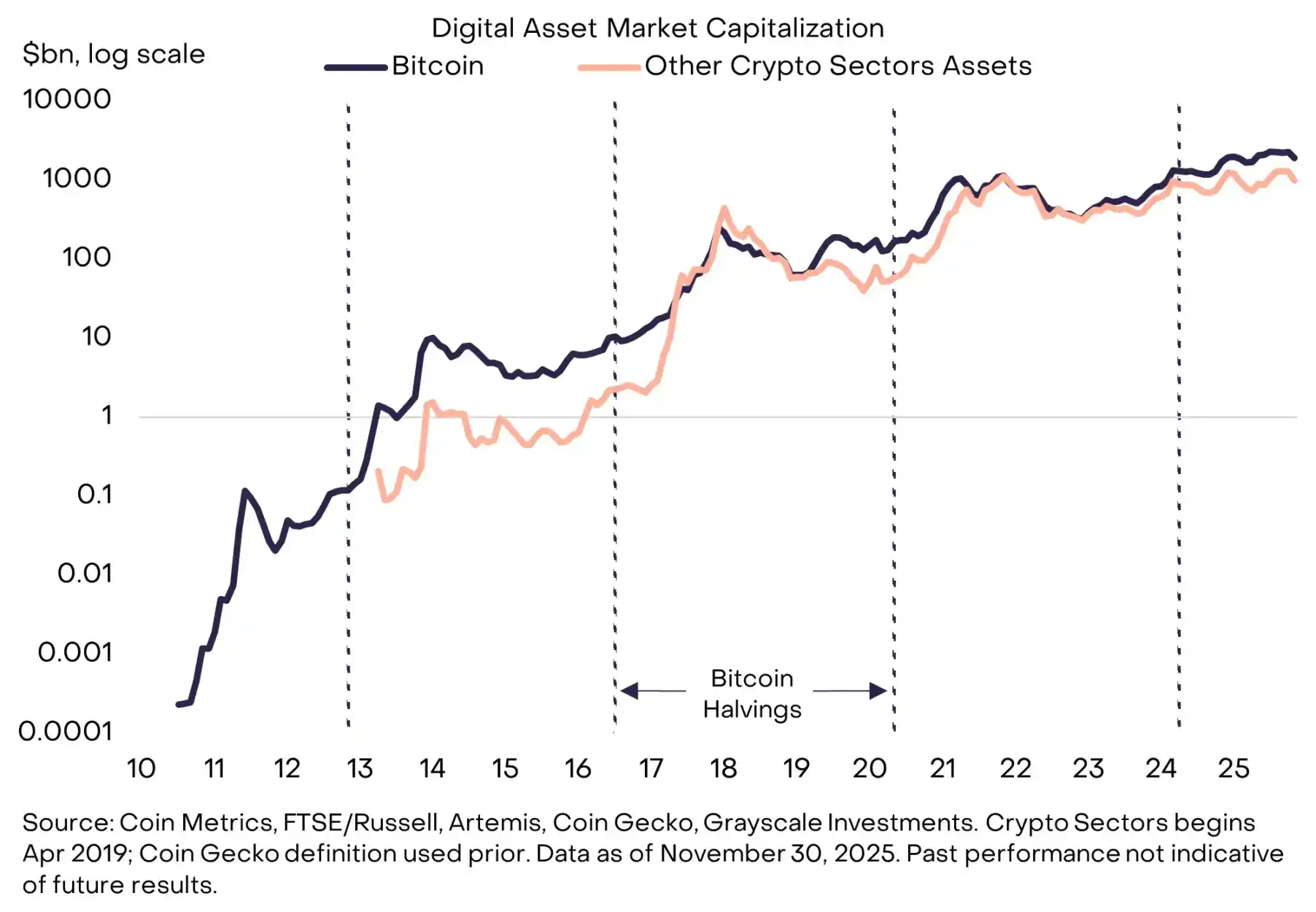
Grayscale believes the crypto asset class is in a sustained bull market, and 2026 will be a key year marking the end of the so-called "four-year cycle." We expect valuations across six major crypto asset sectors to rise overall in 2026 and judge that Bitcoin's price is likely to break its previous all-time high in the first half of the year.
Our optimism is primarily based on two core pillars:
First, macro demand for alternative stores of value will persist.
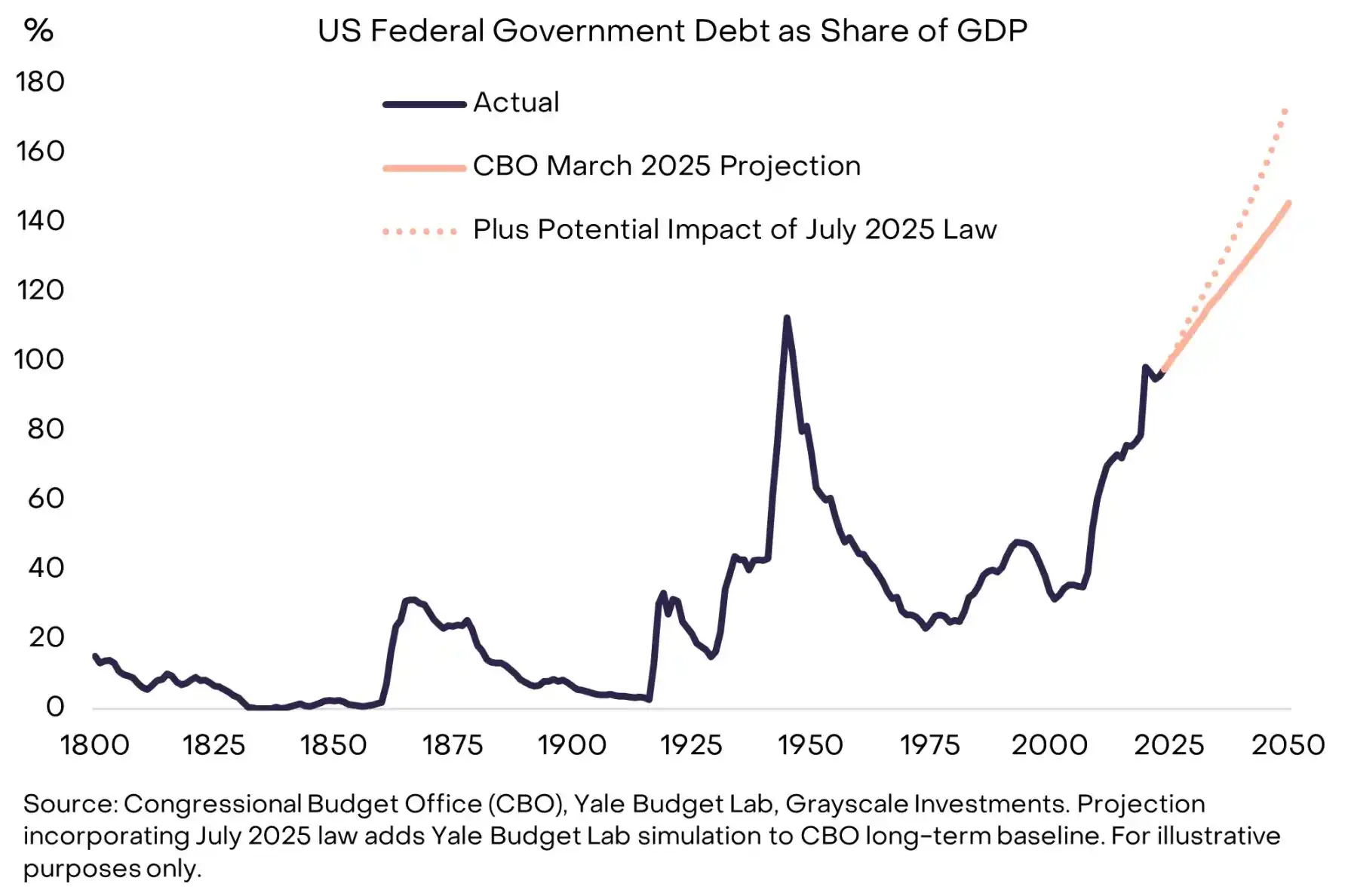
By market capitalization, Bitcoin and Ethereum are the two largest crypto assets today and can be viewed as scarce digital commodities and alternative monetary assets. Meanwhile, the fiat system (and assets denominated in fiat) face additional risks, as high and rising public sector debt could create inflationary pressures over the medium to long term (see Chart 3).
In this context, scarce commodities, whether physical like gold and silver or digital like Bitcoin and Ethereum, can act as "ballast" in portfolios hedging against fiat risk. In our view, as long as the risk of fiat devaluation continues to rise, portfolio demand for Bitcoin and Ethereum is likely to strengthen concurrently.
Chart 3: U.S. debt issues undermine the credibility of low inflation expectations
Second, regulatory clarity is driving institutional capital into the public blockchain space.
This is easily overlooked, but until this year, the U.S. government was still investigating and/or litigating against several leading crypto industry entities, including Coinbase, Ripple, Binance, Robinhood, Consensys, Uniswap, and OpenSea. Even today, exchanges and other crypto intermediaries still lack clear, unified regulatory guidance at the spot market level.
However, the situation is slowly but decidedly shifting.
In 2023, Grayscale won its lawsuit against the U.S. Securities and Exchange Commission (SEC), paving the way for crypto spot exchange-traded products (ETPs);
In 2024, Bitcoin and Ethereum spot ETPs officially entered the market;
In 2025, the U.S. Congress passed the GENIUS Act for stablecoins, and regulators began adjusting their stance towards the crypto industry, emphasizing consumer protection and financial stability while collaborating with the industry to provide clearer guidance;
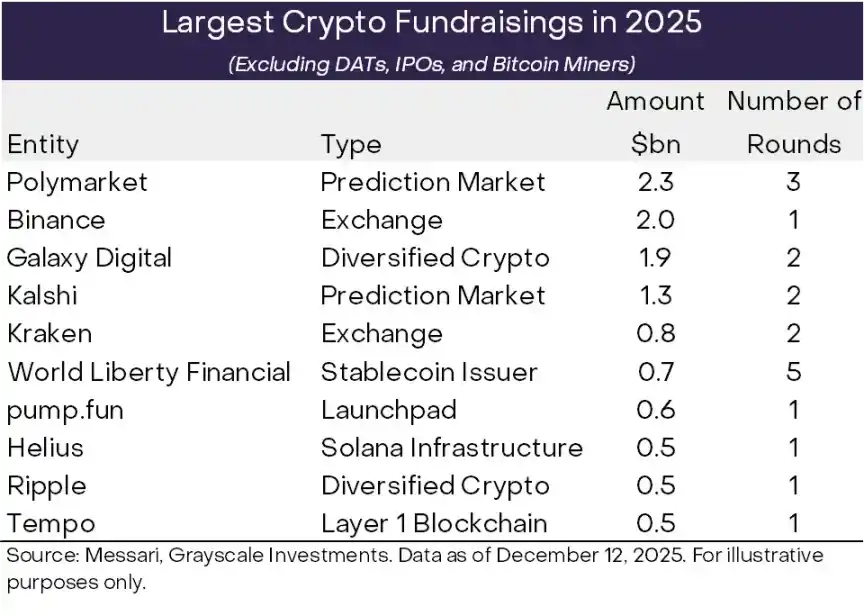
In 2026, Grayscale expects Congress to pass bipartisan crypto market structure legislation, which could institutionally solidify the role of blockchain finance in U.S. capital markets and further drive sustained inflows of institutional investment (see Chart 4).
Chart 4: Rising financing scale may reflect growing institutional confidence
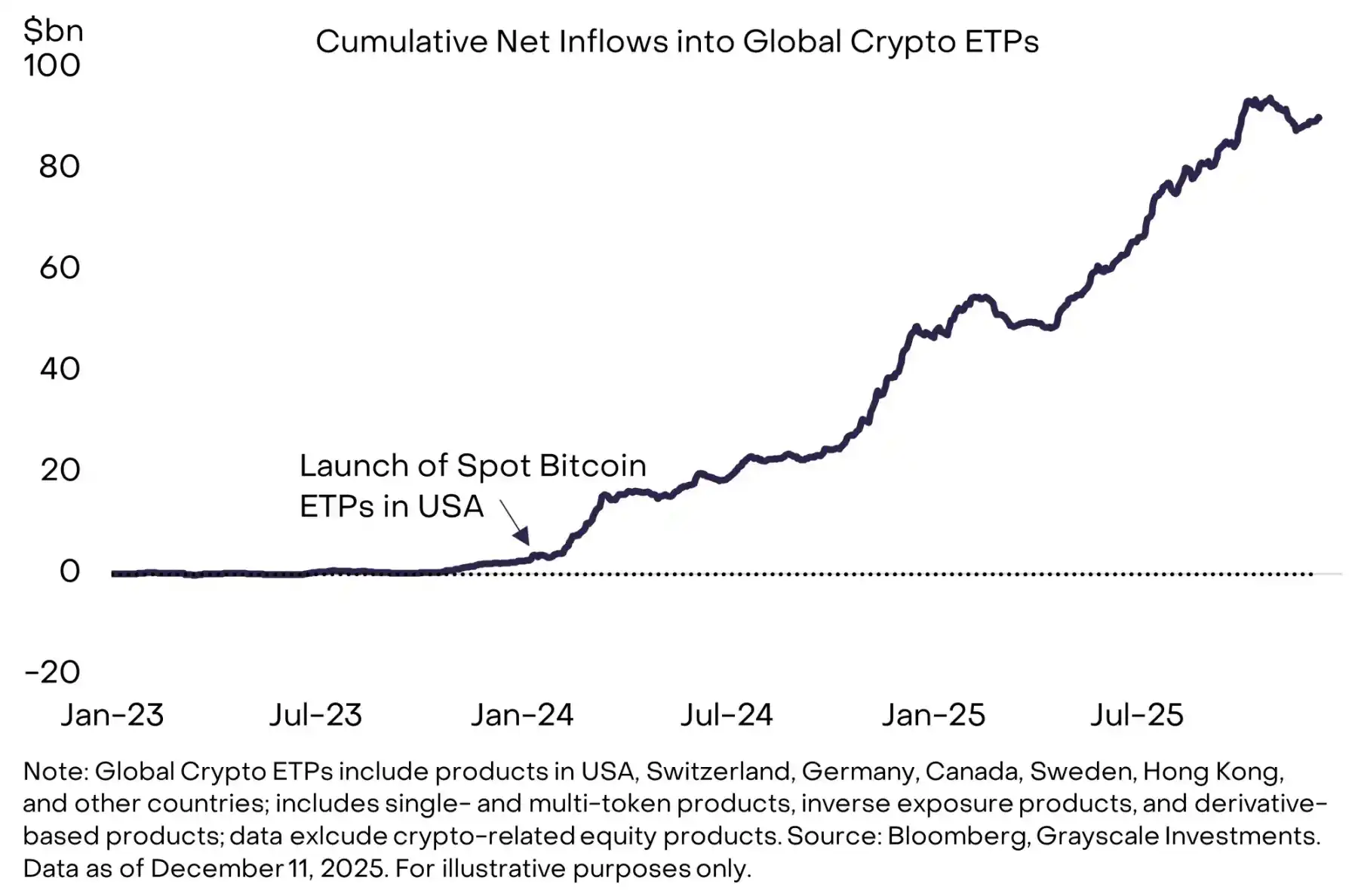
In our view, new capital entering the crypto ecosystem will primarily flow in through spot ETPs. Since Bitcoin spot ETPs launched in the U.S. in January 2024, global crypto ETPs have recorded approximately $87 billion in net inflows (see Chart 5).
Although these products achieved significant success upon launch, the process of integrating crypto assets into mainstream investment portfolios is still in its early stages. Grayscale estimates that less than 0.5% of U.S. trustee/advisor-managed wealth is currently allocated to crypto assets. As more investment platforms complete due diligence, establish corresponding capital market assumptions, and include crypto assets in model portfolios, this percentage is expected to rise steadily.
Beyond wealth management channels, some pioneering institutions have already allocated crypto ETPs in their institutional portfolios, including Harvard Management Company and Mubadala (one of Abu Dhabi's sovereign wealth funds). We expect this list of institutions to expand significantly by 2026.
Chart 5: Crypto spot ETPs continue to attract net inflows
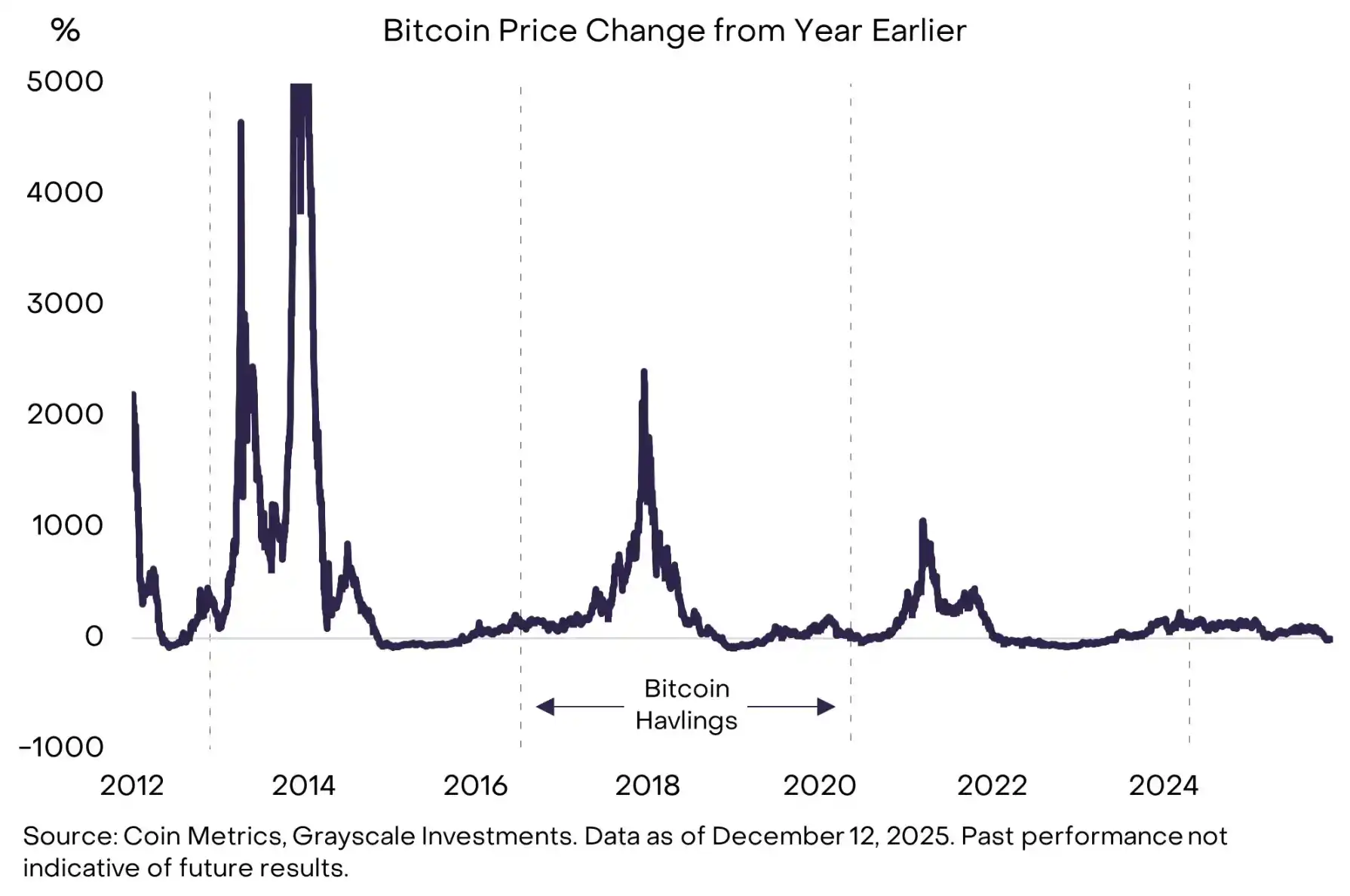
As crypto markets are increasingly driven by institutional capital inflows, the characteristics of price performance have also changed. In each previous bull market, Bitcoin's price rose by at least 1000% within a year (see Chart 6). In the current cycle, the peak year-over-year increase was approximately 240% (as of the period ending March 2024).
We believe this difference reflects more robust, sustained institutional buying behavior recently, rather than the retail sentiment-driven FOMO patterns of past cycles. Although crypto asset investment still carries significant risks, at the time of writing this report, we judge the probability of a deep and prolonged cyclical drawdown is relatively low. In contrast, the possibility of more平稳, gradual price appreciation, driven by sustained institutional inflows, is greater and likely to dominate the trend next year.
Chart 6: Bitcoin's price has not experienced a sharp spike this cycle
A relatively friendly macro market environment may also provide some buffer against downside risks for token prices in 2026.
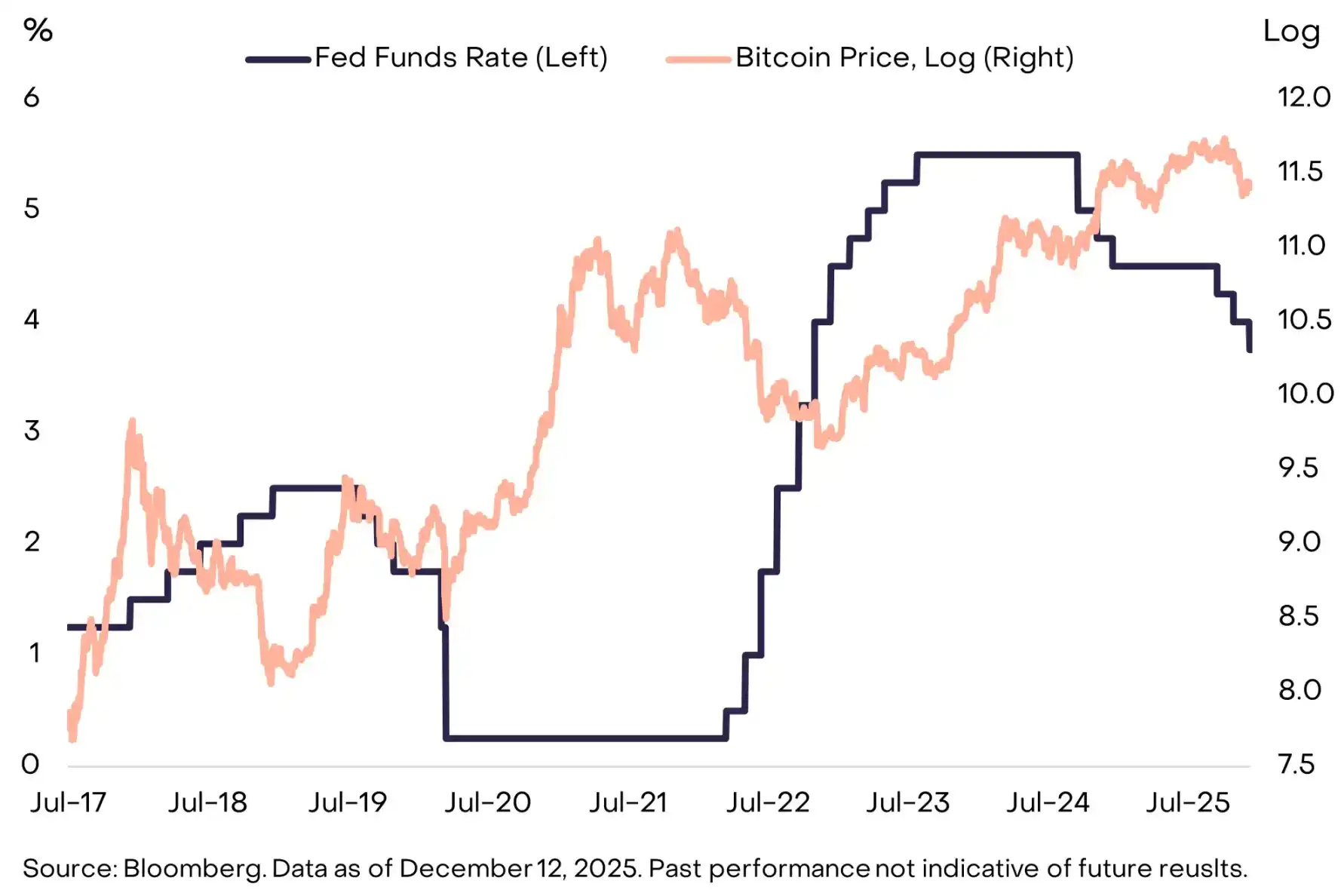
Historically, the previous two cyclical peaks occurred during Federal Reserve rate hiking phases (see Chart 7). In contrast, the Fed has cut rates three times in 2025 and is expected to continue lowering rates next year.
Kevin Hassett, seen as a potential successor to Jerome Powell as Fed Chair, recently stated on "Face the Nation": "The American people can expect that President Trump will choose someone who will help them get cheaper car loans and get a mortgage more easily at lower rates."
Overall, economic growth combined with a accommodative Fed policy environment typically favors increased risk appetite among investors and creates potential upside for risk assets, including crypto assets.
Chart 7: Previous cyclical peaks often coincided with Fed rate hikes
Like other asset classes, crypto asset prices are driven by both fundamentals and capital flows. Commodity markets are cyclical, and crypto assets may also experience prolonged cyclical drawdowns at some future stages. However, we do not believe 2026 presents such conditions.
From a fundamental perspective, the supporting factors remain solid: sustained macro demand for alternative stores of value and institutional capital entry facilitated by improved regulatory clarity are laying a long-term foundation for public blockchain technology. Meanwhile, new capital continues to enter the market. By the end of next year, crypto ETPs are likely to be present in more investment portfolios. This cycle has not seen a single, concentrated wave of retail capital; instead, it has been characterized by sustained, stable allocation demand for crypto ETPs from various portfolios. In an overall friendly macro environment, we believe this is the key condition for the crypto asset class to reach new highs in 2026.
Top 10 Crypto Investment Themes for 2026
Crypto assets are a highly diversified asset class, reflecting the multitude of applications covered by public blockchain technology. The following section outlines Grayscale's assessment of the ten most important crypto investment themes for 2026, plus two additional "red herrings." For each theme, we list the tokens we view as most relevant. For a classification of investable digital asset types, refer to our Crypto Sectors framework.
Theme 1: Dollar Devaluation Risks Drive Demand for Monetary Alternatives
Relevant Crypto Assets: BTC, ETH, ZEC
The U.S. economy faces structural debt issues (refer back to Chart 3), which could pressure the U.S. dollar's status as a store of value over the medium to long term. Other countries face similar challenges, but as the dollar remains the world's most important international currency today, the credibility of U.S. policy is particularly critical for potential cross-border capital flows.
In our view, only a small subset of digital assets are viable as stores of value, requiring sufficient adoption, highly decentralized network structures, and constrained supply growth. The most typical representatives are the two largest crypto assets by market cap—Bitcoin and Ethereum. Similar to physical gold, their value stems partly from their scarcity and autonomy.
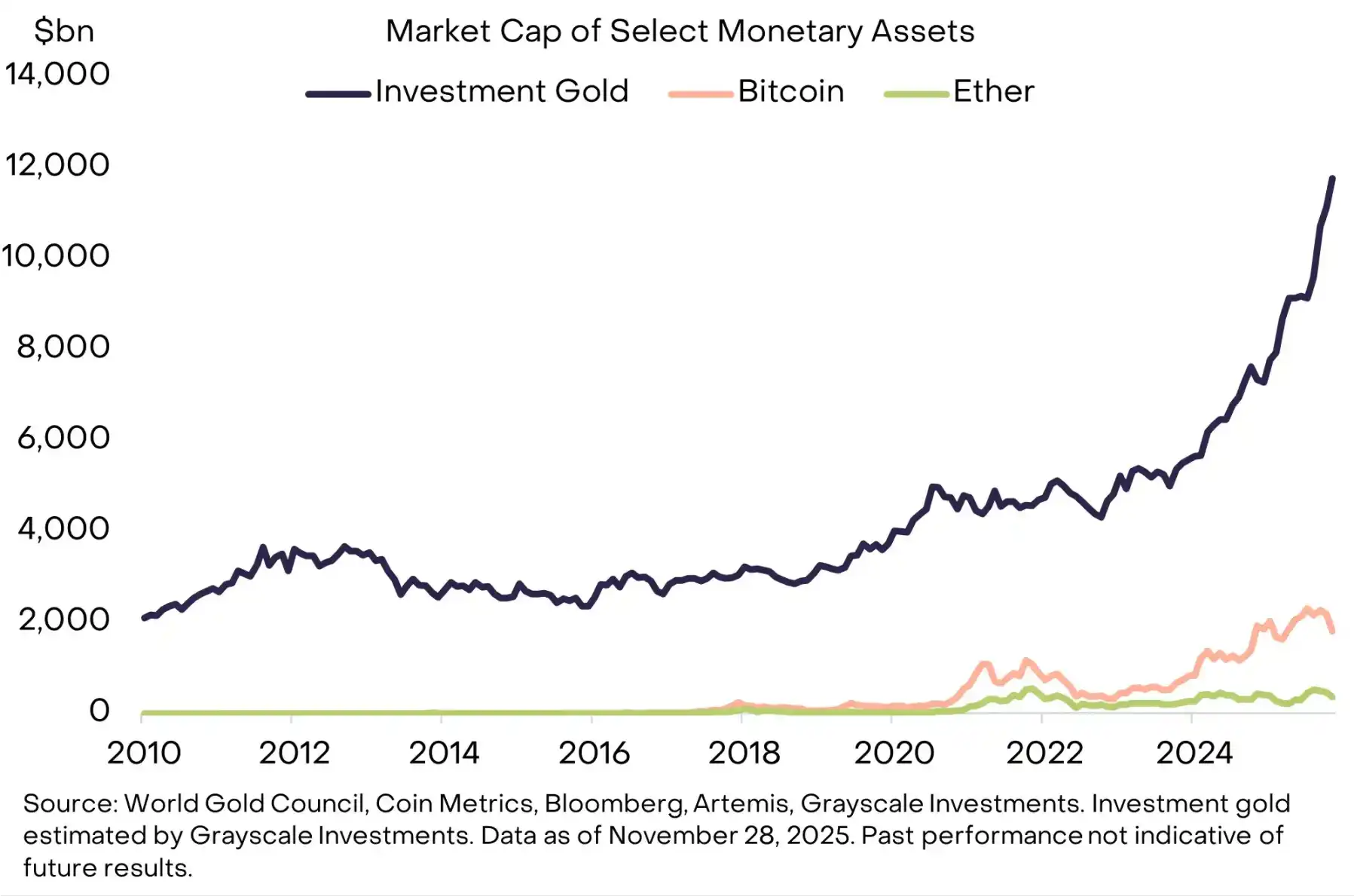
Bitcoin's total supply is permanently capped at 21 million coins, determined entirely by programmatic rules. For example, we can be highly certain that the 20 millionth Bitcoin will be mined in March 2026. This transparent, predictable, and ultimately scarce digital currency system is conceptually simple, but its appeal is growing in the current environment where the fiat system faces tail risks. As long as the macro imbalances causing fiat risks continue to worsen, portfolio demand for alternative store-of-value assets is likely to keep increasing (see Chart 8).
Additionally, Zcash, a smaller, privacy-focused decentralized digital currency, may also be suitable for portfolio allocations hedging dollar devaluation risk (see Theme 5 for details).
Chart 8: Macro imbalances may drive increased demand for alternative stores of value
Theme 2: Improved Regulatory Clarity Supports Broader Digital Asset Adoption
Relevant Crypto Assets: Nearly All
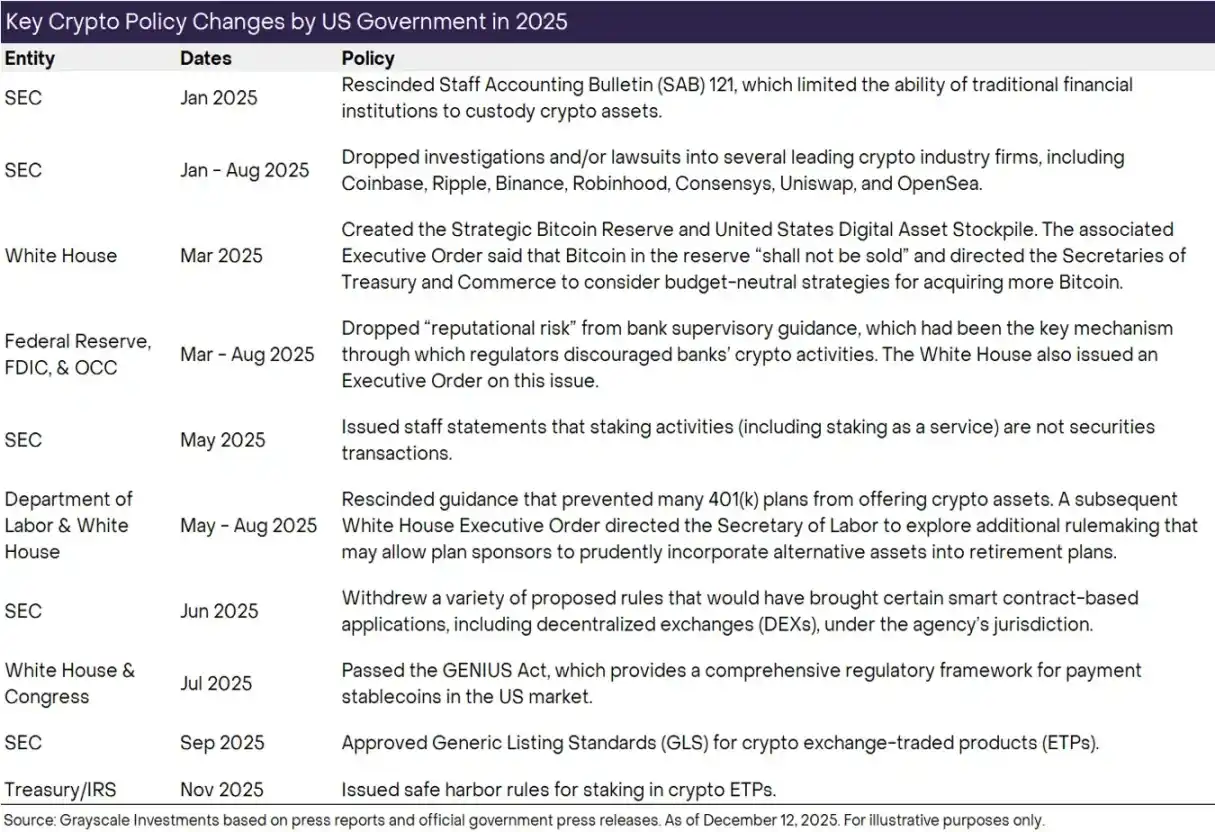
The U.S. took key steps towards crypto regulatory clarity in 2025, including: passing the GENIUS Act for stablecoins, repealing the SEC's Staff Accounting Bulletin No. 121 (SAB 121, related to custody accounting), introducing universal listing standards for crypto ETPs, and addressing crypto industry access to the traditional banking system (see Chart 9).
Looking ahead to 2026, we expect an even more decisive step—the passage of bipartisan crypto market structure legislation. The U.S. House of Representatives passed its version of the bill, the Clarity Act, in July, and the Senate subsequently initiated its own legislative process. Although specific provisions require further negotiation, the overall framework suggests this legislation will provide a rule set for crypto capital markets analogous to traditional finance, covering registration and disclosure requirements, classification standards for crypto assets, and rules governing insider conduct.
Practically, a more complete regulatory framework taking shape in the U.S. and other major economies means regulated financial services institutions may formally incorporate digital assets onto their balance sheets and begin transacting on blockchains. This could also facilitate on-chain capital formation—both startups and established companies might issue compliant on-chain tokens. By further unlocking the potential of blockchain technology, regulatory clarity could lift the value anchor of the crypto asset class overall.
Given the potential importance of regulatory clarity for driving crypto asset development in 2026, we believe significant partisan disagreement or breakdown in the relevant legislative process should be viewed as a material downside risk.
Chart 9: The U.S. significantly advanced crypto regulatory clarity in 2025
Theme 3: Stablecoin Influence Expands Post-GENIUS Act Passage
Relevant Crypto Assets: ETH, TRX, BNB, SOL, XPL, LINK
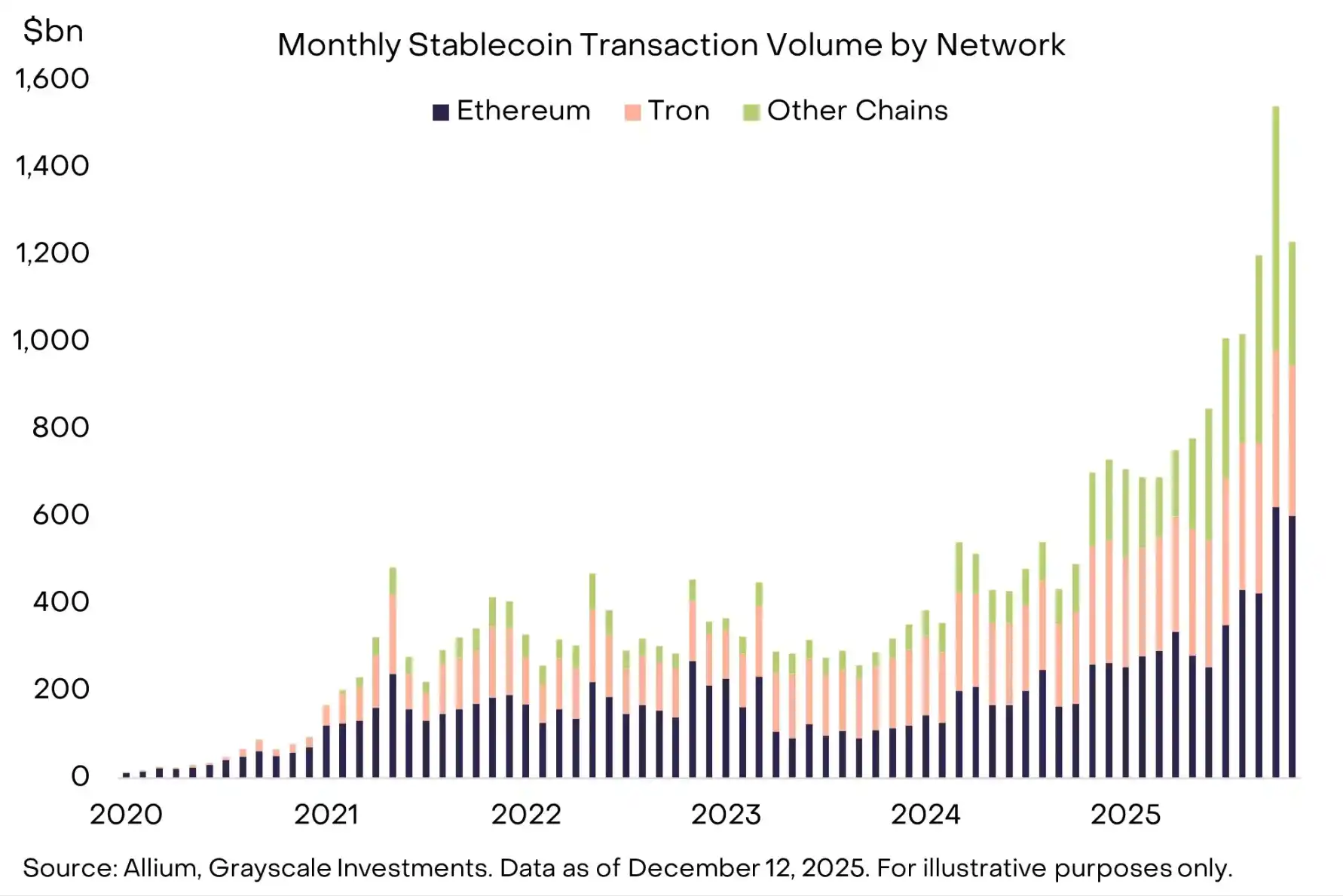
Stablecoins had a true "breakout moment" in 2025: their outstanding supply grew to approximately $300 billion, with average monthly trading volume around $1.1 trillion over the past six months through November; meanwhile, the U.S. Congress passed the GENIUS Act, and substantial institutional capital began accelerating into this space (see Chart 10).
Looking to 2026, we expect these changes to translate into practical applications: stablecoins will be more widely embedded in cross-border payment services; used as collateral on derivative exchanges; appear on corporate balance sheets; and serve as an alternative to credit cards in online consumer payments. Concurrently, the continued heating up of prediction markets may further generate new demand for stablecoins.
Sustained growth in stablecoin trading volume will directly benefit the blockchain networks that host these transactions (e.g., ETH, TRX, BNB, SOL, etc.), while also driving the development of supporting infrastructure (like LINK) and decentralized finance (DeFi) applications (see Theme 7 for details).
Chart 10: Stablecoins reach a critical breakout period
Theme 4: Asset Tokenization Reaches a Critical Inflection Point
Relevant Crypto Assets: LINK, ETH, SOL, AVAX, BNB, CC
From a current scale perspective, tokenized assets remain negligible: they account for only about 0.01% of the total global stock and bond market capitalization (see Chart 11). Grayscale expects asset tokenization to experience accelerated growth in the coming years as blockchain technology matures and regulatory clarity improves.
In our view, it is not unimaginable for the scale of tokenized assets to grow approximately 1000-fold by 2030. This expansion process is likely to create significant value for blockchain networks processing tokenized asset transactions and various supporting applications.
Currently, leading public chains in the tokenized asset space include Ethereum (ETH), BNB Chain (BNB), and Solana (SOL), but this landscape could still change in the future. Among supporting applications, Chainlink (LINK) is seen as having a particularly strong competitive advantage due to its unique and comprehensive software technology stack.
Chart 11: Tokenized assets have enormous room for growth

Theme 5: Blockchain Goes Mainstream, Increasing Demand for Privacy Solutions
Relevant Crypto Assets: ZEC, AZTEC, RAIL
Privacy is a fundamental component of the financial system. Most people assume their salary, tax information, asset size, and spending habits should not be publicly displayed on a public ledger. However, most blockchains are designed by default to be highly transparent. If public blockchains are to integrate more deeply into the financial system, they must be accompanied by more mature and robust privacy infrastructure—and this is becoming increasingly evident as regulation drives the convergence of blockchain and traditional finance.
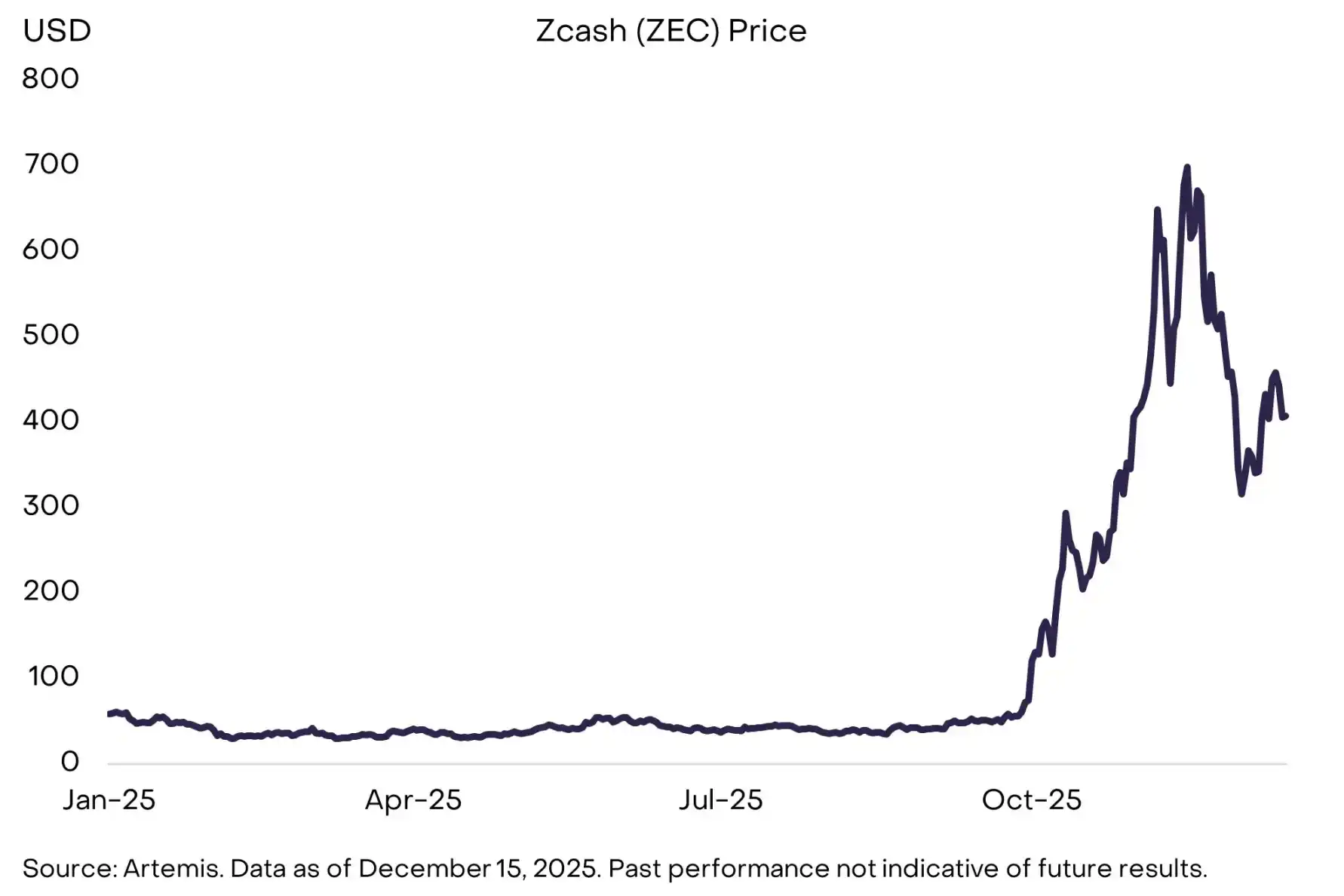
Amid rising investor focus on privacy issues, one potential beneficiary is Zcash (ZEC): a decentralized digital currency structurally similar to Bitcoin but with built-in privacy features. Zcash saw significant gains in Q4 2025 (see Chart 12). Other important projects include Aztec (a privacy-focused Ethereum Layer 2) and Railgun (privacy middleware for DeFi).
Additionally, we may see mainstream smart contract platforms more widely adopt "confidential transaction" mechanisms, such as Ethereum's ERC-7984 standard and Solana's Confidential Transfers token extension. Meanwhile, the improvement of privacy tools may also force simultaneous upgrades in identity verification and compliance infrastructure within the DeFi space.
Chart 12: Crypto investors' attention to privacy features is increasing
Theme 6: AI Centralization Calls for Blockchain-Based Solutions
Relevant Crypto Assets: TAO, IP, NEAR, WORLD
The underlying fit between crypto technology and artificial intelligence has never been clearer or stronger. Currently, AI systems are increasingly centralizing around a few leading companies, raising concerns about trust, bias, and ownership; crypto technology offers a set of primitives that directly address these risks.
For example, decentralized AI development platforms like Bittensor aim to reduce reliance on centralized AI technology; World's verifiable "Proof of Personhood" attempts to distinguish real humans from AI agents in an environment flooded with synthetic activity; and networks like Story Protocol provide transparent, traceable on-chain expression for intellectual property in an era where the origin of digital content is becoming harder to identify. Meanwhile, tools like X402, a zero-fee stablecoin payment open layer running on Base and Solana, provide the low-cost, instant micropayment capability needed for economic interaction between agents or between machines and humans.
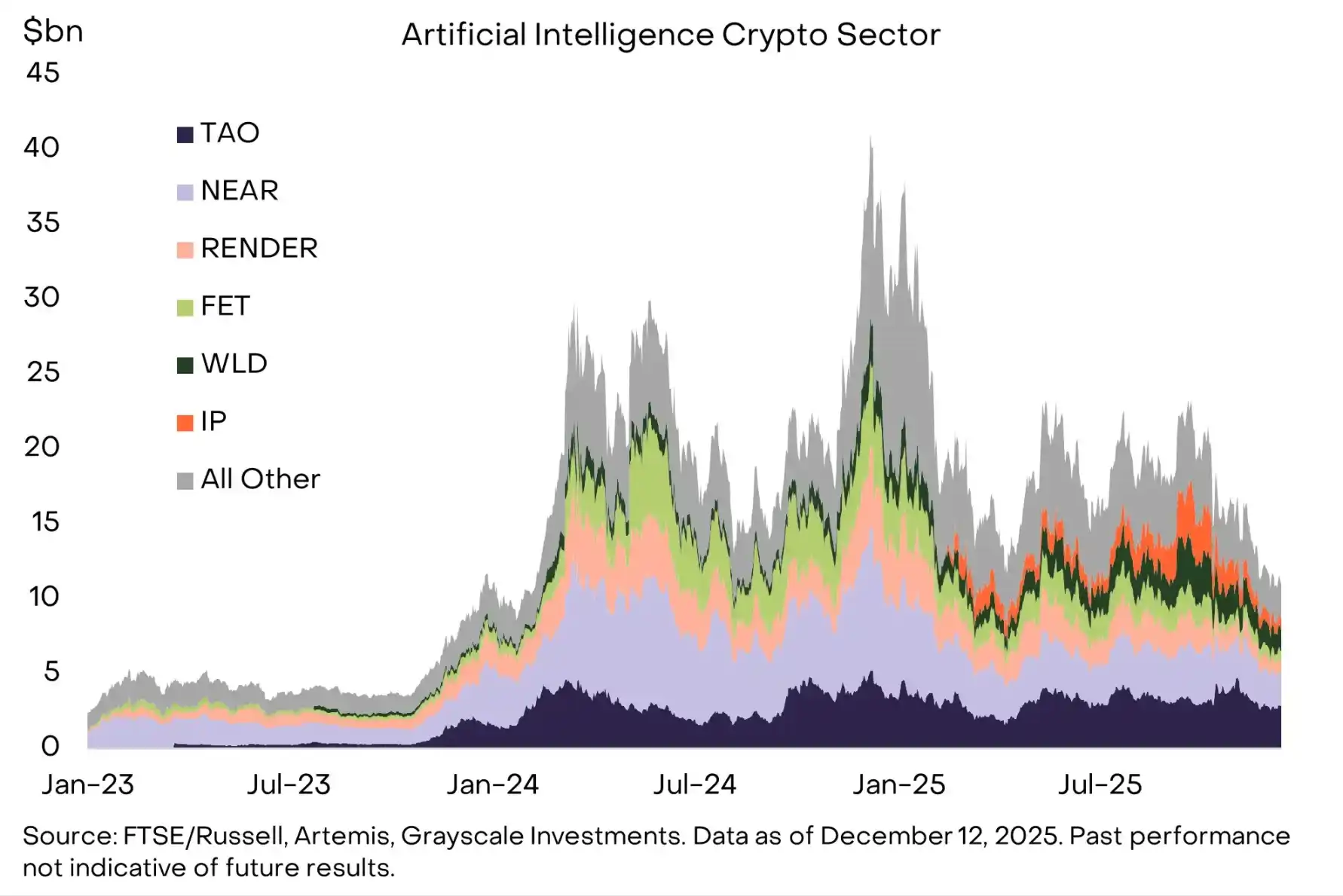
These elements collectively form the early infrastructure of the so-called "agent economy": a system where identity, computing power, data, and payments must be verifiable, programmable, and censorship-resistant. Although this ecosystem is still early and unevenly developed, the intersection of crypto and AI remains one of the most imaginative long-term application directions in the entire industry. As AI becomes more decentralized, autonomous, and economically capable, protocols building real infrastructure are poised to be potential beneficiaries (see Chart 13).
Chart 13: Blockchain offers solutions to key risks posed by AI
Theme 7: DeFi Accelerates, Led by the Lending Track
Relevant Crypto Assets: AAVE, MORPHO, MAPLE, KMNO, UNI, AERO, RAY, JUP, HYPE, LINK
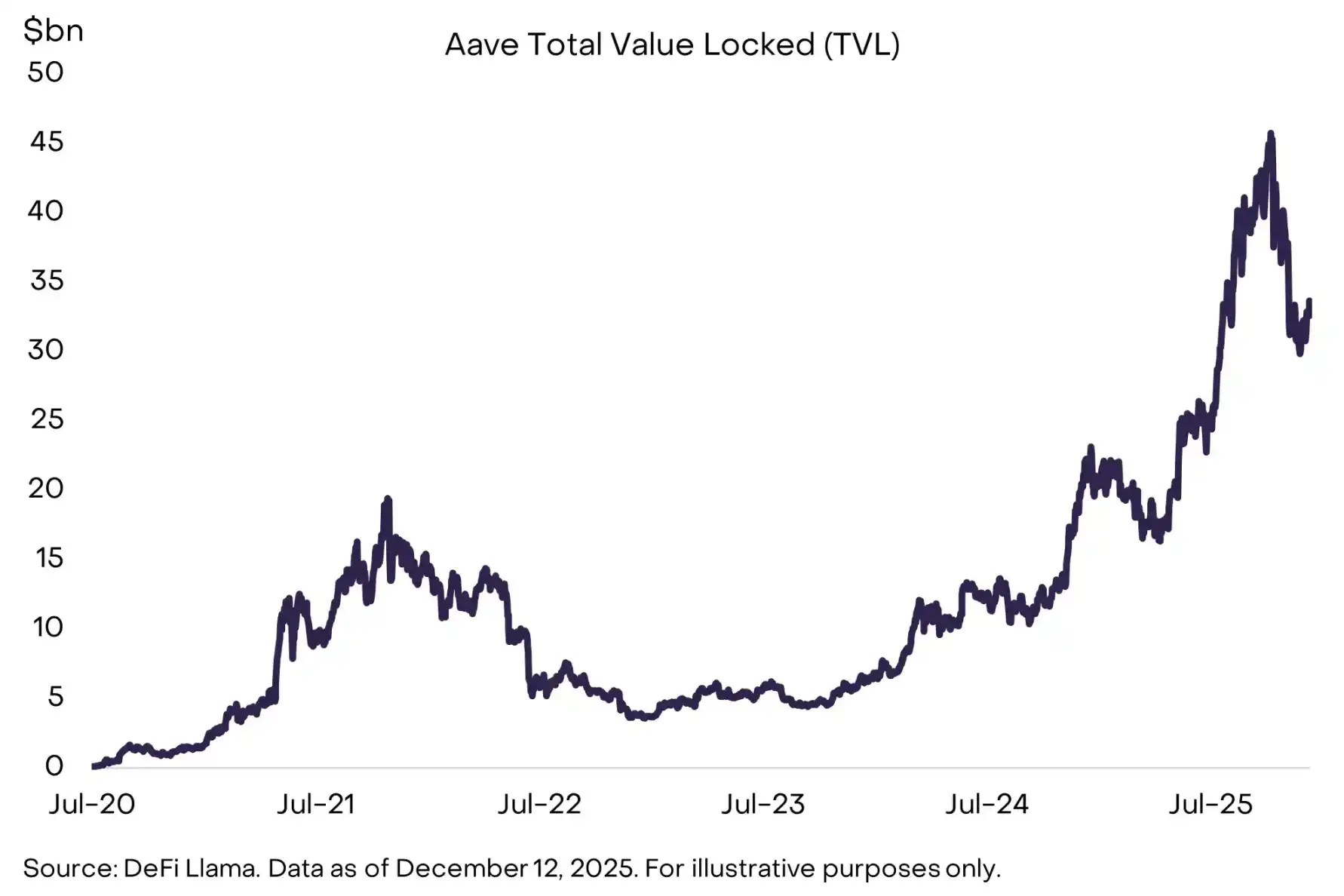
Driven by both improved technological maturity and a better regulatory environment, DeFi applications significantly accelerated in 2025. The growth of stablecoins and tokenized assets are the most prominent success stories, but meanwhile, the DeFi lending space also achieved substantial expansion, led by protocols like Aave, Morpho, and Maple Finance (see Chart 14).
Concurrently, decentralized perpetual futures exchanges (like Hyperliquid) have consistently approached, and even rivaled, some large centralized derivative exchanges in metrics like open interest and daily trading volume. Looking ahead, as liquidity improves, cross-protocol interoperability strengthens, and connections with real-world price systems become tighter, DeFi is gradually becoming a credible alternative for users wishing to conduct financial activities directly on-chain.
We expect more DeFi protocols to partner with traditional fintech companies to leverage their mature infrastructure and existing user bases. In this process, core DeFi protocols are likely to continue benefiting—including lending platforms (e.g., AAVE), decentralized exchanges (e.g., UNI, HYPE), and related infrastructure protocols (e.g., LINK); simultaneously, the public chain networks hosting most DeFi activity (e.g., ETH, SOL, BASE) will also benefit.
Chart 14: DeFi scale and forms continue to expand, ecosystem increasingly diverse
Theme 8: Mainstream Adoption Forces Next-Generation Infrastructure Upgrades
Relevant Crypto Assets: SUI, MON, NEAR, MEGA
New generations of blockchains are constantly pushing the technological boundaries forward. However, some investors believe that more block space is not needed currently because demand on existing public chains has not been fully absorbed. Solana was once a classic case of this: an extremely fast but underutilized public chain, it was seen as "excess block space" until subsequent application waves arrived, transforming it into one of the industry's most successful examples.
Not all current high-performance public chains will replicate Solana's path, but we believe a few projects among them have the potential to break through. Superior technology does not necessarily lead to adoption, but the architecture of these next-generation networks gives them unique advantages in emerging application scenarios, such as: AI micropayments, real-time gaming loops, high-frequency on-chain trading, and intent-based systems.
In this tier, we expect Sui to be particularly prominent, benefiting from clear technical leadership and a highly integrated development strategy (see Chart 15). Other projects worth watching include Monad (parallelized EVM architecture), MegaETH (ultra-fast Ethereum Layer 2), and Near (a blockchain focused on AI and making progress on its Intents product).
Chart 15: Next-gen blockchains like Sui enable faster, lower-cost transactions

Theme 9: Increased Focus on Sustainable Revenue Capability
Relevant Crypto Assets: SOL, ETH, BNB, HYPE, PUMP, TRX
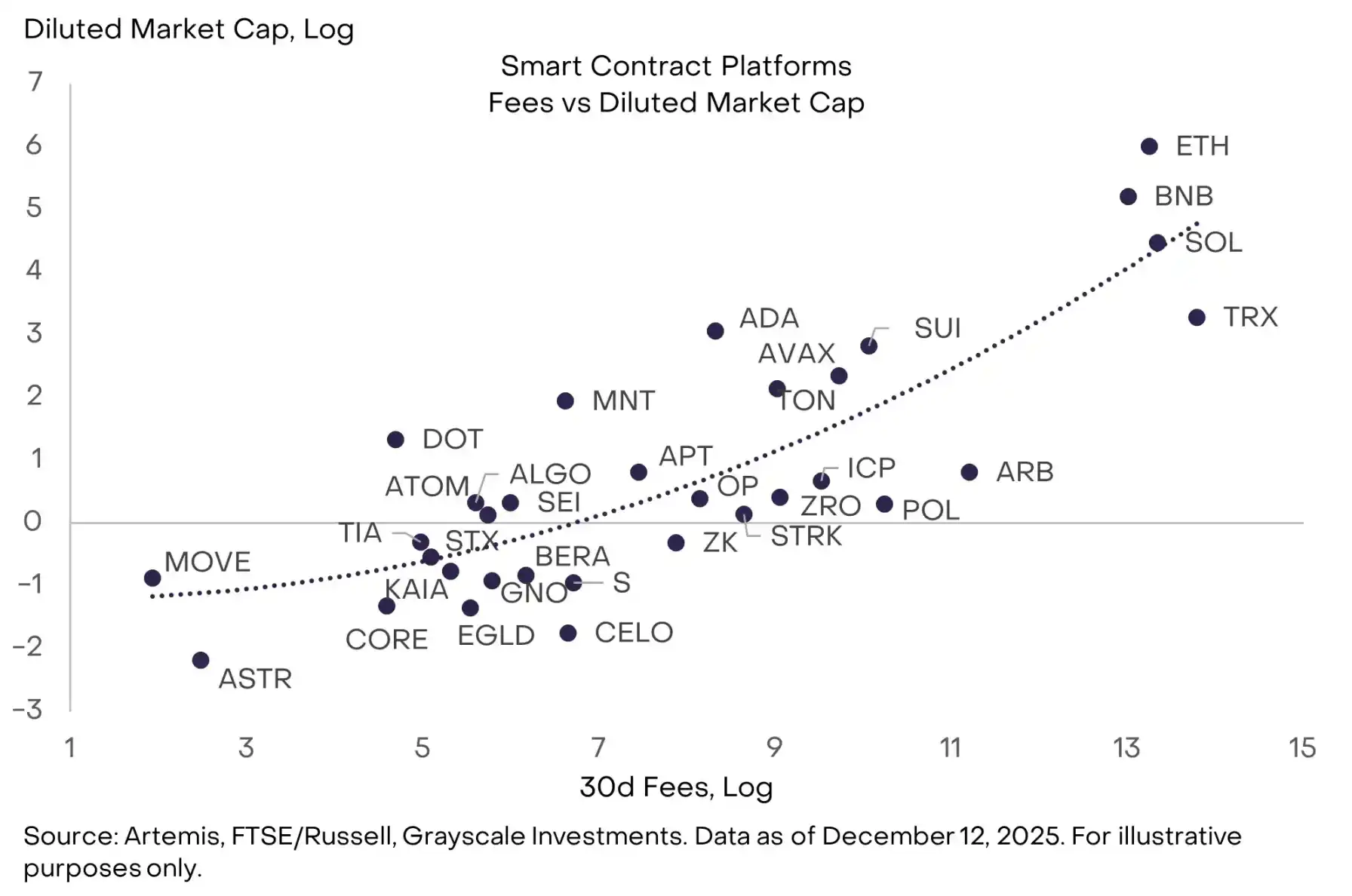
Blockchains are not traditional companies, but they do have quantifiable fundamental metrics, including: user count, number of transactions, fees, total value locked (TVL), developer size, and application ecosystem. Among these metrics, Grayscale believes transaction fees are the most valuable single fundamental metric, as they are the most difficult to manipulate artificially and offer higher comparability across different blockchains (while also showing the best empirical fit).
From a traditional corporate finance perspective, transaction fees can be analogized to "revenue." For blockchain applications, a further distinction is needed between protocol-layer fees/revenue and "supply-side" fees/revenue. As institutional investors begin systematically allocating to crypto assets, we expect they will pay more attention to blockchains and applications with high or clearly growing fee revenue levels (Bitcoin excepted).
Currently, among smart contract platforms, those with relatively high fee revenue include TRX, SOL, ETH, and BNB (see Chart 16); among application-layer assets, those with high revenue performance include HYPE, PUMP, and others.
Chart 16: Institutional investors may scrutinize blockchain fundamentals more strictly
Theme 10: Investors Will "Default" to Staking
Relevant Crypto Assets: LDO, JTO
U.S. policymakers made two key adjustments regarding staking mechanism in 2025, paving the way for more token holders to participate in staking activities:
The U.S. Securities and Exchange Commission (SEC) clearly stated that liquid staking activities do not constitute securities transactions;
The Internal Revenue Service (IRS) and Treasury Department confirmed that investment trusts and exchange-traded products (ETPs) can stake digital assets.
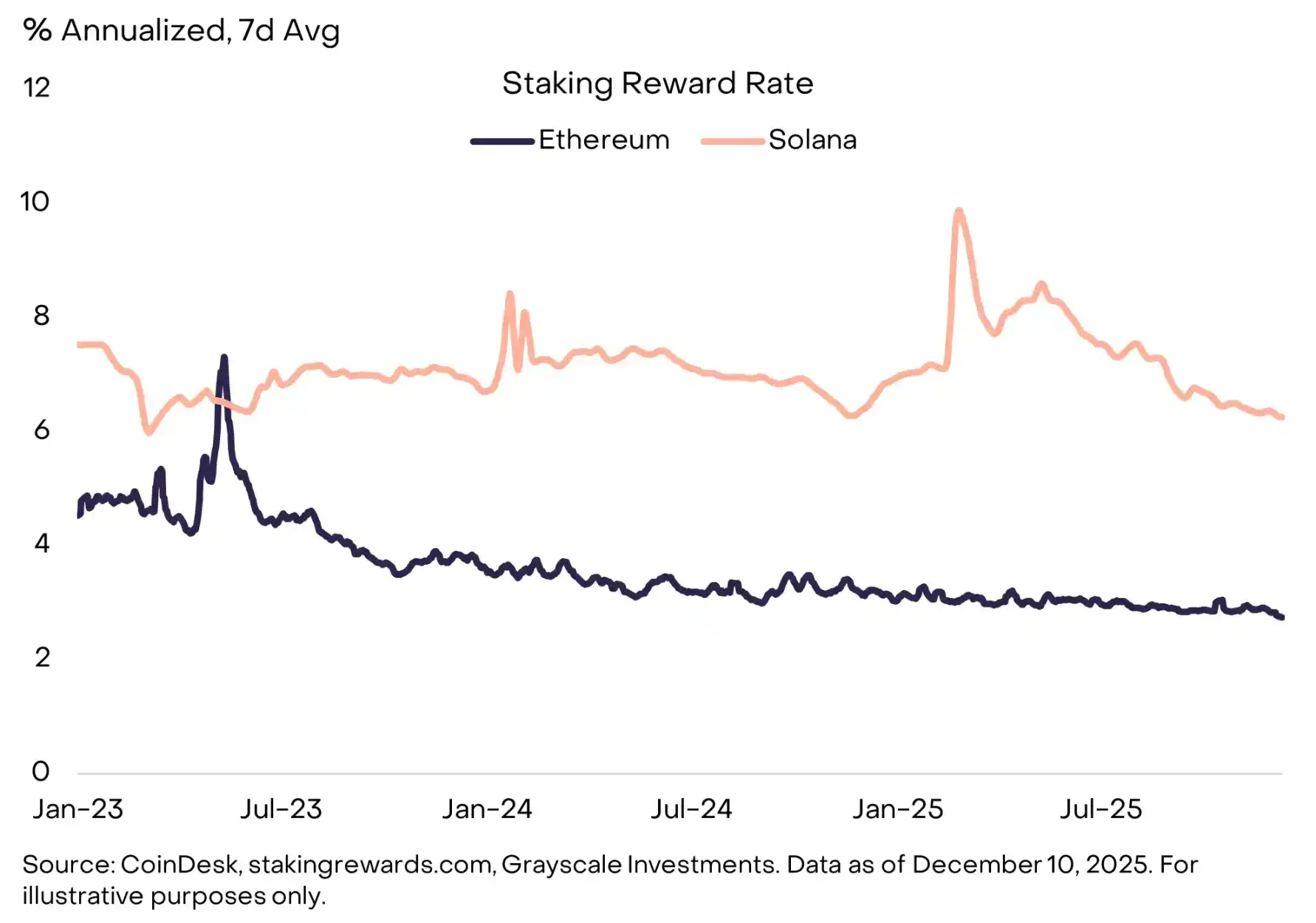
Regulatory guidance around liquid staking services is expected to directly benefit Lido and Jito—the leading liquid staking protocols by TVL (Total Value Locked) in the Ethereum and Solana ecosystems, respectively. From a broader perspective, the ability of crypto ETPs to participate in staking will likely make "staking as the default holding method" the standard structure for Proof-of-Stake (PoS) token investments, thereby pushing up the overall staking ratio and exerting some downward pressure on staking yields (see Chart 17).
In an environment where staking is more widely adopted, custodial staking through ETPs will provide investors with a convenient way to obtain staking yields; while on-chain, non-custodial liquid staking has unique advantages in terms of composability within the DeFi ecosystem. We expect this dual-track structure to persist for quite some time.
Chart 17: Proof-of-Stake (PoS) tokens inherently have a staking yield mechanism
2026's "Red Herrings"
We expect all the investment themes above to have a practical impact on crypto market development in 2026. But there are also two topics, despite high discussion volume, that we do not believe will substantially influence crypto market trends next year: the potential threat of quantum computing to cryptography, and the evolution of Digital Asset Treasuries (DATs). Significant ink will be spilled围绕 these two issues, but in our view, they are not core variables determining the market outlook.
On Quantum Computing
If quantum computing technology continues to advance, most blockchains will eventually need to upgrade their cryptographic systems. Theoretically, a sufficiently powerful quantum computer could reverse-engineer a private key from a public key, thereby generating a valid digital signature and transferring user funds. Therefore, Bitcoin and the vast majority of blockchains,乃至 the entire modern economy reliant on cryptography, will need to transition to post-quantum cryptographic tools in the long term. However, experts generally believe that quantum computers capable of breaking Bitcoin's cryptography are unlikely to appear before 2030 at the earliest. We expect research into quantum risk and community-level preparation work will accelerate in 2026, but this theme is unlikely to have a material impact on prices in the short term.
On Digital Asset Treasuries (DATs)
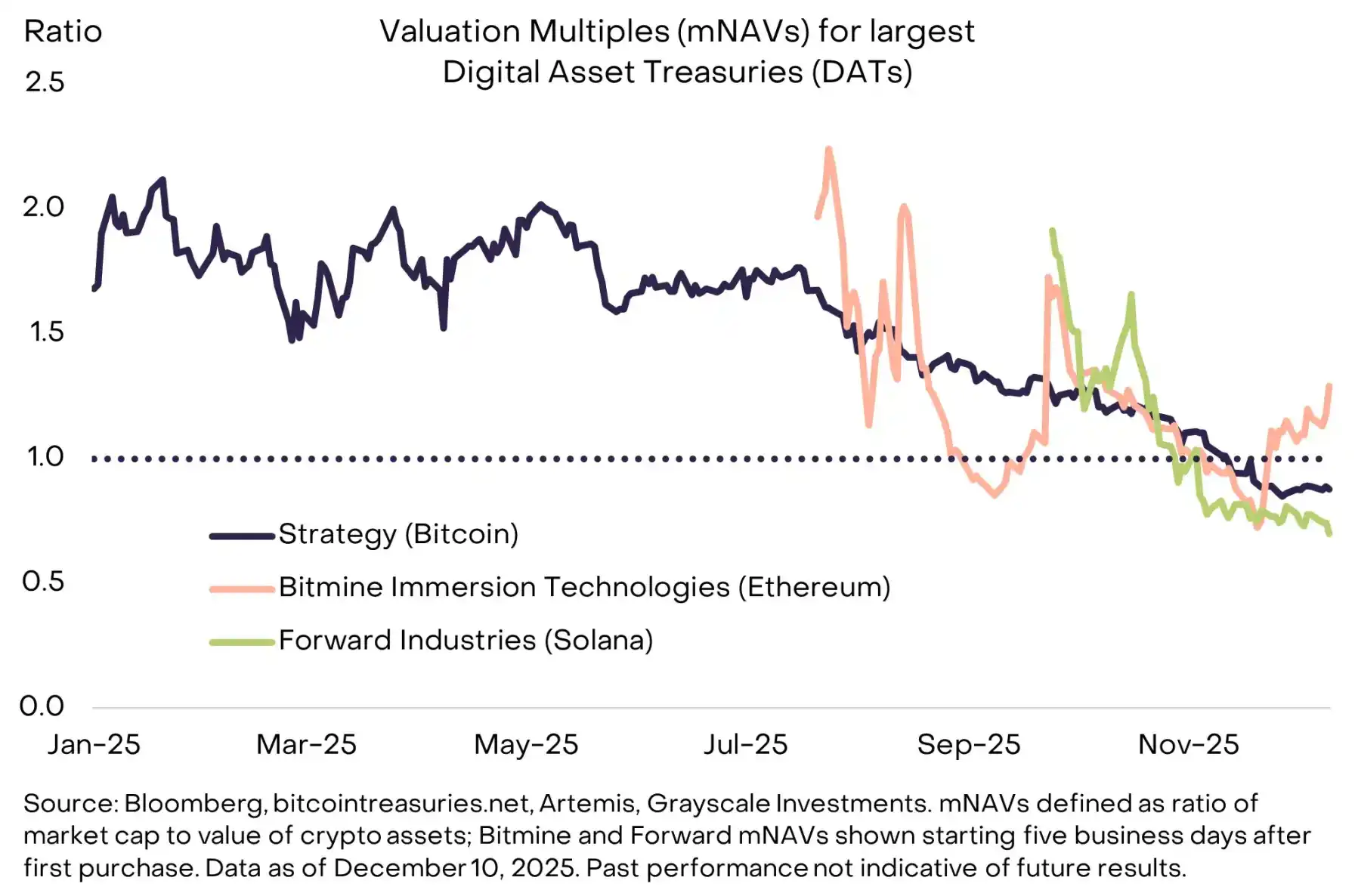
The strategy of "incorporating digital assets into corporate balance sheets," pioneered by Michael Saylor, spawned dozens of imitators in 2025. By our estimates, DATs currently hold 3.7% of Bitcoin's total supply, 4.6% of Ethereum's, and 2.5% of Solana's. However, demand for such instruments has cooled since the peak in mid-2025: the largest DATs now see their mNAV (market price to Net Asset Value) fall back to near 1.0 levels (see Chart 18).
It is important to note that most DATs do not employ excessive leverage (or are completely unleveraged), so they are unlikely to be forced to sell assets in a market downturn. The largest DAT by market cap, Strategy, recently established a USD reserve fund to ensure it can continue paying preferred stock dividends even if Bitcoin's price falls. We expect most DATs will behave more like closed-end funds: trading within a range around their NAV, occasionally at a premium or discount, but rarely actively liquidating assets.
Overall, these instruments are likely to become a permanent part of the crypto investment landscape, but in our view, they are neither likely to be a major source of new token demand in 2026 nor a significant source of selling pressure.
Chart 18: DAT premiums have significantly收敛, but large-scale asset sales are unlikely
Conclusion
We hold a positive view on the prospects for digital assets in 2026, primarily supported by the resonance of two forces: sustained macro demand for alternative stores of value and continuously improving regulatory clarity. Next year's key themes will likely involve further deepening the connectivity between blockchain finance and traditional finance, alongside sustained institutional capital inflows. Tokens gaining institutional adoption often have clear use cases, sustainable revenue models, and access to compliant trading venues and application systems. Investors can also expect the range of crypto assets investable through ETPs to continue expanding, with staking mechanisms enabled by default where conditions allow.
Concurrently, the processes of regulatory clarification and institutionalization will also raise the bar for mainstream success. For example, crypto projects seeking entry into regulated exchanges may need to meet new registration and disclosure requirements. Institutional investors are also more likely to ignore crypto assets lacking clear use cases—even if those assets currently have relatively high market capitalizations. The GENIUS Act legally distinguishes regulated payment stablecoins (which enjoy corresponding rights and obligations under U.S. law) from other stablecoins (which do not have equivalent rights). Similarly, we expect the institutional era for crypto assets will further widen the gap between assets that can access compliant channels and institutional capital and those that cannot.
The crypto industry is entering a全新的 phase, and not every token will successfully transition from the old era to the new one.
Criptos en tendencia










Preguntas relacionadas
QWhat are the two core pillars supporting Grayscale's optimistic outlook for the crypto market in 2026?
AThe two core pillars are: 1) Sustained macro demand for alternative stores of value due to fiat currency risks, and 2) Improved regulatory clarity driving institutional capital inflows.
QAccording to the report, which major event is expected to mark the end of the 'four-year cycle' theory in crypto?
AThe report states that a broad-based valuation increase across six crypto sectors in 2026, with Bitcoin potentially reaching a new all-time high in the first half of the year, will mark the end of the 'four-year cycle' theory.
QName three of the ten key investment themes for 2026 outlined in the Grayscale report.
AThree of the ten themes are: 1) Dollar devaluation risk driving demand for monetary alternatives, 2) Regulatory clarity supporting digital asset adoption, and 3) The continued expansion of stablecoin influence post-GENIUS Act.
QWhat two topics does the report identify as 'red herrings' that are unlikely to substantially impact the market in 2026?
AThe two 'red herrings' are: 1) Quantum computing's threat to cryptography, and 2) Digital Asset Treasuries (DATs).
QHow does the report characterize the nature of capital inflows in the current cycle compared to previous ones?
AThe report characterizes the current inflows as more steady and sustained institutional buying, driven by factors like ETPs and regulatory clarity, rather than the retail-driven, sentiment-fueled surges that defined previous cycles.
Lecturas Relacionadas


Trading
Artículos destacados
Qué es $S$
Entendiendo SPERO: Una Visión General Completa Introducción a SPERO A medida que el panorama de la innovación sigue evolucionando, la aparición de tecnologías web3 y proyectos de criptomonedas juega un papel fundamental en la configuración del futuro digital. Un proyecto que ha llamado la atención en este campo dinámico es SPERO, denotado como SPERO,$$s$. Este artículo tiene como objetivo recopilar y presentar información detallada sobre SPERO, para ayudar a entusiastas e inversores a comprender sus fundamentos, objetivos e innovaciones dentro de los dominios web3 y cripto. ¿Qué es SPERO,$$s$? SPERO,$$s$ es un proyecto único dentro del espacio cripto que busca aprovechar los principios de descentralización y tecnología blockchain para crear un ecosistema que promueva la participación, la utilidad y la inclusión financiera. El proyecto está diseñado para facilitar interacciones entre pares de nuevas maneras, proporcionando a los usuarios soluciones y servicios financieros innovadores. En su esencia, SPERO,$$s$ tiene como objetivo empoderar a los individuos al proporcionar herramientas y plataformas que mejoren la experiencia del usuario en el espacio de las criptomonedas. Esto incluye habilitar métodos de transacción más flexibles, fomentar iniciativas impulsadas por la comunidad y crear caminos para oportunidades financieras a través de aplicaciones descentralizadas (dApps). La visión subyacente de SPERO,$$s$ gira en torno a la inclusividad, buscando cerrar brechas dentro de las finanzas tradicionales mientras aprovecha los beneficios de la tecnología blockchain. ¿Quién es el Creador de SPERO,$$s$? La identidad del creador de SPERO,$$s$ sigue siendo algo oscura, ya que hay recursos públicos limitados que proporcionan información de fondo detallada sobre su(s) fundador(es). Esta falta de transparencia puede derivarse del compromiso del proyecto con la descentralización, una ética que muchos proyectos web3 comparten, priorizando las contribuciones colectivas sobre el reconocimiento individual. Al centrar las discusiones en torno a la comunidad y sus objetivos colectivos, SPERO,$$s$ encarna la esencia del empoderamiento sin señalar a individuos específicos. Como tal, entender la ética y la misión de SPERO es más importante que identificar a un creador singular. ¿Quiénes son los Inversores de SPERO,$$s$? SPERO,$$s$ cuenta con el apoyo de una diversa gama de inversores que van desde capitalistas de riesgo hasta inversores ángeles dedicados a fomentar la innovación en el sector cripto. El enfoque de estos inversores generalmente se alinea con la misión de SPERO, priorizando proyectos que prometen avances tecnológicos sociales, inclusividad financiera y gobernanza descentralizada. Estas fundaciones de inversores suelen estar interesadas en proyectos que no solo ofrecen productos innovadores, sino que también contribuyen positivamente a la comunidad blockchain y sus ecosistemas. El respaldo de estos inversores refuerza a SPERO,$$s$ como un contendiente notable en el rápidamente evolutivo dominio de los proyectos cripto. ¿Cómo Funciona SPERO,$$s$? SPERO,$$s$ emplea un marco multifacético que lo distingue de los proyectos de criptomonedas convencionales. Aquí hay algunas de las características clave que subrayan su singularidad e innovación: Gobernanza Descentralizada: SPERO,$$s$ integra modelos de gobernanza descentralizada, empoderando a los usuarios para participar activamente en los procesos de toma de decisiones sobre el futuro del proyecto. Este enfoque fomenta un sentido de propiedad y responsabilidad entre los miembros de la comunidad. Utilidad del Token: SPERO,$$s$ utiliza su propio token de criptomoneda, diseñado para servir a diversas funciones dentro del ecosistema. Estos tokens permiten transacciones, recompensas y la facilitación de servicios ofrecidos en la plataforma, mejorando la participación y utilidad general. Arquitectura en Capas: La arquitectura técnica de SPERO,$$s$ soporta la modularidad y escalabilidad, permitiendo la integración fluida de características y aplicaciones adicionales a medida que el proyecto evoluciona. Esta adaptabilidad es fundamental para mantener la relevancia en el siempre cambiante paisaje cripto. Participación de la Comunidad: El proyecto enfatiza iniciativas impulsadas por la comunidad, empleando mecanismos que incentivan la colaboración y la retroalimentación. Al nutrir una comunidad sólida, SPERO,$$s$ puede abordar mejor las necesidades de los usuarios y adaptarse a las tendencias del mercado. Enfoque en la Inclusión: Al ofrecer tarifas de transacción bajas y interfaces amigables para el usuario, SPERO,$$s$ busca atraer a una base de usuarios diversa, incluyendo a individuos que anteriormente pueden no haber participado en el espacio cripto. Este compromiso con la inclusión se alinea con su misión general de empoderamiento a través de la accesibilidad. Cronología de SPERO,$$s$ Entender la historia de un proyecto proporciona información crucial sobre su trayectoria de desarrollo y hitos. A continuación, se presenta una cronología sugerida que mapea eventos significativos en la evolución de SPERO,$$s$: Fase de Conceptualización e Ideación: Las ideas iniciales que forman la base de SPERO,$$s$ fueron concebidas, alineándose estrechamente con los principios de descentralización y enfoque comunitario dentro de la industria blockchain. Lanzamiento del Whitepaper del Proyecto: Tras la fase conceptual, se publicó un whitepaper completo que detalla la visión, objetivos e infraestructura tecnológica de SPERO,$$s$ para generar interés y retroalimentación de la comunidad. Construcción de Comunidad y Primeras Interacciones: Se realizaron esfuerzos de divulgación activa para construir una comunidad de primeros adoptantes e inversores potenciales, facilitando discusiones en torno a los objetivos del proyecto y obteniendo apoyo. Evento de Generación de Tokens: SPERO,$$s$ llevó a cabo un evento de generación de tokens (TGE) para distribuir sus tokens nativos a los primeros seguidores y establecer liquidez inicial dentro del ecosistema. Lanzamiento de la dApp Inicial: La primera aplicación descentralizada (dApp) asociada con SPERO,$$s$ se puso en marcha, permitiendo a los usuarios interactuar con las funcionalidades centrales de la plataforma. Desarrollo Continuo y Alianzas: Actualizaciones y mejoras continuas en las ofertas del proyecto, incluyendo alianzas estratégicas con otros actores en el espacio blockchain, han moldeado a SPERO,$$s$ en un jugador competitivo y en evolución en el mercado cripto. Conclusión SPERO,$$s$ se erige como un testimonio del potencial de web3 y las criptomonedas para revolucionar los sistemas financieros y empoderar a los individuos. Con un compromiso con la gobernanza descentralizada, la participación comunitaria y funcionalidades diseñadas de manera innovadora, allana el camino hacia un paisaje financiero más inclusivo. Como con cualquier inversión en el rápidamente evolutivo espacio cripto, se anima a los potenciales inversores y usuarios a investigar a fondo y participar de manera reflexiva con los desarrollos en curso dentro de SPERO,$$s$. El proyecto muestra el espíritu innovador de la industria cripto, invitando a una exploración más profunda de sus innumerables posibilidades. Aunque el viaje de SPERO,$$s$ aún se está desarrollando, sus principios fundamentales pueden, de hecho, influir en el futuro de cómo interactuamos con la tecnología, las finanzas y entre nosotros en ecosistemas digitales interconectados.
339 Vistas totalesPublicado en 2024.12.17Actualizado en 2024.12.17

Qué es AGENT S
Agent S: El Futuro de la Interacción Autónoma en Web3 Introducción En el paisaje en constante evolución de Web3 y las criptomonedas, las innovaciones están redefiniendo continuamente cómo los individuos interactúan con las plataformas digitales. Uno de estos proyectos pioneros, Agent S, promete revolucionar la interacción humano-computadora a través de su marco agente abierto. Al allanar el camino para interacciones autónomas, Agent S tiene como objetivo simplificar tareas complejas, ofreciendo aplicaciones transformadoras en inteligencia artificial (IA). Esta exploración detallada se adentrará en las complejidades del proyecto, sus características únicas y las implicaciones para el dominio de las criptomonedas. ¿Qué es Agent S? Agent S se presenta como un marco agente abierto revolucionario, diseñado específicamente para abordar tres desafíos fundamentales en la automatización de tareas informáticas: Adquisición de Conocimiento Específico del Dominio: El marco aprende de manera inteligente a partir de diversas fuentes de conocimiento externas y experiencias internas. Este enfoque dual le permite construir un rico repositorio de conocimiento específico del dominio, mejorando su rendimiento en la ejecución de tareas. Planificación a Largo Plazo de Tareas: Agent S emplea planificación jerárquica aumentada por la experiencia, un enfoque estratégico que facilita la descomposición y ejecución eficiente de tareas intrincadas. Esta característica mejora significativamente su capacidad para gestionar múltiples subtareas de manera eficiente y efectiva. Manejo de Interfaces Dinámicas y No Uniformes: El proyecto introduce la Interfaz Agente-Computadora (ACI), una solución innovadora que mejora la interacción entre agentes y usuarios. Utilizando Modelos de Lenguaje Multimodal Grandes (MLLMs), Agent S puede navegar y manipular diversas interfaces gráficas de usuario sin problemas. A través de estas características pioneras, Agent S proporciona un marco robusto que aborda las complejidades involucradas en la automatización de la interacción humana con las máquinas, preparando el terreno para innumerables aplicaciones en IA y más allá. ¿Quién es el Creador de Agent S? Aunque el concepto de Agent S es fundamentalmente innovador, la información específica sobre su creador sigue siendo elusiva. El creador es actualmente desconocido, lo que resalta ya sea la etapa incipiente del proyecto o la elección estratégica de mantener a los miembros fundadores en el anonimato. Independientemente de la anonimidad, el enfoque sigue siendo las capacidades y el potencial del marco. ¿Quiénes son los Inversores de Agent S? Dado que Agent S es relativamente nuevo en el ecosistema criptográfico, la información detallada sobre sus inversores y patrocinadores financieros no está documentada explícitamente. La falta de información disponible públicamente sobre las bases de inversión u organizaciones que apoyan el proyecto plantea preguntas sobre su estructura de financiamiento y hoja de ruta de desarrollo. Comprender el respaldo es crucial para evaluar la sostenibilidad del proyecto y su posible impacto en el mercado. ¿Cómo Funciona Agent S? En el núcleo de Agent S se encuentra tecnología de vanguardia que le permite funcionar de manera efectiva en diversos entornos. Su modelo operativo se basa en varias características clave: Interacción Humano-Computadora: El marco ofrece planificación avanzada de IA, esforzándose por hacer que las interacciones con las computadoras sean más intuitivas. Al imitar el comportamiento humano en la ejecución de tareas, promete elevar las experiencias de los usuarios. Memoria Narrativa: Empleada para aprovechar experiencias de alto nivel, Agent S utiliza memoria narrativa para hacer un seguimiento de las historias de tareas, mejorando así sus procesos de toma de decisiones. Memoria Episódica: Esta característica proporciona a los usuarios orientación paso a paso, permitiendo que el marco ofrezca apoyo contextual a medida que se desarrollan las tareas. Soporte para OpenACI: Con la capacidad de funcionar localmente, Agent S permite a los usuarios mantener el control sobre sus interacciones y flujos de trabajo, alineándose con la ética descentralizada de Web3. Fácil Integración con APIs Externas: Su versatilidad y compatibilidad con diversas plataformas de IA aseguran que Agent S pueda integrarse sin problemas en ecosistemas tecnológicos existentes, convirtiéndolo en una opción atractiva para desarrolladores y organizaciones. Estas funcionalidades contribuyen colectivamente a la posición única de Agent S dentro del espacio cripto, ya que automatiza tareas complejas y de múltiples pasos con una intervención humana mínima. A medida que el proyecto evoluciona, sus aplicaciones potenciales en Web3 podrían redefinir cómo se desarrollan las interacciones digitales. Cronología de Agent S El desarrollo y los hitos de Agent S pueden encapsularse en una cronología que destaca sus eventos significativos: 27 de septiembre de 2024: Se lanzó el concepto de Agent S en un documento de investigación integral titulado “Un Marco Agente Abierto que Utiliza Computadoras como un Humano”, mostrando las bases del proyecto. 10 de octubre de 2024: El documento de investigación se hizo disponible públicamente en arXiv, ofreciendo una exploración en profundidad del marco y su evaluación de rendimiento basada en el benchmark OSWorld. 12 de octubre de 2024: Se publicó una presentación en video, proporcionando una visión visual de las capacidades y características de Agent S, involucrando aún más a posibles usuarios e inversores. Estos hitos en la cronología no solo ilustran el progreso de Agent S, sino que también indican su compromiso con la transparencia y el compromiso comunitario. Puntos Clave Sobre Agent S A medida que el marco Agent S continúa evolucionando, varios atributos clave destacan, subrayando su naturaleza innovadora y potencial: Marco Innovador: Diseñado para proporcionar un uso intuitivo de las computadoras similar a la interacción humana, Agent S aporta un enfoque novedoso a la automatización de tareas. Interacción Autónoma: La capacidad de interactuar de manera autónoma con las computadoras a través de GUI significa un avance hacia soluciones informáticas más inteligentes y eficientes. Automatización de Tareas Complejas: Con su metodología robusta, puede automatizar tareas complejas y de múltiples pasos, haciendo que los procesos sean más rápidos y menos propensos a errores. Mejora Continua: Los mecanismos de aprendizaje permiten a Agent S mejorar a partir de experiencias pasadas, mejorando continuamente su rendimiento y eficacia. Versatilidad: Su adaptabilidad en diferentes entornos operativos como OSWorld y WindowsAgentArena asegura que pueda servir a una amplia gama de aplicaciones. A medida que Agent S se posiciona en el paisaje de Web3 y criptomonedas, su potencial para mejorar las capacidades de interacción y automatizar procesos significa un avance significativo en las tecnologías de IA. A través de su marco innovador, Agent S ejemplifica el futuro de las interacciones digitales, prometiendo una experiencia más fluida y eficiente para los usuarios en diversas industrias. Conclusión Agent S representa un audaz avance en la unión de la IA y Web3, con la capacidad de redefinir cómo interactuamos con la tecnología. Aunque aún se encuentra en sus primeras etapas, las posibilidades para su aplicación son vastas y atractivas. A través de su marco integral que aborda desafíos críticos, Agent S tiene como objetivo llevar las interacciones autónomas al primer plano de la experiencia digital. A medida que nos adentramos más en los reinos de las criptomonedas y la descentralización, proyectos como Agent S sin duda desempeñarán un papel crucial en la configuración del futuro de la tecnología y la colaboración humano-computadora.
1.1k Vistas totalesPublicado en 2025.01.14Actualizado en 2025.01.14
Cómo comprar S
¡Bienvenido a HTX.com! Hemos hecho que comprar Sonic (S) sea simple y conveniente. Sigue nuestra guía paso a paso para iniciar tu viaje de criptos.Paso 1: crea tu cuenta HTXUtiliza tu correo electrónico o número de teléfono para registrarte y obtener una cuenta gratuita en HTX. Experimenta un proceso de registro sin complicaciones y desbloquea todas las funciones.Obtener mi cuentaPaso 2: ve a Comprar cripto y elige tu método de pagoTarjeta de crédito/débito: usa tu Visa o Mastercard para comprar Sonic (S) al instante.Saldo: utiliza fondos del saldo de tu cuenta HTX para tradear sin problemas.Terceros: hemos agregado métodos de pago populares como Google Pay y Apple Pay para mejorar la comodidad.P2P: tradear directamente con otros usuarios en HTX.Over-the-Counter (OTC): ofrecemos servicios personalizados y tipos de cambio competitivos para los traders.Paso 3: guarda tu Sonic (S)Después de comprar tu Sonic (S), guárdalo en tu cuenta HTX. Alternativamente, puedes enviarlo a otro lugar mediante transferencia blockchain o utilizarlo para tradear otras criptomonedas.Paso 4: tradear Sonic (S)Tradear fácilmente con Sonic (S) en HTX's mercado spot. Simplemente accede a tu cuenta, selecciona tu par de trading, ejecuta tus trades y monitorea en tiempo real. Ofrecemos una experiencia fácil de usar tanto para principiantes como para traders experimentados.
1.9k Vistas totalesPublicado en 2025.01.15Actualizado en 2026.06.02


