Global Asset Rotation: Why Does Liquidity Drive the Cryptocurrency Cycle? (Part 1)

marsbitPublicado a 2025-12-26Actualizado a 2025-12-26

Resumen

This article introduces a new series on global asset allocation and rotation, arguing that liquidity—not new narratives—is the primary driver of cryptocurrency market cycles. While narratives like RWA or X-402 can attract attention, they are triggers, not fundamental drivers. The real force is capital flow: ample liquidity amplifies even weak narratives, while liquidity contraction undermains the most compelling ones. The framework begins by mapping global assets not by traditional labels (stocks, bonds, commodities) but by their roles and dependencies within economic and liquidity cycles. Cryptocurrency is reclassified not as a traditional risk asset (like equities, which have cash flows and valuation models) but as a non-cash-flow alternative asset. Its price action is driven primarily by capital inflows and outflows, making it highly sensitive to liquidity and risk appetite. Five key macro indicators are identified as core drivers: interest rates (especially real rates), inflation metrics (CPI, PCE), economic growth indicators (PMI, GDP), systemic liquidity (central bank balance sheets, money supply), and risk appetite (volatility indices, credit spreads). A causal chain is proposed: inflation influences interest rates, which affect liquidity, which then drives risk preference and ultimately asset prices. The U.S. remains the anchor for global capital flows, and understanding its monetary policy cycle is crucial. During loose monetary conditions, risk assets like crypto...

This article marks the beginning of a new series of research on global asset allocation and rotation. After delving deeply into this topic, we discovered one of the most unexpected yet crucial facts: what ultimately determines a cryptocurrency bull market is not the emergence of new narratives.

Whether it's RWA, X402, or any other concept, these themes are often triggers, not the true driving forces. They can attract attention but do not, in themselves, provide energy. The real power comes from capital. When liquidity is abundant, even weak arguments can be amplified into market consensus. And when liquidity dries up, the most powerful arguments struggle to maintain their momentum.

This first part focuses on building the foundation: how to construct a global asset allocation and rotation framework that places cryptocurrency in the proper macro context. The latter part of the framework will be explained in subsequent articles.

Step 1: Step Outside Crypto, Map Global Assets

The first step is to deliberately step outside the cryptocurrency market and construct a panoramic view of global assets. Traditional classifications—stocks, bonds, commodities—are useful but insufficient for understanding capital rotation across different cycles.

Instead, we can classify assets based on the roles they play during different phases of the economic and liquidity cycles. What matters is not whether an asset is labeled "equity" or "commodity," but rather what it depends on and what it is vulnerable to. Some assets benefit from falling real rates, some from inflation uncertainty, and others from outright risk aversion.

Building an "asset spectrum map" does not require deep expertise in every market. What it truly requires is an intuitive understanding of the interdependencies of each asset: which conditions support it and which conditions weaken it. This mental map will become the reference system for all subsequent decisions.

Within this framework, cryptocurrency deserves special treatment.
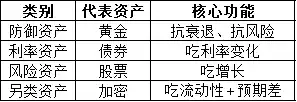
Why Crypto is an Alternative Asset, Not a Traditional Risk Asset?

Cryptocurrencies are often grouped with stocks (especially U.S. tech stocks) because their price movements are highly correlated. Superficially, this classification seems reasonable. Cryptocurrencies exhibit extreme volatility, high beta, and significant drawdowns—all characteristics similar to risk assets.

However, correlation itself does not define economic essence.

From a capital structure perspective, stocks have cash flows. Companies generate earnings, distribute dividends, and can be valued using discounted cash flow models or valuation multiples. Even when prices deviate from fundamentals, the anchoring logic is still based on cash flows.

Crypto assets operate on a fundamentally different logic. They do not generate dividends, nor do they have intrinsic cash flow that can be discounted. Therefore, traditional valuation frameworks simply do not apply.

Instead, cryptocurrencies behave like a purely liquidity-sensitive asset. Their price movements are primarily driven by capital inflows and outflows, rather than changes in fundamental productivity. Narratives help explain *why* capital flows, but they do not determine *that* it flows. Capital flows regardless.

Thus, cryptocurrency is best understood as a non-cash-flow alternative asset, positioned at the extreme end of the risk appetite spectrum. It performs best when liquidity is abundant and risk appetite is high; it underperforms when capital prioritizes safety and yield.

Liquidity is the Core Driver of Crypto Performance

Once you view cryptocurrency as a liquidity asset rather than a valuation asset, its behavior across cycles becomes easier to explain.

In equity research, price targets often stem from a structured process: forecasting future revenue, applying valuation multiples, and discounting the result to present value. This works because the asset itself generates measurable economic output.

Cryptocurrency lacks this anchoring effect. Its upside depends on whether new capital is willing to enter the market and accept higher prices. And this capital almost always comes from outside the crypto ecosystem—from stocks, credit, or cash sitting idle due to low yields.

Therefore, understanding the source and timing of liquidity is more important than tracking individual protocols or events. When capital begins seeking higher volatility and convexity, cryptocurrency becomes one of the most attractive destinations. And when capital prioritizes capital preservation, crypto is often the first asset to be sold.

In short, liquidity is the decisive factor; everything else is secondary.

Step 2: Focus on Macro Drivers First, Asset Details Second

The second pillar of this framework is macro analysis. It is more efficient to first identify the variables influencing price movements rather than starting with the study of specific assets. All assets are integrated together.

At the highest level, five macro indicators play a central role:

  • Interest rates, especially the distinction between nominal and real rates.

  • Inflation indicators, such as the Consumer Price Index (CPI) and Personal Consumption Expenditures (PCE).

  • Economic growth indicators, such as Purchasing Managers' Index (PMI) and Gross Domestic Product (GDP) trends.

  • Systemic liquidity, often reflected in central bank balance sheets and money supply measures.

  • Risk appetite, typically measured by volatility indices and credit spreads.

Many crypto participants closely watch Federal Reserve meetings but often focus solely on the rate decision. However, institutional capital places greater importance on real rates (nominal rates adjusted for inflation) because real rates determine the true opportunity cost of holding a non-yielding asset.

Inflation data is widely discussed in crypto circles, but liquidity and risk appetite receive little attention. This is a blind spot. Monetary supply dynamics and volatility regimes often explain overall market behavior before narratives even emerge.

A useful mental model is a simple chain of transmission:

  1. Inflationary pressures influence interest rates.
  2. Interest rates influence liquidity conditions.
  3. Liquidity conditions influence risk appetite.
  4. Risk appetite drives asset prices.

Understanding where the economy is positioned in this chain provides deeper insight than analyzing assets in isolation.

Step 3: Build a Cycle-Based Mental Model

The economic cycle is a familiar concept, but it remains crucial. At a macro level, economic cycles tend to alternate between expansion and contraction, easing and tightening.

Simply put, the pattern often looks like this:

Periods of monetary easing favor risk assets, including cryptocurrencies and small-cap stocks.

Periods of monetary tightening favor defensive assets like cash, government bonds, and gold.

This framework is not meant to be applied mechanically. Each asset's reaction will vary based on timing, expectations, and positioning. Nonetheless, a cycle-based reference helps avoid emotional decision-making during shifts in the market landscape.

An important nuance is that the global economic cycle is not synchronized. The world does not operate as a single economy.

As growth momentum slows, the U.S. might be transitioning from late-cycle high rates towards easing. Japan might be cautiously ending decades of ultra-loose monetary policy. China continues its structural adjustments in a low-inflation environment, while parts of Europe still grapple with economic stagnation.

Despite this divergence, the United States remains the anchor for global capital flows. Dollar liquidity and U.S. interest rates still exert the strongest influence on global capital movements. Therefore, any global asset rotation framework should start with the U.S. and expand outward.

Conclusion: Framework Before Forecast

This first half of the framework emphasizes structure over prediction. The goal is not to forecast short-term price movements but to understand the factors that make certain assets competitive at specific points in time.

By redefining crypto as a liquidity-driven alternative asset, focusing on macro drivers before narratives, and basing decisions on cycle awareness, investors can avoid many common analytical pitfalls.

The next article will build upon this, delving into the sequence of capital flows, real-world indicators, and how to identify when liquidity is shifting towards high-risk assets.

Some of the above viewpoints are referenced from @Web3___Ace

Original article link

Criptos en tendencia

Preguntas relacionadas

QWhat is the primary driver of cryptocurrency bull markets according to the article?

ALiquidity, not new narratives, is the primary driver of cryptocurrency bull markets. Capital flows are the true source of energy, while narratives are merely triggers that can amplify market consensus when liquidity is abundant.

QHow does the article suggest classifying assets for a global asset allocation framework?

AThe article suggests classifying assets based on the roles they play in different phases of the economic and liquidity cycle, focusing on what conditions support or weaken them, rather than traditional labels like 'equities' or 'commodities'.

QWhy is cryptocurrency considered an alternative asset rather than a traditional risk asset in the framework?

ACryptocurrency is considered a non-cash-flow alternative asset because it lacks intrinsic cash flows (like dividends) and cannot be valued using traditional discounted cash flow models. Its price is primarily driven by capital inflows and outflows, making it a pure liquidity-sensitive asset at the extreme end of the risk preference spectrum.

QWhat are the five core macro indicators that the article identifies as crucial for understanding price movements?

AThe five core macro indicators are: 1) Interest rates, particularly the distinction between nominal and real rates; 2) Inflation indicators like CPI and PCE; 3) Economic growth indicators like PMI and GDP trends; 4) Systemic liquidity, reflected in central bank balance sheets and money supply; 5) Risk appetite, measured by volatility indices and credit spreads.

QWhat is the simple transmission chain model described in the article for understanding how macro factors drive asset prices?

AThe simple transmission chain model is: 1) Inflationary pressures influence interest rates; 2) Interest rates influence liquidity conditions; 3) Liquidity conditions influence risk appetite; 4) Risk appetite drives asset prices.

Lecturas Relacionadas

Fallo del caso de divorcio de Chey Tae-won: Revelando las líneas ocultas de sucesión detrás del imperio trillonario de SK Hynix

El caso de divorcio de Choi Tae-won, presidente de SK Group, concluyó con una sentencia histórica de división patrimonial. Este hecho pone bajo el foco la sucesión en el imperio de SK Hynix, cuyo valor se disparó un 700% alcanzando los 1.000 billones de wones. A diferencia del guion tradicional de los *chaebol* coreanos, centrado en el primogénito varón, los tres hijos de Choi Tae-won siguen trayectorias atípicas. La hija mayor, Choi Yoon-jung (1989), es considerada la candidata más visible. Con formación en biología y un doctorado, ocupa un puesto directivo en SK Bioscience y supervisa la estrategia de crecimiento del grupo. Se casó con el cofundador de una *startup* de IA. La segunda hija, Choi Min-jung (1991), forjó un camino único: sirvió como oficial en la Marina de Corea, trabajó en políticas globales para SK Hynix en Washington y ahora es fundadora de una empresa de salud con IA. Se casó con un ex oficial del Cuerpo de Marines de EE.UU. El hijo menor, Choi In-geun (1995), a pesar de ser el primogénito varón y seguir el patrón formativo típico (consultoría en McKinsey), permanece en un discreto silencio público sin un rol definido dentro del grupo. El divorcio de sus padres, Choi Tae-won y Roh Soh-yeong, hija del expresidente Roh Tae-woo, culminó en una batalla legal multimillonaria que involucró a los tres hijos, quienes presentaron peticiones judiciales no divulgadas. Mientras SK Hynix se convierte en un activo geopolítico global, la sucesión ya no es un asunto meramente familiar. Los herederos de la tercera generación no heredan simplemente una empresa, sino el complejo desafío de navegar la era de la IA, las políticas globales y encontrar nuevas fuentes de crecimiento, redefiniendo así el legado del *chaebol*.

marsbitAyer 09:13

Fallo del caso de divorcio de Chey Tae-won: Revelando las líneas ocultas de sucesión detrás del imperio trillonario de SK Hynix

marsbitAyer 09:13

¡En solo 2 meses su valoración ha pasado de 8.800 millones a 68.000 millones de euros! OpenRouter, la mayor centralita de la IA, podría ser adquirida

Stripe está en conversaciones para adquirir la startup de inteligencia artificial OpenRouter, el mayor mercado de modelos de IA que actúa como intermediario, por un monto cercano a los 100.000 millones de dólares. Esta valoración representa un aumento de casi siete veces respecto a los 13.000 millones de dólares de hace dos meses. La plataforma de OpenRouter permite a los desarrolladores acceder a más de 400 grandes modelos de lenguaje a través de una única API, optimizando automáticamente la selección del modelo según la complejidad de la tarea, el coste y la velocidad, similar a un comparador de precios. Fundada en 2023 por Alex Atallah (cofundador de OpenSea) y Louis Vichy, la empresa tiene un ingreso anualizado de 50 millones de dólares y más de un millón de desarrolladores usuarios. Para Stripe, líder mundial en pagos en línea, esta adquisición es un paso estratégico hacia la consolidación de su infraestructura para la economía de la IA, tras la compra reciente de Metronome, una plataforma de facturación por uso. El objetivo es ofrecer un paquete integral que gestione desde la selección de modelos y la facturación por tokens hasta los pagos, convirtiéndose en el centro de control para las aplicaciones de IA. Aunque la transacción aún podría fracasar, refleja la apuesta por el crecimiento explosivo del sector y el valor de controlar la capa de intermediación que decide cómo se distribuyen las consultas y los costes entre los distintos proveedores de modelos.

链捕手Ayer 09:04

¡En solo 2 meses su valoración ha pasado de 8.800 millones a 68.000 millones de euros! OpenRouter, la mayor centralita de la IA, podría ser adquirida

链捕手Ayer 09:04

Trading

Spot

Artículos destacados

Cómo comprar O

¡Bienvenido a HTX.com! Hemos hecho que comprar O1 exchange (O) sea simple y conveniente. Sigue nuestra guía paso a paso para iniciar tu viaje de criptos.Paso 1: crea tu cuenta HTXUtiliza tu correo electrónico o número de teléfono para registrarte y obtener una cuenta gratuita en HTX. Experimenta un proceso de registro sin complicaciones y desbloquea todas las funciones.Obtener mi cuentaPaso 2: ve a Comprar cripto y elige tu método de pagoTarjeta de crédito/débito: usa tu Visa o Mastercard para comprar O1 exchange (O) al instante.Saldo: utiliza fondos del saldo de tu cuenta HTX para tradear sin problemas.Terceros: hemos agregado métodos de pago populares como Google Pay y Apple Pay para mejorar la comodidad.P2P: tradear directamente con otros usuarios en HTX.Over-the-Counter (OTC): ofrecemos servicios personalizados y tipos de cambio competitivos para los traders.Paso 3: guarda tu O1 exchange (O)Después de comprar tu O1 exchange (O), guárdalo en tu cuenta HTX. Alternativamente, puedes enviarlo a otro lugar mediante transferencia blockchain o utilizarlo para tradear otras criptomonedas.Paso 4: tradear O1 exchange (O)Tradear fácilmente con O1 exchange (O) en HTX's mercado spot. Simplemente accede a tu cuenta, selecciona tu par de trading, ejecuta tus trades y monitorea en tiempo real. Ofrecemos una experiencia fácil de usar tanto para principiantes como para traders experimentados.

221 Vistas totalesPublicado en 2026.06.19Actualizado en 2026.06.29

Cómo comprar O

Cómo comprar PROS

¡Bienvenido a HTX.com! Hemos hecho que comprar Pharos (PROS) sea simple y conveniente. Sigue nuestra guía paso a paso para iniciar tu viaje de criptos.Paso 1: crea tu cuenta HTXUtiliza tu correo electrónico o número de teléfono para registrarte y obtener una cuenta gratuita en HTX. Experimenta un proceso de registro sin complicaciones y desbloquea todas las funciones.Obtener mi cuentaPaso 2: ve a Comprar cripto y elige tu método de pagoTarjeta de crédito/débito: usa tu Visa o Mastercard para comprar Pharos (PROS) al instante.Saldo: utiliza fondos del saldo de tu cuenta HTX para tradear sin problemas.Terceros: hemos agregado métodos de pago populares como Google Pay y Apple Pay para mejorar la comodidad.P2P: tradear directamente con otros usuarios en HTX.Over-the-Counter (OTC): ofrecemos servicios personalizados y tipos de cambio competitivos para los traders.Paso 3: guarda tu Pharos (PROS)Después de comprar tu Pharos (PROS), guárdalo en tu cuenta HTX. Alternativamente, puedes enviarlo a otro lugar mediante transferencia blockchain o utilizarlo para tradear otras criptomonedas.Paso 4: tradear Pharos (PROS)Tradear fácilmente con Pharos (PROS) en HTX's mercado spot. Simplemente accede a tu cuenta, selecciona tu par de trading, ejecuta tus trades y monitorea en tiempo real. Ofrecemos una experiencia fácil de usar tanto para principiantes como para traders experimentados.

222 Vistas totalesPublicado en 2026.06.22Actualizado en 2026.06.29

Cómo comprar PROS

Qué es VERONA

I. Introducción al Proyecto VERONA es una blockchain construida para todos, en cualquier lugar, a través de la abstracción de la cadena. Utilizando su capa de Abstracción Generalizada, VERONA se distingue por integrar funcionalidades complejas de blockchain, como cuentas, firmas e interoperabilidad, directamente a nivel de protocolo. Este enfoque permite interactuar con aplicaciones de blockchain sin necesidad de entender las tecnologías subyacentes.1) Información Básica Nombre: VERONA (VERONA)III. Enlaces Relacionados Enlace al sitio web oficial: https://xion.burnt.com/ Libro Blanco: https://xion.burnt.com/whitepaper.pdf Exploradores: https://explorer.burnt.com/ Redes Sociales: https://x.com/burnt_xion Nota: La introducción del proyecto proviene de los materiales publicados o proporcionados por el equipo oficial del proyecto, que es solo para referencia y no constituye asesoramiento de inversión. HTX no se hace responsable de ninguna pérdida directa o indirecta resultante.

247 Vistas totalesPublicado en 2026.06.22Actualizado en 2026.06.22

Qué es VERONA

Discusiones

Bienvenido a la comunidad de HTX. Aquí puedes mantenerte informado sobre los últimos desarrollos de la plataforma y acceder a análisis profesionales del mercado. A continuación se presentan las opiniones de los usuarios sobre el precio de A (A).

活动图片















