Here’s What’s Next for Dogecoin, Polygon, Chiliz and Two Ethereum Rivals, According to Top Crypto Trader

dailyhodlPublicado a 2022-08-31Actualizado a 2022-09-01

Resumen

A popular crypto analyst is providing the forecast for a handful of crypto assets as...

A popular crypto analyst is providing the forecast for a handful of crypto assets as the markets try to stabilize after a rocky week of trading.
In a new strategy session, the pseudonymous Altcoin Sherpa says that Dogecoin (DOGE) actually lags behind fellow dog-themed meme coin Shiba Inu (SHIB) in terms of user popularity.
“I think it’s interesting that Dogecoin did have that move, but it’s also interesting to note that Dogecoin didn’t even lead the meme coin market, SHIB did. So Shiba will be the one that’s the first mover in these situations.
It is good to buy the laggard, and there’s a lot of opportunities to trade these types of trades, i.e. if SHIB moons really hard and DOGE is not doing anything, you can happily just long Dogecoin and then just assume that it’s going to follow.”
In the near term, Altcoin Sherpa predicts DOGE could fall to $0.058 first and then $0.052.
At time of writing, Dogecoin is trading for $0.062.
Altcoin Sherpa next looks at layer-2 scaling solution Polygon (MATIC) and says overall he expects the crypto asset to resume its downtrend despite recent price surges.
“This is still a bearish market structure, still lower highs [and] lower lows. These moves [up] overall have probably just been bearish retests…
This recent move up, although it was really good, $0.32 tripled in price to a dollar, it’s still a lower high [and]… further continuation downward is coming.”
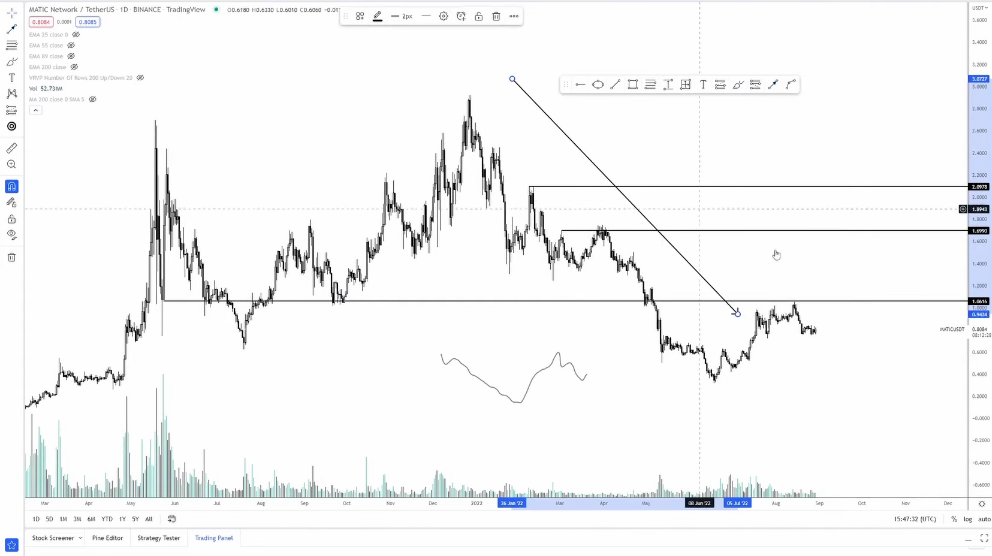
Source: Altcoin Sherpa/YouTube Polygon is currently up less than 2.50% and valued at $0.83.
Moving on to Chiliz (CHZ), utility token of sports fan engagement platform Socios.com, the chart expert believes the altcoin’s recent rally will soon fizzle out.
“This coin did really well the last few weeks. It really outperformed a lot of other coins, but for now I think that it’s a coin that probably can be shorted.
I do think that it will provide a bounce around the $0.18 area, but I expect that we’re going to see more grinding down until we hit that area [$0.18 to $0.19]. Then we might see a more sustainable move after some consolidation and then more downtrend.”
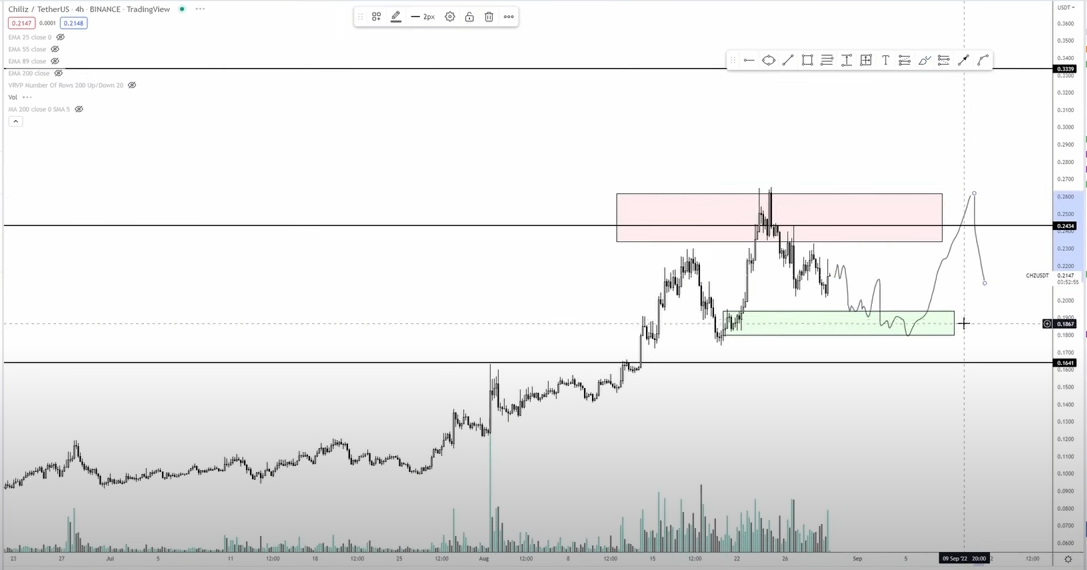
Source: Altcoin Sherpa/YouTube Chiliz is in the red by 4.27% and changing hands for $0.20. The altcoin was worth over $0.26 just a week ago.
Altcoin Sherpa thinks $0.19 could be a decent entry point for enterprise-grade blockchain platform Fantom (FTM), but does caution that broader bear market conditions might send the token plunging.
“The range low is around $0.19. There is this floor around $0.24 that looks like it probably will be the next level up, but I’m not exactly sure if that’s going to hold. $0.19 might be a better buy if you are looking for this for the long term, but it’s also important to note that this is still just a very bearish market structure.
It’s certainly looking like if this current $0.18-$0.19 area goes, then the $0.05 area is probably next, in my opinion.”
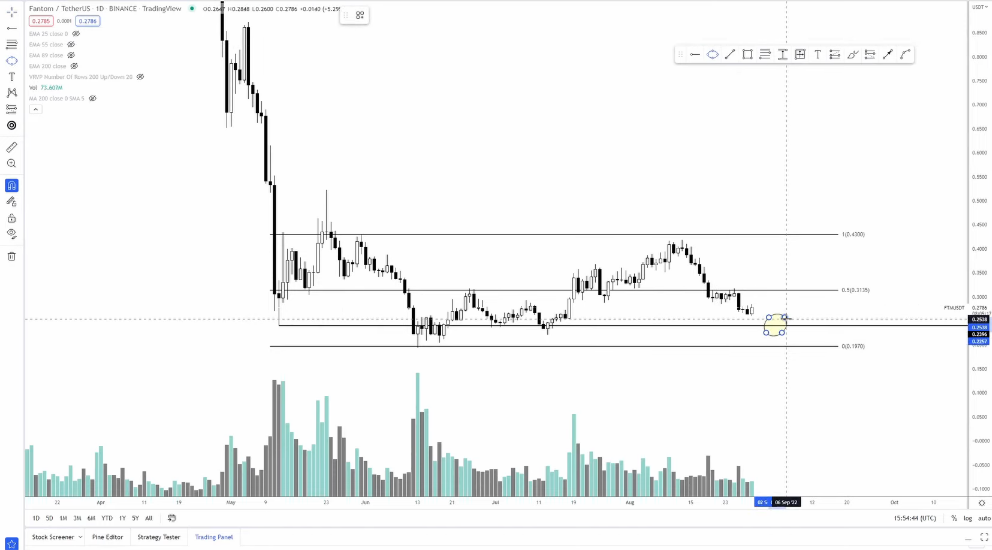

Fantom has seen some choppy price action in recent days, currently flat and trading for $0.28.
Last on the analyst’s watchlist is Ethereum (ETH) competitor NEAR Protocol (NEAR). Altcoin Sherpa thinks the NEAR’s fate might ultimately be tied to how well Bitcoin (BTC) holds up in the future.
“Similar to the other altcoins, it has this kind of rounded bottom type of price action that looks pretty decent, but again I don’t think it’s very sustainable. It’s much more likely that price does this double bottom, maybe it’ll just chop around, maybe it’ll revisit the lows again at three bucks, and then chop around for several weeks, and then grind back up…
I think it’s likely that this just goes lower. If this does go lower and this $3 floor falls out, then I would suspect this $2.75 all the way down to $1.75 area would be the next areas up.
These are some areas of interest if Bitcoin does in fact have another leg down.”
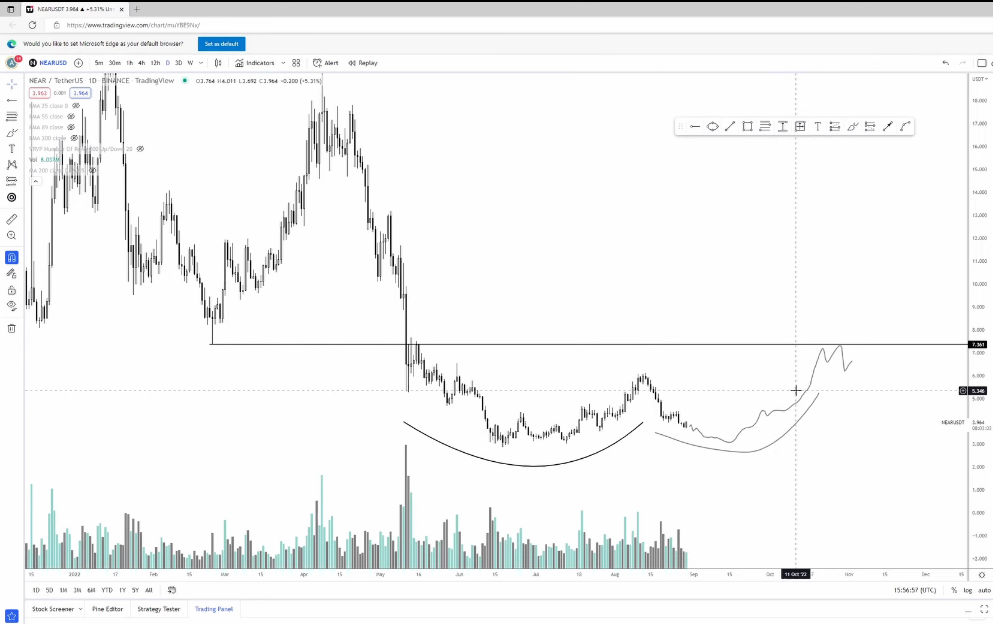
At time of writing, Near Protocol is up by 8.05% with an asking price of $4.32.
Lecturas Relacionadas

El Trilema de la Escalabilidad es un Falso Problema

Autor: Billy Gao Traducción: Jiahuan, ChainCatcher El sistema criptográfico más potente de la historia no puede proteger la privacidad de tus fondos. Cada transacción y cada posición se emiten públicamente en la cadena de bloques. La cadena de bloques es esencialmente una computadora compartida, lenta, costosa y sin propietario. Su principal ventaja es que nadie puede evitar que la uses ni engañarte sobre los resultados. La "trilema" tradicional —descentralización, escalabilidad, seguridad— ha sido en gran medida superada, pero no es el principal obstáculo. El problema real son dos defectos de diseño: la legitimidad y la falta de privacidad. La transparencia total en las cadenas públicas no es una característica positiva, es un impuesto que se paga en forma de MEV, front-running y exposición financiera. Los fondos (como las monedas estables) son el caso de uso ideal para la cadena, ya que el registro en el libro mayor es el activo en sí mismo. Sin embargo, el capital institucional y los grandes patrimonios no participan porque no exponen públicamente sus balances. La legitimidad está mejorando con marcos regulatorios, pero la privacidad sigue siendo la gran barrera. La privacidad con cumplimiento normativo demostrable, basada en pruebas criptográficas de conocimiento cero, es la solución. Permite verificar hechos (solvencia, KYC) sin revelar datos subyacentes, combinando privacidad y transparencia necesaria. Esto representa una mejora pura respecto al modelo actual y es el puente para atraer billones en capital hacia la cadena.

链捕手Hace 8 hora(s)

El Trilema de la Escalabilidad es un Falso Problema

链捕手Hace 8 hora(s)

Las stablecoins finalmente encuentran rendimientos reales: Un análisis detallado del reaseguro en cadena Re | Diálogo con el fundador de Re, Karan Saroya

Establemente las monedas finalmente encuentran rendimientos reales: Re, una plataforma de reaseguro en cadena, absorbe monedas estables de DeFi y las utiliza como garantía para respaldar a aseguradoras estadounidenses, devolviendo las primas obtenidas a los depositantes en cadena. Actualmente respalda a 35 aseguradoras, con un negocio suscrito de 5 mil millones de dólares, y planea superar los 10 mil millones en siete meses. **Puntos clave:** 1. **Fuente de rendimiento real:** Ofrece a los tenedores de monedas estables un rendimiento anual del 12%-14% o más, proveniente del mercado de reaseguro (un billón de dólares), no correlacionado con los mercados tradicionales. 2. **Eficiencia operativa:** Los contratos inteligentes reemplazan los costosos procesos tradicionales de captación de capital, permitiendo a un equipo pequeño competir con gigantes del sector. 3. **Apalancamiento regulatorio:** Por cada 1 dólar de garantía, se pueden respaldar 5-7 dólares en primas, multiplicando los rendimientos. 4. **Integración con DeFi:** Los depositantes reciben un token que puede reutilizarse en protocolos como Morpho para aumentar aún más el rendimiento. 5. **Token de gobernanza RE:** Inspirado en Lloyd's of London, permite a los poseedores gobernar la dirección del capital y los parámetros del sistema. Re representa un punto de inflexión, conectando el capital en cadena con la economía real y proporcionando la demanda necesaria para la infraestructura DeFi existente. Su arquitectura combina un frente regulado con un backend descentralizado eficiente.

链捕手Hace 11 hora(s)

Las stablecoins finalmente encuentran rendimientos reales: Un análisis detallado del reaseguro en cadena Re | Diálogo con el fundador de Re, Karan Saroya

链捕手Hace 11 hora(s)

¿1996 o 1999? La primera prueba de Walsh es 'cómo ver la IA'

El nuevo presidente de la Reserva Federal, Wash, enfrenta su primera gran prueba: determinar si el auge actual de la IA se asemeja más al escenario económico de 1996 o al de 1999. Esta decisión definirá la política monetaria y su legado. Por un lado, está la visión optimista, que asemeja a 1996, donde un crecimiento impulsado por ganancias de productividad permitiría a la Fed mantenerse paciente mientras la inflación retrocede. Wash ha mostrado simpatía por esta narrativa, advirtiendo contra el error de sofocar prematuramente un boom de productividad. Por otro lado, la visión cautelosa, similar a 1999, sostiene que la demanda ya se está calentando y esperar datos concluyentes de productividad podría forzar subidas de tasas más agresivas después. Chicago Fed's Goolsbee argumenta que, al ser un boom ampliamente anticipado, la IA podría inflar la demanda antes de materializar la oferta, presionando la inflación. Wash opera en un contexto más difícil que el de Greenspan en los 90, con presión arancelaria, alto déficit fiscal y menos ventajas globales. Un dilema adicional es su deseo de eliminar la "guía anticipada" de la Fed, un mecanismo creado precisamente en 1999 para gestionar expectativas. Si la economía se recalienta, podría verse forzado a usarlo o arriesgar volatilidad en los mercados. La respuesta a la pregunta central —¿1996 o 1999?— resolverá este y otros dilemas.

marsbitHace 12 hora(s)

¿1996 o 1999? La primera prueba de Walsh es 'cómo ver la IA'

marsbitHace 12 hora(s)

Trading

Spot
Futuros
活动图片