Unlocking $100 Million in Liquidity? Pump.fun's New Policy Tests the 5-Minute Pump Technique

Foresight NewsPublicado a 2026-07-22Actualizado a 2026-07-22

Resumen

Foresight News, July 21 – Pump.fun has launched its new "BOOST" mode as the standard launch mechanism for new tokens. The core of BOOST is to address the issue of "dead liquidity." Historically, when a token migrates from its bonding curve to a liquidity pool, roughly 20% of its liquidity becomes permanently locked and unusable, a problem the platform estimates costs over $100 million annually. The new mechanism redirects this 20% of funds, which would have been locked, to instead be used for a 5-minute Time-Weighted Average Price (TWAP) buyback of the token immediately after migration. The purchased tokens are then permanently burned. For example, this means reserving 17.6 SOL for SOL pairs or about $2516 for USDC pairs at migration. This creates a short-term buying pressure and reduces the token's supply. The goal is to improve the immediate post-launch performance of memecoins, potentially increasing trader retention and transaction volume on the platform. However, critics warn this could lower the bar for token launches, encouraging low-quality projects, and that the brief 5-minute buy pressure might lead to sharper price crashes once it ends if followed by large sell-offs.


Author: Ma He, Foresight News


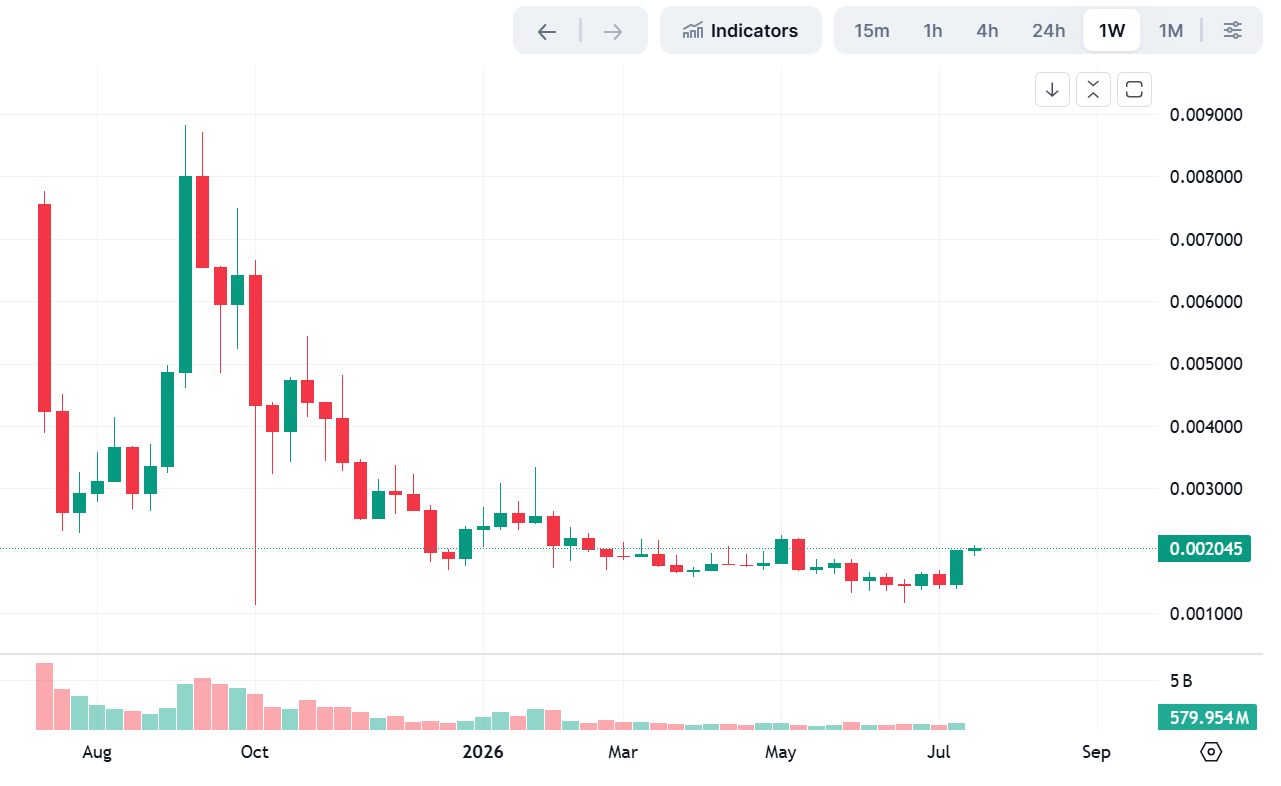
On July 21, Pump.fun officially announced the launch of BOOST mode, setting it as the new standard default launch mechanism for tokens. After the announcement, PUMP's price continued to fluctuate around $0.002.


According to official explanations, historical data shows that whenever a token graduates from the bonding curve and migrates to a liquidity pool, approximately 20% of the liquidity becomes "dead liquidity." Even if all holders sell, these funds remain permanently locked in the LP, becoming unusable. The platform estimates this mechanism causes over $100 million in liquidity to be permanently lost annually.
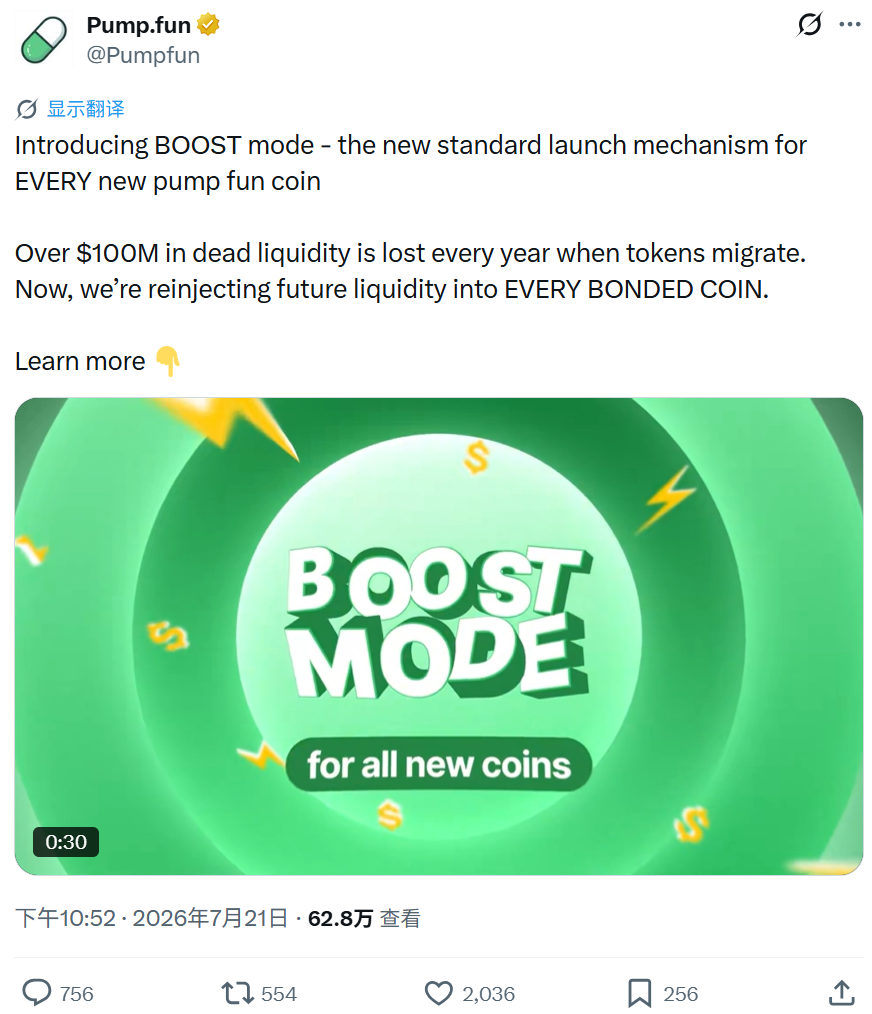


The core action of BOOST mode is straightforward: use these funds, which would otherwise be wasted, to continuously buy the token via TWAP (Time Weighted Average Price) during the first 5 minutes after migration, and immediately burn all purchased tokens. When a token graduates, Pump.fun will forcibly withhold about 20% of the funds. Calculated based on fixed migration rules, this amounts to withholding 17.6 SOL for SOL pairs and about $2516 for USDC pairs.


These funds entirely come from the "sacrificed" portion of liquidity during previous migrations, not from new platform subsidies. After the purchase is completed, the corresponding tokens are directly burned, creating short-term buying pressure while permanently reducing circulating supply.


Using Reserve Funds to Provide a 5-Minute Buy Pressure for Tokens


Pump.fun's classic process is: users create a token with one click, then trade on the bonding curve. When the token reaches a certain market cap threshold, it automatically migrates to the PumpSwap liquidity pool. During migration, the platform locks a portion of the liquidity into the LP at a set ratio to ensure subsequent trading depth.


The problem lies in the high proportion of these locked funds. Even if the token's price later goes to zero and everyone sells out, a sum of "dead money" remains in the LP. This money can neither be withdrawn nor redeployed to other active assets, resulting in systemic capital waste. The official estimate is "over $100 million annually."


BOOST mode does not change the bonding curve trading experience or adjust the graduation threshold itself. It does not arbitrarily add or release any external liquidity. Its essence is to extract the 20% of settlement funds originally intended for the LP and use them to buy and directly burn tokens on the secondary market via TWAP over 5 minutes.


The official explicitly stated that tokens migrated after 22:23 (Beijing Time) on July 21 automatically have BOOST enabled. Tokens migrated before this time, as well as those launched via the Mayhem (AI Agent Lab) mode, do not benefit from this mechanism.


A 5-Minute Fireworks Show


As of July 22, Pump.fun's current annualized revenue is approximately $342.54 million, with total token buyback value around $411.27 million. However, its token price remains far from its all-time high of $0.008. Relying solely on large-scale buybacks can hardly effectively boost price expectations anymore.


The essence of BOOST is not to add another round of buybacks for PUMP, but to attempt to solve the product issues of the launchpad itself.


The logic behind this might be: if meme coins after graduation have slightly thicker order books and better short-term performance, trader retention and repeat purchase intentions would be higher. Most PVP (Player vs. Player) players don't care about a meme coin's fate three days later; they care about whether it can "pump" at the moment of graduation. The Pump.fun team likely sees through this. Instead of locking 20% of funds defensively in the LP pool, it's better to turn that money into a 5-minute "fireworks show."


The platform's real moat isn't "high token launch volume," but "a certain proportion of launched tokens can continuously generate trading volume." Only when the latter stabilizes can protocol revenue truly be sustainable. Stable or growing revenue provides continuous ammunition for buybacks, rather than appearing like "using存量 revenue to barely support the price."


Of course, many traders are concerned that the additional buying pressure could lower the actual difficulty of project launches, potentially making more low-quality tokens appear "successful," thereby encouraging more aggressive launch behavior. Others point out that the 5-minute TWAP buying window is still short. Once buying stops after 5 minutes and faces large sell orders, the token price could crash with even more exaggerated slippage than before. This essentially trades extremely high post-pump dump risk for a 5-minute pumping illusion.


Criptos en tendencia

Preguntas relacionadas

QWhat is the core mechanism of Pump.fun's new BOOST mode, and what problem does it aim to solve?

AThe core mechanism of the BOOST mode is to use the approximately 20% of liquidity that would normally be permanently locked as 'dead liquidity' when a token graduates to a liquidity pool. Instead of locking it, this capital is used to buy the token via TWAP (Time-Weighted Average Price) over the first 5 minutes after graduation and then immediately burn the purchased tokens. It aims to solve the problem of systemic capital waste, estimated by the platform to be over $100 million annually, where funds become unusable even if a token's price goes to zero.

QAccording to the article, what are the potential benefits of the BOOST mechanism for the Pump.fun platform?

AThe potential benefits are: 1) Creating a short-term buying pressure and a 'fireworks' effect in the first 5 minutes after a token's graduation, which could improve trader retention and repurchase intention. 2) Permanently reducing the token's circulating supply through burning, potentially supporting its price. 3) Strengthening the platform's moat by increasing the proportion of launched tokens that generate sustained trading volume, which is crucial for sustainable protocol revenue and, consequently, for funding ongoing token buybacks.

QWhat are the main concerns or criticisms raised about the BOOST mechanism in the article?

AThe main concerns are: 1) It might lower the actual difficulty for a project to launch successfully, making it easier for low-quality tokens to create an illusion of success and encouraging more aggressive token launches. 2) The 5-minute TWAP buying window is short. Once it stops and if faced with large sell-offs, the token price could crash with even worse slippage than before. This essentially trades a high risk of a post-buyback crash for a 5-minute pump illusion.

QWhat is the estimated annual value of 'dead liquidity' that the BOOST mode seeks to repurpose, and where does this capital come from?

AThe platform estimates that over $100 million worth of liquidity is permanently lost ('dead') each year. This capital comes from the portion of funds (about 20%) that is automatically locked into the liquidity pool (LP) when a token graduates from the bonding curve. It is not new platform subsidy but repurposed existing capital that would otherwise be trapped forever.

QWhich tokens on Pump.fun are eligible for the new BOOST mechanism, and which are not?

ATokens that graduate (migrate from bonding curve to liquidity pool) after 22:23 Beijing Time on July 21st automatically have the BOOST configuration enabled. Tokens that migrated before this time, as well as tokens launched through the Mayhem (AI Agent Lab) mode, are not eligible for this mechanism.

Lecturas Relacionadas

Fallo del caso de divorcio de Chey Tae-won: Revelando las líneas ocultas de sucesión detrás del imperio trillonario de SK Hynix

El caso de divorcio de Choi Tae-won, presidente de SK Group, concluyó con una sentencia histórica de división patrimonial. Este hecho pone bajo el foco la sucesión en el imperio de SK Hynix, cuyo valor se disparó un 700% alcanzando los 1.000 billones de wones. A diferencia del guion tradicional de los *chaebol* coreanos, centrado en el primogénito varón, los tres hijos de Choi Tae-won siguen trayectorias atípicas. La hija mayor, Choi Yoon-jung (1989), es considerada la candidata más visible. Con formación en biología y un doctorado, ocupa un puesto directivo en SK Bioscience y supervisa la estrategia de crecimiento del grupo. Se casó con el cofundador de una *startup* de IA. La segunda hija, Choi Min-jung (1991), forjó un camino único: sirvió como oficial en la Marina de Corea, trabajó en políticas globales para SK Hynix en Washington y ahora es fundadora de una empresa de salud con IA. Se casó con un ex oficial del Cuerpo de Marines de EE.UU. El hijo menor, Choi In-geun (1995), a pesar de ser el primogénito varón y seguir el patrón formativo típico (consultoría en McKinsey), permanece en un discreto silencio público sin un rol definido dentro del grupo. El divorcio de sus padres, Choi Tae-won y Roh Soh-yeong, hija del expresidente Roh Tae-woo, culminó en una batalla legal multimillonaria que involucró a los tres hijos, quienes presentaron peticiones judiciales no divulgadas. Mientras SK Hynix se convierte en un activo geopolítico global, la sucesión ya no es un asunto meramente familiar. Los herederos de la tercera generación no heredan simplemente una empresa, sino el complejo desafío de navegar la era de la IA, las políticas globales y encontrar nuevas fuentes de crecimiento, redefiniendo así el legado del *chaebol*.

marsbitAyer 09:13

Fallo del caso de divorcio de Chey Tae-won: Revelando las líneas ocultas de sucesión detrás del imperio trillonario de SK Hynix

marsbitAyer 09:13

¡En solo 2 meses su valoración ha pasado de 8.800 millones a 68.000 millones de euros! OpenRouter, la mayor centralita de la IA, podría ser adquirida

Stripe está en conversaciones para adquirir la startup de inteligencia artificial OpenRouter, el mayor mercado de modelos de IA que actúa como intermediario, por un monto cercano a los 100.000 millones de dólares. Esta valoración representa un aumento de casi siete veces respecto a los 13.000 millones de dólares de hace dos meses. La plataforma de OpenRouter permite a los desarrolladores acceder a más de 400 grandes modelos de lenguaje a través de una única API, optimizando automáticamente la selección del modelo según la complejidad de la tarea, el coste y la velocidad, similar a un comparador de precios. Fundada en 2023 por Alex Atallah (cofundador de OpenSea) y Louis Vichy, la empresa tiene un ingreso anualizado de 50 millones de dólares y más de un millón de desarrolladores usuarios. Para Stripe, líder mundial en pagos en línea, esta adquisición es un paso estratégico hacia la consolidación de su infraestructura para la economía de la IA, tras la compra reciente de Metronome, una plataforma de facturación por uso. El objetivo es ofrecer un paquete integral que gestione desde la selección de modelos y la facturación por tokens hasta los pagos, convirtiéndose en el centro de control para las aplicaciones de IA. Aunque la transacción aún podría fracasar, refleja la apuesta por el crecimiento explosivo del sector y el valor de controlar la capa de intermediación que decide cómo se distribuyen las consultas y los costes entre los distintos proveedores de modelos.

链捕手Ayer 09:04

¡En solo 2 meses su valoración ha pasado de 8.800 millones a 68.000 millones de euros! OpenRouter, la mayor centralita de la IA, podría ser adquirida

链捕手Ayer 09:04

Trading

Spot

Artículos destacados

Cómo comprar PUMP

¡Bienvenido a HTX.com! Hemos hecho que comprar Pump.fun (PUMP) sea simple y conveniente. Sigue nuestra guía paso a paso para iniciar tu viaje de criptos.Paso 1: crea tu cuenta HTXUtiliza tu correo electrónico o número de teléfono para registrarte y obtener una cuenta gratuita en HTX. Experimenta un proceso de registro sin complicaciones y desbloquea todas las funciones.Obtener mi cuentaPaso 2: ve a Comprar cripto y elige tu método de pagoTarjeta de crédito/débito: usa tu Visa o Mastercard para comprar Pump.fun (PUMP) al instante.Saldo: utiliza fondos del saldo de tu cuenta HTX para tradear sin problemas.Terceros: hemos agregado métodos de pago populares como Google Pay y Apple Pay para mejorar la comodidad.P2P: tradear directamente con otros usuarios en HTX.Over-the-Counter (OTC): ofrecemos servicios personalizados y tipos de cambio competitivos para los traders.Paso 3: guarda tu Pump.fun (PUMP)Después de comprar tu Pump.fun (PUMP), guárdalo en tu cuenta HTX. Alternativamente, puedes enviarlo a otro lugar mediante transferencia blockchain o utilizarlo para tradear otras criptomonedas.Paso 4: tradear Pump.fun (PUMP)Tradear fácilmente con Pump.fun (PUMP) en HTX's mercado spot. Simplemente accede a tu cuenta, selecciona tu par de trading, ejecuta tus trades y monitorea en tiempo real. Ofrecemos una experiencia fácil de usar tanto para principiantes como para traders experimentados.

963 Vistas totalesPublicado en 2024.12.12Actualizado en 2026.07.09

Cómo comprar PUMP

Discusiones

Bienvenido a la comunidad de HTX. Aquí puedes mantenerte informado sobre los últimos desarrollos de la plataforma y acceder a análisis profesionales del mercado. A continuación se presentan las opiniones de los usuarios sobre el precio de PUMP (PUMP).

活动图片