Backpack Surges Over 150% in Half a Month

marsbitPublicado a 2026-06-15Actualizado a 2026-06-15

Resumen

BP, the token of the Backpack exchange, has surged over 150% since early June, driven by the platform's expansion into regulated US stock brokerage and asset tokenization services. On June 2nd, Backpack announced Backpack Securities, offering traditional stock trading and tokenization, causing BP's price to jump over 80%. Momentum continued on June 12th with the launch of SPCX, a tokenized product for SpaceX stock on Solana, facilitating seamless conversion between traditional securities and on-chain assets. This aligns with the RWA (Real World Assets) narrative, creating a bridge between traditional finance and Solana DeFi. The token's unique economics also support its growth. All 2.5 billion initially circulating tokens were airdropped to the community, with zero allocation to the team or investors at launch. A key feature allows users who stake BP for at least one year to gain the right to convert tokens into company equity upon an IPO or acquisition. Despite some initial community controversy over airdrop distribution, focus is shifting to BP's long-term utility and value alignment as real products launch.

Author: Ma He, Foresight News

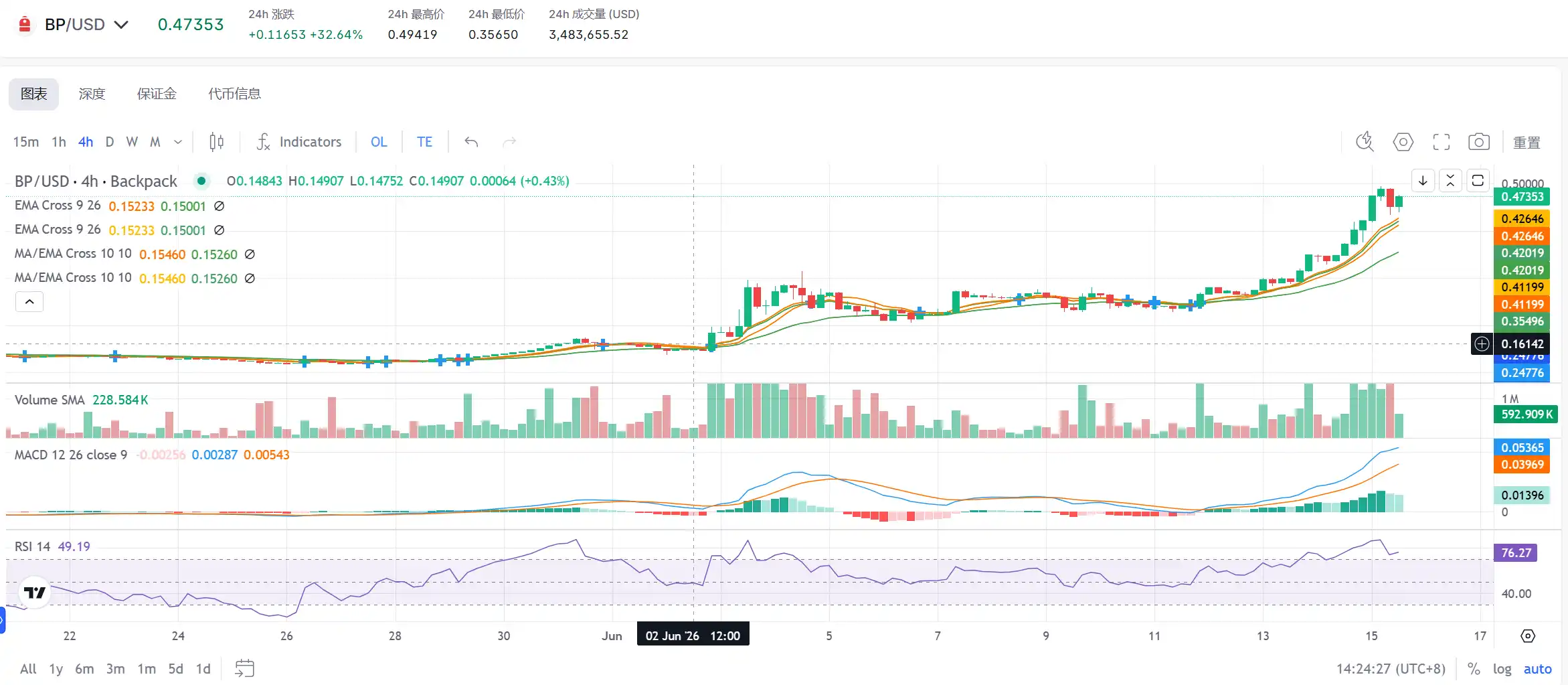
On June 15, the Backpack exchange token BP surged over 30% again within 24 hours, currently quoted at $0.475 with a market cap of $118.48 million and a fully diluted valuation (FDV) of $473.94 million. Since early June this year, BP has skyrocketed from around $0.16, breaking through a high of $0.48.
The direct catalyst for this market surge stems from the platform's latest breakthroughs in traditional U.S. stock brokerage and asset tokenization services.

Venturing into U.S. Stock Brokerage and Tokenization Business

In March 2026, BP completed its Token Generation Event (TGE) on Solana with a total supply of 1 billion tokens and an initial circulating supply of 250 million. After listing, the token price briefly touched a high point before rapidly declining, with a single-day drop exceeding 40% at its worst, as the market was once filled with profit-taking pressure. For several weeks thereafter, the price consolidated at lower levels until a turning point emerged in early June.

On June 2, Backpack announced the launch of the Backpack Securities platform, which will provide regulated U.S. stock brokerage services while also supporting the tokenization of traditional stocks for circulation on the blockchain, enabling seamless conversion between traditional securities and on-chain assets. The brokerage service is planned to launch gradually in June, with initial tokenized products rolled out in the Solana ecosystem through a partnership with Sunrise. BP skyrocketed over 80% in a single day, rapidly climbing from the $0.14-$0.15 range to around $0.27, with its market cap approaching $70 million at one point.

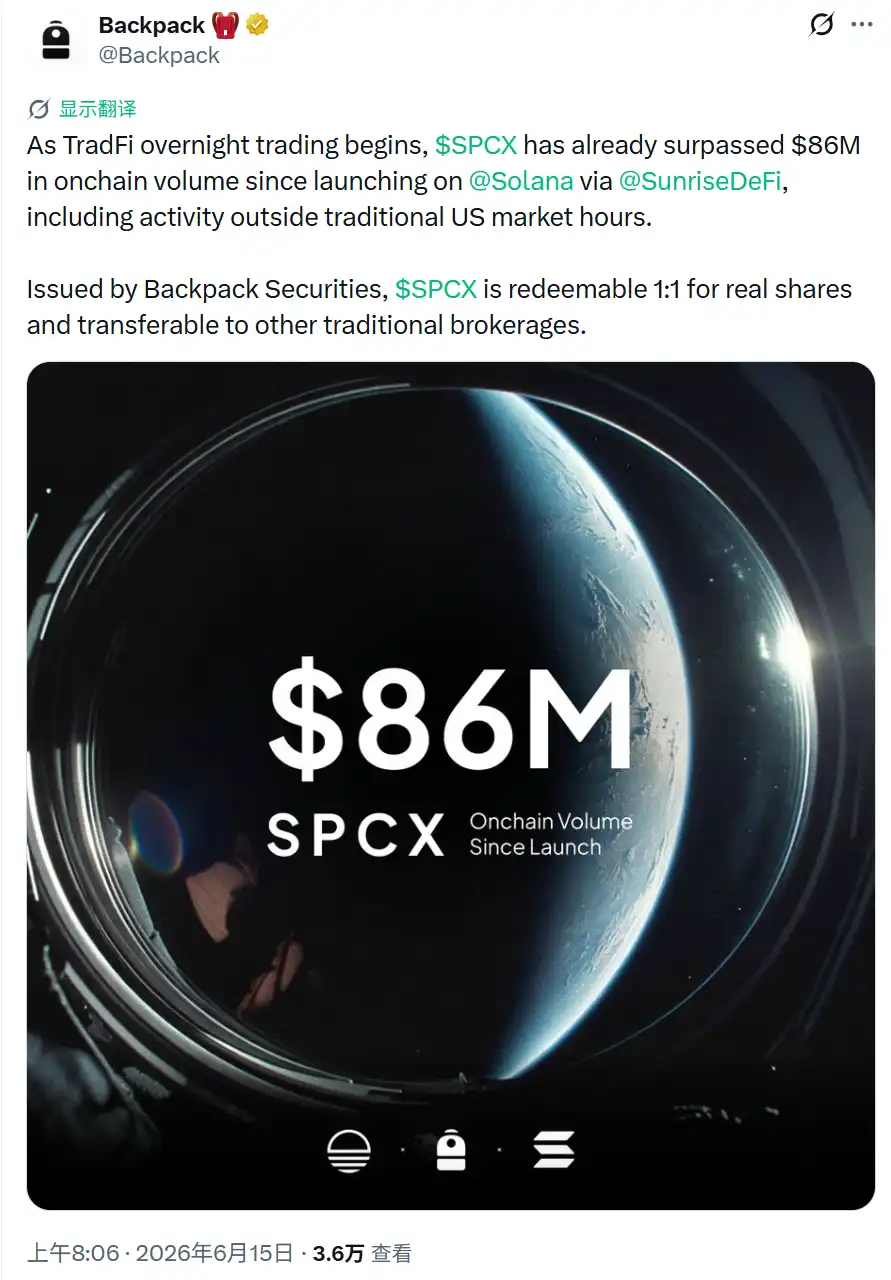
On June 12, coinciding with SpaceX's listing on NASDAQ, its tokenized product SPCX launched on Solana. In the subsequent 24 hours, BP rose approximately 27% further, pushing its price above $0.347. This token is pegged 1:1 to real SpaceX shares, supports 24/7 on-chain trading, and can be redeemed through a Backpack brokerage account into a traditional securities account, achieving interoperability between on-chain and off-chain assets. On its first day of launch, the product generated around $35-38 million in on-chain trading volume across DEXs like Jupiter and Raydium. According to the latest official data, the total on-chain SPCX trading volume exceeds $86 million.
Backpack is building a bridge between traditional U.S. stocks and Solana DeFi. Users can not only trade crypto assets within the platform but also access real stocks through the same account and tokenize portions of their assets for use, trading, or composition on-chain. This pathway aligns highly with the current RWA (Real World Assets) narrative and provides the BP token with clearer use cases and demand support.

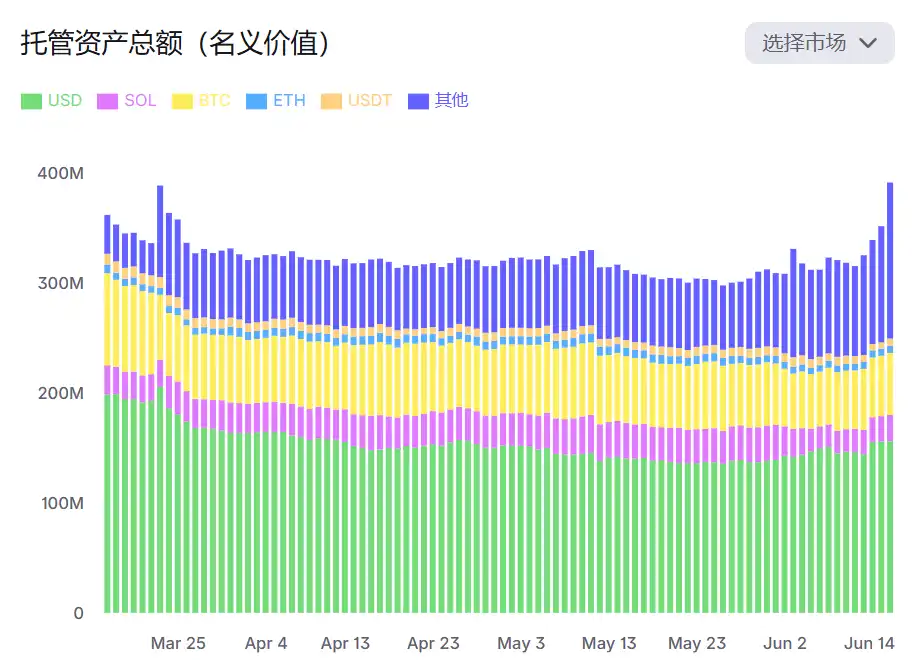
BP's recent surge stems more from substantial platform business expansion than short-term speculation. Currently, its official website shows that Backpack's total custodied assets (nominal value) have rebounded to $390 million.
No Tokens for the Team Unless the Company Goes Public

Supporting the above business development is the BP token and its unique economic structure launched as early as March. The total supply of 1 billion tokens is divided into three phases: 25% (250 million) at TGE was entirely airdropped to community users, with approximately 240 million allocated to participants in the points program and 10 million to Mad Lads NFT holders. At launch, the team, founders, and investors received 0 token allocation; 37.5% in the Pre-IPO phase is tied to growth triggers such as regulatory milestones and product launches, continuing to be distributed to users upon unlocking; 37.5% in the Post-IPO phase enters the company treasury, locked for at least one year after an IPO, with the team benefiting only through equity, not directly through tokens.
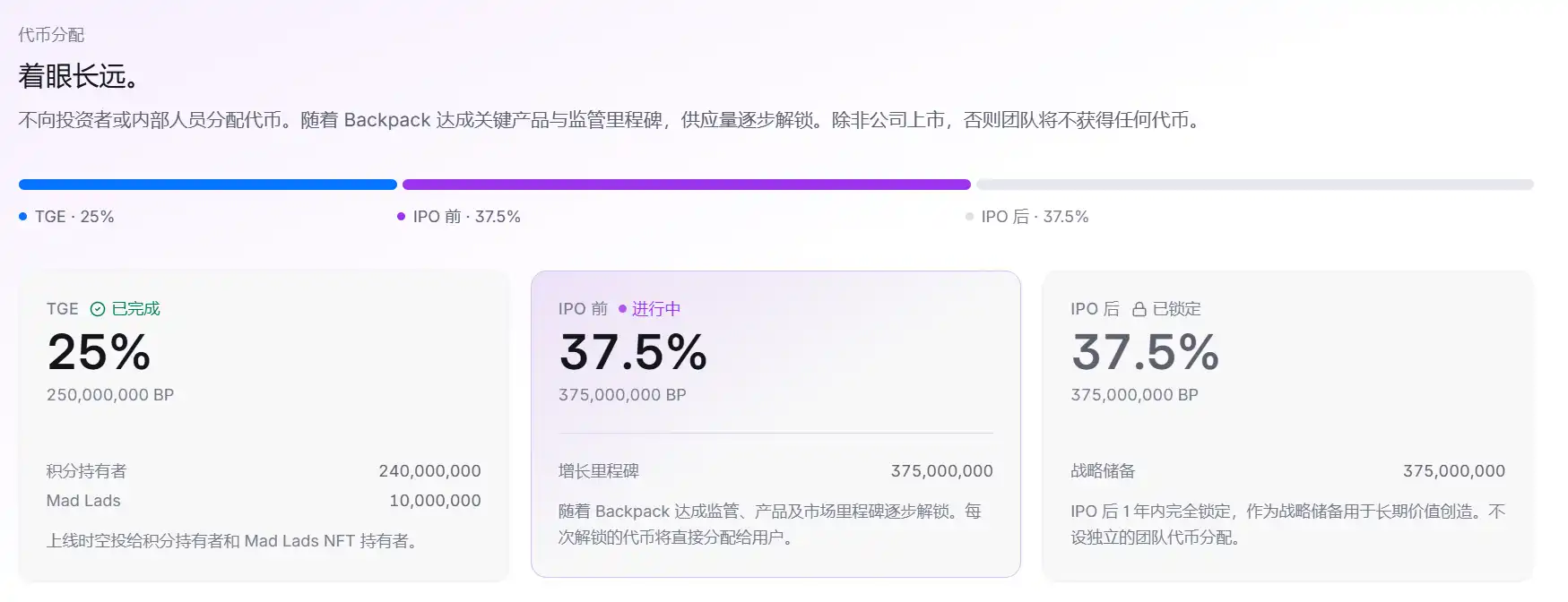
The most attention-grabbing mechanism is the equity conversion design: users who stake BP for at least 1 year gain the right to convert their tokens into company equity upon an IPO or acquisition, with the bonus increasing with holding time up to the 4th year based on the initial unlock.

Additionally, staking provides benefits such as tiered trading fee discounts, extra yield on USD collateral, free wire transfers, and priority access to the Backpack Card. Currently, about 66% (approximately 165 million) of the circulating supply is staked.

While the airdrop process was technically smooth, it also sparked community discussion. Supporters argue that the "no insider TGE allocation" model is quite radical, and the points system genuinely rewarded trading and ecosystem participation. Criticism focused on the relatively strict Sybil filtering mechanism, which led to some long-term users having their points removed, resulting in lower-than-expected allocations, as well as noticeable profit-taking during the post-listing price correction. CEO Armani Ferrante publicly denied allegations of team OTC sales.

These controversies temporarily affected market sentiment, but as tangible products like Backpack Securities were launched, the focus is gradually shifting from allocation details to the platform's long-term growth and the token's actual utility. Against the backdrop of the platform's expansion into U.S. stock brokerage and tokenization services, the long-term alignment value of BP's staking and equity mechanisms is being reevaluated.

Preguntas relacionadas

QWhat is the key factor driving the recent sharp increase in the price of Backpack's BP token?

AThe key driver is Backpack's expansion into traditional U.S. stock brokerage and asset tokenization services through its new Backpack Securities platform, starting with the tokenized SpaceX (SPCX) offering on Solana.

QWhat is the unique feature of BP's tokenomics regarding team and investor allocation?

AAt TGE, 0 tokens were allocated to the team, founders, or investors. 100% of the initial circulating supply (25% of total) was airdropped to the community. Team members can only benefit through company equity (via a token conversion option post-IPO), not through direct token holdings.

QWhat significant milestone for Backpack occurred on June 12 alongside SpaceX's NASDAQ IPO?

AOn June 12, the tokenized product for SpaceX, SPCX, was launched on Solana. It is a 1:1 tokenized representation of real SpaceX stock, facilitating 24/7 on-chain trading.

QWhat major benefit can BP stakers obtain, and what percentage of the circulating supply is currently staked?

AStakers who lock BP for at least one year gain the right to convert their tokens into company equity upon an IPO or acquisition. Currently, approximately 66% (about 165 million) of the circulating supply is staked.

QWhat criticism did the BP token airdrop face from parts of the community?

ACriticism focused on the Sybil filtering mechanism being overly strict, which led to some long-term users having their points invalidated and receiving fewer tokens than expected. There were also accusations of team OTC selling, which the CEO denied.

Lecturas Relacionadas

Los Oso Mantienen el Control Mientras que el ETH Rechaza la Resistencia de la Línea de Tendencia

El último rebote de Ethereum no ha convencido a todos los analistas de que la tendencia bajista haya terminado. En una idea publicada en TradingView el 20 de junio, TheSignalyst argumenta que ETH se mantiene en territorio bajista. Esto se debe a que continúa cotizando por debajo de una línea de tendencia roja descendente y ha formado una secuencia de máximos y mínimos más bajos. El gráfico del analista muestra que el precio de ETH fue rechazado en una zona de confluencia que incluye dicha línea de tendencia y una zona de resistencia horizontal. Este tipo de resistencia combinada suele atraer a vendedores de forma más agresiva. El fracaso en superar ambos niveles se interpreta como una confirmación de que los vendedores mantienen el control. El área de soporte clave se sitúa entre 1.350 y 1.500 dólares. Una ruptura decisiva por debajo de este rango debilitaría significativamente la estructura general de ETH. Por ahora, el precio está comprimido entre este soporte y la línea de tendencia bajista. El desempeño de Ethereum es crucial para el mercado altcoin en general. Cuando ETH lucha frente al dólar, el apetito por el riesgo en DeFi y activos de menor capitalización suele debilitarse también. Por lo tanto, este análisis sirve como advertencia: los alcistas necesitan una ruptura clara por encima de la resistencia antes de poder hablar de un cambio de tendencia sostenido.

bitcoinistHace 9 hora(s)

Los Oso Mantienen el Control Mientras que el ETH Rechaza la Resistencia de la Línea de Tendencia

bitcoinistHace 9 hora(s)

TechFlow Oficina de Inteligencia: Las probabilidades de que Anthropic realice una OPI superan el 80%, Irán vuelve a cerrar el estrecho de Ormuz y desestabiliza los precios del petróleo

Resumen del informe TechFlow: Los mercados anticipan que Anthropic anunciará su OPV antes de noviembre de 2026, planteando dudas sobre si una valoración billonaria puede coexistir con su promesa central de seguridad en IA. Otras tendencias clave: * **Marketing digital:** Marcas adoptan influencers virtuales generados por IA para promocionar productos. * **Energía y Geopolítica:** Irán anuncia el cierre del estrecho de Ormuz, causando volatilidad en el precio del petróleo, aunque datos de seguimiento muestran cierto tráfico marítimo persistente. Paralelamente, Irán reanuda la carga de crudo en la isla de Kharg. * **Finanzas/Tecnología:** Goldman Sachs advierte que los gastos de capital en IA (5,3 billones de dólares) podrían acercarse al límite de crédito. En Europa, se produce la primera incumplimiento en acciones de CLO desde la crisis financiera. * **Empresas tecnológicas:** Cloudflare introduce cuentas temporales para agentes de IA; el tráfico IPv6 de Google supera el 50%; Hyundai adquiere el control total de Boston Dynamics. * **Mercados:** Inversores minoristas invierten fuertemente en la OPV de SpaceX. Elon Musk especula sobre futuras inversiones astronómicas en antimateria para viajes interestelares. **Conclusión subyacente:** Tres señales (tensión en Ormuz, incumplimiento en CLO y advertencias sobre gasto en IA) apuntan a una creciente restricción de la liquidez global y al aumento de los costes marginales. Mientras tanto, el capital sigue buscando narrativas de crecimiento a gran escala (como la OPV de Anthropic, SpaceX y los proyectos de Musk), indicando una bifurcación entre un "viejo mundo" con creciente presión financiera y un "nuevo mundo" que construye narrativas aún más ambiciosas.

marsbitHace 10 hora(s)

TechFlow Oficina de Inteligencia: Las probabilidades de que Anthropic realice una OPI superan el 80%, Irán vuelve a cerrar el estrecho de Ormuz y desestabiliza los precios del petróleo

marsbitHace 10 hora(s)

El cazador cazado: el bot MEV más rentable fue hackeado

**El cazador cazado: El bot de MEV más rentable es hackeado** El conocido bot de MEV en Ethereum, Jaredfromsubway.eth, sufrió un ataque dirigido el sábado, perdiendo más de 7,5 millones de dólares. Según investigaciones, no fue un phishing tradicional ni una explotación de contrato inteligente, sino un sofisticado "ataque de honeypot contra-MEV" diseñado específicamente para explotar la lógica de comportamiento de estos bots. El atacante desplegó durante semanas 66 contratos de tokens falsos y pools de liquidez, disfrazados como activos principales como WETH, USDC o USDT, para crear rutas de arbitraje falsas. El bot, al detectar la aparente oportunidad, ejecutó una transacción que concedió permisos a un contrato controlado por el atacante. Estos permisos no fueron revocados, permitiendo finalmente que el atacante drenara los fondos del bot en una sola transacción. Jaredfromsubway.eth es uno de los bots de MEV más activos e infames de Ethereum, especializado en ataques de "sándwich" para capturar ganancias de los deslizamientos de precio en las transacciones de usuarios. Se estima que ha acumulado decenas de millones en ganancias y estaba relacionado con alrededor del 70% de estos ataques en un período reciente. Este incidente subraya la creciente sofisticación de las amenazas en cripto, demostrando que incluso los actores más agresivos y automatizados ("depredadores") ahora son vulnerables a ataques multidimensionales que explotan sus propias reglas y automatizaciones. Tras el hackeo, una cuenta no oficial en X se hizo pasar por el bot ofreciendo una recompensa falsa, lo que ha generado advertencias de seguridad adicionales.

marsbitHace 11 hora(s)

El cazador cazado: el bot MEV más rentable fue hackeado

marsbitHace 11 hora(s)

Trading

Spot
Futuros
活动图片