Bitcoin Whales Haven’t Made Their Exit Yet – Is The Bull Cycle Still Intact?

bitcoinistPublicado a 2025-04-13Actualizado a 2025-04-13

Resumen

After suffering a steep 30% correction that took prices below $75,000, Bitcoin is showing signs of strength once again. The...

Trusted Editorial content, reviewed by leading industry experts and seasoned editors. Ad Disclosure

After suffering a steep 30% correction that took prices below $75,000, Bitcoin is showing signs of strength once again. The broader crypto market joined BTC in a sharp rebound following a key macro development: US President Donald Trump’s announcement of a 90-day pause on reciprocal tariffs for all countries except China, which now faces a 145% tariff. This easing of trade war fears brought some much-needed relief across risk assets.

Despite the volatility, Bitcoin’s resilience is gaining attention. According to insights from CryptoQuant, whales—large holders excluding entities like exchanges and mining pools—have not exited their positions. In fact, current on-chain data shows accumulation activity similar to what was observed during the August–September 2023 sideways market phase. This pattern historically reflects long-term conviction and has often preceded major rallies.

While short-term uncertainty remains, the continued presence of whale accumulation supports the idea that this correction is part of a broader bullish cycle rather than a structural breakdown. With prices stabilizing and sentiment slowly improving, Bitcoin now faces a critical test to reclaim higher levels and potentially resume its upward trajectory.

Bitcoin Resilient As Key Accumulation Suggests Bull Cycle Intact

Bitcoin remains strong after reclaiming the $80,000 level, and many analysts believe the worst part of the correction is over. However, global tensions—especially those tied to escalating U.S. tariffs—continue to pressure financial markets, with fears of a looming global recession growing. Despite this backdrop, Bitcoin has shown resilience and is now approaching a critical daily resistance near $88,700.

The recent 90-day pause on reciprocal tariffs for all nations except China, which still faces a 145% tariff, has provided some short-term relief. But lasting recovery depends on whether the US and China can reach a broader agreement.

Meanwhile, on-chain data from CryptoQuant reveals a compelling trend: Bitcoin whales haven’t made their exit. These whales, excluding exchanges and mining pools, offer a clearer view of real trading behavior and accumulation patterns. Historically, their movements have closely mirrored price action.

Bitcoin 1-year Change in Whale Holdings | Source: CryptoQuant

At the cycle peak last year, whale exits were marked by consistent profit-taking. This time, however, they are accumulating again, echoing patterns seen in the August–September 2023 sideways market. Unlike the 2020 COVID crash, which whales anticipated with early exits, they are holding firm during this correction.

This suggests the current downturn is not a structural crisis but a sharp pullback in a broader bull cycle. If this manufactured crisis resolves, a new wave of liquidity—possibly driven by QE from both the Fed and China—could favor assets like gold and Bitcoin. For now, whale conviction remains a bullish signal.

BTC Price Near Key Moving Averages

Bitcoin is trading at $83,600, now just 5% away from the 200-day moving average (MA) around $87,100. This technical level is a crucial milestone for bulls aiming to confirm a reversal and reestablish a long-term uptrend. To build a solid bullish case, BTC must not only hold above the $81,000 support zone but also reclaim the $85,000 level, which aligns closely with the 200-day exponential moving average (EMA).
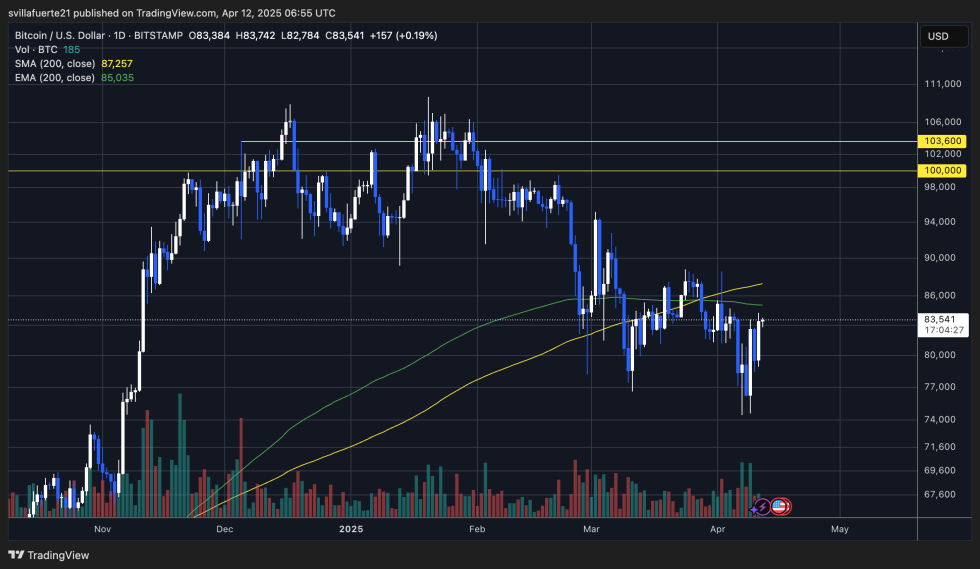
BTC testing crucial liquidity | Source: BTCUSDT chart on TradingView

Reclaiming these moving averages would signal a potential shift in trend, helping reinforce short-term momentum and restoring confidence across the market. The price action over the past week has shown signs of strength, but technical validation through these averages is essential before a true breakout can unfold.

However, downside risks remain. If Bitcoin fails to hold the $81,000–$80,000 range, selling pressure could escalate quickly. A breakdown below this region would likely open the door to a retest of the $75,000 level, where demand could be tested again.

With macroeconomic tensions still weighing on investor sentiment, BTC is at a critical inflection point. The coming days will determine whether bulls can solidify control—or if another correction leg is on the horizon.

Featured image from Dall-E, chart from TradingView 

Editorial Process for bitcoinist is centered on delivering thoroughly researched, accurate, and unbiased content. We uphold strict sourcing standards, and each page undergoes diligent review by our team of top technology experts and seasoned editors. This process ensures the integrity, relevance, and value of our content for our readers.

Sebastian's journey into the world of crypto began four years ago, driven by a fascination with the potential of blockchain technology to revolutionize financial systems. His initial exploration focused on understanding the intricacies of various crypto projects, particularly those focused on building innovative financial solutions. Through countless hours of research and learning, Sebastian developed a deep understanding of the underlying technologies, market dynamics, and potential applications of cryptocurrencies. As his knowledge grew, Sebastian felt compelled to share his insights with others. He began actively contributing to online discussions on platforms like X and LinkedIn, focusing on fintech and crypto-related content. His goal was to expose valuable trends and insights to a wider audience, fostering a deeper understanding of the rapidly evolving crypto landscape. Sebastian's contributions quickly gained recognition, and he became a trusted voice in the online crypto community. To further enhance his expertise, Sebastian pursued a UC Berkeley Fintech: Frameworks, Applications, and Strategies certification. This rigorous program equipped him with valuable skills and knowledge regarding Financial Technology, bridging the gap between traditional finance (TradFi) and decentralized finance (DeFi). The certification deepened his understanding of the broader financial landscape and its intersection with blockchain technology. Sebastian's passion for finance and writing is evident in his work. He enjoys delving into financial research, analyzing market trends, and exploring the latest developments in the crypto space. In his spare time, Sebastian can often be found immersed in charts, studying 10-K forms, or engaging in thought-provoking discussions about the future of finance. Sebastian's journey as a crypto analyst and investor has been marked by a relentless pursuit of knowledge and a dedication to sharing his insights. His ability to navigate the complex world of crypto, combined with his passion for financial research and communication, makes him a valuable asset to the industry. As the crypto landscape continues to evolve, Sebastian remains at the forefront, providing valuable insights and contributing to the growth of this revolutionary technology.

Lecturas Relacionadas

Reservas en la sombra de 60 mil millones de BTC en Venezuela, Walmart acepta pagos en Bitcoin: ¿De qué se habla hoy en el criptomundo internacional?

En las últimas 24 horas, el mercado de criptomonedas ha experimentado múltiples dinámicas, desde discusiones macroeconómicas hasta desarrollos en ecosistemas específicos. Los principales temas incluyen advertencias sobre manipulación de precios en cadena, el uso de IA para capturar oportunidades en mercados predictivos y el impacto potencial de riesgos geopolíticos en la oferta. Se alertó sobre movimientos sospechosos en tokens de Curve ($CVX), donde dos carteras manipularon precios para luego vender grandes cantidades. Polymarket ha ganado atención por permitir el uso de herramientas de IA para rastrear direcciones con información privilegiada, reduciendo la barrera de entrada para traders minoristas. En geopolítica, se reveló que Venezuela posee una "reserva oculta" de más de 600.000 bitcoins (valorados en $600 mil millones), acumulados mediante intercambios de oro y pagos de petróleo en USDT. Esto podría llevar a una congelación de activos por parte de EE.UU., reduciendo la oferta circulante de BTC. Además, Walmart anunció que aceptará pagos en bitcoin a través de OnePay Cash, llegando a más de 150 millones de clientes. En términos de seguridad, aunque los ataques físicos a holders han aumentado en número, el riesgo individual no ha crecido significativamente en comparación con años anteriores. En ecosistemas, Solana superó a todos los exchanges centralizados (excepto Binance) en volumen de operaciones spot, con $1.6 billones. Ethereum consolidó su papel en liquidación de stablecoins, con $8 billones transferidos en Q4 2025. Los Perp DEX también recuperaron niveles de abierto interés previos a las caídas de octubre. Otros desarrollos incluyen avances en transacciones privadas en Sui y la baja recaudación de Infinix en su oferta pública, que apenas alcanzó el 10% de su meta.

marsbitHace 34 min(s)

Reservas en la sombra de 60 mil millones de BTC en Venezuela, Walmart acepta pagos en Bitcoin: ¿De qué se habla hoy en el criptomundo internacional?

marsbitHace 34 min(s)

¿La primera ola de 2026 son los memecoins: ¿Preludio de la recuperación o trampa alcista?

Tras un difícil cuarto trimestre de 2025, las criptomonedas Meme han liderado la primera ola de recuperación del mercado en 2026, con un aumento de capitalización de mercado de casi $100 mil millones desde finales de diciembre. Dogecoin (DOGE), Shiba Inu (SHIB) y Pepe (PEPE) han registrado ganancias significativas, con PEPE subiendo un 64.81%. El volumen de operaciones se disparó un 300%, indicando una amplia participación y no solo una especulación aislada. Técnicamente, el repunte sugiere un regreso de la aversión al riesgo por parte de los inversores. El indicador TOTAL3 (capitalización del mercado excluyendo Bitcoin) muestra una fase de reparación, probando un nivel de resistencia clave. Los derivados de Meme también han visto un fuerte aumento, con un crecimiento en el interés abierto, lo que confirma la entrada de compradores con apalancamiento, aunque también aumenta el riesgo de volatilidad. Históricamente, las Meme coins son las primeras en reflejar los cambios en el apetito de riesgo. Su auge actual podría presagiar un repunte más amplio de las altcoins, beneficiando especialmente a Solana (SOL), cuya red se ha visto impulsada por la actividad de estas monedas. Sin embargo, persiste la duda: ¿es este el preludio de una recuperación sostenida o una trampa alcista clásica impulsada por el sentiment? La respuesta pronto se revelará.

marsbitHace 51 min(s)

¿La primera ola de 2026 son los memecoins: ¿Preludio de la recuperación o trampa alcista?

marsbitHace 51 min(s)

Trading

Spot
Futuros

Discusiones

Bienvenido a la comunidad de HTX. Aquí puedes mantenerte informado sobre los últimos desarrollos de la plataforma y acceder a análisis profesionales del mercado. A continuación se presentan las opiniones de los usuarios sobre el precio de BTC (BTC).

活动图片