The First Fed Chair with Crypto Holdings? Kevin Warsh Discloses at Least 20 Crypto Investments Including Solana and dYdX

marsbit2026-04-15 tarihinde yayınlandı2026-04-15 tarihinde güncellendi

Özet

Kevin Warsh, a former Federal Reserve governor and nominee for Fed Chair, has disclosed at least 20 cryptocurrency-related investments in a 69-page financial filing submitted to the U.S. Office of Government Ethics. The disclosure, required ahead of his Senate confirmation hearing, reveals indirect holdings in major crypto projects including Solana, dYdX, Optimism, Polychain Capital, Dapper Labs, and Lightning Network, among others. These investments are held through various venture funds and special purpose vehicles. Warsh and his wife, Jane Lauder, have a combined net worth of at least $192 million. While the crypto holdings are described as small, risk-focused positions, they span multiple sectors: L1 and L2 blockchains, DeFi protocols, NFT platforms, payment systems, and AI-integrated chains. Warsh has publicly endorsed Bitcoin in the past, calling it “a very good police for policy” and “the new gold for those under 40.” If confirmed, he would become the first Fed Chair with direct exposure to crypto venture investments. His confirmation hearing is scheduled for April 21, though political opposition remains a potential hurdle.

Author: Claude, Deep Tide TechFlow

Deep Tide Guide: Kevin Warsh, nominated by Trump for Fed Chair, submitted a 69-page financial disclosure revealing combined assets with his wife of at least $192 million, including indirect investments in at least 20 crypto-related entities such as Solana, dYdX, Polychain Capital, Optimism, and Dapper Labs. If confirmed, he would become the first Fed Chair with exposure to crypto venture capital. The confirmation hearing is scheduled for April 21st, but Republican Senator Tillis still threatens to vote no due to the Powell investigation stalemate.
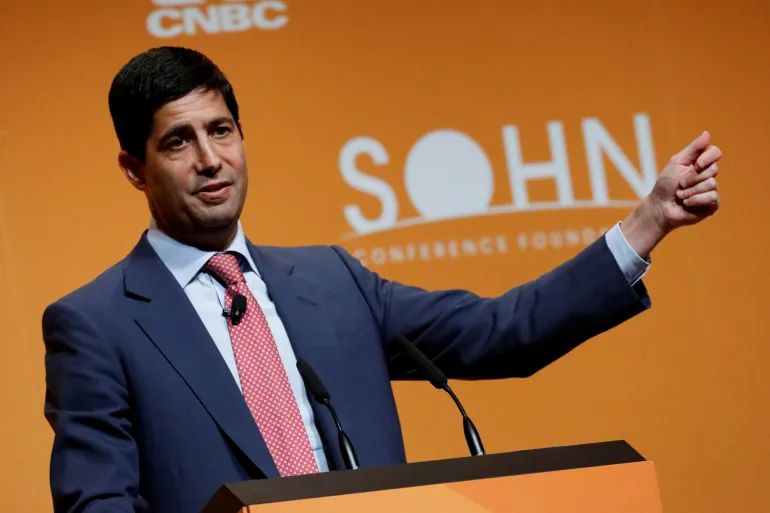
Warsh's crypto holdings list emerged through a 69-page government ethics document.

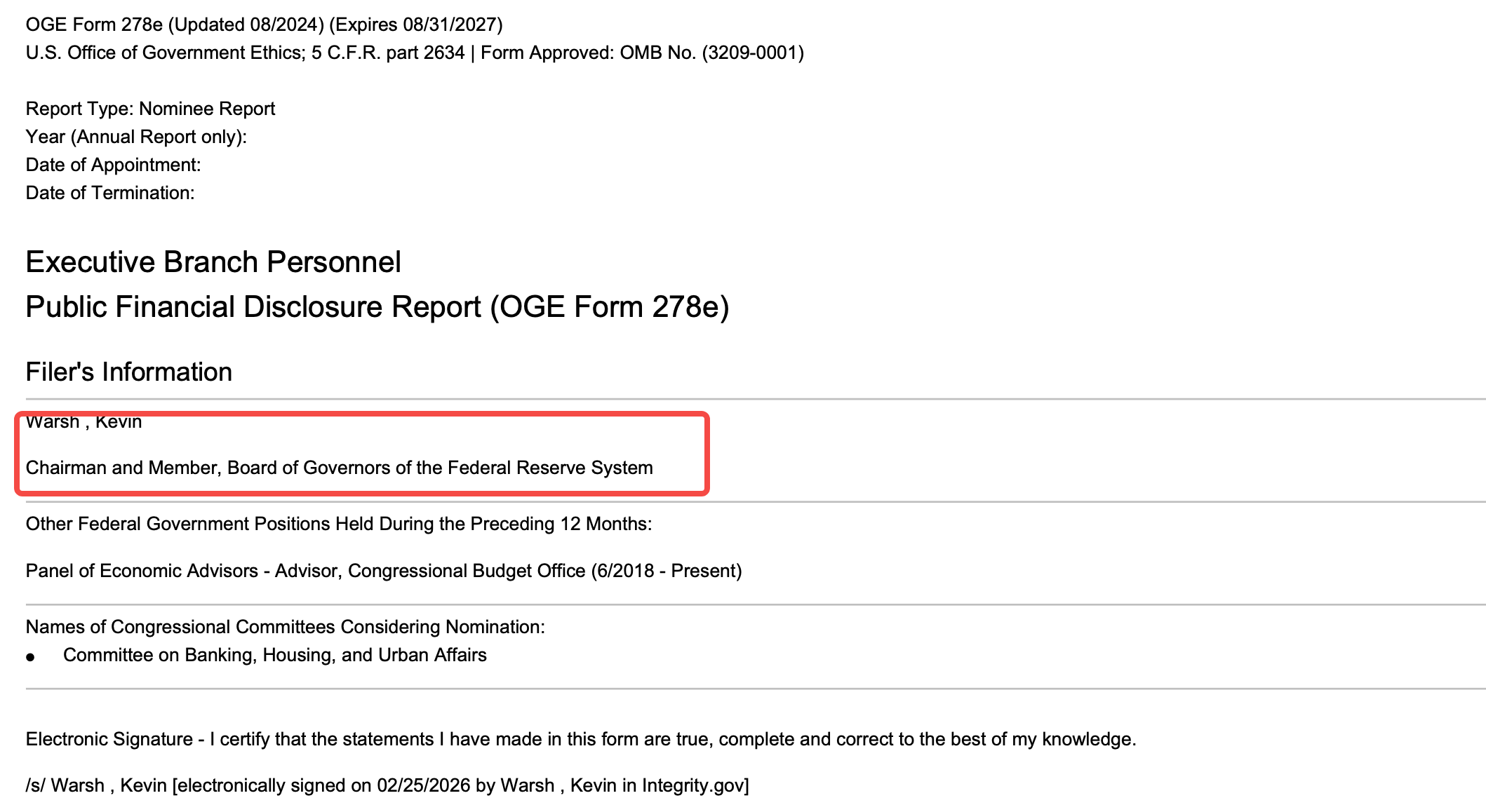
Fed Chair nominee Kevin Warsh submitted his financial disclosure to the U.S. Office of Government Ethics (OGE) on April 14th, the final procedural step before the Senate confirmation hearing. The document shows that Warsh and his wife Jane Lauder have combined assets of approximately $192 million, potentially more. But what truly captured the crypto industry's attention were the over twenty crypto and Web3-related holdings buried deep within the file.
Warsh had previously stated clearly in a public interview at the Hoover Institution: Bitcoin doesn't make him uncomfortable; he considers it an important asset that can help policymakers judge whether their decisions are correct. Now, the disclosure proves he's gone beyond mere words—his money is indeed on this track.

At Least 20 Crypto Entities: Nearly Full Coverage from L1 Public Chains to DeFi Protocols

Warsh's crypto exposure is distributed across multiple venture capital fund structures. Through the AVGF I fund, he indirectly holds interests in Solana, Optimism, and the Lightning Network; through DCM Investments 10 LLC, he holds stakes in dYdX and Polychain Capital, with the same vehicle also including dozens of fintech and Web3 projects like Compound, Lighter, Lemon Cash, and Blast (an Ethereum L2 protocol).

Under the AVF series of funds, crypto-related holdings also appear including Dapper Labs, Deso, Eulith, Onjuno, Ridian, Friends With Benefits, and Zero Gravity (an L2 AI blockchain platform). Warsh also directly holds shares worth $1,001 to $15,000 in Web3 company Metatheory Inc. through Founder Bets Master SPV LLC.
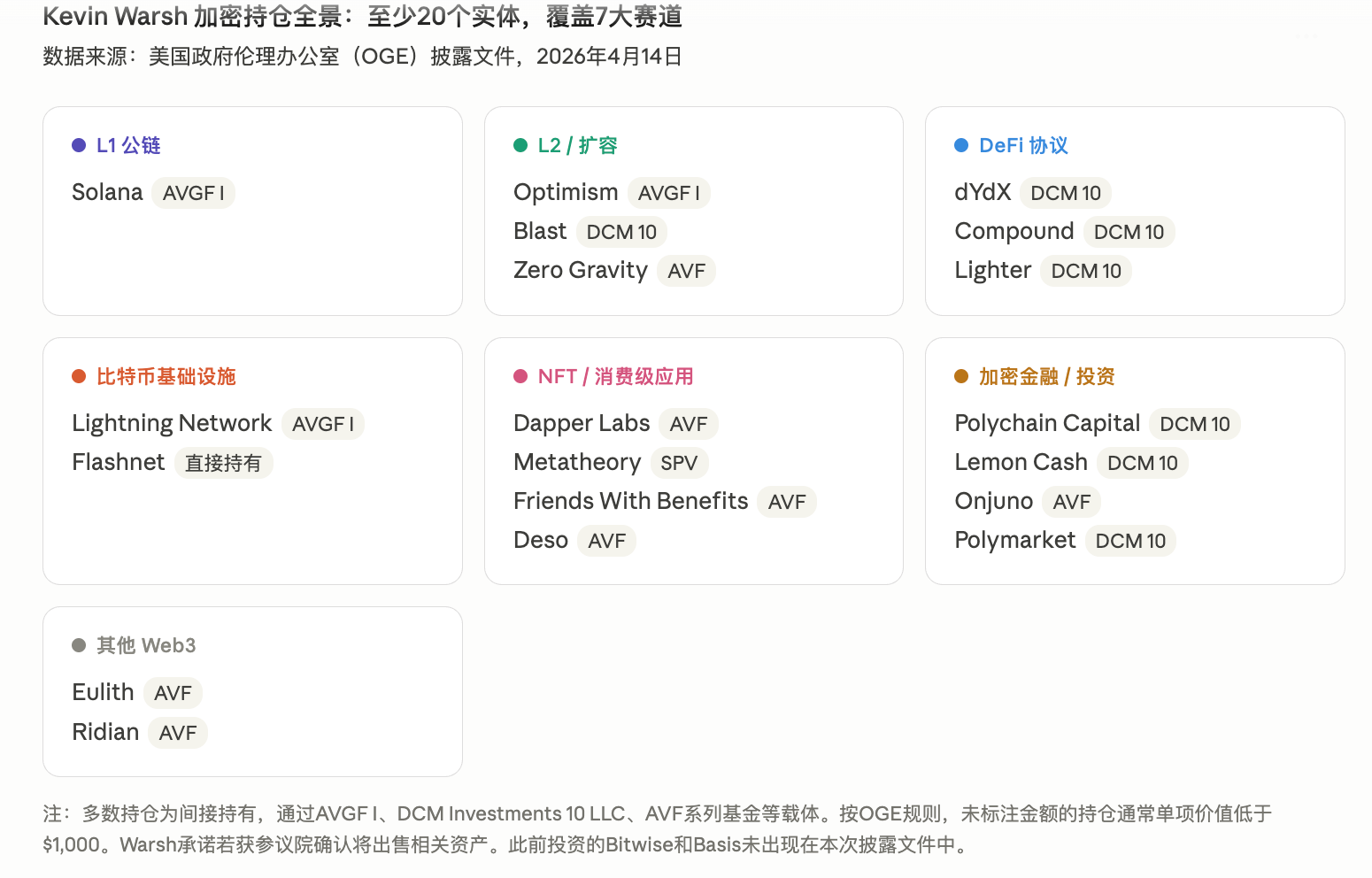
Furthermore, according to Bitcoin Magazine, Warsh also holds equity in Bitcoin payments startup Flashnet, a company positioned as a Bitcoin merchant payment system similar to the Lightning Network. Warsh had previously invested in crypto index management company Bitwise and algorithmic stablecoin project Basis, although these investments did not appear in this disclosure.

In terms of coverage, this holdings list touches nearly every major sector of the crypto industry: L1 public chains (Solana), L2 scaling (Optimism, Blast), DeFi protocols (dYdX, Compound), NFT infrastructure (Dapper Labs), prediction markets (Polymarket), Bitcoin payments (Flashnet, Lightning Network), and even social tokens (Friends With Benefits) and AI blockchain (Zero Gravity).

However, according to OGE rules, holdings without specified amounts typically mean the individual item is valued below $1,000, indicating these crypto positions are mostly small risk bets rather than concentrated positions.

Full Picture of $192 Million in Assets: Druckenmiller Advisory Fees, Juggernaut Fund & Opaque Holdings

Crypto holdings are just one corner of Warsh's vast asset portfolio.

The two largest investments in the file are two positions in the Juggernaut Fund LP, each marked as "over $50 million," but the underlying assets are not disclosed due to confidentiality agreements. Warsh has committed to selling all of these if confirmed. Additionally, about twenty-plus THSDFS LLC series holdings, with individual amounts up to $5 million, also have undisclosed underlying assets due to confidentiality clauses.

Regarding income, Warsh received a $10.2 million advisory fee from the Duquesne Family Office of Wall Street legend Stanley Druckenmiller. He also received $1.55 million from GoldenTree Asset Management, $750,000 from Cerberus Capital Management in advisory fees, and a $750,000 speaking fee from Brevan Howard—all institutions with digital asset trading businesses.

OGE certifying official Heather Jones noted in the review opinion that once Warsh completes the promised asset sales, he will meet the compliance requirements of the Ethics in Government Act.

Warsh's wife, Jane Lauder, is the granddaughter of Estée Lauder's founder, with Forbes estimating her personal net worth at approximately $1.9 billion.

Once Called Bitcoin a "Good Police for Policy," Now His Holdings Confirm His Judgment

Warsh's attitude toward Bitcoin is unique among past and current senior Fed officials.

As early as 2011, Warsh saw the Bitcoin whitepaper from Marc Andreessen at a dinner. In 2018, he wrote in The Wall Street Journal that Bitcoin could become a "sustainable store of value" similar to gold. In 2021, he stated on CNBC that for people under 40, Bitcoin is their new gold.

In 2025, in a Hoover Institution interview, he gave his most complete statement to date: Bitcoin is not a substitute for the dollar, but it can be a very good police for policy. He also characterized software development in the crypto industry as part of U.S. economic competitiveness.

For the crypto industry, Warsh's disclosure is a double-edged signal. On one hand, a Fed Chair with firsthand venture capital exposure to DeFi and blockchain infrastructure may understand the nuances of this technology better than his predecessors; on the other hand, forced sales and recusal obligations may limit his ability to translate these sympathetic attitudes into concrete actions early in his tenure.


İlgili Sorular

QWho is Kevin Warsh and what significant financial disclosure did he make?

AKevin Warsh is a nominee for the position of Federal Reserve Chair. He submitted a 69-page financial disclosure to the U.S. Office of Government Ethics, revealing a combined net worth of at least $192 million with his wife and indirect investments in at least 20 crypto-related entities.

QWhat are some of the major crypto projects and companies that Kevin Warsh has indirect investments in?

AHis disclosed crypto investments include Solana, dYdX, Polychain Capital, Optimism, Dapper Labs, Compound, Lightning Network, Blast, and Flashnet, covering sectors like L1 blockchains, L2 scaling, DeFi, NFTs, and Bitcoin payments.

QWhat is the significance of Kevin Warsh potentially becoming the Federal Reserve Chair with these crypto holdings?

AIf confirmed, Kevin Warsh would be the first Federal Reserve Chair to have a venture capital exposure to the cryptocurrency market, indicating a potential for a more nuanced understanding of the technology within the highest levels of U.S. monetary policy.

QWhat was Kevin Warsh's previous public stance on Bitcoin and cryptocurrency?

AWarsh has publicly stated that Bitcoin does not make him uneasy, views it as an important asset that can act as a 'good police' for policy makers to judge their decisions, and has referred to it as 'new gold' for people under 40.

QWhat are the two largest investments in Warsh's portfolio and what is the plan for them if he is confirmed?

AThe two largest investments are two positions in the Juggernaut Fund LP, each valued at 'over $50 million'. Warsh has committed to divest these holdings, along with other specified assets, if his nomination is confirmed to comply with government ethics rules.

İlgili Okumalar

Uncovering the Truth About Agent Commerce, Payments, and Infrastructure

Decoding Agent Commerce, Payments, and Infrastructure: The Reality Over the past year, I've been building infrastructure for the Agent economy, engaging with major players like Stripe, Visa, Coinbase, Google, and dozens of startups. A clear conclusion emerges: true, large-scale demand does not yet exist. Startups face structural challenges. Data points illustrate this gap. Stripe's Agent commerce platform has over 1,000 merchants but only single-digit transacting agents. Visa's Agent payment token requires 9-month KYC and a $250M revenue threshold, accessible only to giants like Amazon. On-chain analysis reveals actual daily Agent transaction volume is around $17k, half of which are test transactions. The article analyzes four potential markets: **1. Agent-to-Merchant (A2M):** Current AI shopping UX is often inferior to traditional e-commerce for visual, comparison-heavy purchases (clothing, electronics). Chat interfaces are a step back. Real merchant interest is defensive "Agent Engine Optimization," fearing future obsolescence, not current demand. Potential exists in high-frequency, low-decision purchases (e.g., food delivery) or simplifying terrible UX (complex checkouts, non-native shoppers), but these require massive consumer distribution channels dominated by giants like DoorDash and Amazon. **2. Agent-to-API (A2A):** Developers already have subscriptions and billing for core APIs (compute, data). The argument for micro-payments via crypto for sub-dollar API calls is addressed by pre-paid balances today. The deeper issue is supplier resistance; major SaaS firms rely on enterprise contracts, not fractional cent pricing. Opportunity lies in the long tail of niche services, but this is a smaller market catering to developers, a historically low-paying group. **3. Agent-to-Agent (A2A):** This remains a theoretical long-term vision with near-zero current transaction volume. It involves unique challenges: discovery, trust, negotiation, dispute resolution. When it materializes, it will require a fundamentally new settlement infrastructure for high-speed, variable-value, multi-party transactions. It's a real long-term bet, but not the current market. **4. Agent-to-Finance (A2F):** This is the only category with existing, paying demand. Integrating AI into financial workflows (trading, portfolio management) is a natural evolution and enables new capabilities like autonomous rebalancing. However, competition favors incumbents with regulatory licenses, compliance infrastructure, and existing client relationships. **The Real Issue:** Why is infrastructure still being built? Incumbents can afford long-term bets, and payment companies see every problem as a nail for their payment hammer. However, payment is just one piece. The core challenge is *coordination*—orchestrating work between Agents and humans, verifying outcomes, and settling results. Payment is part of settlement, which is part of coordination. Companies that solve the coordination problem will subsume payments, not the other way around. Startups lack the infinite runway of giants and must find today's real market, which, after a year of exploration, lies outside these four categories—in an area with real, growing, and underserved activity.

marsbit1 saat önce

Uncovering the Truth About Agent Commerce, Payments, and Infrastructure

marsbit1 saat önce

Kalshi, MTS, and a16z's Ambition

The article "Kalshi, MTS, and a16z's Ambition" explores prediction markets as a focal point of excitement in 2025 for investors, crypto enthusiasts, and media. It traces their intellectual lineage from Friedrich Hayek's ideas on dispersed knowledge and market coordination to Robin Hanson's Logarithmic Market Scoring Rule (LMSR), which incentivizes truthful information sharing. The piece argues that a16z's significant investment in prediction market platform Kalshi (valued at $220B) transcends mere financial speculation. a16z frames prediction markets as a new form of "media" that provides "presence"—a way for individuals to actively engage with and influence world events through financial stakes, countering postmodern detachment. By wagering on outcomes, users become "super observers," and the market's aggregated probabilities gain authoritative power to define event truth and importance. The article uses media company MTS ("Monitoring The Situation") as a case study of a16z's "new media" strategy: rapidly producing high-intensity, multi-format content to "take over the timeline." However, prediction markets like Kalshi are presented as the ultimate piece in this media empire. Their real-money, crowd-sourced probabilities possess a unique "reality distortion field" and perceived objectivity, potentially swaying public opinion and granting a private company unprecedented interpretive power over reality. Ultimately, Kalshi's immense valuation is attributed not just to its exchange model, but to its role as a foundational component in a16z's envisioned new media landscape, where prediction markets define narrative and truth.

链捕手1 saat önce

Kalshi, MTS, and a16z's Ambition

链捕手1 saat önce

İşlemler

Spot
Futures

Popüler Makaleler

DYDX Nasıl Satın Alınır

HTX.com’a hoş geldiniz! dYdX (DYDX) satın alma işlemlerini basit ve kullanışlı bir hâle getirdik. Adım adım açıkladığımız rehberimizi takip ederek kripto yolculuğunuza başlayın. 1. Adım: HTX Hesabınızı OluşturunHTX'te ücretsiz bir hesap açmak için e-posta adresinizi veya telefon numaranızı kullanın. Sorunsuzca kaydolun ve tüm özelliklerin kilidini açın. Hesabımı Aç2. Adım: Kripto Satın Al Bölümüne Gidin ve Ödeme Yönteminizi SeçinKredi/Banka Kartı: Visa veya Mastercard'ınızı kullanarak anında dYdX (DYDX) satın alın.Bakiye: Sorunsuz bir şekilde işlem yapmak için HTX hesap bakiyenizdeki fonları kullanın.Üçüncü Taraflar: Kullanımı kolaylaştırmak için Google Pay ve Apple Pay gibi popüler ödeme yöntemlerini ekledik.P2P: HTX'teki diğer kullanıcılarla doğrudan işlem yapın.Borsa Dışı (OTC): Yatırımcılar için kişiye özel hizmetler ve rekabetçi döviz kurları sunuyoruz.3. Adım: dYdX (DYDX) Varlıklarınızı SaklayındYdX (DYDX) satın aldıktan sonra HTX hesabınızda saklayın. Alternatif olarak, blok zinciri transferi yoluyla başka bir yere gönderebilir veya diğer kripto para birimlerini takas etmek için kullanabilirsiniz.4. Adım: dYdX (DYDX) Varlıklarınızla İşlem YapınHTX'in spot piyasasında dYdX (DYDX) ile kolayca işlemler yapın.Hesabınıza erişin, işlem çiftinizi seçin, işlemlerinizi gerçekleştirin ve gerçek zamanlı olarak izleyin. Hem yeni başlayanlar hem de deneyimli yatırımcılar için kullanıcı dostu bir deneyim sunuyoruz.

139 Toplam GörüntülenmeYayınlanma 2024.12.13Güncellenme 2026.06.02

DYDX Nasıl Satın Alınır

Tartışmalar

HTX Topluluğuna hoş geldiniz. Burada, en son platform gelişmeleri hakkında bilgi sahibi olabilir ve profesyonel piyasa görüşlerine erişebilirsiniz. Kullanıcıların DYDX (DYDX) fiyatı hakkındaki görüşleri aşağıda sunulmaktadır.

活动图片