From the Wild Path to the Table: Why Compliance is the Inevitable Route

比推Publié le 2026-02-09Dernière mise à jour le 2026-02-09

Résumé

The article "From the Fringes to the Main Table: Why Compliance is the Inevitable Path" discusses the critical shift toward regulatory compliance in the cryptocurrency and blockchain industry, using key players like Binance, Coinbase, and Hyperliquid as case studies. It highlights how Binance leveraged regulatory arbitrage to become a global leader by 2017 but faced increasing pressure from regulators, leading to its compliance efforts in jurisdictions like Abu Dhabi (ADGM) by 2025. Meanwhile, Coinbase capitalized on U.S. regulatory frameworks under evolving policies, though its growth in derivatives markets remained limited. Hyperliquid emerged as a significant player by exploiting gaps left by larger exchanges, capturing about 15% of Binance's market share through derivatives and ventures into non-traditional areas like precious metals and prediction markets—yet its long-term sustainability hinges on eventual compliance. The piece argues that compliance is no longer optional but essential for scalability and legitimacy, especially as Real-World Assets (RWA)—such as tokenized stocks, bonds, and stablecoins—gain traction. Regulatory clarity, particularly from the U.S. and China, is reshaping the landscape, forcing once-"underground" economies to formalize or risk exclusion from major markets. The conclusion underscores that while regulatory arbitrage offers short-term advantages, the future of crypto and DeFi depends on integrating into established financial systems und...

Written by: Zuo Ye

Original Title: Compliance is the Coming-of-Age Ceremony for the Underground Economy


In 2017, Binance rapidly became the world's number one through regulatory arbitrage, but in 2025, the more liberal Hyperliquid could only capture 15% of Binance's market share. Does RWA, as a source of underlying assets for DeFi, have the space for regulatory arbitrage and a scalable future?

Compliance has become the main theme of 2026. The offshore exchange Binance officially went onshore in the UAE's ADGM, Coinbase scored two major wins with the Talent Act and the Clarity Act, and even the Eastern power has "in principle" tested the waters of RWA regulation.

We are at a clear inflection point. Blockchain will not replace the internet, Web3 is just a self-righteous scam, the listing effect ended with Binance's purchase of Bitcoin. However, Hyperliquid is making strides in precious metals and prediction markets, while the tokenization of RWA—represented by currencies (stablecoins), stocks (U.S. stocks), bonds (U.S. bonds, subprime bonds), and funds (hedge, active)—is happening now.

Against this backdrop, compliance has evolved beyond the symbolic role of "holding a small country's license to arbitrage a large country's regulations" into a real framework separating trading, clearing, and custody. When the industry breaks through scale limitations, regulatory benefits will become profitable.

In the quiet moments, compliance not only signifies the end of the last era of reckless expansion, but also, amidst the rumbling thunder, there will always be tracks with arbitrage space for development in exchange for scale.

Let's start with exchanges to glimpse the economic considerations beyond compliance.

Civilized Wall Street, Crazy Barbarians

Barbarian conquerors are, by an eternal law of history, themselves conquered by the superior civilization of their subjects.

In 2022, FTX collapsed dramatically. Wall Street once harbored ambitions to dominate the exchange赛道. Citadel Securities, Fidelity, and Charles Schwab collaborated to launch EDX Markets in Singapore, operating under the Singapore MAS compliance framework based on the principle of separating trading and custody.

With Gary Gensler's SEC relentlessly pursuing Binance, Coinbase and Kraken were confined to the U.S. spot market,迟迟 unable to venture into高端 markets like futures and options. At that time, the market also had high hopes for EDX Markets.

If nothing unexpected happened, we should have witnessed Binance's fall, similar to BitMEX after the March 12, 2020 crash. But history never repeats itself. Hyperliquid was the real winner. The weakened Binance and the still U.S.-confined Coinbase were surprisingly not the protagonists of the next act.

To understand the winner's experience, one must first understand the loser's lessons.

After its establishment in 2017, Binance did at least two things right:

  • While actively embracing going overseas, it continued to accept users from mainland China, creating a seesaw effect between trading volume刷量 and user scale;

  • In 2019, it launched IEO (Initial Exchange Offering), creating real wealth effects before DeFi Summer.

After the September 4 ban, providing trading services to users in mainland China entered a "gray area." The third regulation directly targeted trading platforms, requiring them not to provide services like quotation, matching, and clearing. If we refer to He Yi's response to Cathie Wood, Binance would respond by "not providing services to users in mainland China."

From 2017 to 2019, Binance secured its position as the world's number one offshore exchange. From 2020 to 2022, Binance filled the futures market gap left by BitMEX. From 2022 to 2024, Binance dominated the global altcoin market, where the listing effect was equivalent to the "listed on Binance" effect.

Entering 2025, Binance officially came under the compliance framework of Abu Dhabi's ADGM in the UAE, dividing itself into three entities: trading, clearing, and over-the-counter, but this still retained Binance's characteristic arbitrage.

Especially since compliance did not stop Binance's listing team from adding Meme coins. Secondly, ADGM and the entire UAE financial system simply lack the capacity to regulate a behemoth like Binance. One can refer to the Bahamas' helplessness regarding FTX's global站.
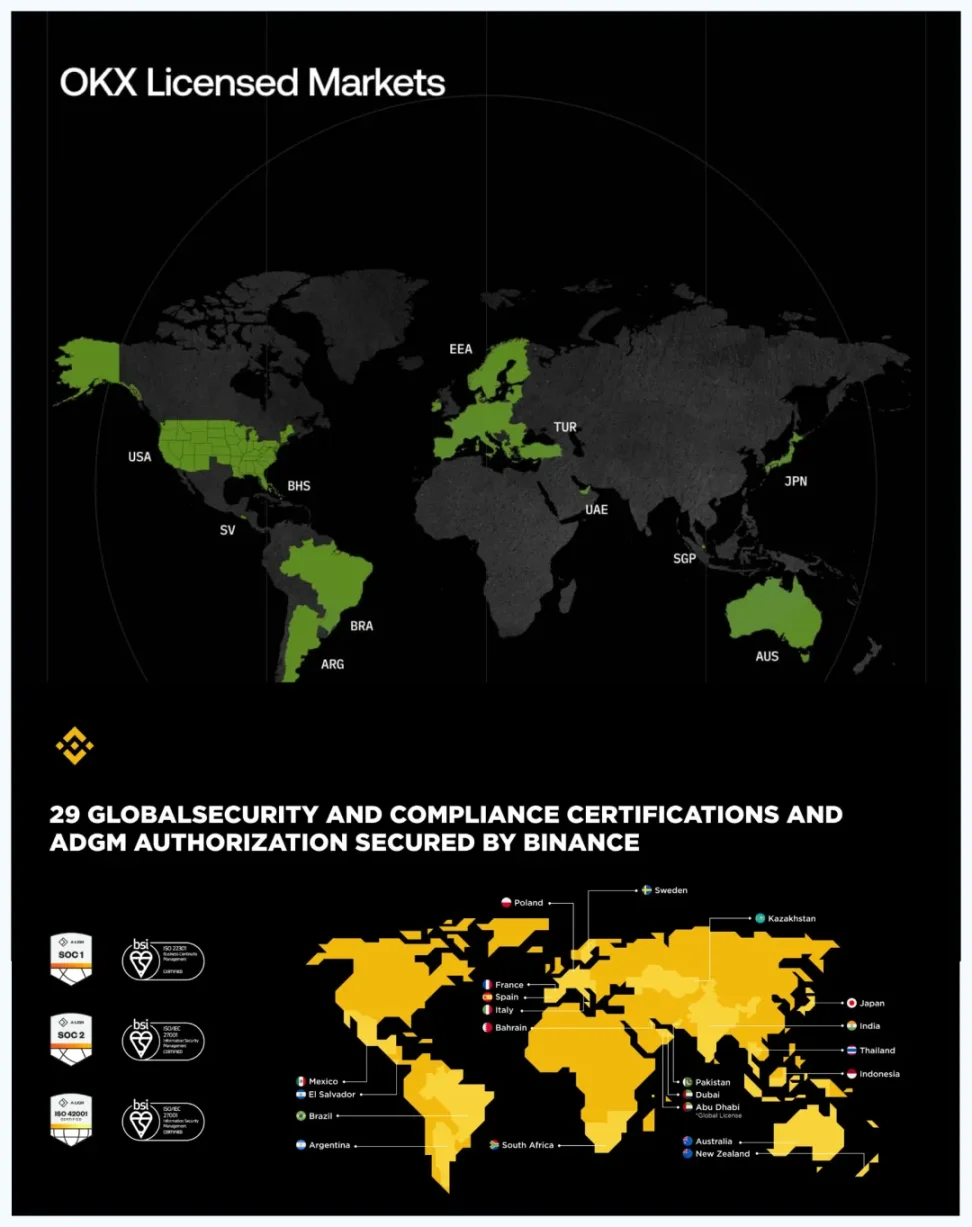
Image Caption: "Passing the Civil Service Exam" to go ashore, Image Source: @binance @okx

Coinbase was the most compliant after FTX's collapse, but this compliance stemmed from Trump's post-election restructuring of the SEC, CFTC, and OCC, demanding they adopt more crypto-friendly regulatory measures.

Roughly, the SEC is responsible for reviewing whether a token meets the definition of a security, the CFTC oversees derivatives trading, and the OCC manages banking licenses for custody services. The U.S. does not have a license类似 ADGM's "crypto exchange license"; it only has regulatory scopes divided by business type.
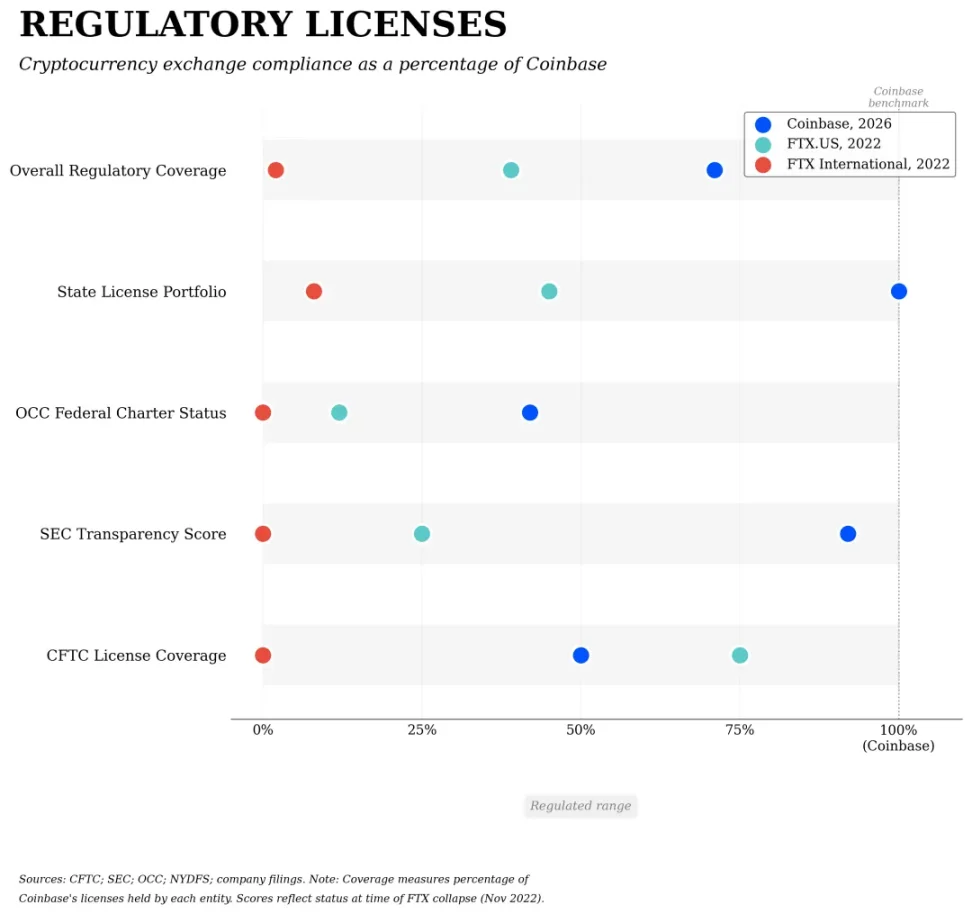
Image Caption: Regulatory Progress, Image Source: @zuoyeweb3

The construction of this regulatory framework is still ongoing, but it's certain that Coinbase will shape the U.S. compliance framework, covering listing (spot, futures), trading (spot, futures), custody (retail, institutional), clearing/settlement (fiat, crypto), audit (technical, asset)/insurance (fiat, crypto) aspects.

Binance's licensing under ADGM and Coinbase's licensing in the U.S. are completely different concepts. The latter's licensing will actually fall under the management of regulatory agencies.

Regulation is about clarifying rules, not protecting retail interests. For example, institutional clients enjoy bankruptcy isolation protection in Coinbase's custody business, corresponding to the entity Coinbase Custody Trust Company.

However, funds deposited by ordinary retail users into Coinbase correspond to the entity Coinbase Inc. If it's fiat currency, it might be protected by the corresponding bank's FDIC deposit insurance, but crypto assets could very well meet the same fate as FTX.

For instance, purchasers of the FTX token FTT were deemed equity owners and were not strictly protected in claims. Coinbase is similar. The only good news is that Coinbase has not faced a run on its funds.

Hyperliquid Enters the RWA Field "Unlicensed"

Human progress will no longer be like the terrible pagan idol, who would not drink the nectar but from the skulls of the slain.

Regulatory arbitrage still exists. In the crypto asset trading field, EDX's American compatriot Hyperliquid also started in Singapore and is蚕食 (eroding) Binance's global market and Coinbase's U.S. market.

This can be called "second-order arbitrage": Binance arbitrages global regulations, Hyperliquid arbitrages Binance.
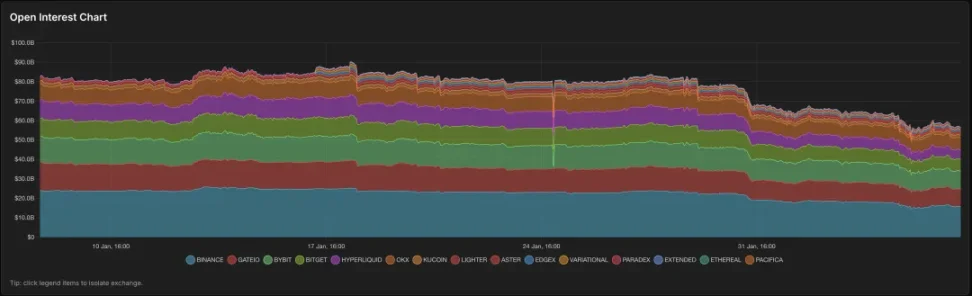
Image Caption: CEX and DEX are hard to distinguish, Image Source: @LorisTools

Hyperliquid blocks U.S. IP addresses, but this block has no practical effect. Compare this to the fact that U.S. users can almost never open an account on Binance Global站, only on Binance US.

Coinbase just began allowing futures business for U.S. users, but its business volume is almost negligible. Thus, in a bizarre space, Hyperliquid captured some European and American users outside of Binance and Coinbase, engaging in derivatives business.

But note, Hyperliquid's arbitrage cannot replicate Binance's growth miracle, nor can it learn from Coinbase to capture the U.S. compliant market. It can probably only capture about 15% of Binance's market share.

As Hyperliquid expands into non-traditional businesses like precious metals and prediction markets, its impact on the global financial market is gradually strengthening. If the U.S. can regulate Binance and Tornado Cash, then action against Hyperliquid would not meet resistance from Singapore either.

Ultimately, most "underground economy" models cannot enter the realm of scale. Take USDT as an example; it has become increasingly strict in its issuance reserves and circulation bans. The Bybit hacker放过 (spared) USDT and the freezing of black USDT after the Huione case are clear evidence.

  • Huione can support the entire underground economy of Cambodia and even Southeast Asia, but Cambodia cannot bear the cost of being placed on FATF's money laundering "grey list."

  • Binance can support the BNB chain economy dominated by altcoins, but the squeeze between China and the U.S. prevents Binance from accessing higher-quality trading assets.

This is essentially due to the U.S.'s advantage of low regulatory costs. The core of U.S. external economic sanctions is not the dollar and the U.S. military. The U.S. is the world's largest single consumer market and the most important financial market. Once Cambodia and Binance are cut off from the U.S., their fate would be like North Korea's.

This is why Binance pays a high price to become compliant, and why Hyperliquid's compliance is only a matter of time.

This leads to an extended discussion: can RWA replicate the trajectory of the crypto asset trading赛道, i.e., preserve itself through regulatory arbitrage and develop its volume within a compliance framework?

This is based on the dual premise that Hyperliquid, in the crypto asset trading field, almost certainly cannot surpass Binance, and in terms of compliance, almost certainly cannot surpass Coinbase.

If we were in 2017, CZ himself might not have believed that CEX was the future. Looking back, stamp coins, P2P, O2O, ofo were all fleeting. Looking forward, DeFi mining, NFT, GameFi, SocialFi all ended without result.

So Binance and BNB should be understood as project-based. Their光环 (halo) is constantly extended by wealth effects. They should have ended hastily, like one financial bubble after another.

But under network effects, the network effect of trading breaks free from the constraints of crypto assets and enters all financial fields, thus meeting RWA in a broad sense. Yield-bearing stablecoins冲击 (impact) CBDC, and asset-based securitization will迟早 (sooner or later) be tokenized.

For example, the recent regulatory guidelines from the Eastern power are essentially an overflow of the U.S. impact in the financial field, which will rewrite on-chain finance in a peculiar way.
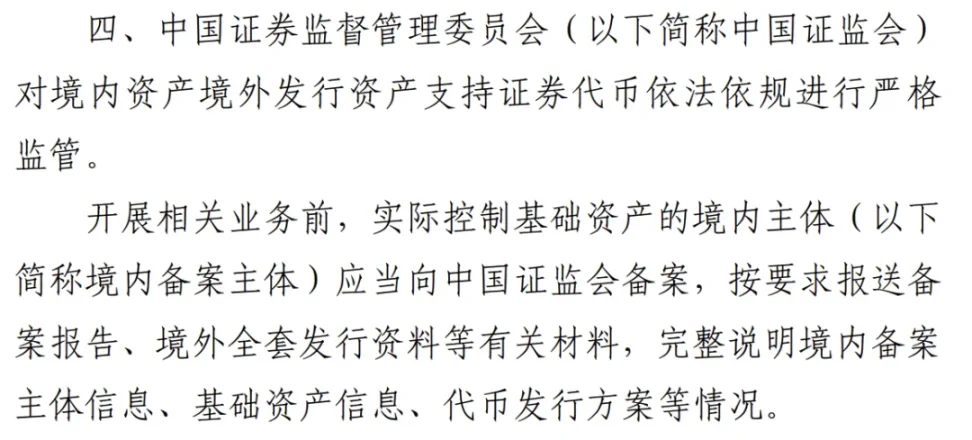
Image Caption: The flower blooms inside the wall, but its fragrance is enjoyed outside

Regarding the new regulatory measures from the Eastern power, Caixin's interpretation divides them into four categories: foreign debt, equity, asset securitization, and others. But in my view, the only meaningful aspect is the opening for security tokenization, aligning with the reform direction of "securitizing all assets." Regarding this:

  • Clearly identifies the CSRC as the competent authority

  • Requires CSRC approval for issuance

  • Only allows issuance from within the territory to outside the territory

Furthermore, these security tokenization guidelines clearly state that both rights and收益 (profits) must be compliant. This corresponds to the SEC's encouragement of the evolution of native "stock tokenization." Overseas RMB stablecoins, foreign debt, and funds are more特殊 (special cases).

  • Overseas offshore RMB stablecoin business has always existed, and Tether, the issuer of USDT, is also involved, but it lacks practical use, and the business volume is very small;

  • Overseas bond issuance and fund tokenization are already happening de facto, completely isolated from domestic assets and issued to overseas clients, unrelated to these guidelines.

This regulation involves the overseas issuance of domestic assets, essentially emphasizing this isolation: what is overseas belongs overseas, what is domestic belongs domestic. Only when the two交叉 (intersect) is there a need to enter the regulatory process.

In the current RWA field, China and the U.S. are already de facto engaged in a land grab. This liquidity溢出 (spillover) onto the chain is enough to rewrite the current financial landscape.

Conclusion

The destiny of an industry depends, of course, on self-striving, but also on the course of history.

CZ might not even believe CEX is the future himself. Even Bitcoin is just a stage of a new form of pyramid scheme, quickly becoming a historical term that vanishes with the wind, like P2P, high-interest loans.

But no one expected CEX to survive until 2026. Hyperliquid is charging into new forms like precious metals and prediction markets, but it still hasn't Flipped Binance.

If we add RWA to Hyperliquid, can it reach the other shore this time?


Twitter:https://twitter.com/BitpushNewsCN

Bitpush TG Discussion Group:https://t.me/BitPushCommunity

Bitpush TG Subscription: https://t.me/bitpush

Original Link:https://www.bitpush.news/articles/7610212

Questions liées

QWhat are the two key factors that contributed to Binance's rapid growth according to the article?

AAccording to the article, Binance did two things right: 1) It continued to accept users from Mainland China while actively expanding overseas, creating a seesaw effect between trading volume and user scale. 2) It launched IEO (Initial Exchange Offering) in 2019, creating a real wealth effect before the DeFi Summer.

QHow does the article differentiate between Binance's licensing in ADGM and Coinbase's licensing in the US?

AThe article states that Binance's licensing under the ADGM framework and Coinbase's licensing in the US are completely different concepts. Binance's licensing involves dividing itself into trading, clearing, and over-the-counter entities but retains its characteristic arbitrage, and the ADGM lacks the capacity to regulate a behemoth like Binance. In contrast, Coinbase's licensing in the US will place it under the actual management scope of US regulators, shaping a comprehensive US compliance framework covering listing, trading, custody, clearing/settlement, and auditing/insurance.

QWhat is the 'second-order arbitrage' mentioned in the context of Hyperliquid?

AThe 'second-order arbitrage' refers to Hyperliquid arbitraging Binance's position. While Binance arbitraged global regulations to become a top exchange, Hyperliquid is now arbitraging the opportunity created by Binance's restrictions, capturing a segment of users (including some from Europe and the US) that are not fully served by the compliant but limited Coinbase or the restricted Binance, particularly in derivatives trading.

QWhat is the core reason cited in the article for why entities like Binance and Cambodia's Huione Pay ultimately seek compliance, despite operating in 'grey areas'?

AThe core reason is the immense economic power of the United States. The US possesses a low regulatory cost advantage and is the world's largest single consumer market and most important financial market. The threat of being cut off from the US financial system and facing consequences like being placed on the FATF 'grey list' for money laundering is a powerful incentive for these entities to seek compliance to maintain global market access.

QAccording to the article's analysis, what is the significant aspect of the new Eastern power's (implied to be China) regulatory guidance on RWA?

AThe significant aspect is that it provides an opening for the securitization of tokens, aligning with a broader reform direction of 'securitizing all assets.' It mandates that the China Securities Regulatory Commission (CSRC) is the competent authority, requires CSRC approval for issuance, and only allows domestic-to-overseas issuance, emphasizing the separation between onshore and offshore activities for cross-border tokenized securities.

Lectures associées

Le parti colombe de la Fed se tourne collectivement vers la fauconnerie, la première performance de Warsh entre deux feux

Des responsables de la Réserve fédérale, autrefois favorables à une baisse des taux (colombes), y compris Christopher Waller, ont récemment indiqué qu’une hausse n’était pas exclue, laissant presque plus aucun membre du comité en faveur d’un assouplissement. La première réunion présidée par le nouveau président Kevin Warsh pourrait ainsi envoyer un signal : la prochaine étape de la Fed pourrait être un relèvement des taux. Warsh, nommé par le président Trump pour ses positions accommodantes, arrive à un moment délicat. L’inflation américaine dépasse désormais 3 %, le marché du travail se renforce et des tensions sur les prix persistent. Les raisons qui justifiaient une baisse des taux s’effacent une à une. Le changement d’orientation est net. Christopher Waller, qui plaidait pour une baisse début 2024, déclare désormais ne plus pouvoir exclure une future hausse. Même des membres modérés comme Lisa Cook se disent prêts à relever les taux si la baisse de l’inflation tarde trop. Les faucons, tels que Beth Hammack et Lorie Logan, estiment depuis longtemps que les conditions justifient un resserrement et mettent en garde contre le risque d’une inflation ancrée. Lors de sa première réunion, la Fed devrait maintenir son taux directeur mais supprimer toute mention d’une orientation accommodante dans son communiqué, indiquant ainsi que hausse et baisse sont désormais des options équivalentes. Les projections des membres (« point plot ») devraient refléter moins de baisses de taux attendues cette année, voire quelques hausses. Warsh, critique des outils de communication de la Fed comme le « point plot », se trouve dans une position difficile : il doit gérer un comité qu’il n’a pas formé, utiliser des méthodes qu’il a longtemps contestées, et possiblement conduire la politique vers une direction contraire aux souhaits du président qui l’a nommé. Son entrée en fonction marque un tournant net vers un possible resserrement monétaire.

marsbitIl y a 1 h

Le parti colombe de la Fed se tourne collectivement vers la fauconnerie, la première performance de Warsh entre deux feux

marsbitIl y a 1 h

« Yi Zhong Tian » à un billion de dollars de capitalisation boursière, qui est le vrai champion du rapport qualité-prix ?

L'article analyse les trois leaders chinois du secteur des modules optiques, surnommés "Yi Zhong Tian" (d'après les noms Xinyisheng, Zhongji Innolight et TFC Optical Communication), qui ont connu une hausse spectaculaire de leur valorisation, dépassant 1 000 milliards de yuans. L'accent est mis sur la comparaison de leur "rapport qualité-prix" en termes d'investissement. Xinyisheng présente le ratio PEG le plus bas (environ 0,30) et une bonne qualité de bénéfices, mais sa décote reflète des risques : forte dépendance à quelques clients, exposition aux tensions commerciales et incertitudes sur sa croissance durable. Zhongji Innolight, le leader du marché, bénéficie de la plus forte prime pour sa position dominante (plus de 50% des parts de marché sur les modules 800G de NVIDIA) et son avance technologique. Son principal risque est géopolitique, après son inscription sur une liste du département américain de la Défense. TFC Optical Communication, fournisseur de composants en amont, a la marge brute la plus élevée et parie sur la future architecture CPO/NPO. Cependant, sa valorisation est très élevée (PER élevé) et sa croissance est plus stable, moins sensible aux cycles d'investissement AI que les assembleurs de modules. Enfin, l'article souligne un défi sous-jacent : la vraie valeur et les profits durables se situent en amont de la chaîne, dans les puces laser et les semi-conducteurs, dominés par des entreprises comme Coherent et Lumentum. La pérennité à long terme des "Yi Zhong Tian" dépendra de la capacité de l'industrie chinoise à monter en gamme et à capturer cette partie de la valeur ajoutée.

marsbitIl y a 1 h

« Yi Zhong Tian » à un billion de dollars de capitalisation boursière, qui est le vrai champion du rapport qualité-prix ?

marsbitIl y a 1 h

Le marché de la cryptographie a-t-il touché le fond ? Voici ce qu'en pensent les institutions

Le marché des cryptomonnaies a-t-il atteint son point bas ? Trois institutions financières présentent des analyses divergentes. Galaxy Digital estime que le fond n'est pas encore atteint. Sur la base de 13 indicateurs historiques (tels que la moyenne mobile sur 200 semaines et l'indice de peur et de cupidité), seuls 4 signaux sont pleinement activés. Leur analyse suggère un creux potentiel entre 30 000 et 54 000 dollars, avec un scénario neutre entre 40 000 et 46 000 dollars. NYDIG adopte une position plus nuancée. Bien que de nombreux indicateurs soient proches des niveaux de creux historiques, l'absence d'une vente de panique généralisée typique des marchés baissiers majeurs persiste. L'institution note que l'entrée des investisseurs institutionnels pourrait avoir modifié la dynamique des cycles, permettant un creux moins prononcé que par le passé. À l'inverse, la Standard Chartered affirme que le fond a été touché à environ 59 000 dollars. La banque s'appuie sur deux facteurs : une éventuelle détente diplomatique entre les États-Unis et l'Iran, et l'hypothèse que les ventes récentes dans les ETF Bitcoin étaient liées à la préparation de l'introduction en bourse anticipée de SpaceX. Elle prévoit désormais que le Bitcoin pourrait atteindre 100 000 dollars d'ici la fin de l'année. Malgré ces divergences sur le niveau exact du creux, les trois rapports s'accordent sur des points essentiels pour les investisseurs à long terme : 1. Le fond du marché devrait être atteint au cours de l'année 2024. 2. Le prix actuel est plus proche du creux que des sommets précédents. 3. Une nouvelle phase haussière (bull market) pour le Bitcoin reste attendue à l'avenir. L'article conclut que, quelle que soit la fourchette exacte du creux (entre 40 000 et 60 000 dollars), la perspective d'une remontée vers 100 000 dollars ou plus offre un potentiel de rendement significatif pour les investisseurs patients. Les fondamentaux à long terme du Bitcoin, comme l'endettement public mondial, l'inflation et l'adoption numérique, restent solides, rendant le contexte actuel plus favorable que lors des hivers cryptographiques précédents.

marsbitIl y a 1 h

Le marché de la cryptographie a-t-il touché le fond ? Voici ce qu'en pensent les institutions

marsbitIl y a 1 h

La "Douleur du Cœur" et la Percée de la Chaîne Industrielle Photonique Chinoise

Dans la course mondiale à l'IA, les modules optiques, qui assurent la conversion et la transmission des données entre les GPU, sont des éléments clés. Leur composant essentiel, la puce DSP haute performance, est dominé par les entreprises américaines Marvell et Broadcom, détenant plus de 90% du marché des hauts débits (800G/1.6T). Les fabricants chinois de modules optiques, leaders mondiaux de l'assemblage (comme Zhongji Innolight et Eoptolink), dépendent de ces fournisseurs pour leurs exportations vers les géants de l'IA nord-américains. Cette dépendance crée une vulnérabilité, mais une interdiction totale est improbable à court terme. Marvell et Broadcom dépendent fortement du marché chinois (environ 56% des revenus pour la région) et de la chaîne d'approvisionnement locale pour l'assemblage et les composants optiques. De plus, les puces à semi-conducteurs comme les EML laser (domaine de Lumentum) présentent un risque moindre grâce à une concurrence plus diversifiée et des progrès plus rapides dans les substituts chinois. Pour atténuer les risques, l'industrie chinoise peut : à court terme, diversifier ses fournisseurs et ses marchés ; à moyen terme, promouvoir l'adoption à grande échelle de puces DSP et optiques nationales (Huawei Hisilicon, Innochips, etc.) sur le marché intérieur ; et à long terme, accélérer la R&D sur les DSP hauts débits et les nouvelles technologies comme la photonique sur silicium et l'OPC. La solution durable réside dans l'autonomisation de la chaîne d'approvisionnement en puces de haute technologie, en s'appuyant sur la force du marché intérieur et des capacités de fabrication.

marsbitIl y a 1 h

La "Douleur du Cœur" et la Percée de la Chaîne Industrielle Photonique Chinoise

marsbitIl y a 1 h

Trading

Spot
Futures

Articles tendance

Comment acheter ROUTE

Bienvenue sur HTX.com ! Nous vous permettons d'acheter Router Protocol (ROUTE) de manière simple et pratique. Suivez notre guide étape par étape pour commencer votre parcours crypto.Étape 1 : Création de votre compte HTXUtilisez votre adresse e-mail ou votre numéro de téléphone pour ouvrir un compte sur HTX gratuitement. L'inscription se fait en toute simplicité et débloque toutes les fonctionnalités.Créer mon compteÉtape 2 : Choix du mode de paiement (rubrique Acheter des cryptosCarte de crédit/débit : utilisez votre carte Visa ou Mastercard pour acheter instantanément Router Protocol (ROUTE).Solde :utilisez les fonds du solde de votre compte HTX pour trader en toute simplicité.Prestataire tiers :pour accroître la commodité d'utilisation, nous avons ajouté des modes de paiement populaires tels que Google Pay et Apple Pay.P2P :tradez directement avec d'autres utilisateurs sur HTX.OTC (de gré à gré) : nous offrons des services personnalisés et des taux de change compétitifs aux traders.Étape 3 : stockage de vos Router Protocol (ROUTE)Après avoir acheté vos Router Protocol (ROUTE), stockez-les sur votre compte HTX. Vous pouvez également les envoyer ailleurs via un transfert sur la blockchain ou les utiliser pour trader d'autres cryptos.Étape 4 : tradez des Router Protocol (ROUTE)Tradez facilement Router Protocol (ROUTE) sur le marché Spot de HTX. Il vous suffit d'accéder à votre compte, de sélectionner la paire de trading, d'exécuter vos trades et de les suivre en temps réel. Nous offrons une expérience conviviale aux débutants comme aux traders chevronnés.

170 vues totalesPublié le 2024.12.11Mis à jour le 2026.06.02

Comment acheter ROUTE

Discussions

Bienvenue dans la Communauté HTX. Ici, vous pouvez vous tenir informé(e) des derniers développements de la plateforme et accéder à des analyses de marché professionnelles. Les opinions des utilisateurs sur le prix de ROUTE (ROUTE) sont présentées ci-dessous.

活动图片