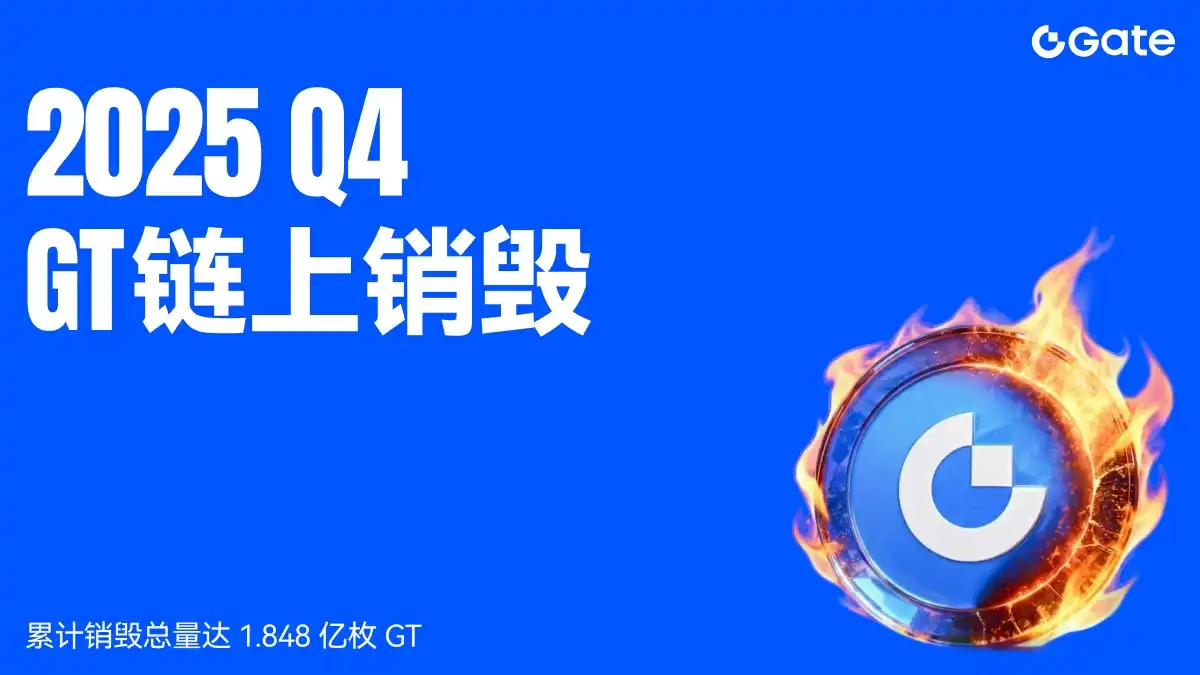
GateToken (GT) Destroys 2,163,900 Tokens in Q4 2025, Building a More Robust Token Economic Structure Through Ecosystem Expansion

marsbit2026-01-08 tarihinde yayınlandı2026-01-08 tarihinde güncellendi

Özet

GateToken (GT) completed its Q4 2025 on-chain token destruction, permanently removing 2,163,900 GT tokens, valued at over $26.92 million. The total number of GT destroyed to date has reached 184,819,426, with a cumulative value exceeding $1.901 billion. As the native utility and gas token of GateChain, GT supports the network’s transfer system and transaction execution. Since the mainnet launch in 2019, GT’s total supply has decreased by approximately 61.61% from its original 300 million tokens due to its ongoing destruction mechanism. With the expansion of Gate’s Layer and Web3 ecosystem—including products like Gate Perp DEX, Gate Fun, Meme Go, and Gate Swap—GT is increasingly integrated as the essential gas token across all on-chain activities. Its usage and consumption continue to grow alongside ecosystem development. Gate remains committed to its deflationary tokenomics, reinforcing GT’s scarcity and value through sustained and compliant destruction. This approach aligns token economics with real on-chain demand and supports long-term ecosystem growth. As part of its All in Web3 strategy, Gate continues to enhance decentralized infrastructure and expand application scenarios, aiming to deliver a secure, efficient, and diverse Web3 experience.

According to the official announcement, the on-chain destruction of GateToken (GT) for Q4 2025 has been officially completed. A total of 2,163,900.48229 GT tokens were transferred to the burn address, with a destruction value exceeding $26.92 million. To date, GT has cumulatively destroyed 184,819,426 tokens, with a cumulative destruction value exceeding $1.901 billion (calculated at the current price).

On-chain transaction details can be viewed at: https://etherscan.io/tx/0x03773d485c05dc26a541f5d74e15097d02e010dea34c5cc4f6d3a127ac0126ce

GT (GateToken) is the core platform token of Gate and the native asset of GateChain. As the Utility Token and Gas Fee payment token on GateChain, GT supports the underlying transfer system of GateChain. Since the launch of the GateChain mainnet in 2019, GT has consistently implemented a continuous destruction mechanism, reducing the total token supply by approximately 61.61% from the initial 300 million tokens.

As Gate Layer and its Web3 ecosystem products enter a phase of stable operation and scaled development, GT's foundational role within the entire Gate ecosystem is continuously being solidified. Centered around core applications such as Gate Perp DEX, Gate Fun, Meme Go, and Gate Swap, Gate has progressively built a comprehensive Web3 application system covering trading, issuance, liquidity, and on-chain interactions, with on-chain activity and genuine usage demand continuously being released. As the sole Gas token of Gate Layer, GT is deeply integrated into key aspects such as network operation, transaction execution, and application interaction. Its on-chain consumption and usage scenarios continue to grow alongside ecosystem expansion.

Gate remains steadfast in executing the GT destruction plan, steadily advancing the deflationary process in compliance with laws and regulations. Through a long-term, stable, and sustainable destruction mechanism, Gate continuously strengthens GT's scarcity attributes and value foundation, creating a tighter positive feedback loop between the token economic model and genuine on-chain usage demand and ecosystem growth.

Simultaneously, Gate persists in advancing its All in Web3 strategy, continuously deepening underlying infrastructure construction, expanding decentralized trading and diverse on-chain application scenarios to provide users with a safer, more efficient, and richer Web3 experience. Through the synergistic advancement of the deflationary mechanism and ecosystem construction, Gate, as a long-term builder, is promoting the evolution of Web3 infrastructure towards a more mature and sustainable development path.

About Gate

Founded in 2013 by Dr. Han, its founder and CEO, Gate is one of the world's leading cryptocurrency trading platforms. The platform serves over 47 million users and supports trading for over 4,200 crypto assets. As an industry benchmark, Gate was the first to achieve 100% Proof of Reserves, and its ecosystem encompasses diverse services including Gate Wallet and Gate Ventures.

To learn more, please visit: Website | X | Telegram | LinkedIn | Instagram | YouTube

Disclaimer:

This content does not constitute any offer, solicitation, or recommendation. You should always seek independent professional advice before making any investment decision. Please note that Gate may restrict or prohibit all or part of its services from restricted regions. Please read the User Agreement for more information at: https://www.gate.com/zh/user-agreement.


İlgili Sorular

QHow many GT tokens were burned in Q4 2025 and what was their approximate USD value?

AIn Q4 2025, 2,163,900.48229 GT tokens were burned, with a value exceeding $26.92 million.

QWhat is the total number of GT tokens that have been burned to date and their total value?

AA total of 184,819,426 GT tokens have been burned, with a cumulative value exceeding $1.901 billion at current prices.

QWhat is the primary function of GT (GateToken) within the GateChain ecosystem?

AGT is the native asset and gas fee payment token of GateChain, supporting its underlying transfer system and serving as its core platform token.

QBy what percentage has the total token supply of GT been reduced since its inception?

AThe total token supply of GT has been reduced by approximately 61.61% from its initial amount of 300 million tokens.

QWhat is the name of Gate's overarching strategic vision mentioned in the article?

AThe overarching strategic vision mentioned is the 'All in Web3' strategy.

İlgili Okumalar

OpenAI's Hyperliquid Pre-IPO Pricing Venture: Why Did It Last Only Half a Year?

The article discusses the rise and fall of Pre-IPO pricing markets on the Hyperliquid blockchain. Trade.xyz, an anonymous team, successfully built the largest pre-market for SpaceX (SPCX) by launching a contract with a clear anchor: the eventual Nasdaq listing price. This provided inherent price stability and validation. In contrast, Ventuals, a team backed by Paradigm, failed despite holding exclusive contracts for highly sought-after companies like OpenAI and Anthropic. Its key mistake was its pricing mechanism. For companies with no near-term IPO date, Ventuals' oracle relied partly on opaque private market transactions and, critically, partly on its own contract's moving average price. This created a self-referential feedback loop where prices were artificially propped up and detached from genuine supply and demand, leading to illiquid markets. Ventuals shut down after nine months, settling positions at final prices of $1,341.80 for OpenAI and $1,618.90 for Anthropic. Ironically, some employees and late-stage investors of these very companies reportedly used these flawed Ventuals prices for valuation reference, highlighting the acute demand for any price signal in illiquid private markets. The article concludes that while demand for pre-IPO trading is real and growing, with players like Coinbase now entering the space, the fundamental challenge remains: without a public listing to provide a definitive price anchor, these markets struggle to establish truly accurate and liquid pricing. The need for a transparent, self-correcting market is the critical lesson from Ventuals' failure.

marsbit3 dk önce

OpenAI's Hyperliquid Pre-IPO Pricing Venture: Why Did It Last Only Half a Year?

marsbit3 dk önce

With Daily Active Users Reaching 3-4 Times That of the Industry's Second Place, Which Crack in the Office Agent Market Has Tencent's WorkBuddy Torn Open?

Tencent's AI office assistant, WorkBuddy, has achieved daily active users (DAU) 3-4 times that of the industry's second-place product, primarily driven by non-technical users like HR, operations, and administrative staff. Its rapid growth, starting with a public beta in March 2026, highlights a key strategic divergence from competitors like OpenAI's Codex and Anthropic's Claude Code. Unlike those tools, which originated as developer-focused assistants (in command lines or IDEs) and are now expanding towards office scenarios, WorkBuddy was built from the ground up for non-technical office workers. Its development was user-driven, initiated after腾讯云's team observed non-technical employees using their CodeBuddy coding tool for general tasks. WorkBuddy's design is defined by three core decisions aimed at lowering barriers: 1) Using natural language instead of technical concepts, so users describe their goal without needing to understand prompts or agents. 2) Providing pre-packaged "Skill" templates for common office tasks like data processing, content creation, and research. 3) Natively integrating into existing腾讯 ecosystems like腾讯 Docs and WeChat, making the agent a seamless part of the user's workflow rather than a separate tool. This "scenario encapsulation" approach, prioritizing the shortest path for users to get work done, contrasts with the "underlying capability" focus of Codex and Claude, which offer more flexibility but require more technical setup. Analysts confirm WorkBuddy's leading market position in China by mid-2026, with massive user and request growth following its launch. Recognizing the same trend of surging non-technical adoption, OpenAI and Anthropic are now pivoting their products with features like role-based plugins (Codex) and a simplified desktop interface (Claude Cowork). However, adapting tools built for developers requires significant changes to interaction models and integrations. WorkBuddy currently holds an estimated six-month lead in delivering a complete solution for non-technical office users. Its recently launched enterprise version aims to solidify this advantage. The competition underscores two valid paths: embedding agent capabilities directly into familiar work environments versus building powerful, general-purpose agents that users must learn to access. WorkBuddy's early success demonstrates the effectiveness of the former strategy for mainstream office adoption.

marsbit11 dk önce

With Daily Active Users Reaching 3-4 Times That of the Industry's Second Place, Which Crack in the Office Agent Market Has Tencent's WorkBuddy Torn Open?

marsbit11 dk önce

Dalio's Latest Warning: Don't Get Carried Away by AI, Real Returns on US Stocks in the Next 5-10 Years Could Be -5% to -10%

Ray Dalio, founder of Bridgewater Associates, warns investors against excessive concentration in AI stocks. He argues the current market, dominated by a few AI giants, mirrors historical patterns where revolutionary new technologies lead to high risk, volatility, and uncertainty. While acknowledging AI's transformative potential, Dalio emphasizes that most investors fail at this stage of the cycle by over-concentrating in a handful of leading companies. He cites inherent risks: companies cannot accurately forecast investment needs or external shocks (e.g., monetary policy, geopolitics, taxes), face potential disruption from future technologies and international competition (notably from China), and experience significant price swings. Dalio's core advice is diversification, calling it his "Holy Grail of Investing." He presents a mathematical case that a well-diversified portfolio of 15-20 uncorrelated, good bets offers a superior risk-adjusted return compared to a concentrated position. Dalio also offers a cautious outlook, suggesting U.S. stocks may deliver real returns of -5% to -10% over the next 5-10 years based on valuation and bubble indicators. He concludes that in the face of high uncertainty, the prudent strategy is not to avoid betting entirely, but to avoid large, concentrated bets where one lacks sufficient informational edge. Instead, investors should build a strategically balanced, diversified portfolio.

marsbit1 saat önce

Dalio's Latest Warning: Don't Get Carried Away by AI, Real Returns on US Stocks in the Next 5-10 Years Could Be -5% to -10%

marsbit1 saat önce

İşlemler

Spot
Futures

Popüler Makaleler

GT Nasıl Satın Alınır

HTX.com’a hoş geldiniz! Gatechain (GT) satın alma işlemlerini basit ve kullanışlı bir hâle getirdik. Adım adım açıkladığımız rehberimizi takip ederek kripto yolculuğunuza başlayın. 1. Adım: HTX Hesabınızı OluşturunHTX'te ücretsiz bir hesap açmak için e-posta adresinizi veya telefon numaranızı kullanın. Sorunsuzca kaydolun ve tüm özelliklerin kilidini açın. Hesabımı Aç2. Adım: Kripto Satın Al Bölümüne Gidin ve Ödeme Yönteminizi SeçinKredi/Banka Kartı: Visa veya Mastercard'ınızı kullanarak anında Gatechain (GT) satın alın.Bakiye: Sorunsuz bir şekilde işlem yapmak için HTX hesap bakiyenizdeki fonları kullanın.Üçüncü Taraflar: Kullanımı kolaylaştırmak için Google Pay ve Apple Pay gibi popüler ödeme yöntemlerini ekledik.P2P: HTX'teki diğer kullanıcılarla doğrudan işlem yapın.Borsa Dışı (OTC): Yatırımcılar için kişiye özel hizmetler ve rekabetçi döviz kurları sunuyoruz.3. Adım: Gatechain (GT) Varlıklarınızı SaklayınGatechain (GT) satın aldıktan sonra HTX hesabınızda saklayın. Alternatif olarak, blok zinciri transferi yoluyla başka bir yere gönderebilir veya diğer kripto para birimlerini takas etmek için kullanabilirsiniz.4. Adım: Gatechain (GT) Varlıklarınızla İşlem YapınHTX'in spot piyasasında Gatechain (GT) ile kolayca işlemler yapın.Hesabınıza erişin, işlem çiftinizi seçin, işlemlerinizi gerçekleştirin ve gerçek zamanlı olarak izleyin. Hem yeni başlayanlar hem de deneyimli yatırımcılar için kullanıcı dostu bir deneyim sunuyoruz.

63 Toplam GörüntülenmeYayınlanma 2024.12.12Güncellenme 2026.06.02

GT Nasıl Satın Alınır

Tartışmalar

HTX Topluluğuna hoş geldiniz. Burada, en son platform gelişmeleri hakkında bilgi sahibi olabilir ve profesyonel piyasa görüşlerine erişebilirsiniz. Kullanıcıların GT (GT) fiyatı hakkındaki görüşleri aşağıda sunulmaktadır.

活动图片