Zhejiang University Research Team Proposes New Approach: Teaching AI How the Human Brain Understands the World

marsbitPublished on 2026-04-05Last updated on 2026-04-05

Abstract

A research team from Zhejiang University published a paper in *Nature Communications* challenging the prevailing notion that larger AI models inherently think more like humans. They found that while model performance on recognizing concrete concepts improved as parameters increased (from 74.94% to 85.87%), performance on abstract concept tasks slightly declined (from 54.37% to 52.82%) in models like SimCLR, CLIP, and DINOv2. The key difference lies in how concepts are organized. Humans naturally form hierarchical categories (e.g., grouping a swan and an owl into "birds"), enabling them to apply past knowledge to new situations. Models, however, rely heavily on statistical patterns in data and struggle to form stable, abstract categories. The team proposed a novel solution: using human brain signals (recorded when viewing images) to supervise and guide the model's internal organization of concepts. This method, termed transferring "human conceptual structures," helped the model learn a brain-like categorical system. In experiments, the model showed improved few-shot learning and generalization, with a 20.5% average improvement on a task requiring abstract categorization like distinguishing living vs. non-living things, even outperforming much larger models. This research shifts the focus from simply scaling model size ("bigger is better") to designing smarter internal structures ("structured is smarter"). It highlights a new pathway for developing AI that possesses more hum...

Large models have been growing in size, with the mainstream view being that the more parameters a model has, the closer it gets to human-like thinking. However, a paper published by a Zhejiang University team on April 1 in Nature Communications presents a different perspective (original article link: https://www.nature.com/articles/s41467-026-71267-5). They found that as model size (primarily SimCLR, CLIP, DINOv2) increases, the ability to recognize specific objects does continue to improve, but the ability to understand abstract concepts not only fails to improve but can even decline. When parameters increased from 22.06 million to 304.37 million, performance on concrete concept tasks rose from 74.94% to 85.87%, while performance on abstract concept tasks dropped from 54.37% to 52.82%.

Differences Between Human and Model Thinking

When the human brain processes concepts, it first forms a system of categorical relationships. Swans and owls look different, but humans still classify them both as birds. Moving up, birds and horses can be further grouped into the animal category. When humans encounter something new, they often first consider what it resembles from past experience and which category it might belong to. Humans continuously learn new concepts, then organize this experience, using this relational system to recognize new things and adapt to new situations.
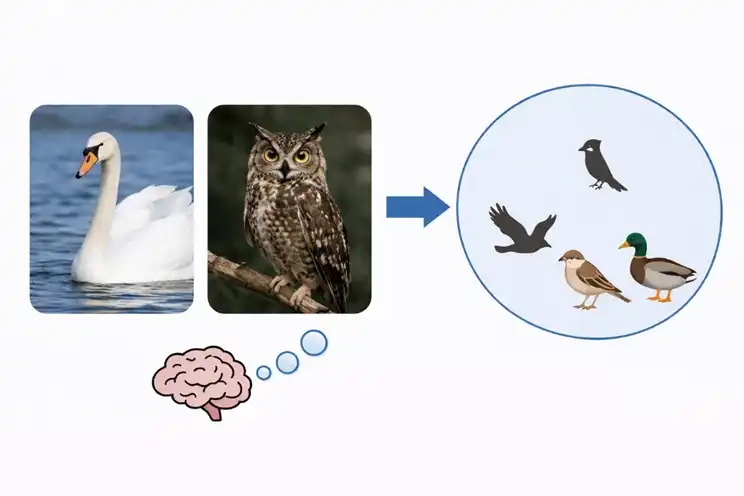
Models also classify, but they form these classifications differently. They rely primarily on patterns that repeatedly appear in large-scale data. The more frequently a specific object appears, the easier it is for the model to recognize it. When it comes to larger categories, models struggle more. They need to capture the commonalities between multiple objects and then group these commonalities into the same category. Existing models still have significant shortcomings here. As parameters continue to increase, performance on concrete concept tasks improves, while performance on abstract concept tasks sometimes even decreases.
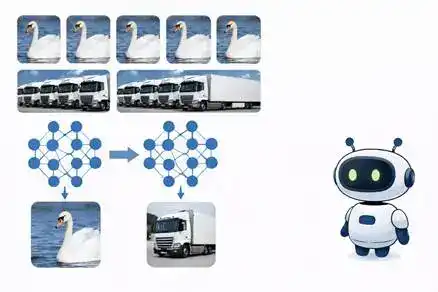
A commonality between the human brain and models is that both internally form a system of categorical relationships. However, their emphases differ. The higher-order visual regions of the human brain naturally distinguish broad categories like living and non-living things. Models can separate specific objects but find it difficult to stably form these larger categories. This difference means the human brain more easily applies past experience to new objects, allowing for rapid categorization of unseen things. Models, conversely, rely more on existing knowledge, so when encountering new objects, they tend to focus on superficial features. The method proposed in the paper addresses this characteristic, using brain signals to constrain the model's internal structure, making it closer to the human brain's categorization method.

The Solution from the Zhejiang University Team

The team's proposed solution is also unique: instead of simply adding more parameters, they use a small amount of brain signal data for supervision. These brain signals come from recordings of brain activity while humans view images. The original paper states the goal as transferring 'human conceptual structures' to DNNs. This means teaching the model, as much as possible, how the human brain classifies, generalizes, and groups similar concepts together.
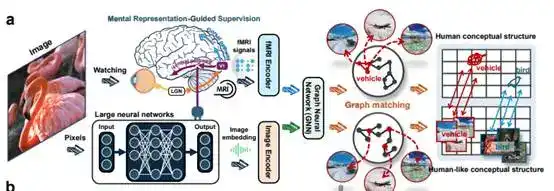
The team conducted experiments using 150 known training categories and 50 unseen test categories. The results showed that as this training progressed, the distance between the model's representations and the brain representations continuously narrowed. This change occurred for both categories, indicating that the model was learning not just individual samples but truly beginning to learn a conceptual organization method more akin to the human brain.

After this process, the model demonstrated stronger few-shot learning capabilities and performed better in novel situations. In a task requiring the model to distinguish abstract concepts like living vs. non-living things with very few examples, the model improved by an average of 20.5%, even surpassing much larger control models. The team also conducted 31 additional specialized tests, where several types of models showed improvements of nearly ten percent.

Over the past few years, the familiar path in the modeling industry has been larger model scale. The Zhejiang University team has chosen a different direction: moving from 'bigger is better' to 'structured is smarter'. Scaling up is indeed useful, but it primarily improves performance on familiar tasks. Abstract understanding and transfer capabilities, inherent to humans, are equally crucial for AI. This requires future AI thinking structures to more closely resemble the human brain. The value of this direction lies in redirecting the industry's attention from pure size expansion back to the cognitive structure itself.

Neosoul and the Future

This points to a larger possibility: AI evolution may not only occur during the model training phase. Model training can determine how AI organizes concepts and forms higher-quality judgment structures. Then, after entering the real world, another layer of AI evolution just begins: how an AI agent's judgments are recorded, tested, and how they continuously grow and evolve through real-world competition, learning and evolving on their own, much like humans. This is precisely what Neosoul is doing now. Neosoul doesn't just have AI agents produce answers; it places AI agents into a system of continuous prediction, verification, settlement, and selection, allowing them to continuously optimize themselves based on predictions and outcomes, preserving better structures and淘汰ing worse ones. What the Zhejiang University team and Neosoul jointly point towards is actually the same goal: enabling AI to not just solve problems, but to possess comprehensive thinking abilities and continuously evolve.


Related Questions

QWhat was the key finding of the Zhejiang University team's research published in Nature Communications regarding model scaling?

AThey found that as model parameters increased (from 22.06 million to 304.37 million), performance on recognizing concrete concepts improved (74.94% to 85.87%), but performance on understanding abstract concepts not only failed to improve but actually decreased (54.37% to 52.82%).

QWhat is the fundamental difference between how the human brain and AI models form conceptual categories?

AThe human brain naturally forms a hierarchical classification system (e.g., grouping specific birds into the 'bird' category, then 'birds' and 'horses' into 'animals'). AI models primarily rely on statistical patterns from large-scale data, excelling at recognizing specific, frequently appearing objects but struggling to form stable, larger abstract categories.

QWhat was the unique solution proposed by the Zhejiang University team to improve AI's abstract reasoning?

AInstead of scaling model size, they used a small amount of brain signal data (recordings of human brain activity when viewing images) as supervision to transfer human conceptual structures to the deep neural networks (DNNs), teaching them how to classify and generalize concepts more like the human brain.

QWhat improvements were observed in the model after being trained with the brain signal supervision method?

AThe distance between the model's representations and brain representations decreased. The model showed stronger few-shot learning capabilities and performed better in novel situations. In a task requiring abstract concept discrimination with very few examples, performance improved by an average of 20.5%, even surpassing much larger control models.

QWhat broader shift in AI development philosophy does the research and Neosoul project represent, according to the article?

AIt represents a shift from the 'bigger is better' paradigm focused on scaling parameters to a 'structured is smarter' approach. The focus is on improving the AI's cognitive structure to be more human-like, enabling abstract understanding and transfer capabilities, and creating systems for continuous learning and evolution through real-world prediction, verification, and competition.

Related Reads

$292 Million KelpDAO Cross-Chain Bridge Hack: Who Should Foot the Bill?

On April 18, 2026, an attacker stole 116,500 rsETH (worth ~$292M) from KelpDAO’s cross-chain bridge in 46 minutes—the largest DeFi exploit of 2026. The stolen assets were deposited into Aave V3 as collateral, causing $177–200M in bad debt and triggering a cascade of losses across nine DeFi protocols. Aave’s TVL dropped by ~$6B overnight. This legal analysis argues that KelpDAO and LayerZero Labs share concurrent liability, with fault apportioned 60%/40%. KelpDAO negligently configured its bridge with a 1-of-1 decentralized verifier network (DVN)—a single point of failure—despite LayerZero’s explicit recommendation of a 2-of-3 setup. LayerZero, which operated the compromised DVN, failed to secure its RPC infrastructure against a known poisoning attack vector. Both protocols’ terms of service cap liability at $200 (KelpDAO) or $50 (LayerZero), but these limits are likely unenforceable due to unconscionability, gross negligence exceptions, and potential securities law invalidation (if rsETH is deemed a security under the Howey test). Aave’s governance also faces fiduciary duty claims for raising rsETH’s loan-to-value ratio to 93%—far above competitors’ 72–75%—without adequately assessing bridge risks, amplifying the systemic fallout. Practical recovery targets include LayerZero Labs (a registered Canadian entity), KelpDAO’s founders, auditors, and identifiable Aave governance delegates. The incident underscores escalating legal risks for DeFi protocols, infrastructure providers, and governance participants.

marsbit31m ago

$292 Million KelpDAO Cross-Chain Bridge Hack: Who Should Foot the Bill?

marsbit31m ago

Insider Trading in War: 5 People Involved, the Highest Earner Was Arrested

On April 24, the U.S. Department of Justice arrested U.S. Army Special Forces Staff Sergeant Gannon Ken Van Dyke for insider trading related to the capture of Venezuelan President Nicolás Maduro on January 3. Van Dyke allegedly profited over $400,000 by placing bets on a prediction market, Polymarket, using insider knowledge of the covert operation. According to the indictment, Van Dyke registered an account (0x31a5) on December 26 and made a series of bets predicting Maduro’s capture and U.S. military involvement in Venezuela. He withdrew most of his funds on the day of the operation and attempted to obscure his tracks by transferring assets through crypto and brokerage accounts. This case marks the first time the DOJ has prosecuted insider trading on Polymarket. PolyBeats had previously identified five suspicious accounts, including Van Dyke’s—the highest earner—in January. The other accounts, with profits ranging from $34,000 to $145,000, remain under unofficial scrutiny but have not been charged. Their lower profits, indirect access to information, and unclear legal boundaries may complicate prosecution. Polymarket has since strengthened its market integrity rules, explicitly prohibiting trading based on confidential or insider information. Van Dyke’s arrest, nearly four months after his trades, signals increased regulatory attention and the persistent traceability of blockchain-based transactions.

marsbit33m ago

Insider Trading in War: 5 People Involved, the Highest Earner Was Arrested

marsbit33m ago

Bitwise: Bullish on Bitcoin's Performance in the Second Half of the Year, AI and Regulation Will Spark a New Altcoin Season

Bitwise CIO Matt Hougan and Research Lead Ryan Rasmussen express strong bullish sentiment on Bitcoin's long-term prospects, suggesting that its $1 million price target may be too conservative. They argue Bitcoin serves a dual role: as digital gold and a potential global settlement asset, especially amid declining trust in traditional monetary systems. Despite a weak Q1 2026 where nearly all crypto assets and prices saw double-digit declines, the analysts remain optimistic due to strong forward-looking catalysts, including institutional adoption via Bitcoin ETFs from major firms like Morgan Stanley and Goldman Sachs. Geopolitical instability, such as Iran’s mention of using Bitcoin for international payments, increases the value of Bitcoin’s “out-of-the-money call option” as a non-political, global settlement currency. This enhances its appeal beyond a mere store of value. . Additionally, Hougan highlights that a clearer regulatory token framework under current SEC leadership, combined with AI efficiency gains and high-performance blockchains, could fuel a new “altseason” by late 2026. This may lead to a wave of legitimate, value-capturing token projects, unlike the earlier ICO boom. . Bitwise also announced an Avalanche ETF, citing its unique architecture and rapid growth in real-world asset (RWA) tokenization, which has surged 10x to nearly $30 billion in two years. The firm believes Layer 1 blockchains are still early in their growth cycle, with significant potential ahead.

marsbit1h ago

Bitwise: Bullish on Bitcoin's Performance in the Second Half of the Year, AI and Regulation Will Spark a New Altcoin Season

marsbit1h ago

Trading

Spot
Futures
活动图片