Zcash Flaw Sparks Monero Audit Interest as Privacy Coin Debate Heats Up

TheNewsCryptoPublished on 2026-06-06Last updated on 2026-06-06

Abstract

A significant security flaw in Zcash's Orchard privacy pool was disclosed by non-profit developer Shielded Labs, causing ZEC's price to drop 38% in 24 hours before a modest recovery. The vulnerability, discovered on May 29th by security researcher Taylor Hornby using Anthropic's Opus 4.8 AI model, could have allowed an attacker to create an unlimited supply of counterfeit ZEC tokens undetected. This event has intensified the privacy coin debate. In response, Hornby announced plans to audit Monero (XMR), a leading privacy-focused cryptocurrency that, unlike Zcash, defaults to hiding all transaction data. Hornby expressed confidence in finding vulnerabilities in such privacy coins. The disclosure has cast fresh security scrutiny on the sector.

After non-profit developer Shielded Labs revealed a serious weakness in the blockchain’s Orchard privacy pool, which could have jeopardized the integrity of the token supply, Zcash (ZEC) fell 38% in 24 hours, speeding up the drop. Recent trading for ZEC has been around $361, with a low of $290, and the price has made some modest recovery of around 8% in the last 24 hours as per data from CMC.
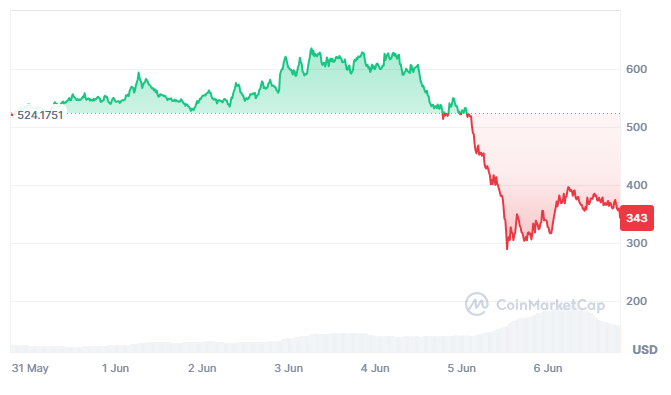
Fresh Security Scrutiny

On Thursday night, Shielded Labs released a comprehensive disclosure about X, exposing a security hole that, if used, might have enabled an attacker to secretly produce an infinite supply of fake ZEC tokens. Imagine someone sneaking into the Federal Reserve’s dollar printing machine and making off with a bunch of additional cash; the only difference is that not even the Fed would know it happened.

The flaw was found on May 29th by Taylor Hornby, a security expert hired by Shielded Labs in April 2026 to find protocol weaknesses before bad guys could. The Orchard circuit is the cryptographic scheme supporting Zcash’s most sophisticated privacy pool; Hornby performed a focused evaluation of it using Anthropic’s newly published Opus 4.8 AI model.

One of the tokens that security researcher Taylor Hornby plans to audit next is privacy coin Monero. Hornby utilized Anthropic’s Opus 4.8 AI model to discover a serious flaw in Zcash. Hornby said, “Absolutely!” when asked on X whether he could find vulnerabilities in private coins like Monero. Adding that, Monero will be put up to my list of things to audit.

Unlike Zcash, which gives users the option to be either visible or shielded, Monero (XMR) defaults to hiding transaction data and is one of the biggest privacy-focused cryptocurrencies.

Highlighted Crypto News Today:

Worldcoin Falls Terribly as Arthur Hayes Dumps WLD

TagsAltcoinMoneroZcash

Related Questions

QWhat was the key event that triggered the drop in Zcash's price and sparked interest in auditing Monero?

AThe key event was the disclosure by Shielded Labs of a serious security flaw in Zcash's Orchard privacy pool, which could have allowed an attacker to secretly create an unlimited supply of fake ZEC tokens.

QWho discovered the critical vulnerability in Zcash's Orchard circuit, and what tool did they use?

AThe vulnerability was discovered by security expert Taylor Hornby, who was hired by Shielded Labs. He found the flaw using Anthropic's newly published Opus 4.8 AI model.

QHow did the disclosure of the Zcash flaw specifically impact its price (ZEC) in the short term?

AFollowing the disclosure, Zcash (ZEC) fell 38% within 24 hours, reaching a low of around $290. It later saw a modest recovery of about 8% in the subsequent 24 hours.

QWhat is the fundamental difference between Monero's (XMR) and Zcash's (ZEC) approach to privacy, as mentioned in the article?

AThe fundamental difference is that Monero defaults to hiding all transaction data by design, whereas Zcash gives users an option to choose between transparent (visible) or shielded (private) transactions.

QWhat is the next project that security researcher Taylor Hornby plans to audit, and what was his confident response regarding finding vulnerabilities in it?

ATaylor Hornby plans to audit the privacy coin Monero next. When asked on X if he could find vulnerabilities in privacy coins like Monero, he responded, 'Absolutely!'

Related Reads

Michael Saylor: 110 Reasons to Oppose BIP-110

Michael Saylor presents 110 arguments against Bitcoin Improvement Proposal (BIP) 110, a soft fork aimed at restricting certain non-monetary data storage uses (like inscriptions) on the Bitcoin blockchain. He acknowledges the proponents' valid concerns—such as node costs, fee pressure, and preserving Bitcoin's monetary focus—but fundamentally disagrees with the proposed solution. Saylor argues that BIP 110 represents a dangerous precedent of using consensus rules to enforce value judgments on transaction validity, moving away from Bitcoin's core principles of neutrality and permissionless innovation. His key objections are organized into eleven categories: 1) It violates neutrality and hard consensus by banning currently valid transactions. 2) It fails to meet the high burden of proof required for a consensus change, lacking concrete data on the alleged crisis. 3) Its seven bundled technical restrictions are overly broad, targeting generic script functionalities and blocking future upgrade paths. 4) It sacrifices compatibility and future optionality by closing off designed upgrade hooks. 5) Its temporary rules add significant complexity (grandfathering, expiry states) without sufficient justification. 6) The economic and security impacts, particularly on miner revenue and fee markets, are uncertain and unmodeled. 7) Superior, market-based tools (fee markets, relay/mining policies) already exist to manage blockchain load. 8) It stifles innovation by creating a chilling effect for developers. 9) Its modified activation mechanism (55% threshold, forced signaling) is aggressive and risks network splits. 10) The precedent it sets—using consensus to suppress disliked but legal uses—is more dangerous than the problem it aims to solve. 11) A better path exists: improving measurements, refining resource-based policies, and allowing market forces to work. Saylor concludes that Bitcoin's strength lies in its neutral rules, open markets, and hard consensus. Changing these foundational elements to target specific use cases is an unnecessary and risky "iatrogenic" intervention. He advocates for guarding Bitcoin's neutrality rather than acting as its redeemer.

marsbit9m ago

Michael Saylor: 110 Reasons to Oppose BIP-110

marsbit9m ago

Trading

Spot
活动图片


